

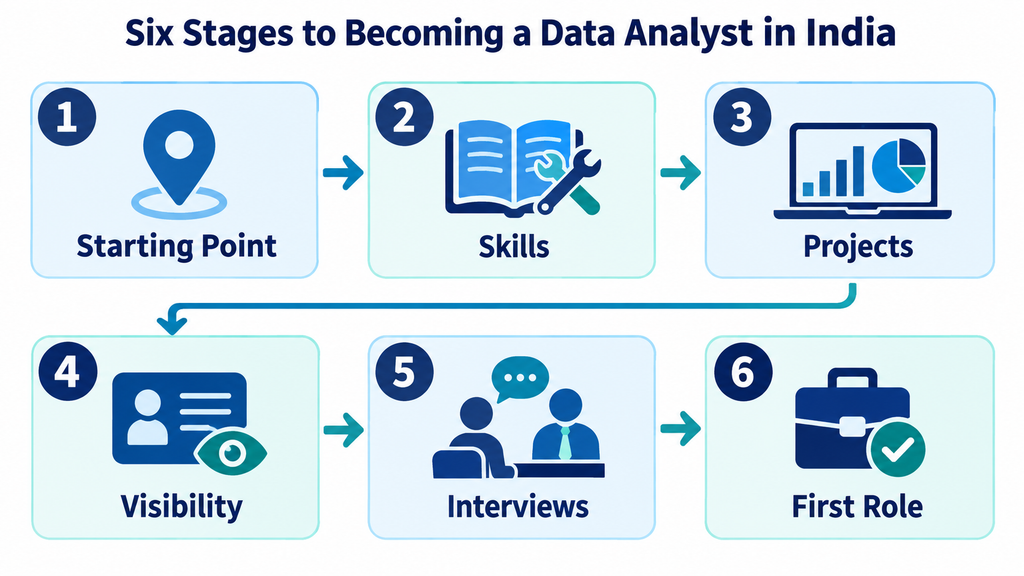
Becoming a data analyst in India takes six stages: find your starting point, learn the skills in a sensible order, build three to five real projects, make that work publicly visible, prepare for the interview rounds, and apply widely, including to adjacent titles such as MIS, reporting, and business analyst roles. At roughly 15–20 hours a week from a beginner start, the skills and portfolio take about six months, with another one to three months of applying.
You do not need a technical degree or advanced mathematics. You need business curiosity, comfort with SQL, one BI tool, and the ability to turn an analysis into a recommendation someone can act on. This guide covers the whole journey; where a stage deserves its own treatment, it links to a deeper article.
Key takeaways
- Learn in this order: business thinking, statistical judgement, AI fluency, then Excel, SQL, Python, Power BI, and automation. Tools come after the thinking.
- SQL is the highest-leverage single skill and the one most often tested first.
- Three to five documented projects substitute for work experience better than any certificate.
- Expect roughly six months of study at 15–20 hours a week, plus one to three months of job searching.
- Indicative fresher ranges run about ₹3–4 LPA for Excel and reporting up to ₹5–8 LPA for SQL, Power BI, Python, and AI workflows combined.
- Apply to MIS, reporting, operations, and business analyst roles too, not only jobs titled “Data Analyst”.
Table of contents
- What does a data analyst do?
- Stage 1: Find your starting point
- Stage 2: Learn the skills in the right order
- Stage 3: Build three to five projects
- Stage 4: Make your work visible
- Stage 5: Prepare for the interview rounds
- Stage 6: Land the first role
- Which certifications are worth it?
- Data analyst salary in India
- Career path and future growth
- Do you need a course?
- Frequently asked questions
- Final thoughts
What does a data analyst do?
A data analyst turns raw data into decisions. The day-to-day mix is usually more cleaning and querying than modelling: pulling data from a database, checking it makes sense, building or updating a dashboard, investigating why a number moved, and explaining the finding to someone who has to act on it.
A useful way to think about the job is four questions in increasing order of value: what happened, why it happened, what is likely to happen next, and what the business should do. Most junior analysts are hired for the first two and promoted for the last two.
Stage 1: Find your starting point
There is no single mandatory degree. What changes is where you should begin and which of your existing strengths to lead with.
| Your starting point | Begin with | Your advantage |
|---|---|---|
| No technical background | Business metrics, Excel, basic statistics, then SQL | You already think in business terms, which many technical candidates do not |
| Excel or operations experience | SQL, Power BI, data storytelling, automation | You know how messy real operational data actually is |
| BCA, BSc, BTech, or CS background | SQL, Python, statistics, BI, and portfolio projects | Programming fundamentals let you move faster through the tool stages |
| Working professional switching careers | Analytics applied to problems in your current industry | Domain knowledge is genuinely scarce and hard to teach |
| Existing developer or data professional | Business acumen, dashboards, experimentation, stakeholder communication | You can skip most of the tooling curve |
Stage 2: Learn the skills in the right order
Most beginners fail by starting with tools: a Python tutorial, then a SQL course, then a Power BI video, ending with fragments rather than the ability to answer a business question. A business-first order works better, because every tool then has something real to be pointed at.
| Order | What to learn | Rough time |
|---|---|---|
| 1 | Business acumen and KPI design: how organisations create value, who decides what, how to turn a vague question into a measurable one | 2–3 weeks |
| 2 | Statistical thinking: correlation versus causation, variability, significance, sampling and survivorship bias, data leakage | 2–3 weeks |
| 3 | AI fluency: prompting, structured output, and how to check what an AI assistant gives you | 2–3 weeks |
| 4 | Excel, SQL, and Python as one workflow: cleaning, pivots, joins, window functions, Pandas, exploratory analysis | 6–8 weeks |
| 5 | Power BI or Tableau: data models, measures, filters, drill-downs, and storytelling | 3–4 weeks |
| 6 | AI knowledge systems: retrieval basics, connecting an assistant to approved documents with sources | 2–3 weeks |
| 7 | Forecasting and automation: trend analysis, KPI monitoring, anomaly detection, automated reporting | 4–5 weeks |
AI fluency sitting before the tools is deliberate. An assistant that can draft SQL and explain a formula makes every later stage faster, but only if you already have the judgement to catch when it is wrong. Learn to check it before you learn to lean on it.
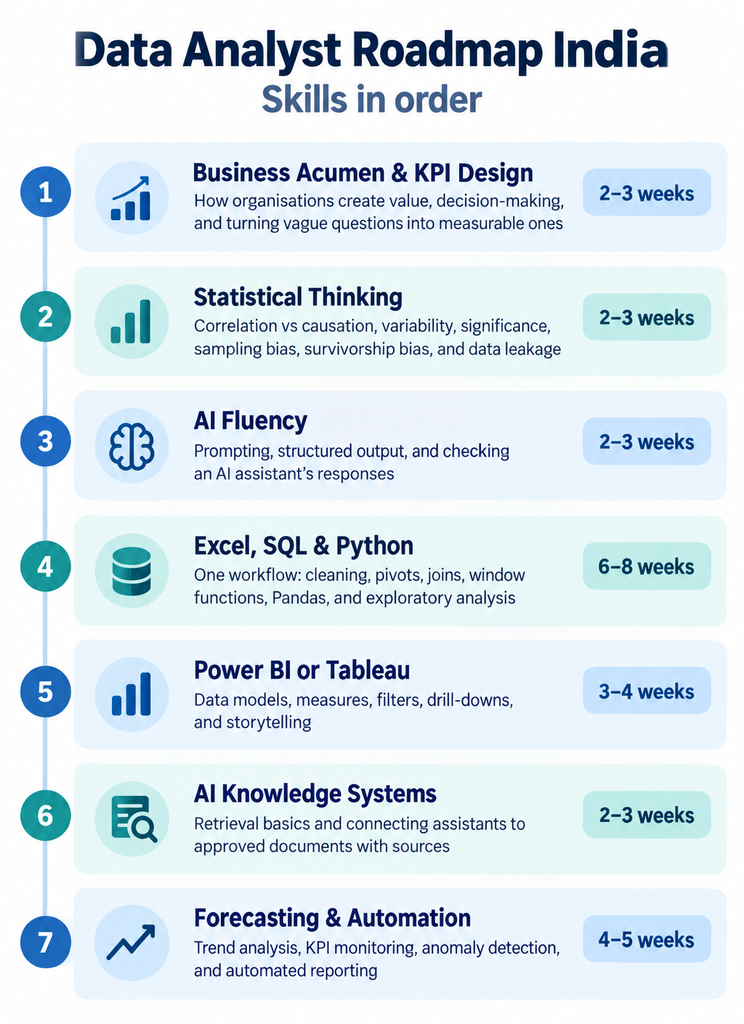
Timings assume around 15–20 hours a week including practice. For a phase-by-phase breakdown of what to cover in each, see the beginner’s guide to learning data analytics.
How long will it take at your pace?
| Weekly hours | Skills and portfolio | Including job search |
|---|---|---|
| 8–10 hours | 10–12 months | 12–15 months |
| 15–20 hours | 6 months | 7–9 months |
| 30+ hours (full-time) | 3–4 months | 4–6 months |
These assume a beginner start with no programming background. Prior experience with Excel, SQL, or any programming language shortens the middle stage considerably.
Stage 3: Build three to five projects
Aim for three to five finished projects rather than a long list of started ones. A workable set covers different skills: a KPI dashboard, a SQL and Python analysis of sales or customer behaviour, and one forward-looking piece such as a forecast or an automated report. Build each around a decision someone would actually make, using public data from sources such as Kaggle, the UCI Machine Learning Repository, or India’s open government data portal at data.gov.in.
Every project needs a problem statement, the data source and its limitations, your method, the output, and a recommendation. The part most beginners skip, and the part interviewers ask about, is what you would do differently next time.
For six project briefs with skills mapped to each, see the beginner’s guide. For more advanced AI-oriented projects with datasets and evaluation methods, see AI Portfolio Projects for 2026.
Stage 4: Make your work visible
Work no one can see does not count. Three surfaces do most of the work here.
Resume
- Use a clear headline such as “Aspiring Data Analyst | SQL | Power BI | Python | Business Analytics”.
- Write project bullets as action, method, result, and business context, in that order. “Analysed 18 months of retail sales in SQL and Python to identify three underperforming regions, and recommended a stock reallocation” beats “Worked on a sales analysis project”.
- Link directly to the portfolio, repository, or dashboard rather than describing it.
- List only tools you can be questioned on. An interviewer will pick the one you are least confident about.
Portfolio and GitHub
- One page or repository per project, each with a README that opens with the business question.
- Include screenshots, a live dashboard link, or a two-minute walkthrough video; assume nobody will run your code.
- State the data source, cleaning steps, assumptions, and limitations honestly.
- Add a measurable result where one genuinely exists, such as forecast error, report turnaround time, or errors caught by a validation step.
LinkedIn and networking
- Post short project breakdowns: one chart, the insight, the recommendation. This works better than announcing certificates.
- Connect with analysts and recruiters in the industries you want to work in, and with alumni from your college.
- Comment substantively on analytics and business problems; it puts you in front of people who hire without requiring you to ask for anything.
Stage 5: Prepare for the interview rounds
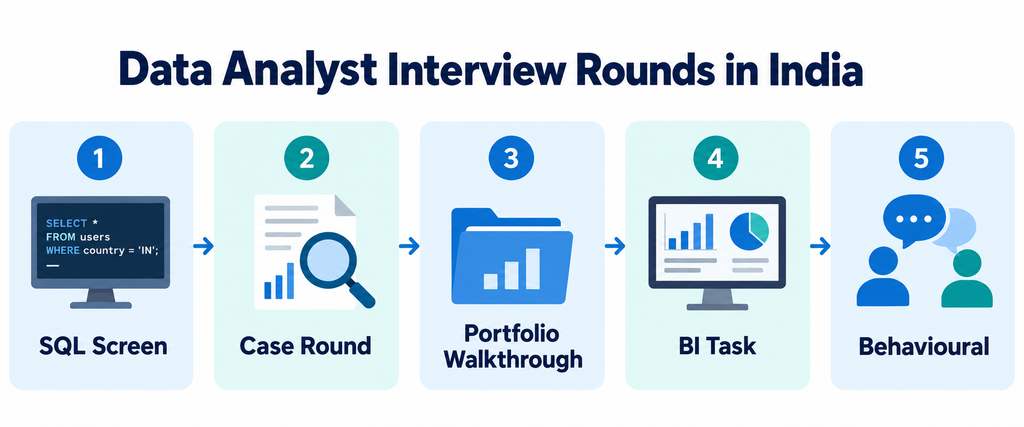
Analyst hiring in India usually runs through three to five rounds. Knowing their shape is half the preparation.
| Round | What is tested | How to prepare |
|---|---|---|
| SQL screening | Joins, aggregations, GROUP BY, subqueries, CTEs, window functions, and whether your logic survives edge cases | Practise on realistic business questions: monthly revenue, repeat customers, funnel conversion, top products per category. Platforms with SQL question banks help here. |
| Case or business round | Whether you can frame a vague problem, choose metrics, and reach a recommendation | Practise out loud: “Sales dropped 12% last quarter, how would you investigate?” State assumptions, segment the problem, say what data you would want. |
| Portfolio walkthrough | Depth of ownership: can you defend your choices and name your limitations | Rehearse one project end to end in five minutes. Be ready for “why this method?” and “what would you do differently?” |
| Excel or BI task | Practical cleaning, pivots, or building a small dashboard, sometimes as a take-home | Time yourself on a messy dataset. Presentation and clarity are marked as much as correctness. |
| Behavioural round | Communication, stakeholder handling, and how you respond to being wrong | Prepare examples of explaining something technical to a non-technical person, and of a time your analysis was challenged. |
Two topics now come up regularly that older guides miss. Expect to be asked how you handled missing data, duplicates, or conflicting metric definitions, and expect to be asked whether you used AI and how you verified what it produced. Saying you used an assistant and then checked the numbers yourself is a stronger answer than claiming you did not use one.
Stage 6: Land the first role
The most common mistake at this stage is searching only for the exact title “Data Analyst”. A large share of entry-level analytical work in India is advertised as something else.
- Adjacent titles to search: MIS Executive, Reporting Analyst, Business Analyst, Operations Analyst, Data Associate, Analytics Associate, BI Analyst, and any “Analyst” role prefixed with a function such as marketing, supply chain, or risk.
- Internships count. A three to six month analytics internship is often the fastest route into a full-time role, and internships are far less competitive than fresher openings at the same companies.
- Use your current job. If you already work, volunteer for the reporting, tracking, or dashboard work on your team. That becomes genuine experience on your resume without a career break.
- Where to search: LinkedIn, Naukri, Indeed, internship platforms, company career pages, and analytics communities. Set alerts rather than searching manually.
- Apply beyond your city. Remote and hybrid analyst roles are common, and a public portfolio is what makes you assessable to an employer who will never meet you in person.
Based in Dehradun or another smaller city? Titled analyst roles are limited locally, so the remote strategy matters more. The Dehradun guide covers the local market and which employers to target.
Which certifications are worth it?
Certifications help you pass an automated screen and structure your learning. They do not replace a portfolio, and no recruiter will hire on one alone. If you want one, these are the names Indian recruiters recognise.
| Certification | Best for | Worth noting |
|---|---|---|
| Google Data Analytics Professional Certificate | Complete beginners wanting a structured start | Broad and beginner-friendly, but widely held, so it does not differentiate you on its own |
| Microsoft Certified: Power BI Data Analyst Associate (PL-300) | Proving BI skill specifically | A proctored exam, so it carries more weight with employers than a completion certificate |
| Tableau Desktop Specialist | Roles that specify Tableau rather than Power BI | Check the job postings you are targeting before choosing between this and PL-300 |
If you have to choose between spending three months on a second certificate and three months on a deeper project, choose the project.
Data analyst salary in India
Pay depends on skills, portfolio quality, employer, industry, city, and interview performance. The ranges below are indicative India-wide annual CTC figures based on commonly reported 2026 data from aggregators such as Glassdoor, AmbitionBox, and Indeed. Treat them as planning ranges, not guaranteed offers.
| Experience or skill profile | Indicative range | What moves you up the range |
|---|---|---|
| Fresher: Excel and reporting | ₹3–4 LPA | Accuracy, communication, an internship, dependable delivery |
| Fresher: Excel, SQL, Power BI | ₹3.5–5.5 LPA | Strong SQL, polished dashboards, case studies, interview performance |
| Fresher: SQL, Power BI, Python, statistics | ₹4.5–7 LPA | Automation, forecasting, domain relevance, a substantial portfolio |
| Fresher: the above plus AI workflows and automation | ₹5–8 LPA | Demonstrated AI-assisted analysis with validation, in stronger roles |
| 1–3 years | ₹6–10 LPA | Ownership of a domain, advanced SQL, stakeholder management, measurable impact |
| 3–5 years | ₹9–15 LPA | Experimentation, analytics engineering, domain expertise, mentoring |
| Senior analyst or analytics lead | ₹15–25 LPA and above | Strategy, team leadership, BI architecture, visible business impact |
Two things shift these numbers more than the job title does. City matters: metro employers in Bengaluru, Hyderabad, Pune, and Delhi NCR generally pay above employers in smaller cities, while remote roles follow the employer’s own bands. Industry matters too: product companies, fintech, and consulting typically pay above services and operations-heavy businesses at the same experience level.
Career path and future growth
| Stage | Roles | What to add next |
|---|---|---|
| Entry | Data Analyst, Reporting Analyst, MIS Analyst, Data Associate | Excel, SQL, Power BI, basic Python, communication |
| Intermediate | Senior Data Analyst, Product Analyst, Operations Analyst, BI Analyst | Advanced SQL, experimentation, domain depth, automation |
| Advanced | Analytics Lead, BI Developer, Analytics Consultant, Analytics Engineer | Data modelling, stakeholder leadership, systems thinking, strategy |
| Sideways moves | Data Scientist, Product Manager, AI-powered analytics specialist | Machine learning, product thinking, AI workflows, business leadership |
The two most common sideways moves are worth knowing early. Analysts who enjoy the modelling side tend towards data science; those who enjoy the stakeholder and decision side tend towards product management. Both are easier from an analyst seat than from outside.
If you are weighing analytics against the AI engineering route before you commit, this comparison sets out the differences in skills, timelines, and roles.
Do you need a course?
Self-study works if you are disciplined and can find people to review your work. A structured programme mainly buys you sequence, feedback, and accountability. Either way, the things worth checking are the same: a roadmap that starts with business thinking rather than tools, projects with messy realistic data, live mentorship and project feedback, portfolio and interview support, transparent fees and prerequisites, and a clear approach to responsible AI use.
OneLeap’s Strategic Data Analyst with AI follows the seven-stage sequence above: six months of weekend classes, 70+ hours of live learning, seven modules, seven real-world projects, weekly one-to-one sessions, and career support. It is built for career switchers and requires no prior coding experience.
Frequently asked questions
How long does it take to become a data analyst in India?
At around 15–20 hours a week from a beginner start, roughly six months to build the skills and a portfolio, plus one to three months of applying and interviewing. At 8–10 hours a week, expect closer to ten to twelve months. The variable that moves this most is project depth, not course length.
Can I become a data analyst with no experience?
Yes, and most people do. Substitute evidence for experience: three to five documented projects, a public dashboard or repository, and the ability to explain your reasoning. Internships, freelance work, and analytical tasks in your current job all count as experience on a resume.
Can I become a data analyst without a technical degree?
Yes. Employers hire from commerce, economics, management, humanities, and science backgrounds. What gets screened is SQL, a BI tool, and whether you can explain a business recommendation. A non-technical background is often an advantage in domain-heavy teams.
Which skill should I learn first?
Business and KPI thinking, then SQL. SQL is the skill most commonly tested in the first interview round, and it is the one that separates candidates who can work with real company data from those who can only open a spreadsheet.
Is a data analyst a good career in India in 2026?
It remains a strong entry point into technology and business roles, with routes into product analytics, BI, analytics engineering, data science, and product management. AI has automated parts of routine reporting, so the durable value is in framing problems, judging evidence, and guiding decisions.
Will AI replace data analysts?
AI has changed the job more than it has shrunk it. Drafting queries, writing summaries, and building first-pass charts are now much faster. What remains human is deciding which question to ask, checking whether the output is right, and owning the recommendation. Analysts who can validate AI output are more employable, not less.
Do I need to know machine learning?
Not for most analyst roles. Forecasting and basic segmentation are useful; deep learning is not. If you find you enjoy the modelling side, that interest points towards data science or AI engineering rather than analytics.
How many projects do I need in my portfolio?
Three to five finished, documented projects. One deep project with real data, a clear recommendation, and honest limitations does more than five tutorial reproductions.
Final thoughts
The route into analytics in India is not complicated, but it is sequential. Learn to frame a business question, learn to judge evidence, then learn the tools. Build a few projects you can defend, put them somewhere people can see, practise the interview rounds, and apply wider than the job title you have in mind.
Most people who stall do so in one of two places: collecting tutorials without finishing a project, or finishing projects nobody ever sees. Avoid both and the timeline above is realistic.
Explore OneLeap: theoneleap.com

Leave a Reply