
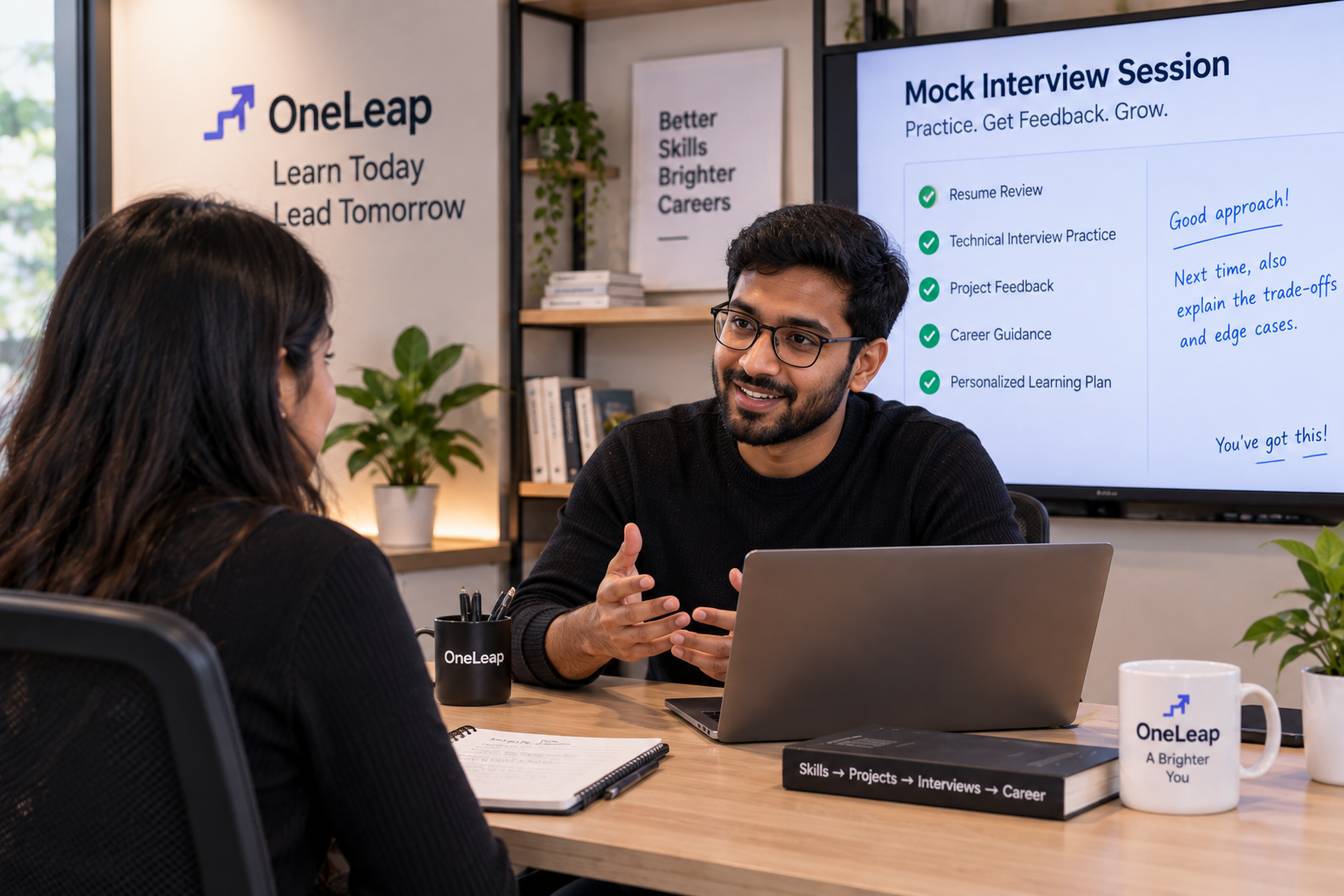
Five things, the same across all three programmes: resume and LinkedIn optimisation positioned for recruiters and applicant tracking systems, interview preparation covering technical mock interviews and system design practice and salary negotiation, hiring network access with direct connections to companies hiring AI talent, weekly 30-minute one-to-one mentorship with industry practitioners, and portfolio coaching to present your projects with impact in interviews.
What it does not include is a job guarantee, and this page is as specific about that as about the rest. Career support closes the gap between being capable and being hireable. It cannot close the gap between being hireable and being hired, because that part depends on your work, your interviews, and the market.
Key takeaways
- Career support is five defined things, not a vague promise. Each is listed in all three programme brochures.
- The most valuable part is usually the weekly mentorship, and it is the part learners most often underuse.
- Interview preparation is role-specific. An AI engineering interview and an analytics interview test different skills.
- Portfolio coaching turns project work into evidence. Doing the project is not the same as being able to present it.
- No provider can guarantee a job, and a provider who does is telling you something about their marketing rather than their programme.
- Support works when you bring specific questions to it. It does very little for someone who attends and waits.
Table of contents
- How to evaluate career support at any provider
- What OneLeap commits to
- How to get real value from each part
- What good looks like
- What differs by programme
- What career support does not guarantee
- Questions to ask before you enrol
- Frequently asked questions
How to evaluate career support at any provider
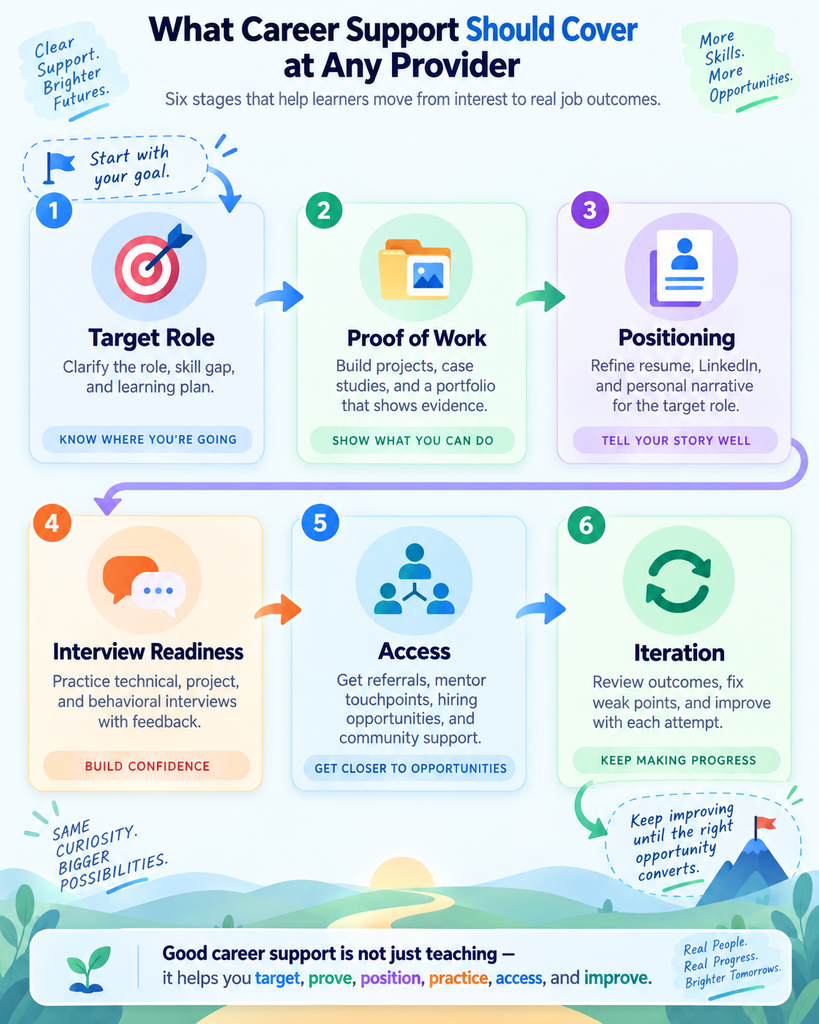
Before looking at any single provider, it helps to know what career support is supposed to do. It should carry a learner through six stages, from deciding what to aim at to improving after rejection. Use this to assess any course you are considering, including this one.
| Stage | What support should provide | What you should end up with |
|---|---|---|
| Target role | Help narrowing to one role, level and industry, and naming the skill gap | A specific target such as Data Analyst or GenAI Engineer, not “something in AI” |
| Proof of work | Project selection, review and documentation | Three to five projects with demos, metrics, architecture and honest limitations |
| Positioning | Resume, LinkedIn and portfolio aligned to that target | One consistent story across all three, using real keywords from real postings |
| Interview readiness | Role-specific practice with feedback from someone who has interviewed candidates | Structured answers, and the ability to defend a project under questioning |
| Access | Introductions, referrals, or visibility with employers who hire for that role | Conversations you would not have got from a job board alone |
| Iteration | A route back after rejection, and someone to review what went wrong | Better materials and better answers by the fifth interview than the first |
A provider missing the last two stages is offering course content with a resume review attached. Those two are where most of the difference lies.
What OneLeap commits to
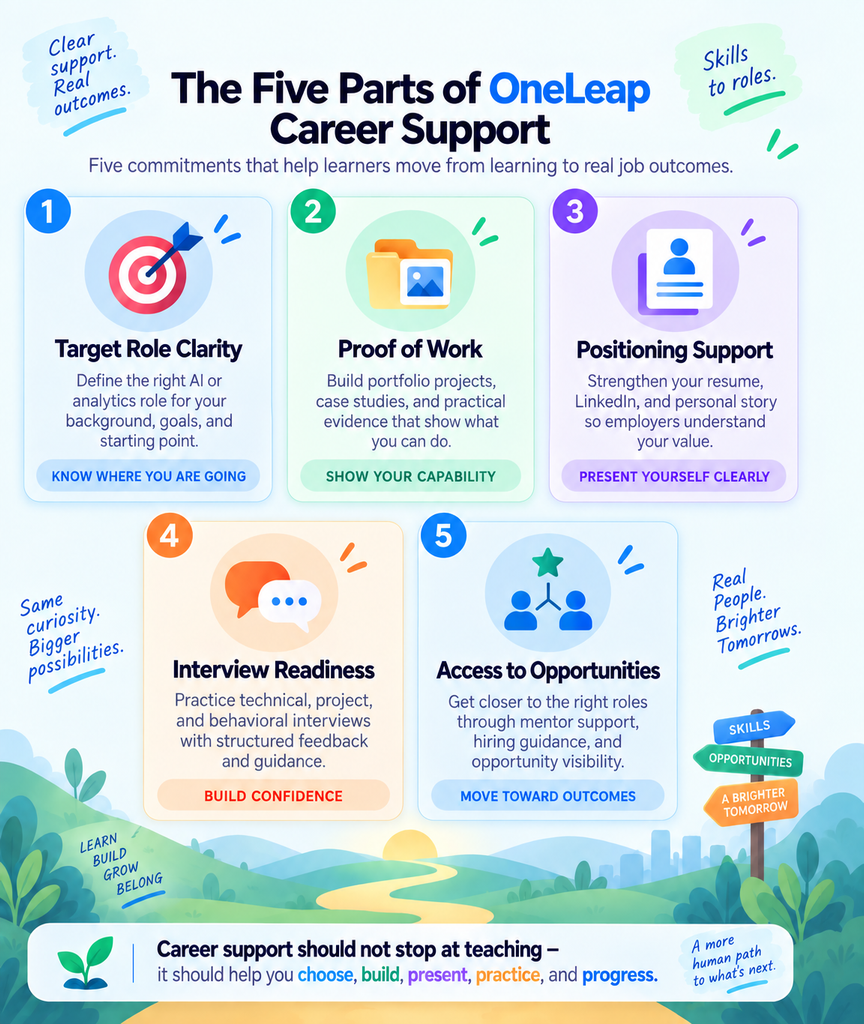
These five are listed in the Strategic Data Analyst with AI, AI For Product Managers and AI Engineering Mastery brochures in identical terms.
| Support | What it covers |
|---|---|
| Resume and LinkedIn optimisation | AI-focused positioning for recruiters and ATS systems |
| Interview preparation | Technical mock interviews, system design practice, salary negotiation |
| Hiring network access | Direct connections to startups and companies hiring AI talent |
| Weekly 1-on-1 mentorship | 30-minute sessions with industry practitioners, run as open office hours |
| Portfolio coaching | Present your projects with impact in interviews |
Two things are worth saying plainly about this list. It is the same for all three programmes, so choosing a programme is a decision about curriculum rather than about support. And all three are built around real projects seven in the analytics programme, eight in the product programme, nine plus a capstone in the engineering programme which means portfolio coaching has genuine material to work with rather than starting from nothing.
How to get real value from each part
Support of this kind rewards preparation and does almost nothing for passive attendance. Here is how to get value out of each part.
The weekly mentorship session
Thirty minutes a week with a practitioner is the most valuable and most wasted part of any programme. Wasted when it becomes live debugging; valuable when it becomes a decision review.
- Send your question or your work the day before, so the session starts with a response rather than an explanation.
- Bring decisions, not only errors: is this scope right, is this architecture sensible, is this project worth finishing.
- Ask for the thing you cannot get elsewhere: judgement. Documentation can teach you syntax; only a practitioner can tell you what they would actually ship.
- Keep a running action list and open the next session with what you did about the last one.
- Use two or three sessions specifically on career direction rather than technical work. That is a legitimate use of the time.
The mock interview
The purpose is not to find out whether you know the answer. It is to find out whether you can produce it out loud, under time pressure, to someone who is judging you.
- Do the first one earlier than feels comfortable. An early bad mock is information; a late one is a scramble.
- Record it if allowed, and watch it back. Most people discover they explain the how and never the why.
- Ask for the specific weakness rather than a score. “What would have made you reject me?” is the useful question.
- Repeat the same question a week later. Improvement between attempts is what you are actually training.
Portfolio coaching
Building a project and being able to present it are separate skills, and the second is the one that gets tested. Coaching is where the first becomes the second.
- Bring the project you are least proud of as well as your best. The weak one usually needs a decision about whether to fix it or drop it.
- Ask which project to lead with for your specific target role. The answer is often not the most technically impressive one.
- Get the limitations section reviewed. Understating a limitation is a bigger interview risk than the limitation itself.
- Practise the three lengths: sixty seconds, five minutes, and a deep technical discussion. They are different explanations, not the same one trimmed.
Resume, LinkedIn and the hiring network
- Bring five real job postings for your target role to the resume review. Positioning against actual postings beats positioning in the abstract.
- Keep the resume and the LinkedIn profile telling one story. A mismatch between them is noticed more often than people expect.
- Treat network access as a supplement, not a channel. It works best for candidates who are already applying consistently, because introductions favour people with momentum.
- Ask what kinds of companies the network actually reaches. A specific answer is a good sign; a vague one is worth noting.
What good looks like
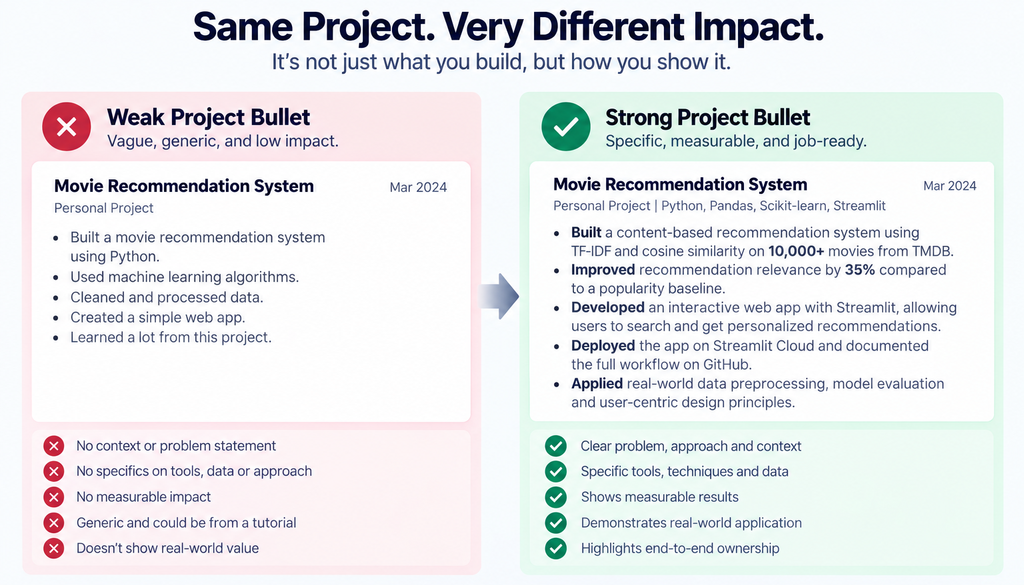
A project bullet, before and after
Before: Created a chatbot using Python and an LLM.
After: Built and deployed a document-grounded support assistant in Python and FastAPI with vector retrieval and citations; evaluated against 80 test questions, tracked retrieval and citation accuracy, and added human escalation for low-confidence answers.
The second version names the problem, the system, the evaluation and a reliability decision. It also gives an interviewer four things to ask about, which is the point: a good bullet invites the conversation you are prepared for.
A LinkedIn headline
For an engineering target: Aspiring AI Engineer | Python, RAG and AI Agents | Building production-oriented AI applications
For an analytics target: Data Analyst | SQL, Power BI and Python | Turning business questions into decisions
Whichever you choose, the headline, the About section, the resume and the portfolio should tell the same story. Consistency is doing more work here than cleverness.
A sixty-second project explanation
“I built a retrieval system for internal policy questions. It ingests approved documents, retrieves the relevant sections, generates answers with citations, and escalates when it is not confident. I evaluated it on 80 test cases, tracked retrieval and citation accuracy, and added access controls because different teams should not see the same documents. The main weakness is tables inside PDFs, which it still gets wrong about half the time.”
Note the last sentence. Volunteering the weakness is what separates a candidate who has run a system from one who has finished a tutorial.
For the underlying craft what belongs in a README, which metrics to publish, how to structure a portfolio see the AI engineering portfolio standard or, for analytics, the roadmap’s visibility and interview stages.
What differs by programme
The support is identical across the three programmes. What differs is what you are preparing for, which changes what the mock interviews and portfolio reviews should focus on.
| Programme | Interviews focus on | Roles it prepares for |
|---|---|---|
| AI Engineering Mastery | Python, ML and LLM concepts, RAG, agents, evaluation, deployment, system design, and defending a project’s architecture | AI Engineer, GenAI Engineer, ML Engineer, AI Developer |
| Strategic Data Analyst with AI | SQL, Excel, Power BI, statistics, business case questions, dashboard walkthroughs, and reaching a recommendation | Data Analyst, Business Analyst, Operations Analyst, Marketing Analyst, Reporting Analyst, Analytics Consultant |
| AI For Product Managers | Product sense, AI opportunity validation, metrics and ROI, workflow design, governance, and knowing when to escalate to engineering | AI Product Manager, Automation Specialist, AI Operations Lead, Growth Marketer, AI Consultant, Business Analyst, RevOps Manager |
If you have not yet chosen between them, the career transition guide works through the four paths and which programme serves each.
What career support does not guarantee
This section exists because most competing pages do not have one. Career support is structure, feedback, preparation and access. It is not an outcome, and treating it as one is the most reliable way to be disappointed by it.
- It does not guarantee a job. Not at a particular company, not at a particular salary, not by a particular date.
- It does not replace the work. Nobody can present a portfolio you have not built or answer an interview question you cannot answer.
- It does not remove the market. Hiring volumes move, and a slow quarter affects prepared candidates too.
- It does not compensate for inconsistent applications. Support improves conversion; you still have to generate the opportunities.
- It does very little passively. Learners who book the mentorship, bring questions and act on feedback get a different experience from learners who attend.
Saying this plainly is not a hedge. A provider willing to tell you what their support cannot do is usually more reliable about what it can, and “100% placement” claims in the Indian coaching sector attract regulatory attention for good reason.
Questions to ask before you enrol
Ask these of any provider, including OneLeap. Specific answers are a good sign; a brochure quoted back at you is not.
- Is the resume and LinkedIn work specific to my target role, or a generic template?
- Who runs the mock interviews, and have they interviewed candidates for the role I want?
- How many mock interviews do I get, and can I repeat them?
- Does portfolio coaching review my architecture and metrics, or only my presentation?
- How often is the one-to-one mentorship, who is it with, and how long does it continue after the final module?
- What does “hiring network access” mean concretely introductions, a referral list, or a job board?
- What happens if I finish the programme and have not found a role in three months?
- Can I speak to two recent learners who were in my situation?
The last one is the most informative and the least often asked.
Frequently asked questions
Does OneLeap help with resume and LinkedIn?
Yes. Resume and LinkedIn optimisation is one of the five documented parts of career support across all three programmes, positioned for both human recruiters and applicant tracking systems. The work is aimed at your target role rather than a generic rewrite.
Does OneLeap provide interview preparation?
Yes. Interview preparation covers technical mock interviews, system design practice and salary negotiation. Practice is role-specific, because an AI engineering interview and a data analyst interview test different things.
What is portfolio coaching?
Help choosing which projects to show, documenting architecture and outcomes, adding demos and metrics, stating limitations honestly, and presenting the work in a resume and in an interview. Every OneLeap programme is built around real projects, so the raw material exists; coaching is about turning it into evidence.
How does the weekly mentorship work?
Weekly 30-minute one-to-one sessions with industry practitioners, described in the brochures as open office hours. They run throughout the programme, which means they are most useful when you bring a specific decision or blocker rather than saving them for emergencies.
Does OneLeap guarantee a job or placement?
No, and you should be cautious of any provider that does. Career support improves your readiness and your access. Whether you get hired also depends on your project quality, interview performance, how consistently you apply, and the market at the time. Check the current programme terms directly before enrolling.
Is career support included, or does it cost extra?
It is described in all three brochures as part of the programme rather than an add-on. Confirm the current terms with OneLeap before enrolling, since programme details change.
How long does career support last?
The brochures describe mentorship and career acceleration as part of the programme. Ask directly how long support continues after the final module, because this is the detail providers most often leave vague and the one that matters most during a job search.
What if I already have a job and just want the skills?
Then use the mentorship and portfolio coaching and skip the rest. Many learners on the programmes are making a role transition rather than a job change, and the portfolio work is what makes an internal move credible.
Final thoughts
Resume, LinkedIn, interviews and portfolio are one job rather than four. They are all versions of the same task: making work you have genuinely done legible to someone who has never met you and has ten minutes.
OneLeap’s part is the structure, the feedback, the practice and the access. Your part is building something worth presenting and then presenting it consistently. Programmes that pretend otherwise are selling the wrong thing.
Browse the three programmes: theoneleap.com/programmes

Leave a Reply