
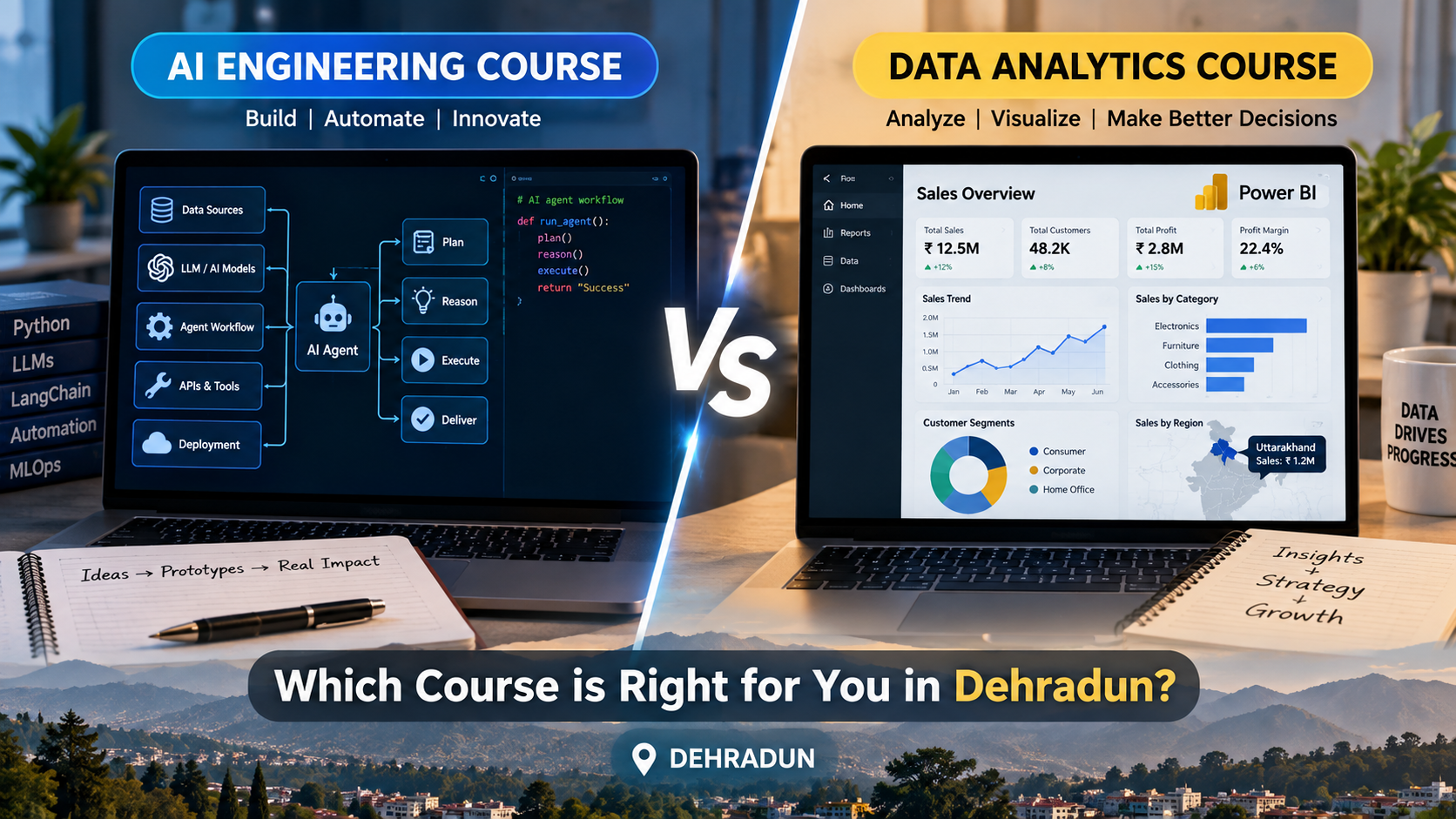
Choose an AI course if you enjoy programming and want to build AI applications such as machine learning systems, LLM products, RAG pipelines, and AI agents. Choose a data analytics course if you want to answer business questions with Excel, SQL, Python, Power BI, and statistics. Analytics is usually the faster, more accessible route to a first job; AI engineering takes longer to prepare for but has a higher technical ceiling.
For students, freshers, and working professionals in Dehradun, the right choice depends on the kind of work you enjoy, how much programming you already know, and how much preparation time you have. The two paths overlap more every year, so you are choosing where to start, not where you must stay.
Key takeaways
- AI courses teach you to build and deploy AI systems; data analytics courses teach you to turn data into business decisions.
- Analytics is usually easier to start and quicker to a first role. AI engineering needs stronger Python and software skills.
- Skills and portfolio quality influence your first salary more than the course title or certificate.
- Specialised analytics and AI roles in Dehradun itself are limited, so most candidates also apply for remote, hybrid, or metro roles. Build a portfolio that can be assessed online.
- Not sure which fits you? Use the five-question self-check below.
- OneLeap, based in Dehradun, offers one programme for each path: AI Engineering Mastery ,Strategic Data Analyst with AI and AI Product Manager
Table of contents
- What does an AI course teach?
- What does a data analytics course teach?
- AI vs data analytics: side-by-side comparison
- Projects and portfolio expectations
- Which path suits you?
- Fresher salary ranges by skill level
- AI and data analyst jobs in Dehradun (and beyond)
- Advice for working professionals
- How to choose the best AI or data analytics course in Dehradun
- OneLeap programmes at a glance
- Common mistakes to avoid
- Frequently asked questions
- Final thoughts
What does an AI course teach?
An AI course prepares you to understand, build, integrate, evaluate, and deploy artificial intelligence systems. Depending on its depth, it may cover Python, machine learning, deep learning, transformer architecture, LLM APIs, prompt engineering, RAG, vector databases, AI agents, fine-tuning, multimodal AI, deployment, observability, safety, and cost optimisation.
A strong AI engineering curriculum goes beyond calling an API. It teaches when to use prompting, retrieval, fine-tuning, deterministic workflows, human review, or agentic systems, and how to measure quality after deployment.
What does a data analytics course teach?
A data analytics course in Dehradun or anywhere else prepares you to collect, clean, query, analyse, visualise, and communicate data. Core topics typically include Excel, SQL, Python, statistics, Power BI or Tableau, data storytelling, KPI design, forecasting, and business problem-solving.
A modern analytics course may also include AI-assisted analysis, prompt engineering, automated reporting, basic RAG for company data, anomaly detection, and workflow automation. The focus stays on supporting decisions rather than building complex models for their own sake.
AI vs data analytics: side-by-side comparison
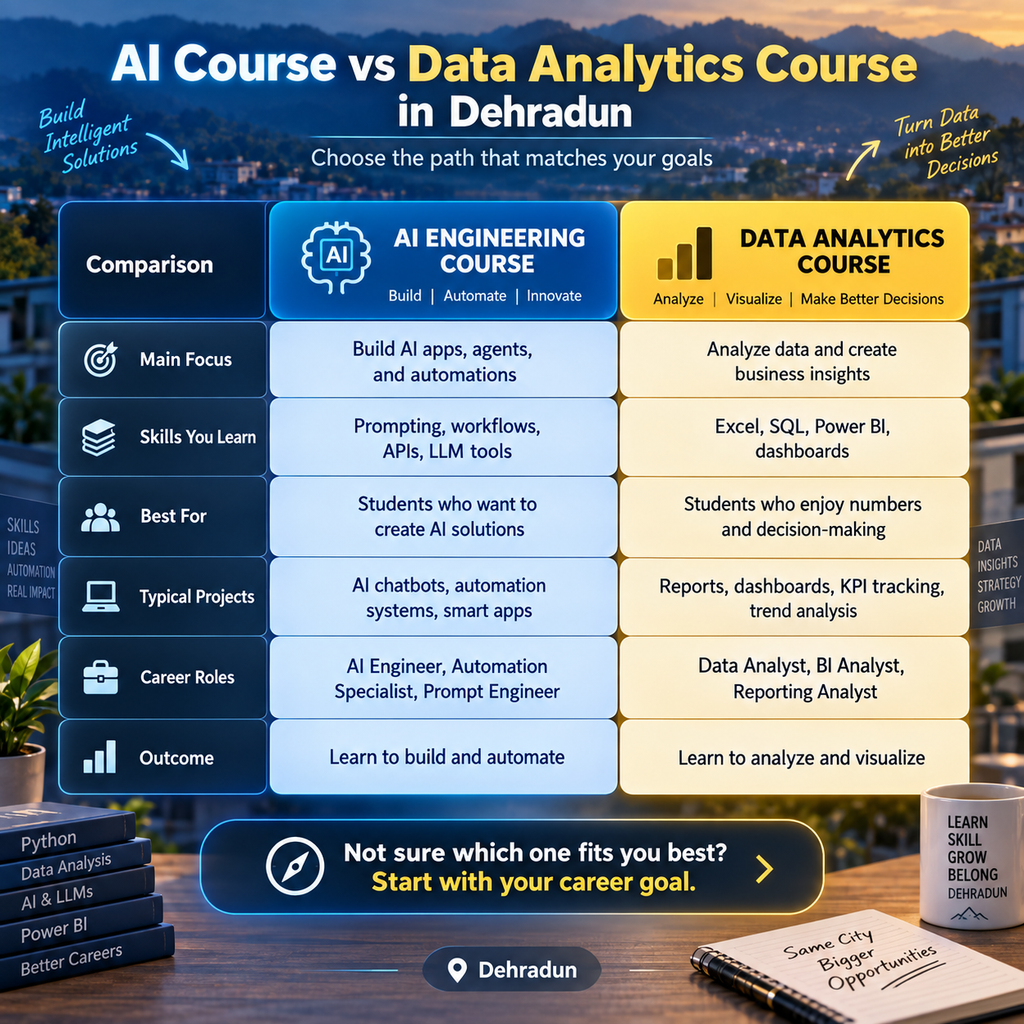
This table sums up the AI vs data analytics career choice across the factors that matter most when you are starting out.
| Factor | AI course / AI engineering | Data analytics course |
|---|---|---|
| Primary goal | Build intelligent applications and production AI systems | Turn data into insights, dashboards, recommendations, and decisions |
| Core tools | Python, Git, APIs, ML and deep-learning libraries, LLM APIs, vector databases, FastAPI, Docker, cloud | Excel or Sheets, SQL, Power BI or Tableau, Python and Pandas, AI assistants for analysis |
| Programming depth | High; strong software fundamentals matter | Beginner-friendly at first; SQL and Python depth grows over time |
| Maths and statistics | Probability, ML concepts, optimisation, evaluation | Descriptive statistics, sampling, bias, correlation, forecasting |
| How work is delivered | Deployed apps and APIs, monitored for quality, cost, and latency | Dashboards, reports, scheduled refreshes, and recommendations to stakeholders |
| Typical entry roles | AI/ML Engineer, GenAI Engineer, AI Developer | Data Analyst, Business Analyst, BI Analyst, MIS or Reporting Analyst |
| Best fit | People who enjoy coding, systems, and technical problem-solving | People who enjoy business questions, numbers, and explaining findings |
| Typical time to job-ready | Often 8–12 months or more from a beginner start | Often 4–6 months of focused study |
Time-to-job-ready figures are rough guides for someone studying seriously from a beginner level; prior programming or domain experience shortens them.
Where does data science fit?
Data science sits between the two. It involves more statistical modelling and machine learning than analytics, but less software engineering and deployment than AI engineering. Many people reach data science by starting in analytics and adding Python and ML over time.
Projects and portfolio expectations
The difference is clearest in what you build. An AI learner should show they can build a reliable AI system; an analytics learner should show they can answer a business question and explain what action should follow.
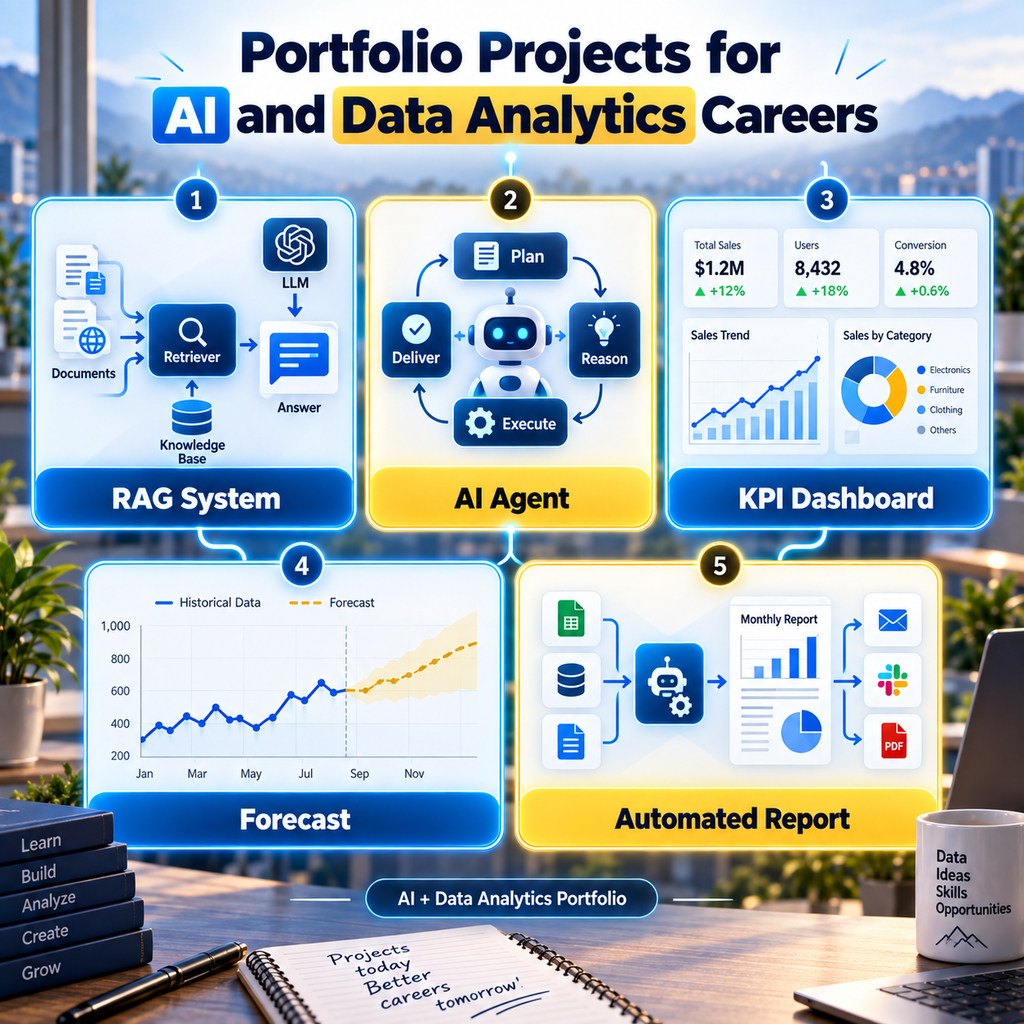
| AI course portfolio | Data analytics course portfolio |
|---|---|
| Enterprise RAG system with citations, access controls, retrieval evaluation, and a deployed interface | Business KPI dashboard built around a clear executive question, with automated refresh, drill-downs, and recommendations |
| AI agent that researches a topic, uses tools, cites sources, and asks for human approval when unsure | Sales performance analysis using SQL and Python to identify trends, seasonality, and growth opportunities |
| Full-stack AI product with authentication, API, database, model integration, testing, and monitoring | Customer segmentation using behaviour and demographics, tied to specific business actions |
| AI monitoring dashboard tracking quality, failures, prompt injection, cost, and latency | Revenue forecast with KPI monitoring and AI-generated summaries, compared against a simple baseline |
For ten detailed project ideas with datasets, difficulty levels, and evaluation tips, see AI Portfolio Projects for 2026.
Which path suits you?
Choose an AI course if you…
- Enjoy programming, debugging, and understanding how systems work.
- Want to build AI applications, LLM products, agents, RAG systems, or ML services.
- Are ready to invest in Python, software engineering, APIs, deployment, and evaluation.
- Are aiming for AI Engineer, ML Engineer, GenAI Engineer, or AI Developer roles.
Choose a data analytics course if you…
- Enjoy business questions, metrics, spreadsheets, and dashboards.
- Want an accessible start with Excel, SQL, Power BI, statistics, and communication.
- Prefer finding patterns and explaining them over building software infrastructure.
- Are aiming for Data Analyst, Business Analyst, BI Analyst, or Product Analyst roles.
Consider a hybrid path if you…
Want to combine business understanding with technical AI skills. You can start in analytics and move into AI-powered analytics, automation, or product roles, or start in AI engineering and add analytics and business skills to become a stronger product or solutions professional.
Five-question self-check
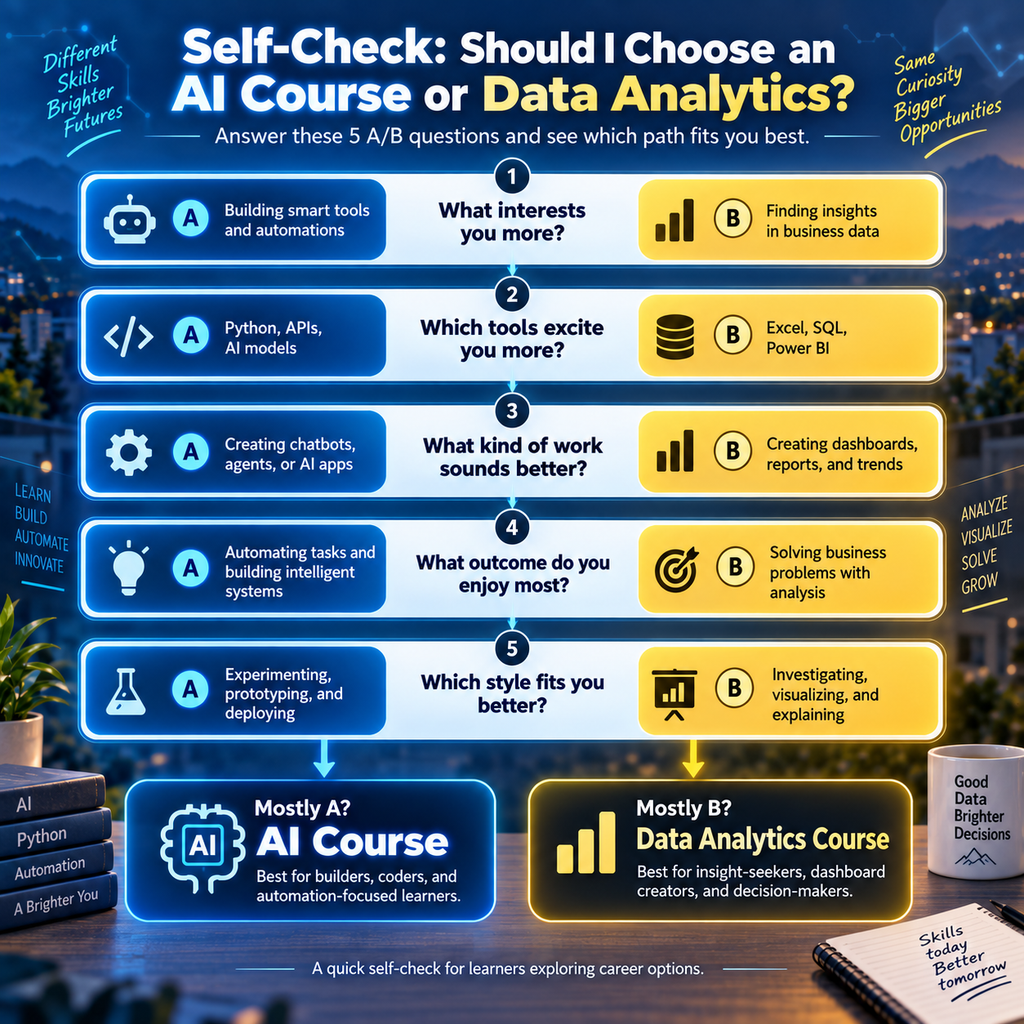
Note whether you lean towards A or B for each question.
- When your code breaks, do you (A) enjoy tracking down the bug, or (B) want to get back to the question you were answering?
- Which feels more satisfying: (A) shipping a tool other people use, or (B) presenting a recommendation that changes a decision?
- Your programming today: (A) I have written Python or another language beyond tutorials, or (B) I am a beginner or mostly use Excel.
- Your timeline: (A) I can invest eight months or more before my first role, or (B) I want to be job-ready in roughly four to six months.
- Job titles that appeal: (A) AI Engineer, ML Engineer, GenAI Developer, or (B) Data Analyst, Business Analyst, Product Analyst.
Mostly A: an AI course is likely the better fit.
Mostly B: start with data analytics.
Mix: start with analytics and add AI skills later, or follow the hybrid path above.
Fresher salary ranges by skill level
Pay depends on experience, employer, location, industry, portfolio quality, and interview performance. The ranges below are indicative India-wide fresher figures based on commonly reported 2026 data from salary aggregators such as Glassdoor, AmbitionBox, and Indeed. They are market ranges, not guaranteed outcomes of any course.
| Skill profile | Typical entry roles | Indicative fresher range (India) |
|---|---|---|
| Excel + basic SQL + reporting | MIS Executive, Reporting Analyst, junior operations roles | ₹3–4 LPA |
| Excel + SQL + Power BI + dashboards | Data Analyst, BI Analyst, Business Analyst | ₹3.5–5.5 LPA |
| SQL + Power BI + Python + statistics | Data Analyst, Product Analyst, Analytics Associate | ₹4.5–7 LPA |
| Python + ML foundations + APIs + deployed projects | Junior AI/ML Engineer, AI Developer | ₹5–9 LPA |
| Python + LLMs + RAG + agents + evaluation | GenAI Engineer, AI Engineer, LLM application developer | ₹6–12 LPA, higher at some product companies |
Two local caveats matter. Offers from employers based in Dehradun are often lower than these national figures, especially for entry-level roles. Remote roles with national or global companies usually follow the employer’s own pay bands, which is one reason a remotely assessable portfolio is so valuable.
In short, analytics tends to lead to a first role sooner, while deeper skills in production AI, LLM systems, cloud, and evaluation can create a higher long-term technical ceiling.
AI and data analyst jobs in Dehradun (and beyond)
Dehradun’s job market is growing, but it is still small for specialised data and AI roles. A large share of local postings, including many around the IT Park on Sahastradhara Road, are in customer support, operations, digital marketing, and general IT services. Dedicated data analyst and AI engineering openings exist but are fewer, so building an AI career in Dehradun usually means combining a local search with remote and hybrid applications.
Local sectors worth targeting include tourism and travel, education, healthcare, real estate, and the city’s IT services companies and startups. Analytics skills are useful in all of them, often under titles such as MIS Executive, Reporting Analyst, or Operations Analyst.
When you search for data analyst jobs in Dehradun, also set alerts for remote and hybrid roles, and for nearby hubs such as Delhi NCR and Chandigarh. Make your work easy to assess remotely: public repositories, live dashboards or demos, architecture diagrams, short videos, and clear project write-ups.
- AI path: AI/ML internships, Python development, GenAI engineering, RAG implementation, automation engineering, and AI application development.
- Analytics path: data analyst internships, MIS and reporting, BI dashboards, operations analytics, marketing analytics, and business analysis.
- Hybrid roles: AI-powered analytics, product analytics, AI operations, solutions consulting, and automation implementation.
Advice for working professionals
If you already work in Dehradun, whether in operations, sales, teaching, accounting, hospitality, or IT support, your domain experience is an asset. Employers value analysts and AI builders who understand how a business actually runs.
- Non-technical roles: data analytics is usually the quicker switch, and you can often apply new skills in your current job straight away.
- Software or IT roles: an AI course builds on the programming you already know and can lead to AI engineering responsibilities in your current team.
- Scheduling: look for evening or weekend batches, recorded sessions, and projects you can base on your own industry using anonymised or public data.
How to choose the best AI or data analytics course in Dehradun
Whether you are looking for the best AI course in Dehradun or a data analyst course in Dehradun, use the same checklist.
- Start with your target role, not the course title. Decide whether you want to build systems or drive decisions with data.
- Check curriculum depth and order: foundations should come before advanced tools.
- Ask to see real student projects with messy data, business constraints, evaluation, and documented outcomes.
- Confirm what mentorship includes: live sessions, feedback on your work, office hours, portfolio reviews, and interview preparation.
- Check prerequisites honestly. Engineering programmes may expect programming basics; analytics programmes are usually more beginner-friendly.
- Get the batch format (classroom, online, or hybrid), schedule, total fees including taxes, and refund policy in writing.
- Treat “100% placement” or guaranteed-salary claims with caution. Ask what placement support actually involves and for verifiable alumni outcomes.
- Ask how the course covers AI safety, validation, privacy, bias, cost, and responsible use.
OneLeap programmes at a glance
OneLeap is a Dehradun-based training provider with one programme for each path.
| Index | AI Engineering Mastery | Strategic Data Analyst with AI |
|---|---|---|
| Best for | Learners who want to build and deploy AI systems | Learners who want to use data and AI to drive business decisions |
| Programme focus | ML and deep-learning foundations, prompt engineering, AI products, production RAG, fine-tuning, AI agents, multi-agent systems, safety, deployment, optimisation, multimodal AI | Business acumen, statistical thinking, AI fluency, Excel, SQL, Python, Power BI, data storytelling, RAG basics, forecasting, workflow automation |
| Example projects | Enterprise RAG system, autonomous research agent, multi-agent orchestrator, domain-specific fine-tuned model, AI safety and monitoring dashboard | Business KPI dashboard, sales performance analysis, customer segmentation, predictive revenue forecasting, AI-powered report generator |
| Prerequisites | Python Basics | No Need |
| Duration | 9-10 Months | 6 Months |
| Format and location | Online/Offline | Online/Offline |
| Fees | Check Wesbite | Check Wesbite |
Explore AI Engineering Mastery or Strategic Data Analyst with AI.
Common mistakes to avoid
- Choosing AI because it sounds more advanced, without enjoying programming or technical problem-solving.
- Choosing analytics while neglecting SQL, statistics, business understanding, or communication.
- Picking a course for its certificate rather than its projects and feedback.
- Trusting guaranteed-placement or guaranteed-salary promises without asking what support actually includes.
- Expecting a high salary from tool familiarity alone, without a portfolio or interview-ready skills.
- Building generic projects that show no user, business problem, evaluation, or recommendation.
- Ignoring remote and hybrid opportunities because you are based in Dehradun.
- Learning both paths superficially instead of building depth in one and adding complementary skills later.
Frequently asked questions
Is an AI course better than a data analytics course?
Neither is better in general. An AI course is the better choice if you want to build and deploy AI systems; a data analytics course is the better choice if you want to work with business data, dashboards, SQL, and decision support. Your interests, starting skills, and timeline should decide.
Which course is easier for a fresher in Dehradun?
Data analytics is usually more accessible because you can start with Excel, SQL, dashboards, and basic statistics. An AI course for freshers in Dehradun is still a realistic option, but expect to spend more time on Python and software fundamentals before the AI-specific material.
How long does each course usually take?
Entry-level data analytics programmes commonly run about four to six months. AI engineering programmes usually take longer, and learners without prior programming experience should allow extra preparation time. Check each programme’s current duration before enrolling.
Do I need a strong maths background for an AI course?
You need comfort with basic probability, statistics, and core linear algebra ideas. Applied LLM work such as RAG and agents relies more on programming and evaluation than on advanced maths. Data analytics needs solid descriptive statistics rather than advanced mathematics.
Is data science the same as data analytics?
No. Data analytics focuses on answering business questions with existing data. Data science adds more statistical modelling and machine learning. AI engineering focuses on building and deploying AI applications as software. Many learners start in analytics and move towards data science or AI later.
Can a data analyst move into AI engineering?
Yes. Add Python depth, data structures, APIs, ML foundations, LLM applications, RAG, agents, evaluation, and deployment. Analytics experience remains valuable because AI systems must solve real business problems.
What salary can I expect after an AI or data analytics course?
Indicative India-wide fresher ranges are roughly ₹3–6 LPA for data analyst roles and ₹6–12 LPA for AI/ML and GenAI engineering roles backed by strong projects. Offers from Dehradun-based employers are often lower than metro figures, and remote roles follow each employer’s pay bands. These are market ranges, not guaranteed outcomes of any course.
Can I find AI or data analyst jobs in Dehradun?
Yes, but specialised openings are limited locally. Combine local searches for data analyst jobs in Dehradun with remote and hybrid roles across India and nearby hubs such as Delhi NCR and Chandigarh. A public portfolio and clear communication matter most for remote hiring.
Can working professionals take these courses?
Yes. Look for evening or weekend batches, recorded sessions, and projects you can base on your own industry. Analytics is usually the quicker switch for non-technical professionals; AI engineering suits those who already write code.
Final thoughts
The AI course vs data analytics course in Dehradun decision comes down to the work you want to do. Choose AI if you want to build intelligent products, RAG systems, agents, and production services. Choose analytics if you want to use Excel, SQL, Python, Power BI, statistics, and AI workflows to support business decisions. Both lead to strong careers when you build real projects and keep adding complementary skills.
For Dehradun students, freshers, and working professionals, the best choice is the path that matches your interests, current foundation, and timeline, not the course with the most fashionable tool list. Explore OneLeap’s programmes to compare both paths in detail.
Explore OneLeap: theoneleap.com
Browse OneLeap programmes: theoneleap.com/programmes

Leave a Reply