
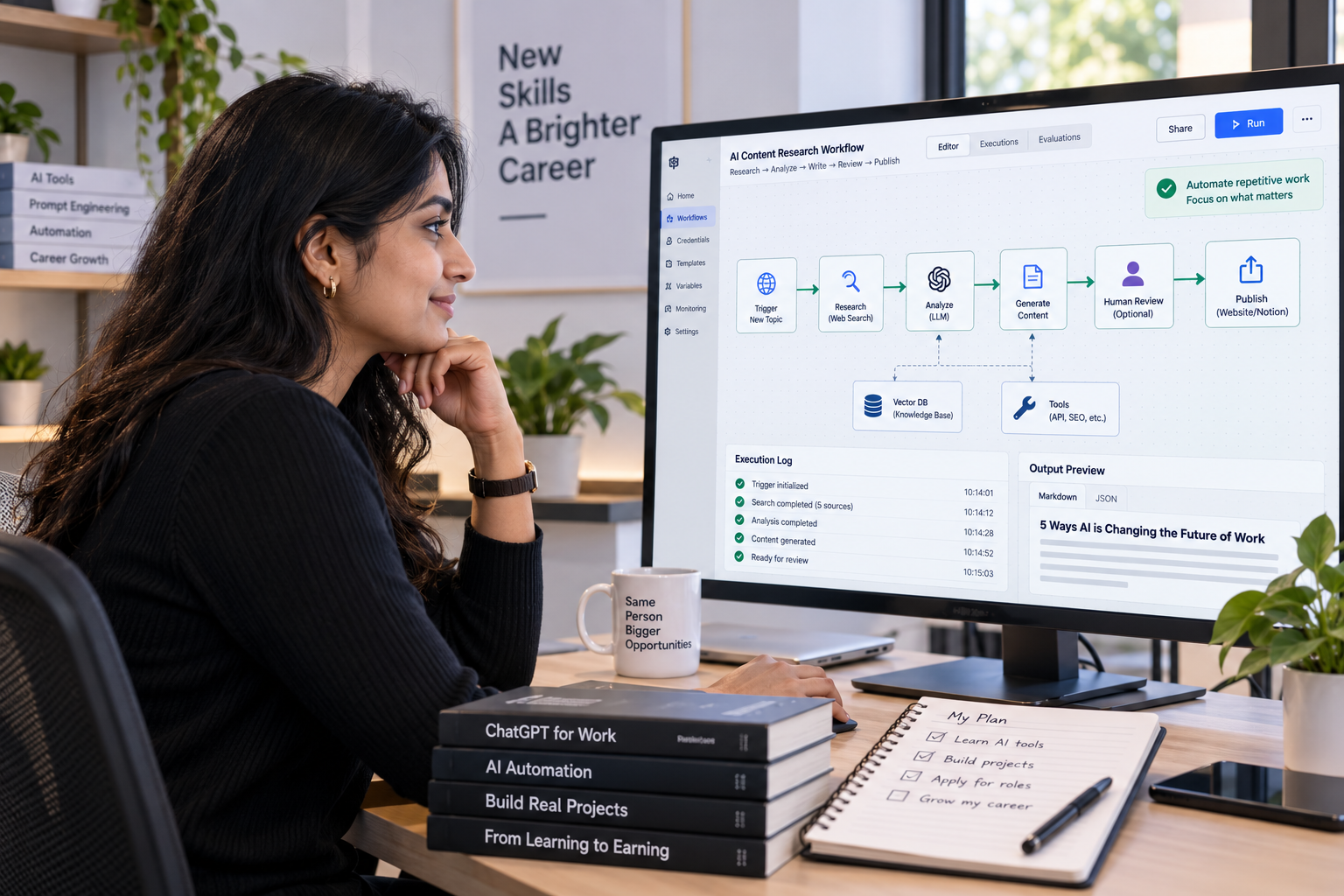
Yes, and the most reliable way is not to start over. Combine the domain expertise you already have in marketing, finance, HR, operations, sales, education or healthcare with one of four AI capabilities: data analytics, no-code AI building and automation, AI product work, or AI engineering. Three of those four require no programming to begin.
This guide is written for working professionals rather than students. You have something a fresher does not: you understand how a real business runs, you have access to real processes to experiment on, and you have less time to waste on the wrong path. The aim here is to help you pick one path and start, not to teach you all four.
Key takeaways
- Your domain knowledge is an asset, not baggage. It is what makes an AI solution correct rather than merely plausible.
- There are two moves available: adding AI to your current role, or pivoting into an AI-titled role. The first is faster and lower risk, and often leads to the second.
- Analytics, no-code AI building and product paths need no programming to start. AI engineering does, and it is honest to say so.
- Pick one path for the next six months. Trying to become an analyst, an engineer and a product manager at once is the most common way transitions stall.
- Build your first project inside your own domain. A finance person’s invoice extraction tool beats a generic chatbot in every interview.
- Your current job is the best laboratory you have. Internal pilots produce better evidence than tutorial projects.
Table of contents
- Two ways to move, and why it matters
- What your current career is already worth
- The four paths, and what each one demands
- Your first project, by background
- How to transition while still employed
- Which OneLeap programme fits which path
- Mistakes that stall a transition
- Frequently asked questions
Two ways to move, and why it matters
Most articles on this subject assume you are quitting. You probably are not, and you may not need to.
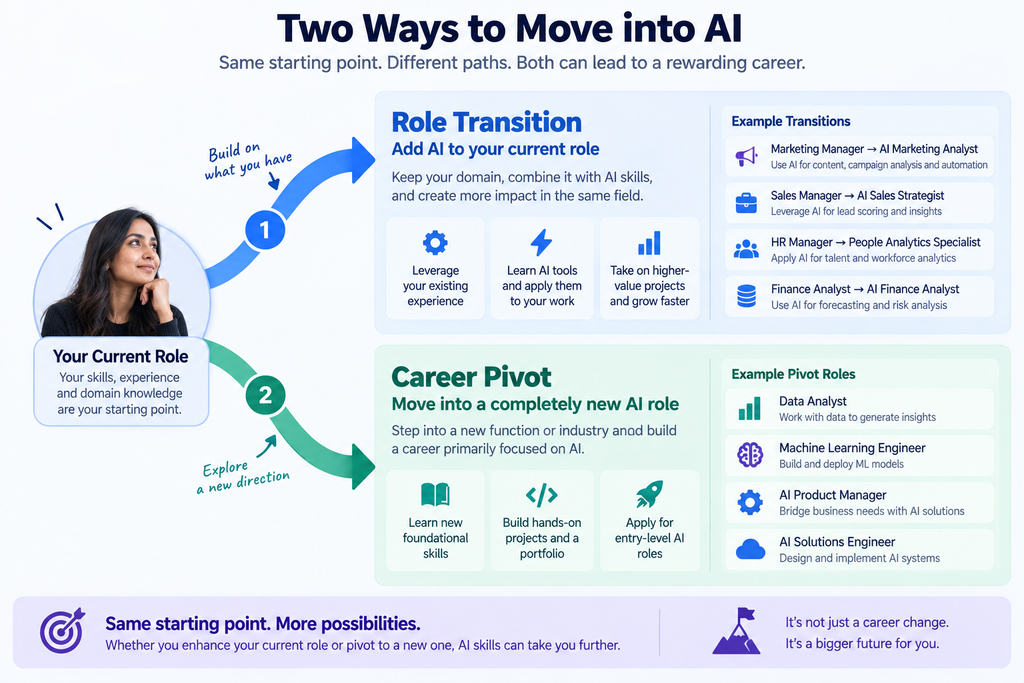
| Role transition | Career pivot | |
|---|---|---|
| What it is | You keep your function and add AI capability to it | You move into a new, AI-titled role |
| Example | A marketer becomes a marketing automation specialist; a finance analyst becomes an AI-assisted FP&A analyst | A marketer becomes a data analyst; an operations lead becomes an AI product manager |
| Risk | Low. No salary gap, no employment gap, and your domain credibility carries over intact | Higher. You may enter at a lower level and compete against people with the title already |
| Speed | You can start on Monday inside your current job | Six to twelve months depending on the path |
| Best when | Your industry is adopting AI and nobody internally owns it yet | You want out of your function, not just out of your tasks |
The role transition is underrated. It is often the fastest route to the pivot as well, because six months of AI work inside your current job is exactly the experience an AI-titled role wants to see, and it comes with a salary attached.
What your current career is already worth
Companies are not short of people who can prompt a model. They are short of people who understand how a claims process, a hiring funnel or a supply chain actually behaves. That understanding is the scarce half of the job, and you already have it.
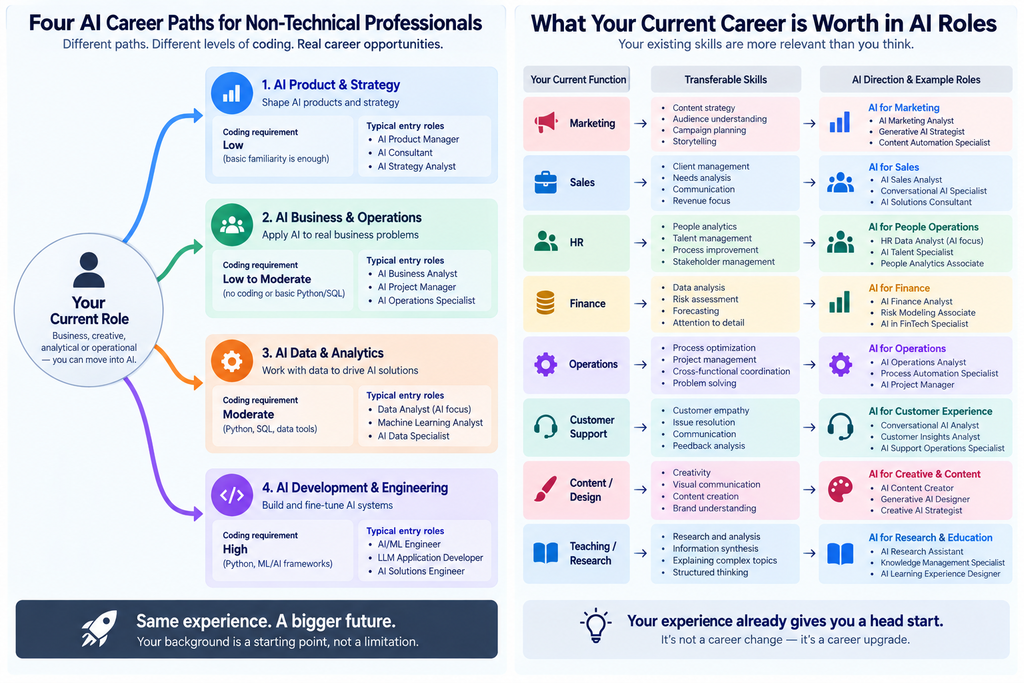
| If you come from | What transfers | Where it points |
|---|---|---|
| Marketing | Customer understanding, campaign metrics, segmentation, messaging | Marketing analytics, AI content workflows, growth automation, AI product |
| Finance or accounting | Numerical reasoning, controls, risk, reporting, compliance instinct | AI analytics, document intelligence, forecasting, finance AI operations |
| HR or recruiting | People processes, screening, stakeholder management, fairness concerns | Workforce analytics, HR automation, AI governance, recruiting operations |
| Operations | Process mapping, efficiency, quality control, coordination | AI automation, operations analytics, workflow design, process intelligence |
| Sales | Customer needs, pipeline discipline, CRM workflows, persuasion | Lead intelligence, sales automation, revenue analytics, RevOps |
| Education or training | Explaining complex things, designing learning, user empathy | AI enablement, learning analytics, adoption programmes, content systems |
| Project or product delivery | Prioritisation, requirements, cross-functional coordination | AI product management, solutions consulting, AI implementation |
The instruction that follows from this table is simple: whatever path you choose, aim it at the industry you already know. A generalist competing on AI skill alone is in a crowded market. A specialist who knows both AI and pharmaceutical supply chains is in a market of a few dozen people.
The four paths, and what each one demands
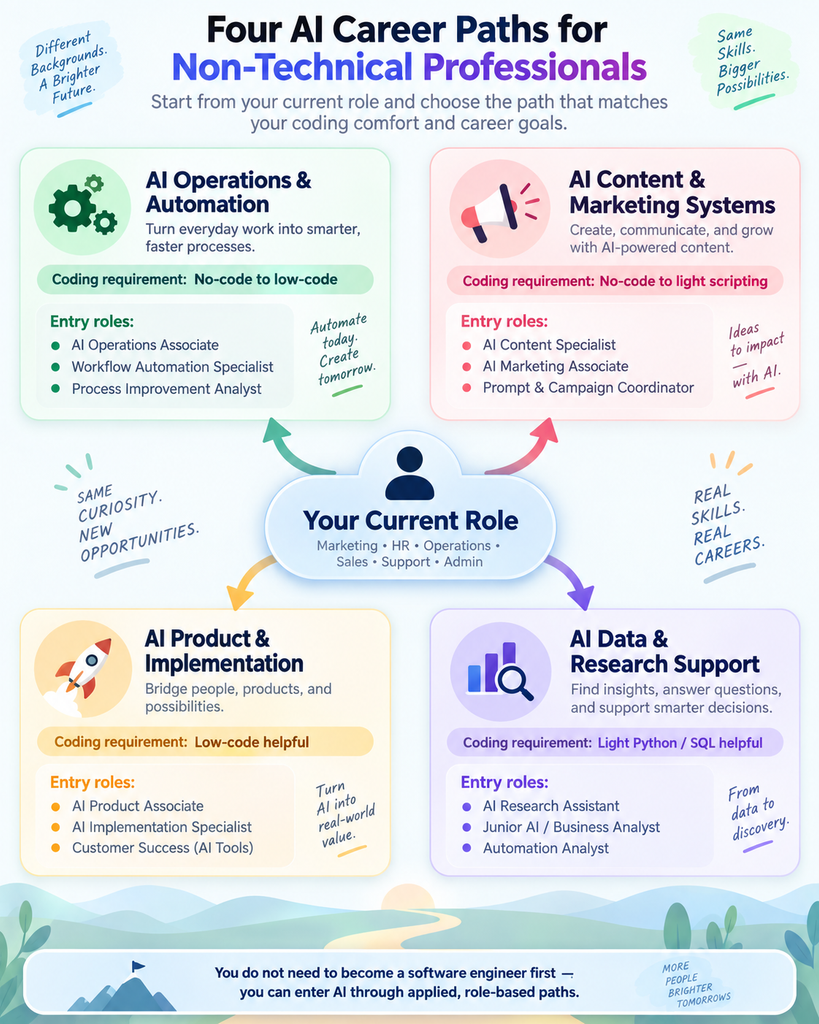
Four paths, in rough order of how quickly a working professional reaches a first role. Each row links to the guide that covers that path properly.
| Path | Suits you if | Coding needed | Entry roles |
|---|---|---|---|
| No-code AI building and automation | You like process improvement, tools, integrations, and seeing something work this week | None to start. Workflow platforms, APIs and prompts instead | Automation Specialist, AI Operations Lead, Solutions Associate, RevOps Manager |
| AI-powered data analytics | You already work with reports, metrics, budgets or performance data | None to start; SQL early, Python later | Data Analyst, Business Analyst, Reporting Analyst, Operations Analyst |
| AI product | You have product, project, customer or domain-owner experience | None, but real technical fluency is required to judge feasibility | AI Product Manager, Product Analyst, Product Operations, AI Consultant |
| AI engineering | You want to build the systems themselves and will invest in programming first | Yes, substantially, and before you start | AI Engineer, GenAI Engineer, ML Engineer, AI Developer |
One honest note on the phrase “no coding required”. It means you will not write software. It does not mean you can avoid technical thinking: APIs, data structure, validation, error handling and evaluation all still apply. The paths differ in whether you express that thinking in code or in a workflow canvas, not in whether you need it.
Where to read more on each
- Analytics: how to become a data analyst in India for the full roadmap, timelines, interview rounds and salary ranges. If you are coming from a non-technical background specifically, start here. Still deciding whether it is worth it, this answers that honestly.
- Engineering: what to learn first sets out the real prerequisites, a readiness self-check and a twelve-week preparation path. Do that before choosing a programme.
- Both: AI course versus data analytics course compares the two on skills, timelines and roles.
Your first project, by background
Build your first project inside the domain you already know. It is faster, because you do not have to learn the business context, and it is more persuasive, because you can explain why the output is right. A generic chatbot proves nothing about you; a working solution to a problem from your own industry proves a great deal.
| If you come from | Build this first | What to show |
|---|---|---|
| Marketing | A campaign performance and content intelligence workflow | An automated KPI report, the insights it surfaced, attribution caveats, and where a human still reviews |
| Finance | Invoice or contract extraction with validation | Structured extraction, the validation rules, the exception queue, an audit trail, and privacy handling |
| HR | A workforce dashboard with attrition exploration | The KPIs, your segmentation, bias considerations, recommendations, and the human oversight step |
| Operations | Ticket routing with anomaly alerts | A before-and-after process map, routing accuracy, alert precision, and the escalation logic |
| Sales | Lead enrichment and prioritisation | CRM integration, transparent scoring criteria, the approval step, and measured research time saved |
| Product or business | An AI feature case study with a prototype | The user problem, a PRD, success metrics, experiment design, risk assessment, and the prototype |
Whichever you build, publish the method alongside the result. “Saved four hours a week” means nothing without “measured by timing twenty tickets handled manually against twenty handled with the workflow”. For more project briefs across AI roles, see AI Portfolio Projects for 2026.
How to transition while still employed
This is the part written for you rather than for a student, and it is the biggest advantage you have. A fresher builds portfolio projects from public datasets. You have real processes, real data, real stakeholders and a salary while you learn.
- Run an internal pilot. Find one repetitive, low-risk workflow in your own team and improve it. Weekly reporting, ticket triage, document checks and meeting summaries are the usual candidates. Get permission first, keep it small, and measure before and after.
- Write it up as an anonymised case study. Strip names, figures and anything confidential, and check your company’s policy before publishing anything. What remains the problem, your approach, the validation, the measured outcome is stronger evidence than any tutorial project.
- Volunteer for the AI question nobody owns. Most organisations currently have AI questions and no designated person. Being that person for six months is a job title in waiting.
- Take the adjacent role first if the direct one is out of reach. Operations analytics, AI implementation, product operations and reporting roles are all closer to your current position than a titled AI role, and all of them are legitimate second steps.
- Protect the learning hours. Fifteen to twenty hours a week is what a serious weekend programme assumes. Schedule it like a meeting, because the thing that derails working professionals is not difficulty, it is the week where work ate everything.
Which OneLeap programme fits which path
OneLeap runs three programmes, one per path, all on weekends and all built for people who are working. Two of the three require no coding experience at all.
| If your path is | The programme | Shape | Entry requirement |
|---|---|---|---|
| No-code AI building, automation, or AI product | AI For Product Managers | 6 months, 50+ hours live, 13 modules, 8 projects | No coding experience; basic computer literacy and a business problem-solving mindset |
| AI-powered data analytics | Strategic Data Analyst with AI | 6 months, 70+ hours live, 7 modules, 7 projects | No coding experience; basic Excel familiarity helps but is not required |
| AI engineering | AI Engineering Mastery | 10 months, 100+ hours live, 14 modules, 9 projects and a capstone | Intermediate Python, data structures and OOP, APIs and databases, Git |
All three include weekly 30-minute one-to-one sessions, merit-based certification rather than attendance certificates, and a qualification interview before admission.
If you are not sure between two of them
Automation or analytics? Ask whether you would rather make a process run without you, or answer a question nobody else can. Automation people build; analytics people explain. AI For Product Managers covers the first, with n8n, multi-model workflows, multimodal AI and integrations into CRMs, Slack, Notion and databases. Strategic Data Analyst with AI covers the second, with Excel, SQL, Power BI, Python, statistics and forecasting.
Product or engineering? Ask whether you want to decide what gets built or to build it. The product path teaches you to validate AI opportunities, size markets, calculate ROI and know when to escalate to engineering. AI Engineering Mastery teaches you to be the person they escalate to, and assumes you can already write Python.
Still undecided? Choose the one whose projects you would enjoy building. The product programme ships content generators, document pipelines, support chatbots, lead scoring, meeting intelligence and marketing automation. The analytics programme ships dashboards, forecasts, segmentation and report generators. The engineering programme ships transformers, RAG systems, agents and deployed services. Browse all three.
Mistakes that stall a transition
- Trying to compete with experienced ML engineers instead of competing on domain knowledge plus AI, where you are one of very few people.
- Reading “non-technical” as “I can avoid technical thinking”. You can avoid writing code on three of the four paths. You cannot avoid APIs, data, validation or evaluation on any of them.
- Collecting AI tools without ever pointing them at a real problem from your own work.
- Leaving your domain experience out of your portfolio and resume, which throws away the one advantage you have.
- Building prompt demos rather than measured case studies. A screenshot of a good output is not evidence.
- Believing salary claims from viral posts. Check current figures against salary aggregators before you plan around any number.
- Ignoring privacy, bias, governance and human review, particularly when experimenting with company data.
- Waiting until your skills feel complete before taking an internal pilot, a freelance brief or an adjacent role. They never feel complete.
Frequently asked questions
Can I move into AI without a technical background?
Yes, and the number of paths that allow it has grown. Analytics, no-code AI building, automation and product roles are all reachable without writing code, though none of them are reachable without technical understanding. AI engineering is the exception: it needs real programming before you start.
Which AI path is easiest for a non-technical professional?
There is no universal answer, but the honest ranking by time to a first role is: no-code AI building and automation, then analytics, then product, then engineering. Pick on the basis of what you would enjoy doing every day, because the easiest path you dislike is slower than the harder one you want.
Do I need to learn Python?
Not for every path, and not at the start of most. Analytics adds Python after Excel and SQL; no-code automation and product roles can go a long way without it. AI engineering needs it on day one. Treat Python as a multiplier rather than a gate, except on the engineering path where it genuinely is a gate.
Can a non-technical professional become an AI engineer?
Yes, but it is the longest route, and it starts with programming rather than with AI. Expect around three months of Python, Git, APIs and SQL before any AI course will accept you. The entry-gate guide covers the prerequisites and a twelve-week preparation path in detail.
How long does a career transition to AI take?
For a working professional putting in 15 to 20 hours a week: roughly six months to job-ready on the analytics, automation or product paths, and closer to ten to thirteen months on the engineering path once preparation is included. Add one to three months for the search itself.
Is my domain experience actually worth anything in AI?
It is often the most valuable thing you bring. Companies have no shortage of people who can prompt a model and a real shortage of people who understand how a claims process, a sales pipeline or a hiring funnel actually works. Domain knowledge is what makes an AI solution correct rather than merely plausible.
Should I quit my job to make the switch?
Usually not. Your current job is the best laboratory you have: real processes, real data, and stakeholders who will tell you whether your solution is useful. Weekend programmes exist precisely so you do not have to choose.
What if I am over 35, or changing industry entirely?
Domain depth compounds with age, which works in your favour on every path except engineering. The transition that tends to fail is the one that discards prior experience and competes with 22-year-olds on raw technical skill. The one that works trades on what you already know.
Final thoughts
A career transition to AI does not require you to erase what you already know. The professionals who make this move well are the ones who treat fifteen years in insurance, logistics or retail as the differentiator rather than the thing to apologise for. Add the AI capability, aim it at the industry you understand, and you become a rare combination rather than another candidate.
Pick one path for the next six months. Build something real inside your own domain. Measure it honestly. Then decide whether you want the role transition or the full pivot, with evidence in hand either way.
Explore OneLeap’s programmes: theoneleap.com/programmes

Leave a Reply