
How to get data analyst jobs in Dehradun
To get a data analyst job in Dehradun in 2026 you need three things: working knowledge of Excel, SQL, Python and Power BI; the statistical judgment to know when a number actually means something; and a portfolio that proves both. Build two or three projects that answer a real business question a sales dashboard, a churn analysis, a demand forecast and write up what you found. Then apply widely. Local IT services firms, startups and operations teams do hire analysts, but so do hundreds of remote employers, and searching only for the exact title “Data Analyst” in one city will cut your options to almost nothing.
The analysts who get hired are rarely the ones with the longest tool list. They are the ones who can take a vague question from a manager why did returns spike last month? turn it into something measurable, work through messy data to an answer, and then say plainly what the business should do about it. AI handles more of the mechanical work every year: drafting queries, summarising documents, producing first-pass reports. What it does not do is notice when the answer is confidently wrong. That judgment is the job.
Key takeaways
- The core stack: Excel, SQL, Power BI or Tableau, Python, statistics, business acumen and communication. SQL is the one that shows up in almost every interview.
- Look past the job title: in Dehradun the same work is advertised as MIS Executive, Reporting Analyst, Operations Analyst and Analytics Intern far more often than as “Data Analyst”.
- Salary: freshers across India earn roughly ₹3–6 LPA, and Indeed estimates about ₹4 LPA on average for a data analyst in Dehradun. Remote and product-company roles pay well above local bands.
- Portfolio over certificates: three documented projects that answer real business questions will do more for you than a folder of course completions and generic dashboard screenshots.
- AI fluency is now part of the role: assisted analysis, automated reporting, forecasting and RAG-based knowledge tools used with verification rather than blind trust.
- What a good course actually buys you: business thinking before tools, real datasets, feedback on your work, and help getting in front of employers.
Table of contents
- What does a data analyst do in 2026?
- Data analyst vs data scientist vs business analyst
- Why data analyst jobs matter in Dehradun
- Data analyst roadmap for 2026
- Skills required for data analyst jobs
- Tools and technologies to learn
- Data analyst salary in Dehradun and India
- Companies and job opportunities in Dehradun
- Career path and future growth
- How to choose the best data analyst course in Dehradun
- OneLeap Strategic Data Analyst with AI
- Best practices for becoming job-ready
- Common mistakes to avoid
- Frequently asked questions
- Final thoughts
What does a data analyst do in 2026?
A data analyst turns raw data into decisions. In practice that means pulling numbers out of a database, working out what is wrong with them, finding the pattern, and explaining it to someone who has to act on it. The day-to-day work looks like tracking KPIs, investigating a dip in sales, segmenting customers, measuring a campaign, or forecasting demand for next quarter.
The 2026 version of the job adds AI to the toolkit. Analysts now use assistants to draft SQL, summarise long documents and produce first-draft reports, and they build small automated pipelines that would once have needed an engineer. What separates a good analyst from a careless one here is verification knowing enough statistics and enough about the business to catch the output that looks plausible and is not.
Data analyst vs data scientist vs business analyst
These three titles get used interchangeably in job ads, and they should not be. The distinction matters when you are deciding what to learn and which openings to apply for.
| Data Analyst | Data Scientist | Business Analyst | |
| Core question | What happened, and why? | What will happen, and what should we do? | What should the business change? |
| Typical output | Dashboards, reports, ad-hoc analysis | Predictive models, experiments, algorithms | Requirements, process design, recommendations |
| Main tools | SQL, Excel, Power BI or Tableau, some Python | Python, statistics, ML libraries, experimentation frameworks | Excel, SQL, documentation and process tools |
| Maths depth | Applied statistics | Heavy statistics and machine learning | Light; business modelling |
| Entry difficulty | Most accessible starting point | Usually needs a stronger maths or engineering base | Accessible from a business background |
For most people in Dehradun starting out, data analyst is the realistic entry point. It has the lowest barrier, the widest range of employers, and it leads naturally into either of the other two once you know which part of the work you enjoy.
Why data analyst jobs matter in Dehradun
Dehradun is not Bengaluru, and it is worth saying so plainly. The city has a real but modest analytics market: IT services firms, a growing startup and SaaS scene, education and healthcare organisations, consulting outfits, and operations teams inside larger businesses. Analyst openings, internships and fresher roles do appear regularly but the volume is thin and listings turn over fast.
That is an argument for a two-track search, not for giving up. Apply locally to build a network and get real data on your CV. Apply remotely at the same time, where a strong portfolio competes on roughly equal terms with candidates in the metros. Analysts based in tier-2 cities working for national employers is now an ordinary arrangement rather than an exception.
- Local entry points: data analyst internships, MIS/reporting roles, operations analytics, marketing analytics, and junior business analyst positions.
- Potential employer categories: IT services firms, SaaS and digital businesses, e-commerce operations, education organisations, financial-services support teams, healthcare operations, and consulting firms.
- Broader route: remote analyst roles, freelance dashboards, contract reporting work, open-data projects, and internships with distributed teams.
Data analyst roadmap for 2026
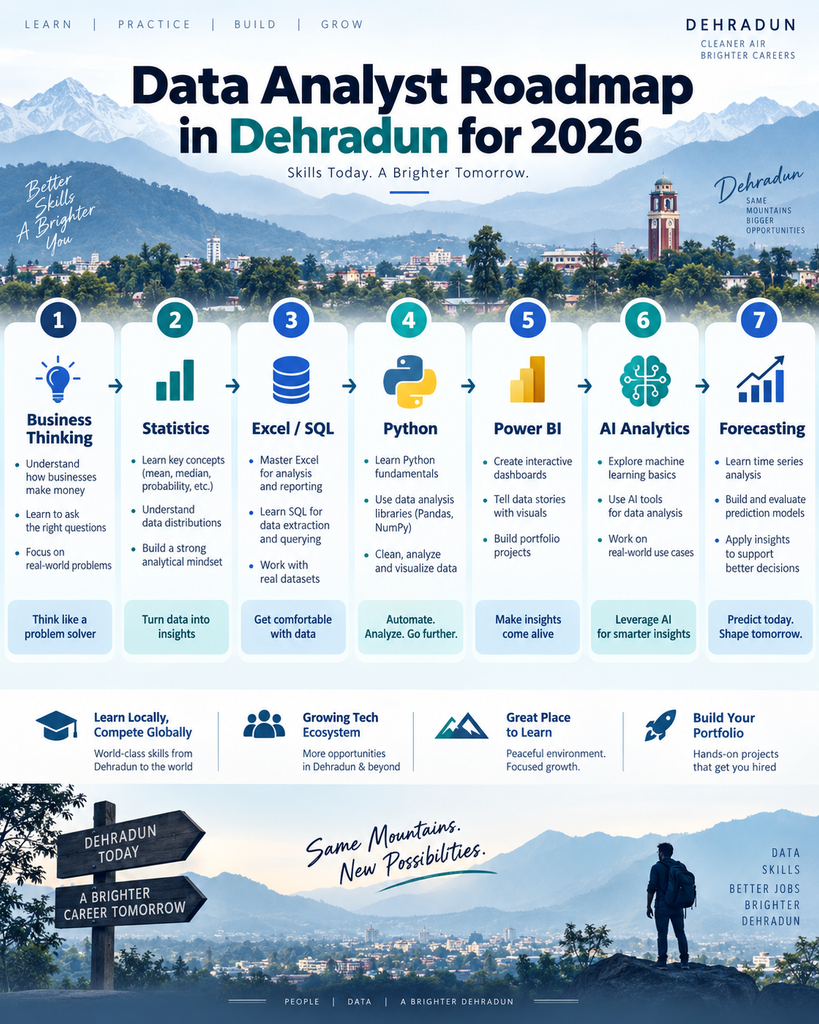
The order below matters. Most people learn the tools first and the business context never, which is why so many portfolios contain technically competent dashboards that answer a question nobody asked. Start with the thinking, then add the tools. This sequence also mirrors OneLeap’s Strategic Data Analyst with AI learning path.
Phase 1: Learn business thinking and KPIs
Before you open a spreadsheet, understand how the organisation makes money, who makes the decisions, and which numbers they watch. The hardest part of analysis is not the query it is working out what question is actually being asked.
- Business models, stakeholders, KPIs, funnels, revenue, retention, cost, and operational metrics
- Turning vague questions into measurable analysis objectives
- Writing a concise problem statement and defining the decision your analysis should support
Phase 2: Build statistical and analytical judgment
This is the layer that stops you from being confidently wrong. Correlation versus causation, sampling bias, variability, confidence intervals, data leakage: none of it is glamorous, and all of it is what lets you tell a real trend from noise or catch an AI-generated summary that has invented a pattern.
- Descriptive statistics and distributions
- Sampling bias, survivorship bias, and data-quality checks
- Statistical significance, confidence intervals, and practical significance
- Responsible interpretation of AI-generated insights
Phase 3: Master Excel and SQL
Excel and SQL are what you will be tested on. Excel handles cleaning, pivots, lookups and quick exploration. SQL is how you get data out of a real database, and it is the single most common technical screen for analyst roles in India. If you only have time to get good at one thing this year, make it SQL.
- Excel: cleaning, lookups, pivot tables, conditional logic, dashboard basics
- SQL fundamentals: SELECT, WHERE, JOIN, GROUP BY, subqueries
- SQL that gets you hired: CTEs, window functions, query optimisation
For a deeper SQL learning guide, read: Why SQL Is Still the Most Important Skill for a Data Analyst in 2026
Phase 4: Add Python for analysis
Bring in Python once analysis itself feels comfortable. It does not replace SQL — it is what you reach for when a spreadsheet has turned into a manual chore, or the dataset is too big to open, or you need the same analysis to run again next month without you.
- Pandas and NumPy: cleaning, reshaping, merging real datasets
- Exploratory analysis: distributions, outliers, missing data, visualisation
- Reproducible notebooks someone else can pick up and run
Phase 5: Build dashboards and tell the story
A dashboard is an argument, not a scoreboard. Learn Power BI or Tableau properly data modelling, filtering, drill-downs, visual hierarchy and then practise the harder part: saying what happened, why it happened, what it means, and what should change as a result.
- Data modelling: relationships, measures, calculated fields
- Design: visual hierarchy, colour discipline, filtering and drill-downs
- Narrative: one question per dashboard, one recommended action
Phase 6: Become AI-fluent for analytics
Learn to use AI on analytical work without handing your judgment to it. Prompt well for tables, summaries and report drafts, then check every output against the data. Once that habit is solid, look at knowledge systems that connect an assistant to your own documents and databases.
- Prompting for tabular data, summaries and report drafts
- Validating output and protecting sensitive or client data
- RAG and LangChain basics: connecting an assistant to your own documents
Phase 7: Learn forecasting and automation
Finish with the work that gets analysts promoted: predicting what happens next, and making the reporting run itself. A capstone that combines a forecast, automated KPI monitoring and AI-written summaries is the strongest single item you can put in a portfolio.
- Trend analysis, forecasting and anomaly detection
- No-code AutoML and automated KPI monitoring
- A capstone combining prediction, monitoring and AI-generated summaries
Skills required for data analyst jobs in Dehradun
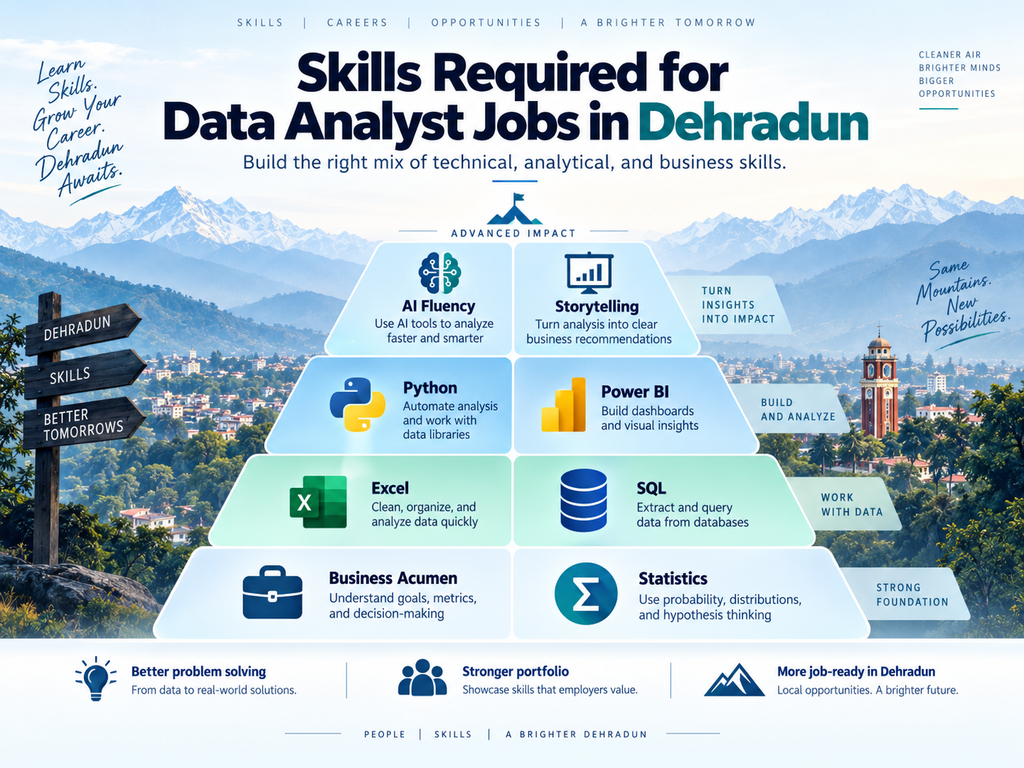
| Skill area | What to learn | Why it matters |
| Business acumen | KPIs, revenue, funnels, retention, operations, stakeholder needs | Analysis only creates value when it supports a real decision. |
| Excel / Sheets | Cleaning, formulas, lookup functions, pivot tables, dashboards | Common starting point for operational and business analysis. |
| SQL | SELECT, JOIN, GROUP BY, CTEs, window functions, query optimisation | Core skill for extracting and analysing business data. |
| Python | Pandas, NumPy, EDA, visualisation, automation | Supports repeatable analysis and larger or more complex datasets. |
| BI and visualisation | Power BI or Tableau, data modelling, dashboard design | Turns analysis into accessible insights for decision-makers. |
| Statistics | Sampling, bias, correlation, confidence intervals, experimentation | Prevents misleading conclusions and improves analytical judgment. |
| AI fluency | Prompts, AI-assisted workflows, responsible validation, RAG basics | Accelerates work while keeping the analyst accountable for accuracy. |
| Communication | Data storytelling, presentations, recommendations, documentation | Helps stakeholders understand what to do with an insight. |
Tools and technologies to learn
| Category | Examples | Practical use |
| Spreadsheets | Microsoft Excel, Google Sheets | Data cleaning, quick analysis, pivots, simple dashboards |
| Databases and queries | MySQL, PostgreSQL, SQL Server | Extracting, joining, aggregating, and analysing structured data |
| Programming | Python, Pandas, NumPy, Jupyter | Exploration, data transformation, automation, reproducible analysis |
| Visualisation | Power BI, Tableau, Matplotlib, Seaborn | Dashboards, reports, and business storytelling |
| Collaboration | GitHub, documentation tools, presentation software | Versioning work, sharing portfolios, explaining decisions |
| AI-assisted analytics | LLM assistants, Power BI Copilot concepts, RAG/LangChain fundamentals | Summaries, report support, knowledge retrieval, workflow acceleration |
| Predictive and automation tools | AutoML, workflow automation, KPI monitoring tools | Forecasting, anomaly detection, repeatable reporting |
Data analyst salary in Dehradun and India
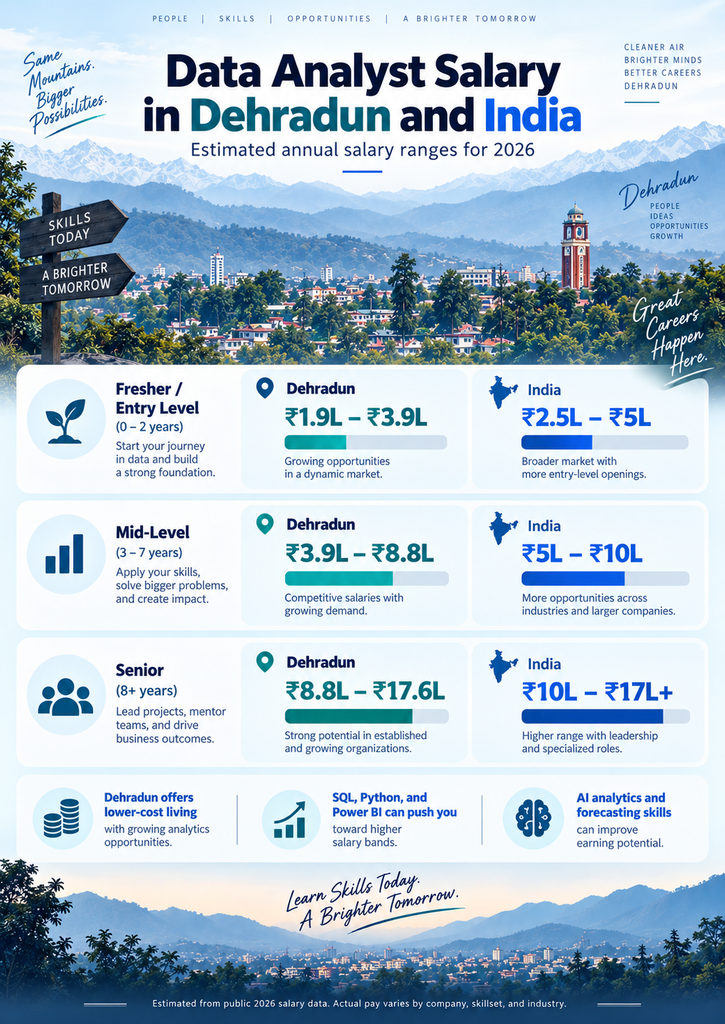
What you earn as an analyst depends on experience, employer type, industry, technical depth and how well you present your work. Location still matters, but less than it did remote hiring has partly decoupled pay from postcode. Treat the figures below as planning benchmarks, not offers.
| Experience level | Dehradun / Uttarakhand | India-wide range |
| Fresher / 0–2 years | Around ₹3–4.5 LPA. Indeed estimates roughly ₹4 LPA for the city | ₹3–6 LPA |
| Mid-level / 3–5 years | Roughly ₹5–9 LPA locally or hybrid; remote roles go higher (estimated) | ₹6–12 LPA |
| Senior / 5+ years | Roughly ₹9–15 LPA (estimated); remote and product roles exceed this | ₹12–20 LPA, reaching ₹25–30 LPA at lead level |
Figure: Data analyst salary benchmarks for 2026. India-wide figures compiled from Glassdoor, Indeed, GUVI and GrowAI (see Sources and references). The Dehradun fresher figure is Indeed’s city estimate; the mid and senior Dehradun bands are estimates derived by applying a typical tier-2 discount to national ranges, because no reliable city-level data exists at those levels.
Be more sceptical of Dehradun figures than national ones. Glassdoor’s Dehradun page, for instance, is built on three submitted salaries and returns an average that is obviously wrong. Indeed’s estimate of roughly ₹4 LPA is the most credible local number available, and it matches what junior MIS and reporting roles in the city actually pay. Local training providers quote ₹3.5–6 LPA for freshers, which is consistent once you account for the stronger candidates who land remote offers.
What actually moves you up a band
- SQL depth: the gap between basic SELECT statements and confident window functions shows up directly in offers.
- Owning a dashboard: not building one owning it, including the metric definitions, the refresh and the questions it is meant to answer.
- Domain knowledge: two years inside retail, finance or healthcare analytics is worth more than two more tools on your CV.
- Automation: turning a recurring manual report into a pipeline is the clearest business case you can make at a review.
- Remote scope: for anyone based in Dehradun this is the single biggest lever, and it costs nothing but portfolio work.
- Communication: the analyst who presents to leadership gets promoted ahead of the one who only sends the file.
The practical move for someone in Dehradun: take a local role if it is the fastest route to real data and real stakeholders, but build the portfolio that lets you apply nationally within a year. Local experience plus a portfolio that travels beats waiting for the perfect local opening.
Companies and job opportunities in Dehradun
Stop searching for “Data Analyst”. In a city the size of Dehradun that one query returns almost nothing, while the same work sits advertised under half a dozen other titles: MIS Executive, Reporting Analyst, Business Analyst, Operations Analyst, Marketing Analyst, Data Associate, Analytics Intern, Junior BI Developer.
| Employer category | Typical analytics work | Search terms to use |
| IT services and software firms | Client reporting, product analytics, databases, dashboards, operations | Data Analyst, SQL Analyst, BI Developer, MIS Executive |
| Startups and SaaS companies | Funnel analysis, customer behaviour, growth metrics, automated reporting | Product Analyst, Growth Analyst, Business Analyst |
| Operations and retail teams | Inventory, forecasting, process performance, demand and cost analysis | Operations Analyst, Supply Chain Analyst, Reporting Analyst |
| Marketing and digital agencies | Campaign ROI, attribution, leads, conversion funnels, audience analysis | Marketing Analyst, Web Analyst, Performance Analyst |
| Education, healthcare and services | Student/patient/service operations, dashboards, reporting and planning | Data Coordinator, Reporting Analyst, Business Analyst |
| Remote companies | Product, finance, e-commerce, consulting, research and data operations | Remote Data Analyst, Analytics Associate, Junior BI Analyst |
Set alerts on LinkedIn, Indeed and Naukri for every title in that last column, check company career pages directly rather than waiting for aggregators, and put your portfolio link in the header of your resume instead of the footer. Dehradun listings turn over quickly, so a short weekly check works better than an occasional long session.
Career path and future growth
Analytics branches early, and where you go depends on which part of the work you actually enjoy the business conversation, the dashboard craft, the product questions, or the modelling. One pattern holds across all of them: technical skill gets you the first job, domain knowledge and influence get you everything after that.
| Starting role | Potential next step | Longer-term direction |
| Data Analyst | Senior Data Analyst | Analytics Lead, Analytics Manager, Analytics Consultant |
| Reporting / MIS Analyst | BI Analyst or BI Developer | BI Lead, Data Visualisation Specialist, Analytics Architect |
| Business Analyst | Product Analyst or Strategy Analyst | Product Manager, Analytics Manager, Strategy Consultant |
| Marketing Analyst | Growth Analyst or Customer Insights Analyst | Growth Lead, CRM/Marketing Analytics Manager |
| Operations Analyst | Supply Chain or Process Analyst | Operations Excellence Lead, Business Operations Manager |
| Data Analyst with Python/ML exposure | Junior Data Scientist or Analytics Engineer | Data Scientist, Analytics Engineer, AI-powered Analytics Specialist |
For more career directions, see: 10 High-Growth Career Opportunities for Data Analysts in 2026 and Beyond
How to choose the best data analyst course in Dehradun
The best data analyst course in Dehradun is not the one with the longest tool list on the brochure. Tools are the easy part, and they change. What you are actually paying for is business judgment, honest feedback on your work, and evidence you can put in front of an employer. A few things worth checking before you enrol in any data analysis course in Dehradun:
- Check whether the course starts with business problems, KPIs, and analytical thinking not tools in isolation.
- Look for a complete practical stack: Excel, SQL, Python, Power BI, statistics, data storytelling, and responsible AI use.
- Prioritise real-world datasets and projects over only theory, quizzes, or sanitised classroom exercises.
- Look for feedback, live sessions, mentorship, code/dashboard reviews, and clear portfolio guidance.
- Check instructor experience and whether the curriculum reflects real workplace workflows.
- Ask about career support: resume positioning, LinkedIn optimisation, mock interviews, portfolio coaching, and hiring access.
- Confirm that prerequisites match your background; a beginner-friendly programme should not require prior coding experience.
OneLeap Strategic Data Analyst with AI
OneLeap’s Strategic Data Analyst with AI is built around that idea: business thinking first, tools in service of it. The programme runs six months on weekends, with 70+ hours of live teaching across seven modules, seven real-world projects, weekly one-to-one open-office sessions, hands-on labs, merit-based certification and career support.
The curriculum moves from strategic mindset and business acumen into statistical thinking, then AI fluency and prompt engineering, AI-assisted analysis with Excel, SQL and Python, visual intelligence with Power BI, AI knowledge systems and RAG basics, and finally predictive analytics and automation. It is aimed at aspiring analysts, business professionals, Excel users moving into SQL and Python, and career switchers. No coding experience is required; basic Excel familiarity helps.
You finish with seven portfolio pieces: a business KPI dashboard, a sales performance analysis, a customer segmentation model, an AI-powered report generator, a company-data Q&A system, a revenue forecasting model, and an end-to-end capstone that combines prediction, automated KPI monitoring and AI-generated summaries.
Explore the curriculum, roadmap and eligibility criteria: OneLeap Strategic Data Analyst with AI programme
Best practices for becoming job-ready
- Build projects around decisions: every dashboard or notebook should answer a business question and recommend a next action.
- Keep a portfolio with clean documentation, data sources, methodology, screenshots, findings, and limitations.
- Practice SQL daily: query writing improves through repetition and is central to many analyst interviews.
- Use AI as an assistant, not an authority: validate calculations, sources, assumptions, and conclusions.
- Learn one BI tool deeply before jumping between tools; Power BI or Tableau is enough to start.
- Develop domain knowledge in one or two areas such as marketing, retail, finance, SaaS, operations, or HR.
- Present your work: explain insights in plain language, quantify impact where possible, and state what action the business should take.
Common mistakes to avoid
| Mistake | Why it costs you |
| Learning tools in isolation | Excel, SQL, Python and Power BI learned separately, with no business decision attached, produces someone who can operate software but cannot answer a question. |
| Dashboards with no narrative | Twenty charts and no priority tells a manager nothing. A dashboard that does not point at an action is decoration. |
| Ignoring data quality | Missing values, duplicates, bias and inconsistent metric definitions will quietly invalidate an analysis that otherwise looks clean. |
| Treating correlation as causation | Presenting a weak pattern as fact is the fastest way to lose the trust of the people you are advising, and it rarely survives a second look. |
| Copying portfolio projects | Interviewers ask why you chose that join, that metric, that chart. A copied project falls apart in the second follow-up question. |
| Trusting AI output unchecked | AI-generated SQL, formulas and summaries are frequently plausible and wrong. You own the conclusion, not the tool. |
| Waiting for a perfect portfolio | The portfolio improves fastest once you are being interviewed and rejected. Applying early is part of the learning, not a reward for finishing it. |
Frequently asked questions
Are there data analyst jobs in Dehradun?
Yes, though not in large numbers and rarely under that exact title. Local openings show up as analytics intern, reporting analyst, MIS executive, business analyst and operations analyst. Because availability shifts week to week, apply for hybrid and remote analyst roles in parallel while you build local connections.
What skills are required for data analyst jobs in Dehradun?
The core skills are Excel, SQL, Power BI or Tableau, Python, statistics, data cleaning, business acumen, and communication. AI fluency is also becoming valuable for faster reporting, analysis support, automation, and responsible insight generation.
What is the data analyst salary in Dehradun?
Indeed estimates roughly ₹4 LPA on average for a data analyst in Dehradun, and junior MIS, reporting and analytics roles in the city generally fall between ₹3 and ₹4.5 LPA. Experienced analysts go well beyond that, but the fastest route past local bands is usually a remote or product-company role rather than a promotion inside a small local team. Treat city-level figures cautiously: the published samples for Dehradun are very small.
Can I become a data analyst without coding experience?
Yes. You can start with Excel, business metrics, and SQL before moving into Python. A beginner-friendly roadmap should build skills progressively, though consistent practice is essential.
Which tool should I learn first: Excel, SQL, Python or Power BI?
Start with Excel and basic business metrics, then learn SQL. Add Power BI or Tableau for dashboards and Python for more advanced, repeatable analysis. The best order depends on your current experience, but SQL should be a priority for most job seekers.
How long does it take to become job-ready as a data analyst?
It depends on where you are starting and how many hours a week you can hold to. A structured six-month path with consistent project work builds a solid foundation, but readiness is decided by what you can demonstrate, not by elapsed time portfolio depth, interview practice, and how consistently you apply.
What should I look for in a data analyst course in Dehradun?
Look for a programme that teaches business thinking, statistics, Excel, SQL, Python, Power BI, AI-assisted analysis, real-world projects, live feedback, mentorship, and career support. Avoid courses that teach tools without context or do not help you build a portfolio.
What career growth can I expect after becoming a data analyst?
You can grow into senior analytics, BI, product analytics, operations analytics, marketing analytics, analytics consulting, data science, analytics engineering, or management roles. Growth is strongest when you combine analytical depth with business expertise and clear communication.
Final thoughts
Data analyst jobs in Dehradun are within reach for students, freshers, business professionals and career switchers but not on the strength of certificates. Build the business thinking first, get properly good at SQL, learn one BI tool deeply, add Python and AI-assisted workflows, and put three real projects behind you. Then apply on both tracks: locally for the network and the experience, remotely for the pay.
If you want a structured, job-focused roadmap that covers business acumen, Excel, SQL, Python, Power BI, AI-powered workflows, RAG basics, forecasting, and portfolio projects, explore OneLeap’s Strategic Data Analyst with AI programme.

Leave a Reply