

Yes, and the sequence is the same anywhere: Python and software foundations, then data and APIs, then machine learning, then LLM applications, RAG, agents, evaluation and deployment. What is different here is not the learning. It is the decisions around it whether to take the campus placement, whether to stay or move, and how to get production experience in a state with very few titled AI roles.
This article is about those decisions. For the national roadmap and the universal parts of the journey, there is better material elsewhere; this is the version written for someone graduating in Dehradun, Roorkee, Pantnagar or Srinagar who is trying to work out what to do in the next twelve months.
Key takeaways
- Titled AI engineering roles inside Uttarakhand are scarce. Plan for remote or metro employment, at least for the first few years.
- The campus placement decision is the real fork. A service-company offer is not a dead end if you use it deliberately.
- Your college shapes your starting point more than your state does. An IIT Roorkee graduate and a UTU-affiliated graduate have different problems, not different sequences.
- Non-CS graduates should budget a quarter on Python, data structures and Git before enrolling anywhere.
- Uttarakhand has genuinely distinctive project data pilgrimage tourism, disaster and weather, forest, hydropower that nobody else is building portfolios from.
- A deployed project with a readable repository removes most of the location disadvantage, because remote employers assess evidence rather than addresses.
Table of contents
- The honest picture: what this state offers
- Where you are starting from
- The campus placement decision
- Three routes from here
- What to learn, and in what order
- Projects only an Uttarakhand graduate can build
- Where the local ecosystem actually is
- What the money looks like, honestly
- Frequently asked questions
The honest picture: what this state offers
Start with the part most articles skip. If you search for AI engineering jobs in Uttarakhand you will find almost nothing, and that is an accurate result rather than a search problem. The state does not have an AI employer base. It has IT services work, a startup and product layer around Dehradun’s IT Park and STPI, and a large number of non-technology employers who are beginning to need analytics and automation.
That reality shapes everything. It means your first AI engineering job will almost certainly be remote or outside the state, which in turn means your portfolio has to be assessable by someone who will never meet you. It also means the local opportunities worth taking are the ones that pay you to build relevant skills, even when the title says something else.
What the state does give you is cheaper time. Living costs here are a fraction of Bengaluru’s, which means six months of focused building is financially survivable in a way it is not in a metro. That is a real advantage and most graduates waste it by treating relocation as the only move.
Where you are starting from
Your institution matters more than your city, mostly because of what it does and does not give you by default.
| If you graduated from | What you already have | What to work on first |
|---|---|---|
| IIT Roorkee or NIT Uttarakhand | A national placement pipeline, strong fundamentals, a recognised brand | Deciding whether to go into software engineering first and move towards AI from inside a strong team, which is usually faster than applying to AI roles as a fresher |
| GB Pant Pantnagar, BTKIT Dwarahat, THDC Tehri | Solid government-college fundamentals, often better than private equivalents | Reach. The teaching holds up; the placement network is narrower, so your portfolio and applications have to do more work |
| UPES, Graphic Era, DIT University | An active placement cell, campus recruiters, Dehradun’s ecosystem on your doorstep | Looking past the service-company pipeline the placement cell will route you into by default |
| Quantum, COER, Tula’s, Dev Bhoomi, UTU-affiliated colleges | A degree and whatever you built yourself | Everything the college did not give you which, done deliberately, is a stronger story than a placement you drifted into |
| A non-CS branch anywhere | Engineering discipline and often a domain nobody in AI understands | A full quarter on Python, data structures and Git before anything AI-specific |
The last row deserves emphasis. A mechanical graduate who understands manufacturing processes and can also write Python is rarer and more valuable than another CS graduate with the same bootcamp projects. Your branch is an asset if you aim your projects at it.
The campus placement decision
This is the decision that actually matters in your final semester, and almost nothing written about AI careers addresses it. Most Uttarakhand colleges place into IT services companies, often into support, testing or maintenance roles, at packages well below what the AI articles promise. You have an offer in hand and six months to decide what it means.
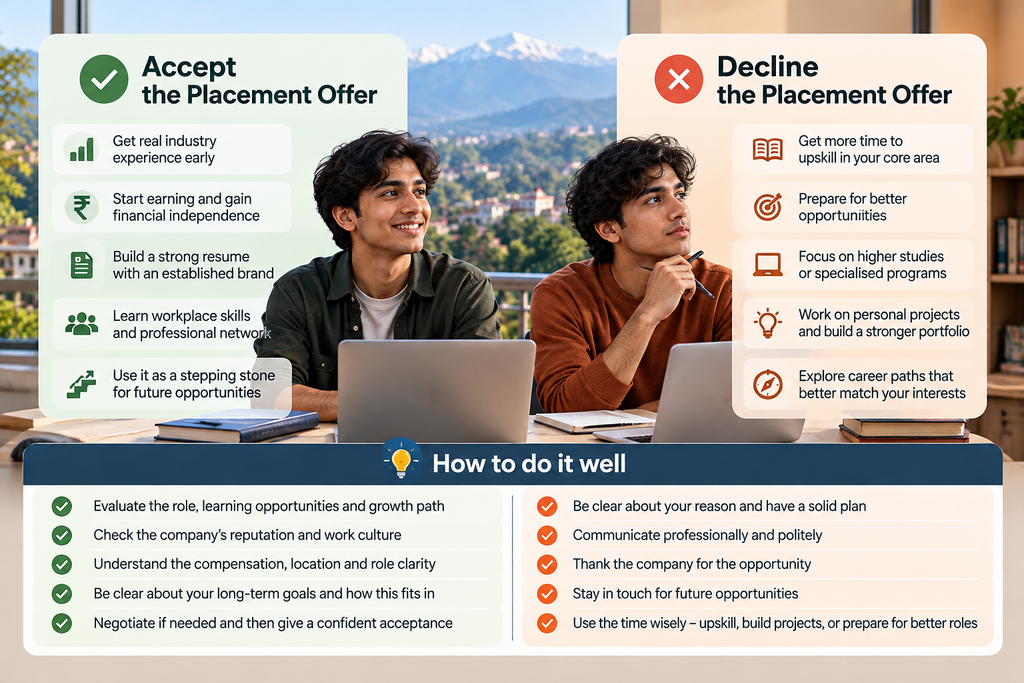
There is no universally correct answer, but there is a wrong way to decide, which is to treat the offer as either a trap or a rescue.
| Take the offer | Decline and build | |
|---|---|---|
| Makes sense when | It is your only offer, you have no financial runway, or your family needs the income to start now | You have six months of runway and the discipline to use them without a structure imposing one |
| The real risk | Drifting. Three years in maintenance work with no portfolio is a harder position than you are in today | Running out of money at month five with half a portfolio and no income |
| How to do it well | Treat it as paid runway. Volunteer for anything involving data, automation or internal tools. Keep building evenings and weekends. Set a date to reassess. | Enrol in something with fixed sessions and deadlines. Self-direction fails more often than it succeeds, and the failure is slow enough to be invisible. |
| The move after | Internal transfer into a data or AI team, or an external move at 18 to 24 months with real work experience behind you | A first role on the strength of the portfolio, often remote, usually three to nine months after you finish building |
The internal-transfer route is underrated. Service companies have analytics, automation and increasingly AI practices, and they move people into them from inside far more readily than they hire freshers into them from outside. Taking the offer and engineering a transfer within two years is a legitimate plan, not a consolation.
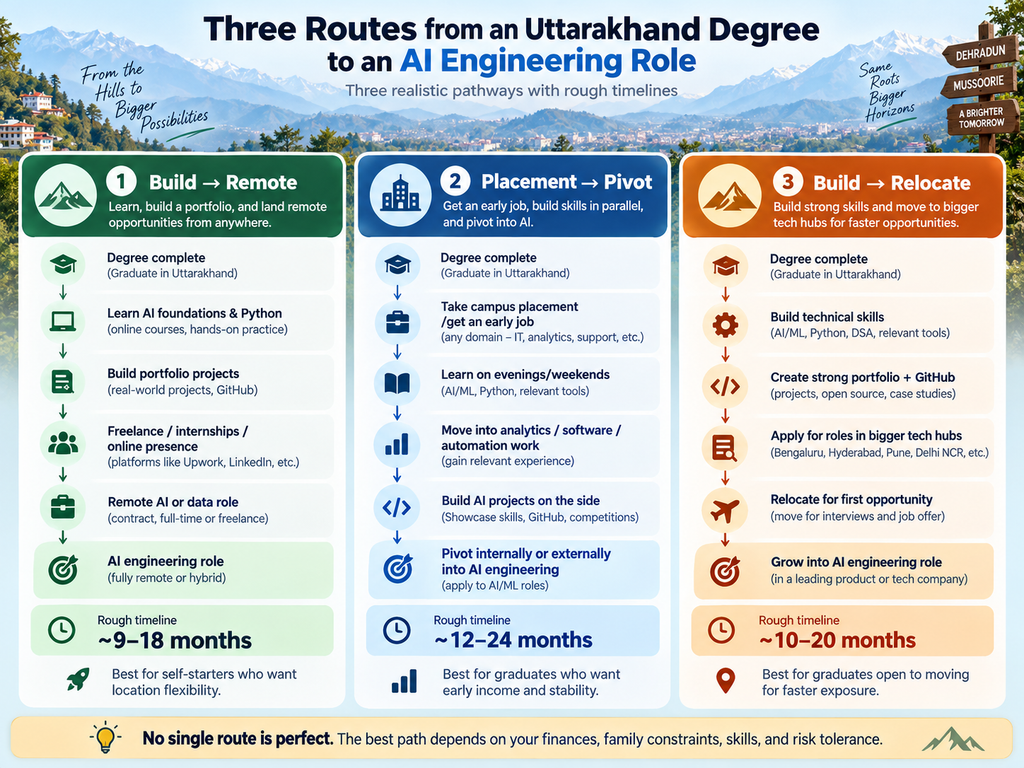
Three routes from here
| Route | What it looks like | Suits you if |
|---|---|---|
| Build first, then apply remotely | Six to twelve months of focused learning and projects from home, then applications to remote-first employers across India | You have runway, discipline, and work that can be judged online |
| Placement first, pivot inside | Take the campus offer, volunteer for data and automation work, build in parallel, move internally or externally at 18 to 24 months | You need income now, or the offer is at a company with analytics and AI practices worth transferring into |
| Build here, move later with leverage | Two to three years of remote or local experience, then relocate to a metro as an experienced engineer rather than a fresher | You want metro compensation eventually but not the fresher version of it |
All three beat the default, which is to graduate, apply to AI Engineer roles with a degree and no portfolio, collect rejections for a year, and conclude the problem was the state.
What to learn, and in what order
The learning sequence is not local and there is no Uttarakhand version of it. Briefly: Python and software fundamentals, then Git, APIs and databases, then machine learning and transformers, then LLM applications, RAG, agents, and finally evaluation, safety and deployment. Build something at every stage rather than collecting tutorials.
Two things worth checking before you spend money. First, whether you are over the entry bar at all: what to learn first sets out the real prerequisites for any serious AI engineering programme, with a readiness self-check and a twelve-week preparation path for people below it. Non-CS graduates should assume they need that quarter.
Second, what you will build: the AI engineering portfolio ladder maps fourteen projects to the stages of a full curriculum, from a transformer written from scratch to a deployed system. You do not need all fourteen; three or four covering different competencies is the target.
If you are not certain AI engineering is the right path at all rather than analytics or no-code automation, the four routes are compared here.
Projects only an Uttarakhand graduate can build
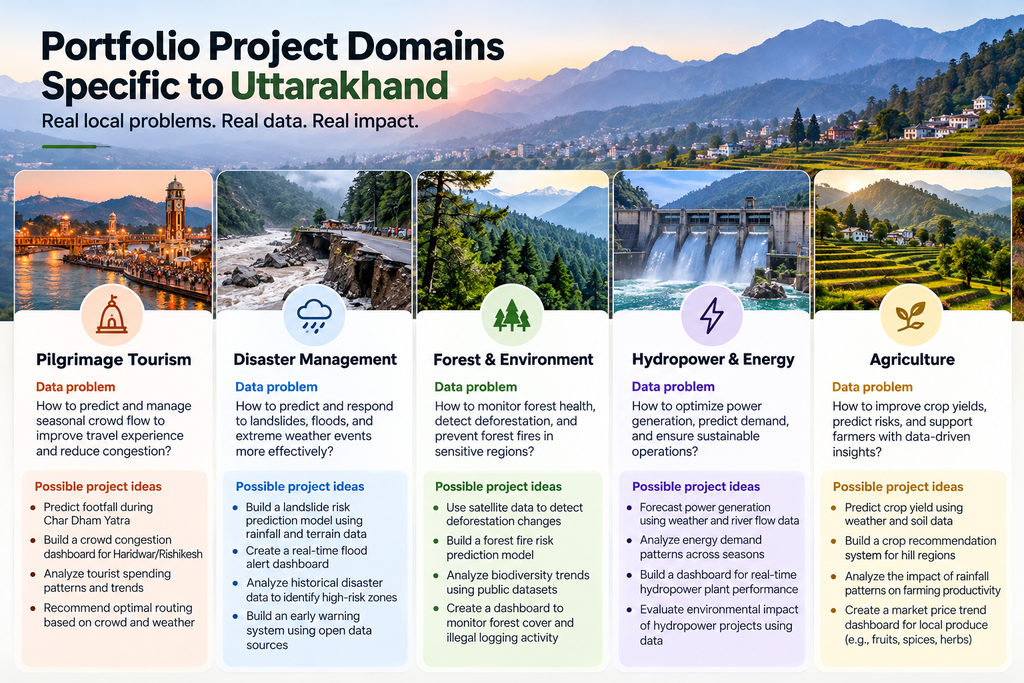
Here is the part where being from Uttarakhand is an advantage rather than a handicap. Every fresher portfolio in India is built on the same public datasets. This state has problems that are genuinely distinctive, locally understood, and almost entirely unexploited for portfolio work.
| Domain | The project | Why it stands out |
|---|---|---|
| Pilgrimage and tourism | Forecast Char Dham or seasonal visitor flow, model capacity against registration data, flag anomalous surges | Extreme seasonality, real public interest, and a forecasting problem with obvious operational consequences |
| Disaster and weather | Early-warning or risk-scoring prototype from rainfall, landslide and terrain data | Hard, meaningful, and an interviewer will remember it. Be careful to frame it as a prototype, not a safety system |
| Forest and environment | Fire-risk prediction or forest-cover change detection from satellite imagery | Combines vision work with a public-good problem; strong material for a multimodal project |
| Hydropower and energy | Generation forecasting or maintenance anomaly detection from operational time series | A serious industrial domain with a large employer base in the state |
| Agriculture and horticulture | Yield or price forecasting for hill crops, or a crop-advisory assistant grounded in extension documents | Pairs naturally with a RAG project and GB Pant’s research output |
| Local business operations | Dashboards, automation or document extraction for a Dehradun or Haridwar business you can actually visit | Real messy data and a stakeholder who will tell you whether it is useful |
Data sources to start from: the national open data portal at data.gov.in carries state-level tourism, forest and agricultural datasets; India Meteorological Department data covers weather; and there are Uttarakhand tourism-flow datasets on Kaggle. For anything involving disaster or safety, state the limitations prominently and never present a student prototype as operational.
For project briefs with evaluation methods, see AI Portfolio Projects for 2026. The point of the table above is the domain, not the technique the technique you can learn anywhere.
Where the local ecosystem actually is
The state’s technology activity concentrates in a few places, and knowing where they are is worth more than another job-board search.
- Dehradun IT Park on Sahastradhara Road, which hosts STPI Dehradun along with IT services firms and startups. STPI has operated here since 2001 and provides incubation, co-location and data communication services, which makes it the closest thing the state has to a startup cluster.
- IIT Roorkee’s orbit. Workshops, conferences, hackathons and research groups, open to more people than most assume. For anyone in Haridwar or Roorkee this is the single best networking asset in the state.
- The Dehradun universities. UPES, Graphic Era and DIT run tech events and have active student communities. If you are still studying, these are free; if you have graduated, most are still open to you.
- Non-technology employers with data problems. Hospitals, hotel groups, manufacturers and education institutions across the state are where analytics and automation work actually exists, usually under titles like MIS Executive or Operations Analyst.
If you are in Haridwar or Rishikesh specifically, this covers the local market and the Dehradun commute in detail both cities are within about an hour of Dehradun, which makes weekend study a journey rather than a move.
What the money looks like, honestly
Indicative India-wide fresher ranges for AI and ML engineering roles run roughly ₹5–9 LPA with Python, ML foundations and deployed projects, rising to around ₹6–12 LPA with LLM applications, RAG, agents and evaluation. Those are market ranges based on commonly reported 2026 figures, not guaranteed outcomes of any course.
Two local adjustments matter. Employers based in Uttarakhand generally pay below those national figures, and campus placement packages at most colleges in the state sit well below them. Remote roles with national or global companies follow the employer’s own bands, which is the clearest financial argument for building work that can be assessed from anywhere.
The analytics and AI paths are compared in more detail here, including what each demands before you start. Treat all published figures as planning ranges and check current data before you make decisions on them.
Frequently asked questions
Can I become an AI engineer without leaving Uttarakhand?
You can become one. Whether you can stay here long-term depends on finding a remote role, because titled AI engineering jobs inside the state are scarce. The realistic plan is to build here, work remotely or at a metro employer for two or three years, and then decide whether to come back with leverage.
Should I take the campus placement offer or skip it?
Take it if it is your only offer and you have no financial cushion; a service-company job pays you while you build, and internal mobility into data or AI teams is a genuine route. Skip it only if you have six months of runway and the discipline to use them. Refusing an offer to study is a real strategy, not a romantic one, and it fails when the runway runs out.
Does an IIT Roorkee degree change the plan?
It changes the starting point, not the sequence. The national pipeline is already open to you, so the question is whether to go into software engineering first and move towards AI from inside a strong team, which is often the faster route to production experience than applying to AI roles directly as a fresher.
I am from a non-CS branch. Is it too late?
No, but your first three months look different. Mechanical, civil and electronics graduates typically need Python, data structures and Git before any AI course will take them. Budget a quarter for that, and do it before you spend money on a programme.
Are there AI jobs in Dehradun?
Few under that title. There is IT services work, startup and product work around the IT Park and STPI, and a growing amount of analytics and automation work inside non-tech employers. Search for Python Developer, Software Engineer, Data Analyst and Automation roles rather than AI Engineer, and treat remote applications as the main channel.
Is a remote job realistic for a fresher from here?
Harder than for an experienced engineer but not unrealistic, and it depends almost entirely on whether your work can be assessed without meeting you. A deployed project with a readable repository and a short walkthrough does more than any amount of location-based disadvantage.
How long will this take?
From a CS degree with real programming: roughly ten to thirteen months to job-ready at 15 to 20 hours a week, including preparation. From a non-CS degree: add a quarter. Add one to three months of applying on top of either.
Should I do a Master’s instead?
Only if you want research. For engineering roles, two years of a taught Master’s generally produces less hiring leverage than one year of building and deploying systems while employed. The exception is if you want to move abroad, where the degree carries visa weight that a portfolio does not.
Where OneLeap fits
AI Engineering Mastery runs ten months of weekend classes with 100+ hours of live teaching, fourteen modules and nine production-grade projects plus a capstone, with weekly one-to-one sessions throughout. It assumes intermediate Python, data structures, APIs, databases and Git on day one, and admission includes a qualification interview, so arrive prepared rather than hoping to catch up.
Both online and offline cohorts run, which is what makes it workable from across the state. If AI engineering turns out not to be your path, Strategic Data Analyst with AI and AI For Product Managers require no coding experience at all.
Final thoughts
The disadvantage of graduating in Uttarakhand is real but narrower than it feels. You are not short of learning material, and you are not short of time living cheaply here buys you months that a Bengaluru graduate cannot afford. What you are short of is local employers who will hire you into the role you want, which is a reason to build work that travels rather than a reason to despair.
Decide about the placement offer deliberately. Pick one of the three routes. Build projects aimed at problems this state actually has. Make the work visible to people who will never meet you. Relocation stays available later, on better terms than it is on now.
Browse OneLeap’s programmes: theoneleap.com/programmes

Leave a Reply