
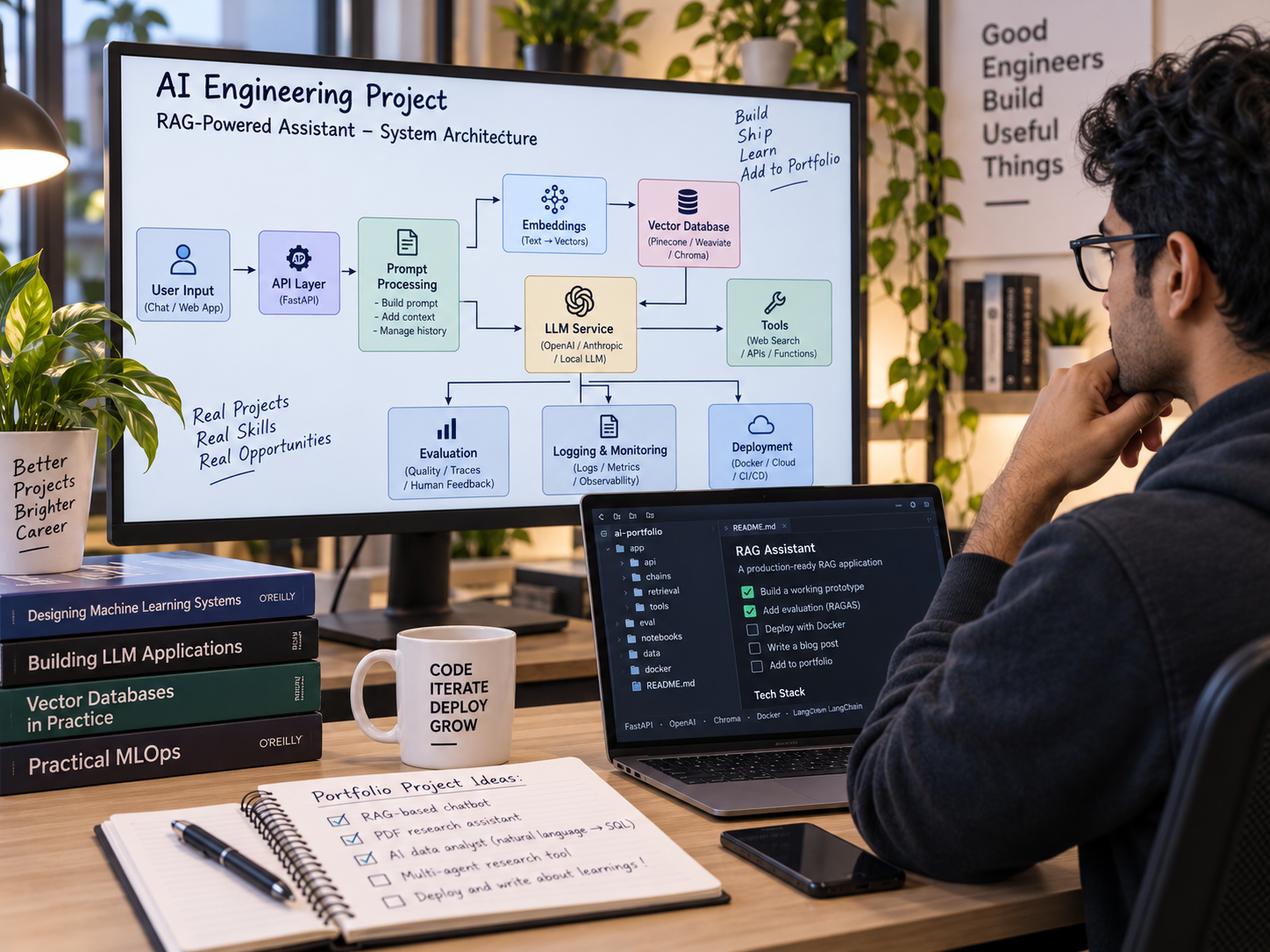
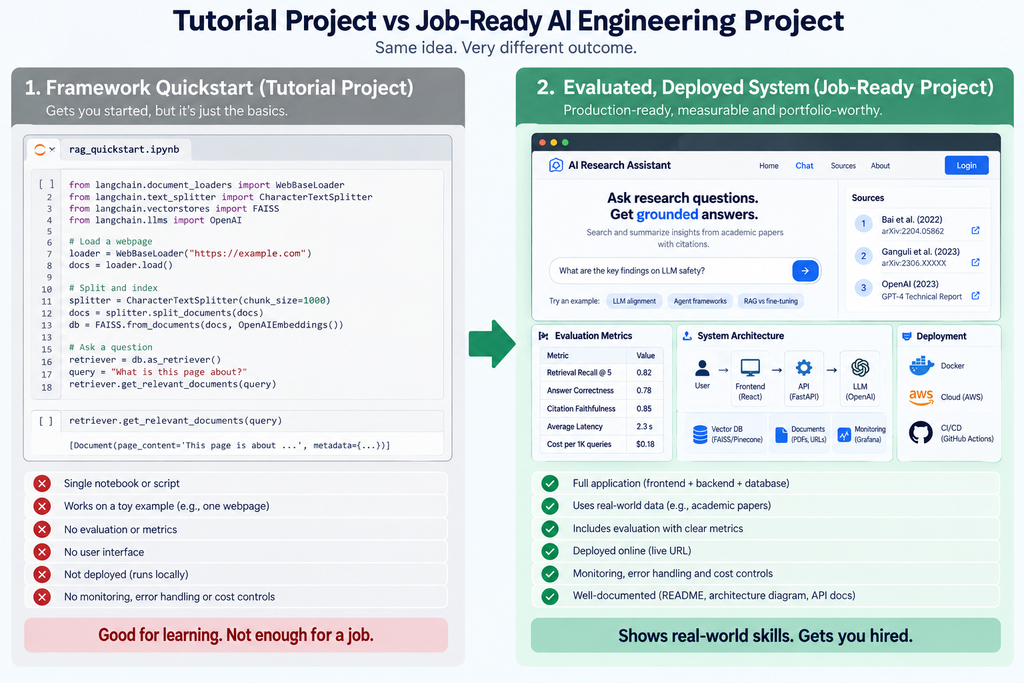
A job-ready AI engineering portfolio contains three to five finished projects that together cover six competencies: retrieval, agents, evaluation, deployment, operations, and one specialisation. Each needs a real user, realistic data, an architecture you can defend, published metrics, and a working demo or walkthrough. What it should not be is a folder of notebooks or a chatbot built from a framework quickstart.
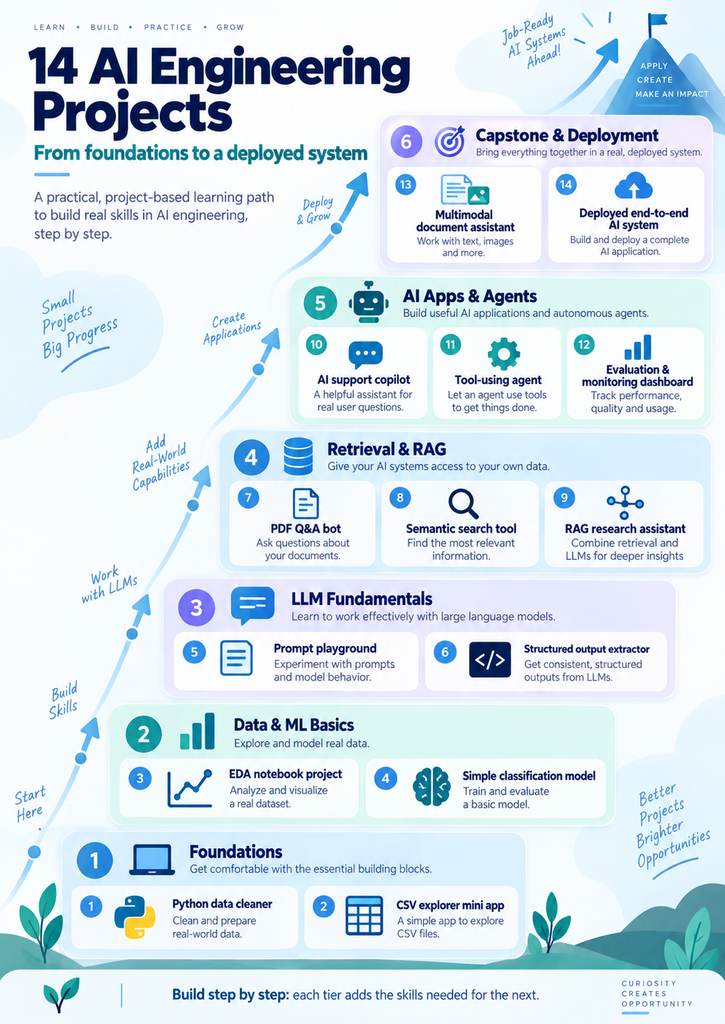
This article lays out fourteen projects arranged as a ladder, one for each stage of a full AI engineering curriculum, from a transformer written from first principles to a deployed system combining retrieval, agents and visual AI. You are not meant to build all fourteen. The ladder shows what each rung proves, so you can choose the three or four that cover the most ground for the roles you want.
Key takeaways
- Three to five finished projects beat ten started ones, but they must cover different competencies rather than being variations on one idea.
- Cover retrieval, agents, evaluation, deployment, operations, and one specialisation. That spread is what a reviewer is scanning for.
- Publish cost and latency alongside quality. A project reporting only accuracy reads as unfinished.
- Include the comparison where your approach lost. A benchmark against a simple baseline is stronger evidence than a benchmark you win.
- Visual AI, deployment optimisation, and a transformer written from scratch are the three areas most portfolios miss, and therefore the three that differentiate.
- Every project needs a limitations section. Hiding failures is what reviewers notice.
Table of contents
- What hiring managers actually look for
- The six competencies a portfolio must cover
- 14 projects, from foundations to a shipped system
- How many of these you actually need
- The evaluation and production checklist
- How to present the work
- How OneLeap’s curriculum maps to this ladder
- Mistakes that sink an AI engineering portfolio
- Frequently asked questions
What hiring managers actually look for
Reviewers spend a few minutes on a portfolio before deciding whether to read properly. They are looking for six things, and most portfolios answer two of them.
| The question in a reviewer’s head | What answers it |
|---|---|
| Can you solve a real problem? | A named user, business context, requirements, and a stated success criterion |
| Can you build end to end? | Ingestion, the AI component, a backend, an interface, delivery, and error handling |
| Can you tell whether it works? | A golden test set, quality and retrieval metrics, latency, cost, and failure analysis |
| Can you operate it? | Deployment, logging, monitoring, alerts, retries, access control, and a rollback path |
| Do you understand trade-offs? | Written reasoning on model, architecture, retrieval, prompt, cost and latency decisions |
| Can you explain it? | A README, an architecture diagram, a short demo video, and plain-language framing |
The six competencies a portfolio must cover
Think in competencies rather than project count. A portfolio of five retrieval systems covers one competency five times; three well-chosen projects can cover five.
| Competency | Covered by | What it proves |
|---|---|---|
| Retrieval | Production RAG system (project 4) | You can ground outputs in trusted data and measure the grounding |
| Agents and orchestration | Agent versus pipeline (6), frameworks (7), multi-agent (8) | You can handle tools, state, approvals, retries and recovery |
| Evaluation | Prompt evaluation framework (2), and the metrics inside every other project | You can measure quality, catch regressions, and compare options |
| Deployment | Full-stack application (3), deployment pipeline (10) | You can wrap AI in a product and operate it under real traffic |
| Operations and safety | Safety and observability layer (9) | You understand latency, spend, errors, attacks and system health |
| Specialisation | Fine-tuning (5), visual AI (11–13) | You can go deep in one area and explain the trade-offs |
14 projects, from foundations to a shipped system
Each project below maps to one stage of a full AI engineering curriculum. They are ordered deliberately: every tier assumes the one before it. Build in order and each project gets easier; build out of order and the advanced ones become copy-paste exercises.
This list is engineering-specific. If you want project ideas across a wider set of AI roles, including automation, analytics and product, see AI Portfolio Projects for 2026.
Foundations (projects 1–3)
These three prove you understand what you are building on. Skipping them is what produces engineers who can call an API but cannot explain why an output is wrong.
1. A transformer written from scratch
Implement a working transformer from first principles: attention, positional encoding, the training loop, the lot. Train it on a small corpus until it produces recognisable text. This is the one project that separates someone who understands the architecture from someone who uses it, and almost no fresher portfolio has it.
- What it proves: You understand attention, embeddings, and training dynamics rather than treating the model as a black box
- Data to use: TinyShakespeare for a character-level model, or a WikiText-103 subset for tokens. Small and public on purpose; the point is the implementation, not the scale.
- Evidence to publish: Training and validation loss curves, attention-head visualisations, and an ablation: remove positional encoding, show exactly what breaks and explain why
2. A prompt evaluation and versioning framework
Build the harness that stores prompts, runs them against a test set, scores outputs against a rubric, tracks versions, and flags regressions before release. Then use it to answer the question the module is really about: for one specific task, is prompting or fine-tuning the right call?
- What it proves: You treat prompts as versioned artefacts with measurable quality, not as text you tweak until it looks fine
- Data to use: A golden set of 80–150 cases you write yourself for one narrow task, with known-correct answers. Building it is part of the skill.
- Evidence to publish: A regression report across prompt versions, failure categories, cost and latency per version, and a short written verdict on prompt versus fine-tune with the numbers behind it
3. A full-stack AI application
A complete product, not a notebook: authentication, a database, an API backend, a responsive interface, usage limits, and a real deployment. Pick one specific user problem proposal drafting, contract review, content quality checks and build the whole thing.
- What it proves: You can ship software, which is the part of AI engineering that most portfolios quietly skip
- Data to use: Whatever your chosen problem needs. The AI is one component here; the architecture around it is the point.
- Evidence to publish: A live URL, an architecture diagram, API documentation, how you handle model failures and timeouts, and per-user cost controls
Core systems (projects 4–5)
Retrieval and tuning are the two levers you reach for when a base model is not good enough. Employers test both.
4. A production RAG system
Not a chat-with-PDF demo. Build retrieval with a considered chunking strategy, hybrid search, reranking, conversation memory, and citations, and measure whether any of it actually helped. The measurement is what makes it a production system.
- What it proves: You can ground a model in trusted data and prove the grounding works
- Data to use: SEC EDGAR filings for financial documents, or CUAD for legal contracts. Both are public, messy, and realistic in ways a clean dataset is not.
- Evidence to publish: Retrieval recall at k, citation faithfulness, answer correctness against a 50–100 question golden set, latency, and a comparison of at least two chunking strategies with the losing one included
5. A domain-specific fine-tuned model
Fine-tune a small open-weight model for one narrow task using PEFT or LoRA, then compare it honestly against simply prompting a larger hosted model. The valuable finding is often that fine-tuning was not worth it, and saying so is a stronger signal than hiding it.
- What it proves: You can judge when fine-tuning earns its cost, curate a dataset, and evaluate against a baseline
- Data to use: Amazon Product Reviews for classification and intent, or medical transcription with PubMed for a domain task. Hold out a test set the model never sees.
- Evidence to publish: A dataset card, base versus tuned metrics on the held-out set, cost per thousand requests for both routes, error analysis, and your recommendation either way
Agents (projects 6–8)
Three separate projects, because agents are three separate skills. Most portfolios show one agent and imply the rest.
6. An agent, and the pipeline that beats it
Build a tool-using agent with function calling and a planning pattern such as ReAct. Then build a plain deterministic pipeline that does the same task, and compare them. This directly answers the question the module poses, and it is the most persuasive agent project you can put in a portfolio precisely because it does not assume agents win.
- What it proves: You know when an agent is the right tool and when it is an expensive way to do something a script does better
- Data to use: One task with a verifiable answer, so quality can actually be scored. A multi-step data lookup or a form-filling workflow works well.
- Evidence to publish: Quality, cost, latency and failure rate for both implementations, and a clear statement of which one you would ship
7. The same agent across two frameworks, plus an MCP server
Implement one agent twice, in two different frameworks such as LangGraph and an agent SDK, and write up where each was better. Then expose your own tools through a Model Context Protocol server so any compatible client can use them. Framework opinions backed by having built the same thing twice carry weight in interviews.
- What it proves: You can choose tooling on evidence rather than on whichever tutorial you found first
- Data to use: Reuse the task from project 6 so the comparison is controlled
- Evidence to publish: A framework comparison covering state handling, debugging, streaming and cost, plus a working MCP server someone else can point a client at
8. A multi-agent orchestrator
Several specialised agents that coordinate on one job: passing messages, handing off work, and resolving conflicts when two agents disagree. Conflict resolution is the part everyone skips and the part that actually breaks in production.
- What it proves: You can manage coordination, shared state, and failure across agents rather than chaining prompts
- Data to use: A research or analysis task with enough breadth to justify splitting the work
- Evidence to publish: A benchmark against the single-agent version from project 6 on quality, time and cost, plus a written account of the coordination failures you hit and how you handled them
Production (projects 9–10)
This is the tier that separates a portfolio from a set of demos, and the tier most self-taught candidates are missing entirely.
9. A safety and observability layer
Wrap one of your earlier projects in guardrails: output validation, prompt-injection defence, monitoring, alerting, and a human-in-the-loop path for uncertain cases. Then attack it yourself and publish what got through.
- What it proves: You think about what happens when the model is wrong, manipulated, or unavailable
- Data to use: Build a red-team suite of injection attempts and adversarial inputs against your own system
- Evidence to publish: How many attacks were caught and how many were missed, your alert rules and thresholds, a worked incident with the remediation, and the cases you still cannot defend
10. A deployment and optimisation pipeline
Take a working project and make it cheap and fast: containerise it, add automated tests and a CI/CD pipeline, then attack cost and latency with caching, batching, a smaller model, or distillation. Add a rollback path and prove it works.
- What it proves: You understand token economics and latency as engineering problems with measurable fixes
- Data to use: Load-test traffic against your own deployed service
- Evidence to publish: P50 and P95 latency before and after optimisation, cost per thousand requests before and after, a load-test chart, health checks, and a demonstrated rollback
Visual AI (projects 11–13)
Three modules, three projects. Most curricula stop at text, which is exactly why this tier differentiates a portfolio.
11. Controlled image generation with a custom model
Go past typing prompts into an image model. Fine-tune a LoRA or DreamBooth model on a specific subject or style, then use conditioning to control composition precisely. The skill on display is reproducible control, not one lucky output.
- What it proves: You understand diffusion, conditioning, and model customisation rather than prompt roulette
- Data to use: 15–30 images of one consistent subject or style that you own or that are clearly licensed for the purpose
- Evidence to publish: A consistency grid showing the same subject across varied prompts, before-and-after comparison with the base model, training settings, and the failure cases
12. A vision-language system with a model bake-off
Build something that reads images scanned forms, product photos, diagrams and extracts structured information or flags defects. Then run the same labelled set through two or three vision-language models and report where each one wins and loses.
- What it proves: You can integrate vision models and choose between them on measured evidence
- Data to use: MVTec AD for defect detection, or SROIE, CORD or DocVQA for document understanding. Check the licence: MVTec AD restricts commercial use, which is fine for a portfolio.
- Evidence to publish: Accuracy by category for each model, cost and latency per image, how uncertain cases get routed to a human, and the categories where all the models failed
13. A generative video pipeline
An end-to-end pipeline that takes a script to a finished short video: generated or edited footage, an avatar with lip sync, and assembly into something watchable. Rare in portfolios and increasingly asked about in interviews.
- What it proves: You can orchestrate several generative models into one reproducible workflow with a quality bar
- Data to use: Your own scripts and licensed or generated source assets
- Evidence to publish: The finished video, the pipeline diagram, a quality rubric you scored outputs against, cost per minute of finished footage, and the rejection rate
The capstone (project 14)
One project that proves the parts work together, which is a different claim from proving each part works.
14. An integrated, deployed AI system
Design one system that combines retrieval, agents and visual AI against a real problem, deploy it, and present it for review. This is the project you will spend most of an interview discussing, so choose a domain you can talk about with genuine interest.
- What it proves: You can scope, build, evaluate, ship and defend a complete system rather than a component
- Data to use: Whatever the domain requires, with the sourcing and permissions documented
- Evidence to publish: A full architecture diagram, evaluation across every component, cost and latency for the whole system, a limitations section, and a recorded walkthrough under ten minutes
How many of these you actually need
Fourteen projects is a curriculum, not an application requirement. For a first AI engineering role, three or four finished projects covering different competencies will do more than a long list of half-built repositories.
| If you are aiming at | Build these | Because |
|---|---|---|
| A first AI engineering role | 4, 6, 10 | Retrieval, orchestration judgement and operations are what entry interviews probe |
| Standing out on fundamentals | 1, 4, 9 | Very few candidates have written a transformer or defended their own system |
| LLM application roles | 2, 4, 7 | Evaluation, retrieval and framework judgement are the daily work |
| Agent-focused roles | 6, 7, 8 | Three projects that show agents as a considered choice rather than a default |
| Multimodal or creative AI roles | 11, 12, 13 | The tier almost nobody else has finished |
| Any of the above, with time | Add 14 | The capstone is what an interview conversation usually settles on |
The evaluation and production checklist
Before you call a project finished, answer these. If a row is blank, that is the next thing to work on, and it is also the question an interviewer will find.
| Area | Questions to answer |
|---|---|
| Data | Where did it come from? Is it licensed for this use? How did you clean, label, split and version it? |
| Model | Why this model? Which alternatives did you reject, and on what evidence? |
| Retrieval | What chunking, embedding, search, reranking and citation strategy, and what did you compare it against? |
| Quality | What is the test set? Which metrics and which human rubric? What is the current score? |
| Safety | How do you handle prompt injection, sensitive data, unsafe requests and uncertain answers? |
| Performance | Latency at P50 and P95, token usage, cost per thousand requests, throughput, failure rate |
| Reliability | What happens when an API fails, a tool times out, or the model returns invalid output? |
| Operations | How do you log, monitor, alert, debug and roll back? |
How to present the work
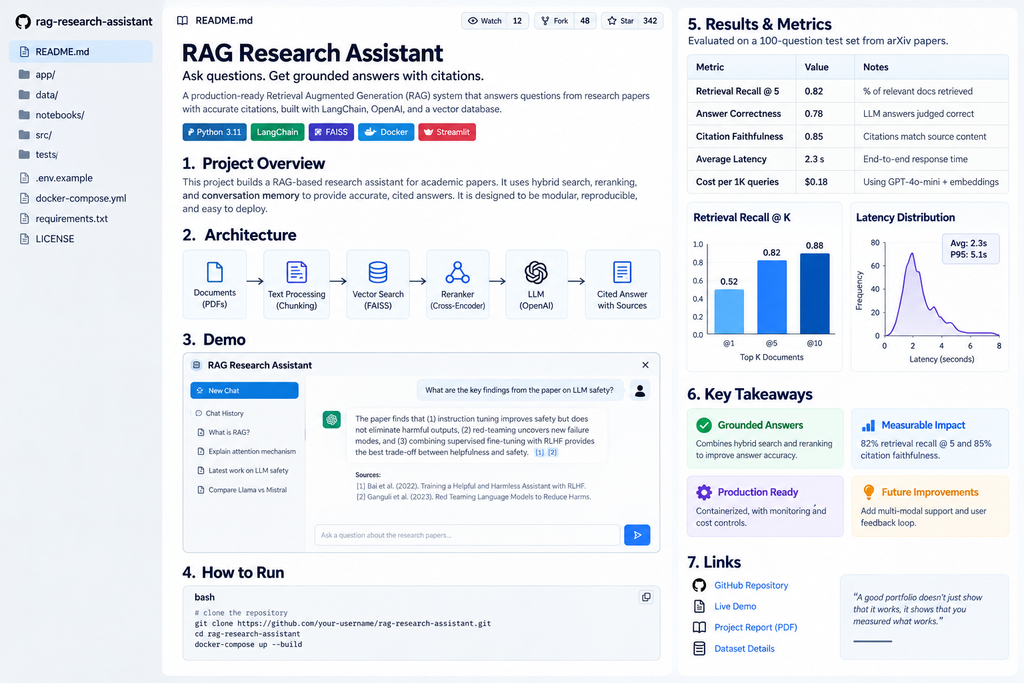
- Give every project a README that opens with the problem and the user, not with installation instructions.
- Include an architecture diagram showing data flow, model calls, retrieval, tools, storage and monitoring. Reviewers look at this before they look at code.
- Publish the numbers in a small table: metric, result, and how it was measured. The third column is the one that earns trust.
- Record a walkthrough under ten minutes. Assume nobody runs your code, because almost nobody will.
- Write a limitations section naming what fails, when, and what you would do about it next.
- Say what you personally built when a project was collaborative. Vagueness here is read as overclaiming.
- Pin your strongest three repositories and keep a single portfolio page that states the role you are targeting.
How OneLeap’s curriculum maps to this ladder
The ladder above follows the structure of a full AI engineering curriculum, because that is the order in which these skills actually build. OneLeap’s AI Engineering Mastery runs the same arc across 14 modules and 10 months, with nine production-grade projects plus a capstone, and every project reviewed individually.
| Module | Programme project | Ladder project |
|---|---|---|
| 1. ML and deep learning foundations | Transformer architecture from scratch | 1 |
| 2. Advanced prompt engineering | Prompt evaluation framework | 2 |
| 3. Building AI products | Full-stack AI application | 3 |
| 4. Production RAG systems | Enterprise RAG system | 4 |
| 5. Fine-tuning and model optimisation | Domain-specific fine-tuned model | 5 |
| 6. AI agents foundations | Autonomous research agent | 6 |
| 7. Agent frameworks | Autonomous research agent | 7 |
| 8. Multi-agent systems | Multi-agent orchestrator | 8 |
| 9. Production safety and observability | AI safety and monitoring dashboard | 9 |
| 10. Production deployment and optimisation | Applied across the deployed projects | 10 |
| 11–13. Image, multimodal and video AI | Multimodal content pipeline | 11, 12, 13 |
| 14. Capstone | End-to-end integrated system | 14 |
The programme’s case studies use named public datasets rather than toy data: SEC EDGAR filings for financial document analysis, CUAD for legal contract extraction, Amazon Product Reviews for support automation, Instacart for recommendations, CodeSearchNet with GitHub issues for a code-review agent, and medical transcription with PubMed for healthcare triage. Those are the same kinds of dataset worth using if you build this ladder independently.
It assumes intermediate Python, data structures, APIs, databases and Git on day one. If you are not there yet, what to learn first sets out the prerequisites and a twelve-week preparation path. Otherwise, explore AI Engineering Mastery.
Mistakes that sink an AI engineering portfolio
- Ten shallow repositories instead of three finished ones with published numbers.
- Notebooks with no API, interface, deployment or walkthrough. A notebook is working out, not a deliverable.
- A framework quickstart with the problem, data and architecture unchanged. Reviewers recognise these instantly.
- A multi-agent design where a deterministic pipeline would be clearer, cheaper and safer. Complexity without justification reads as inexperience.
- Reporting model accuracy while ignoring retrieval quality, cost, latency, safety and whether the user’s task actually completed.
- Claiming production readiness with no monitoring, failure recovery, access control or rollback.
- Leaving your own contribution unclear on collaborative work.
- Hiding the failures instead of documenting them. The limitations section is where experienced reviewers look first.
Frequently asked questions
How many AI engineering projects does a portfolio need?
Three to five finished ones, not fourteen. The ladder above is a curriculum, not a checklist to complete before applying. Pick one project per competency, finish those properly, and leave the rest as things you can talk about.
Which projects should I build first?
If you are choosing three, take the RAG system (4), the agent-versus-pipeline comparison (6), and the deployment pipeline (10). That combination covers retrieval, orchestration and operations, which is what most AI engineering interviews probe. Add the transformer from scratch (1) if you want to stand out on fundamentals.
Is a chatbot a good AI engineering portfolio project?
On its own, no. It becomes one when it has a defined user, trusted data, citations, a test set with published numbers, guardrails, and a deployment. At that point it is no longer a chatbot project; it is project 4 on this list.
Does every project need to be deployed?
At least two should be. For the rest, a recorded walkthrough, an architecture diagram, setup instructions and reproducible code are acceptable. Reviewers rarely run your code, so make the work assessable without it.
What metrics should I publish?
Whatever fits the project, but always include cost and latency alongside quality. Retrieval recall, citation faithfulness, precision and recall, task completion rate, and failure rate are the common ones. A project reporting only accuracy reads as incomplete.
Do I need real company data?
No, and you should not use it. Public, synthetic or clearly licensed data is expected. What matters is documenting the source, its licence, its limitations, and how well it represents the problem you claim to solve.
Can a fresher build this kind of portfolio?
Yes, over time. The foundations tier is achievable with solid Python; the production and visual tiers take longer. Build in the order above rather than starting with the impressive-sounding ones, because each tier assumes the previous.
Should I put failed projects in my portfolio?
Put the failures inside the successful projects. A limitations section naming what did not work, and a comparison where your clever approach lost to a simple baseline, both read as maturity. Hiding them is what reviewers notice.
Final thoughts
A job-ready AI engineering portfolio shows that you can build, evaluate, deploy and operate AI systems, not that you can call a model. The ladder above is the order those skills build in, and the reason to follow it rather than jumping to the impressive-sounding projects is simple: the advanced ones are only impressive when you can explain why every choice inside them was made.
Pick three or four rungs that cover different competencies, finish them properly, publish the numbers including the ones that did not go your way, and make every project easy to review in five minutes.
Explore OneLeap: theoneleap.com

Leave a Reply