
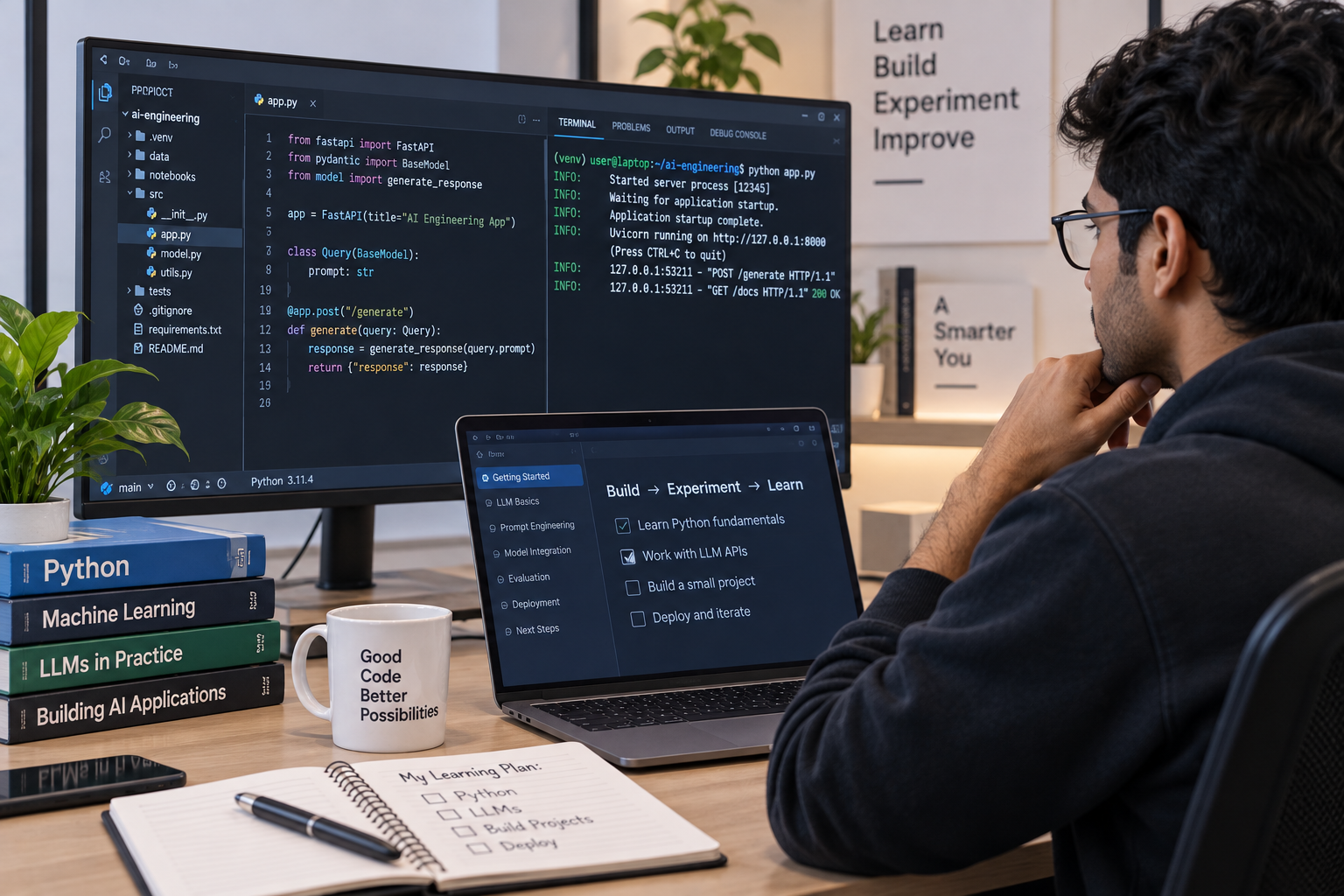
Learn Python and software fundamentals first, then data, SQL, APIs, and Git. Those four things are not the AI part of AI engineering, and that is exactly why they come first: every serious AI engineering programme assumes them on day one. Do not begin with LangChain, agents, or a vector database.
A note on the word beginner, because it does real damage here. If you mean new to AI but already able to write and debug Python, you are ready for an AI engineering course now. If you mean new to programming, you are not, and no honest programme will tell you otherwise. This article sets out where the line actually sits, how to check which side of it you are on, and what to do in either case.
Key takeaways
- AI engineering is software engineering applied to AI systems. The software part is not optional.
- The real entry bar is intermediate Python, data structures and OOP basics, APIs, databases, and Git.
- Starting with frameworks before fundamentals is the most common way beginners stall.
- From little or no programming, budget about three months of preparation at 10–12 hours a week.
- If you would rather not write code, data analytics is a legitimate route into AI-adjacent work, not a consolation prize.
- OneLeap’s AI Engineering Mastery states its prerequisites openly and screens through a qualification interview, so it is worth arriving prepared.
Table of contents
- What AI engineering actually is
- The honest prerequisite bar
- Readiness self-check
- The three-month prep path
- If you are not there yet
- What comes after the prerequisites
- What to check before enrolling anywhere
- OneLeap AI Engineering Mastery
- Mistakes beginners make before they start
- Frequently asked questions
What AI engineering actually is
An AI engineer designs, builds, evaluates, deploys, and operates software that uses AI. In practice that means a retrieval system that answers questions from company documents with citations, an agent that uses tools and asks a human before acting, a fine-tuned model for one narrow task, or an AI feature inside a product that has to stay accurate, secure, observable, and affordable.
Notice how much of that sentence is ordinary software engineering. Calling a model API is the easy part and takes an afternoon to learn. The job is everything around it: where the data comes from, what happens when the model is wrong, how you know whether it is working, what it costs per thousand requests, and who gets alerted at two in the morning.
This is why prompt engineering alone is not AI engineering, and why a course that stops at prompting is not an engineering course.
The honest prerequisite bar
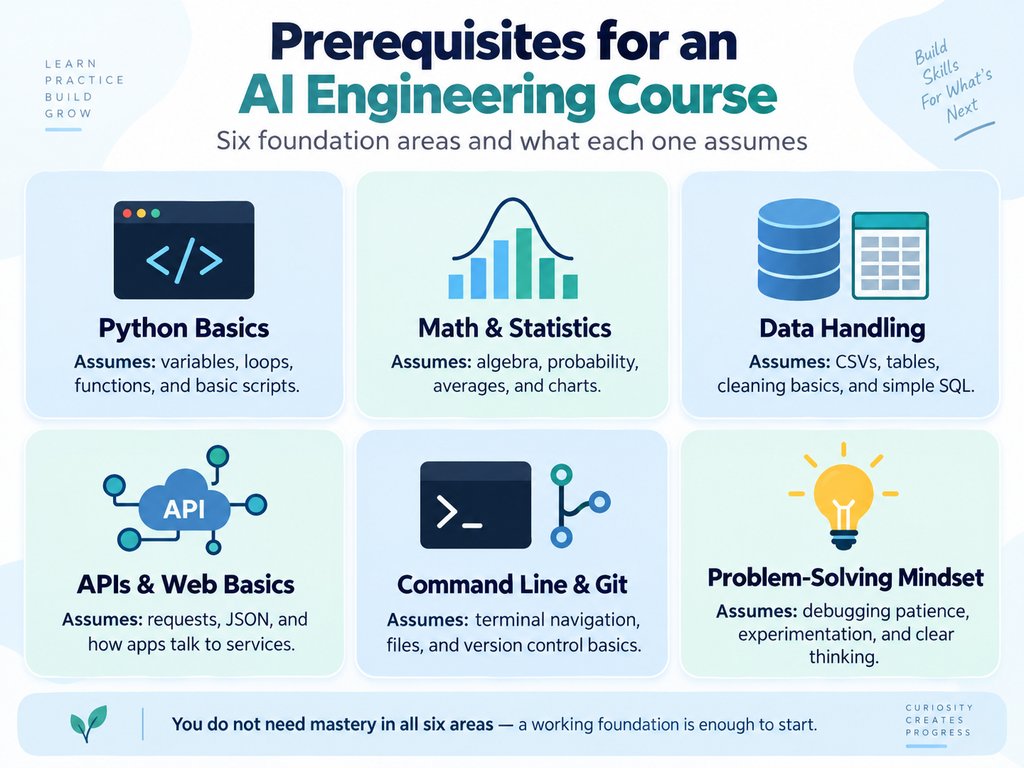
Most course pages are vague about prerequisites because vagueness sells. It is more useful to be specific. A serious AI engineering programme expects roughly this on day one.
| Area | What is assumed | Why it is assumed |
|---|---|---|
| Python | Intermediate: functions, classes, modules, exceptions, file handling, reading unfamiliar code | Every module is taught in Python; the course teaches AI, not the language |
| Programming fundamentals | Data structures, basic algorithms, object-oriented concepts, and independent debugging | AI systems fail in layers, and tracing a failure is a daily task |
| APIs and HTTP | Requests, JSON, authentication, status codes, error handling | An AI application is mostly integrations between services |
| Databases and SQL | Tables, joins, filtering, aggregation, basic schema design | Retrieval systems and application state both live in databases |
| Git and command line | Clone, branch, commit, environments, packages, project structure | Assumed from the first project; not taught alongside |
| Maths intuition | Probability, vectors and matrices, basic statistics | Enough to reason about embeddings and evaluation, not to derive anything |
Being screened out is a worse outcome than spending three months preparing.
Readiness self-check
Six questions. Answer them as they are, not as you hope.
- Have you written a Python program longer than 100 lines that you designed yourself, not followed along with?
- When you hit an error you have never seen, do you read the traceback and work through it, or search for someone else’s fix and paste it?
- Can you call a REST API with authentication, handle a failure, and parse the response without a tutorial open?
- Can you write a SQL query with a join and a GROUP BY from memory?
- Do you use Git branches, or only push to main occasionally?
- Have you ever read someone else’s codebase and understood roughly what it does?
Five or six yes: you are ready to start an AI engineering course now. Skip to what comes after the prerequisites.
Three or four: you are close. Spend four to six weeks on the weak areas using the prep path below.
Two or fewer: take the full three-month prep path first, or consider the analytics route instead. Enrolling now would mean spending the course trying to catch up on the language while everyone else learns the material.
The three-month prep path
This is the part almost no course page gives you, because it is the part that happens before they get your money. At 10–12 hours a week it takes about twelve weeks from a standing start.
| Weeks | Focus | What you should be able to do by the end |
|---|---|---|
| 1–3 | Python fundamentals: syntax, functions, collections, files, exceptions, classes | Write a command-line tool that reads a file, processes it, and handles bad input without crashing |
| 4–5 | Git and the command line: branches, commits, virtual environments, packages | Keep a project in version control and explain what each commit changed |
| 6–7 | HTTP and APIs: requests, JSON, authentication, error handling, rate limits | Build a script that pulls data from a public API, handles failures, and saves structured output |
| 8–9 | SQL and databases: tables, joins, aggregation, simple schema design | Answer real questions from a sample database, and load your API data into one |
| 10–11 | Putting it together: a small web service with FastAPI, reading and writing to a database | Run a service locally with endpoints, validation, and logging |
| 12 | Maths intuition: probability, vectors, matrices, descriptive statistics | Explain what an embedding is and why similarity is measured by distance |
Two rules make this work. Build something in every block rather than only following tutorials, because the gap between watching and doing is where the difficulty actually lives. And use an AI assistant to explain code rather than to write it for you; at this stage generated code you cannot debug is worse than no code at all.
If you are not there yet
If the self-check went badly and the prep path does not appeal, that is worth taking seriously rather than pushing through. Not enjoying debugging is useful information about a career built substantially on debugging.
Data analytics is the honest alternative, and not a lesser one. It starts with business questions, Excel, and SQL rather than software engineering, requires no prior coding, and reaches a first role faster.
Modern analytics work also includes AI: prompting, AI-assisted analysis, retrieval basics, and workflow automation. Plenty of people start there, find they enjoy the technical side more than expected, and move into engineering later with the fundamentals already in place. Strategic Data Analyst with AI is built for exactly that entry point and states that no coding experience is required.
If you are genuinely undecided rather than blocked, AI course vs data analytics course compares the two on skills, timelines, and roles, and the beginner’s guide to data analytics covers the analytics route in full.
What comes after the prerequisites
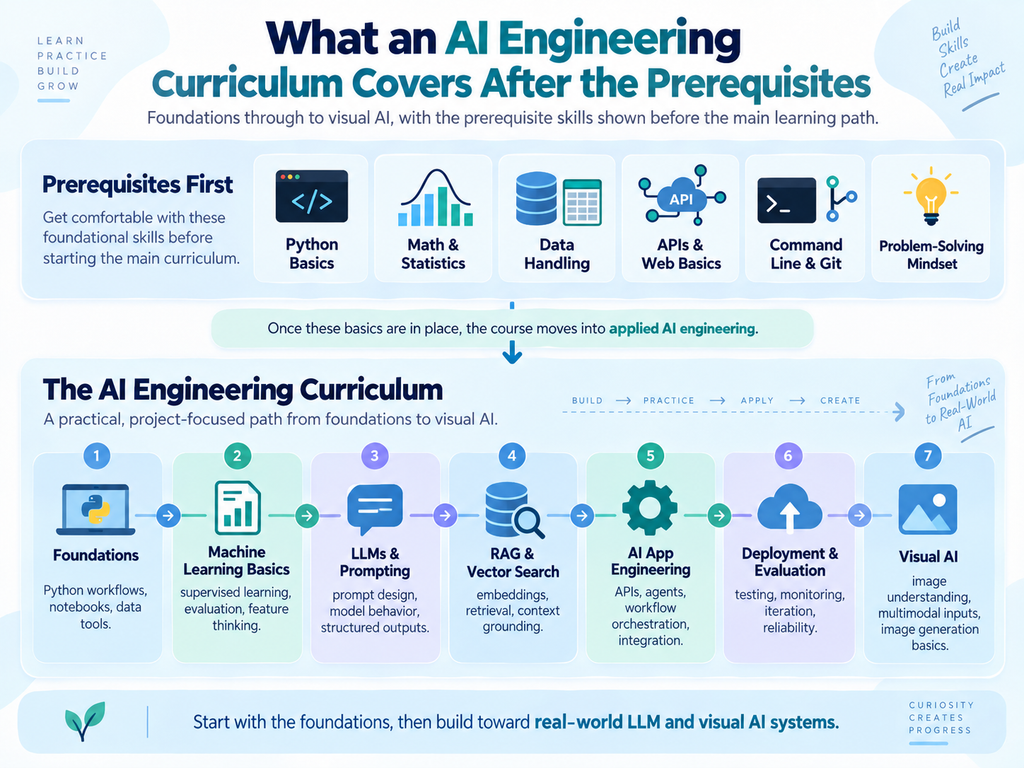
Once the prerequisites are in place, the AI-specific material follows a fairly standard arc. This is what a serious curriculum covers, and it is useful to recognise it when comparing programmes.
| Stage | What it covers |
|---|---|
| Foundations | How machine learning and deep learning work, the transformer architecture, and how generative models produce output. Enough to build with judgement rather than by imitation. |
| Prompting and evaluation | Advanced prompting, structured outputs, and evaluation frameworks. Crucially, when to prompt, when to fine-tune, and when to do neither. |
| Building AI products | UI and API architecture for AI applications, database patterns, and working with coding assistants such as Claude Code and Cursor to ship complete systems. |
| Production RAG | Chunking strategies, retrieval quality metrics, memory architectures, and the data preprocessing that decides whether any of it works. |
| Fine-tuning | When it earns its cost, parameter-efficient techniques such as LoRA and PEFT, dataset curation, and evaluation against a base model. |
| Agents | Tool use, function calling, planning patterns, agent frameworks, Model Context Protocol, and multi-agent coordination. Also when a deterministic pipeline is the safer answer. |
| Safety and observability | Guardrails, output validation, prompt-injection defence, monitoring, failure recovery, and human-in-the-loop design. |
| Deployment and cost | Token economics, latency, caching, batching, distillation, and infrastructure that survives real traffic. |
| Visual and multimodal AI | Diffusion models, vision-language models, and generative video. Often skipped by shorter courses, and increasingly asked for. |
Visual AI is worth flagging. Many curricula stop at text, and image, multimodal, and video work is now a meaningful share of AI engineering roles. For what to build at each stage, see AI Portfolio Projects for 2026.
What to check before enrolling anywhere
Whatever you enrol in, four checks matter more than the syllabus length.
- Stated prerequisites. A programme that will not tell you the expected Python level is either not teaching engineering or not screening. Both are bad signs.
- Deployment and evaluation in the syllabus. If neither appears, it is a prompting course. This is the single fastest way to tell the two apart.
- Projects with real constraints. Messy data, failure cases, cost limits, and someone reviewing your code. Demo projects with clean data teach very little.
- Live feedback. Complex systems are hard to learn from recordings, because the difficulty is in the debugging and that is where you need another person.
OneLeap AI Engineering Mastery
OneLeap’s AI Engineering Mastery is a ten-month programme with weekend classes, 100+ hours of live learning, 14 modules, production-grade projects, weekly 30-minute one-to-one sessions, merit-based certification, and career support. The expected commitment is 15–20 hours a week, and admission includes a qualification interview.
It is built for software engineers moving into AI, CS and IT graduates with solid programming, data scientists wanting production skills, and ML engineers moving into LLM and agent systems. It is not a first programming course, and the prerequisites above are taken from its own eligibility criteria.
The curriculum runs from ML and deep-learning foundations through prompt engineering, AI product development, production RAG, fine-tuning, agents and multi-agent systems, safety and observability, deployment and optimisation, image generation, multimodal AI, and video, ending in a capstone. Projects include a transformer built from scratch, a prompt evaluation framework, a full-stack AI application, an enterprise RAG system, a domain-specific fine-tuned model, an autonomous research agent, a multi-agent orchestrator, an AI safety and monitoring dashboard, and a multimodal content pipeline.
The case studies use named public datasets rather than toy data: SEC EDGAR filings for financial document analysis, CUAD for legal contract clause extraction, Instacart for recommendations, CodeSearchNet and GitHub issues for a code-review agent, and medical transcription with PubMed for a healthcare triage system. Working with real datasets is what makes portfolio projects defensible in an interview.
Teaching is practitioner-led: founder Shubham Pandey, previously at American Express and HCL Technologies, a chief AI architect previously at Cargill Foods, a senior faculty member who is a director at Morgan Stanley, and a senior faculty member in generative and agentic AI who formerly headed AI at L&T Finance. Explore the programme: AI Engineering Mastery.
Mistakes beginners make before they start
- Starting with LangChain, agents, or a vector database before Python and APIs. This is the most common failure and the hardest to recover from, because nothing makes sense and it feels like a personal deficiency rather than a sequencing error.
- Believing prompt engineering is the job. It is one module of fourteen in a serious curriculum.
- Skipping Git, testing, and debugging because they are not the interesting part.
- Collecting frameworks instead of learning one workflow properly.
- Using AI-generated code you cannot debug. At the prep stage this actively slows you down.
- Enrolling above your level and spending the course catching up on the language instead of learning the material.
- Assuming a maths deficit disqualifies you. A programming deficit is the real blocker; the maths can be learned alongside.
Frequently asked questions
Can a complete beginner enrol in an AI engineering course?
It depends what “beginner” means. New to AI but comfortable writing Python, using Git, and calling APIs: yes. New to programming entirely: not in a serious AI engineering programme, and providers that say otherwise are usually teaching prompting rather than engineering. Spend three months on foundations first, or start with data analytics instead.
Do I need a computer science degree?
No, but you do need the parts of a CS degree that matter here: comfort with data structures, some object-oriented programming, and the habit of debugging your own code. Plenty of self-taught developers clear that bar. A portfolio showing working software is what gets tested, not the transcript.
Do I need advanced mathematics to start?
You need intuition rather than proofs. Probability, vectors and matrices, and basic statistics are enough to start. You do not need multivariable calculus or linear algebra theory before your first project; the maths becomes easier to learn once you have seen what it explains.
What should I learn first, Python or machine learning?
Python, without question. Machine learning concepts are much easier to absorb when you can already read and modify the code that implements them. Trying it the other way round is the single most common reason beginners stall.
How long does the preparation take?
Roughly three months at 10–12 hours a week, if you are starting from little or no programming. Faster if you have written code before. The prep path below breaks that down week by week.
What is the difference between an AI course and an AI engineering course?
A general AI course usually covers concepts, tools, and prompting. An AI engineering course covers software systems: APIs, data, LLM applications, RAG, agents, evaluation, deployment, safety, cost, and latency. If a syllabus has no deployment or evaluation in it, it is the first kind.
Can I learn AI engineering while working full-time?
Yes, and most people in these programmes do. Weekend classes plus 15–20 hours a week is the realistic commitment for a serious programme. The part people underestimate is debugging time, which does not compress. Choose projects in your own industry so the domain knowledge is already there.
Is AI engineering harder than data analytics?
Yes, measurably. It asks for software engineering fundamentals that analytics does not, and takes longer before you are employable. That is a reason to choose deliberately rather than a reason to avoid it. Many people start in analytics and move across later.
Where to go next
If the self-check went well, you are ready to choose a programme. If it did not, the prep path above is three months and costs nothing but time, and it is the same three months you would otherwise spend struggling inside a course. Either way, the sequence is the point: fundamentals, then models, then production.
Explore OneLeap: theoneleap.com

Leave a Reply