

Yes, and the honest version is not the one you usually read. It is not “learn everything online and work fully remote from day one”. It is a hybrid: study somewhere structured, which for most people here means Dehradun at under an hour’s drive, build projects using businesses you can actually walk into, and apply to both local adjacent roles and remote openings across India.
That combination works because the two halves fix each other’s weaknesses. Local gives you real problems and real people; remote gives you the market. Relying on either alone is where most attempts stall.
Key takeaways
- Haridwar to Dehradun is about 50 km and under an hour by road. Rishikesh is about 46 km. For weekend classes that is a commute, not a relocation.
- The local economy is bigger than its tech job listings suggest. BHEL, the SIDCUL estate, AIIMS Rishikesh and the tourism sector all run on data somebody has to handle.
- Search adjacent titles. MIS Executive, Operations Analyst and Data Associate are the realistic first roles here, not “AI Engineer”.
- Build projects for businesses you can reach. A dashboard for a Rishikesh hotel beats a public-dataset exercise in every interview.
- Remote openings are real but competitive, and smaller-city students are disproportionately targeted by fake internships and placement-fee scams.
- Weekly hours decide your timeline far more than your postcode does.
Table of contents
- The hour that changes the maths
- What is actually here
- Local entry points, and what to search for
- Projects you can only build here
- The remote half
- Avoiding the scams that target smaller cities
- Studying without moving: online or in a classroom
- Frequently asked questions
The hour that changes the maths
Most advice written for students outside the metros assumes a binary: stay where you are and learn from videos, or move to Bengaluru. For anyone in Haridwar or Rishikesh that framing is simply wrong about the geography.
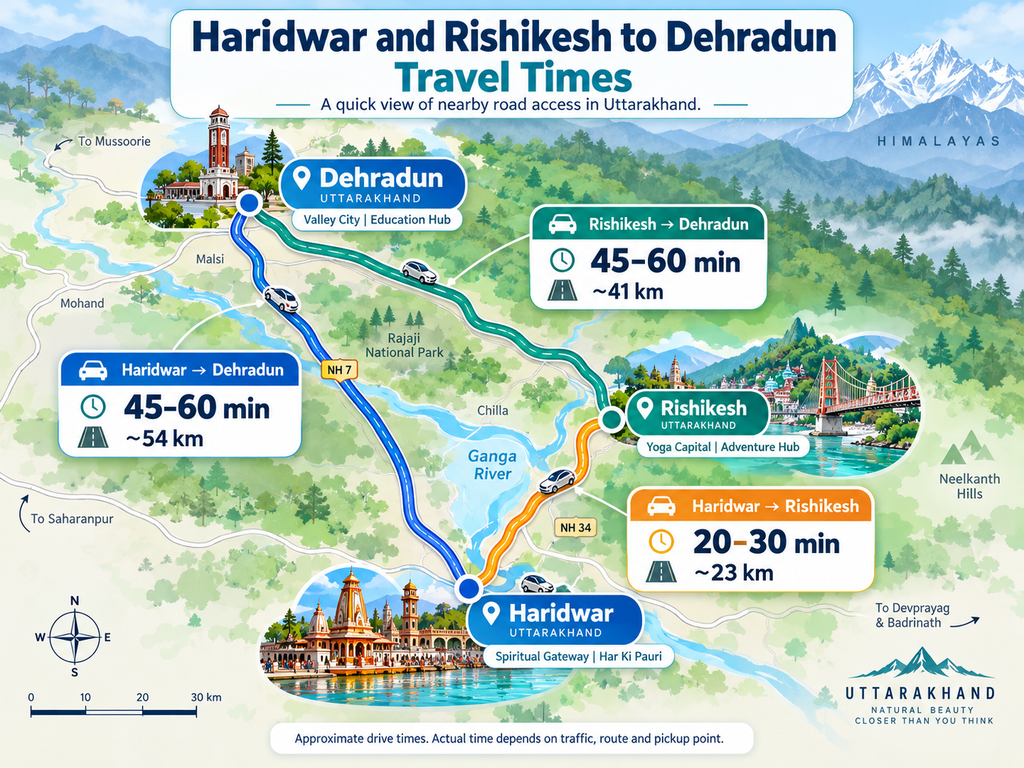
| Route | Distance | Typical time by road |
|---|---|---|
| Haridwar to Dehradun | About 50 km | Under an hour in normal traffic |
| Rishikesh to Dehradun | About 46 km | A little over an hour |
| Haridwar to Rishikesh | About 25 km | Around 45 minutes |
That changes what is available to you. A weekend programme in Dehradun is a Saturday morning journey, not a move. OneLeap’s offline cohort already includes learners who travel in from outside the city, from Selaqui, Rishikesh, Roorke and from Haridwar, so this is a route people take rather than a theory.
It also means you are not choosing between structure and staying home. You can have the fixed weekend commitment that stops a schedule slipping, and still sleep in your own bed and keep whatever job or degree you already have.
What is actually here
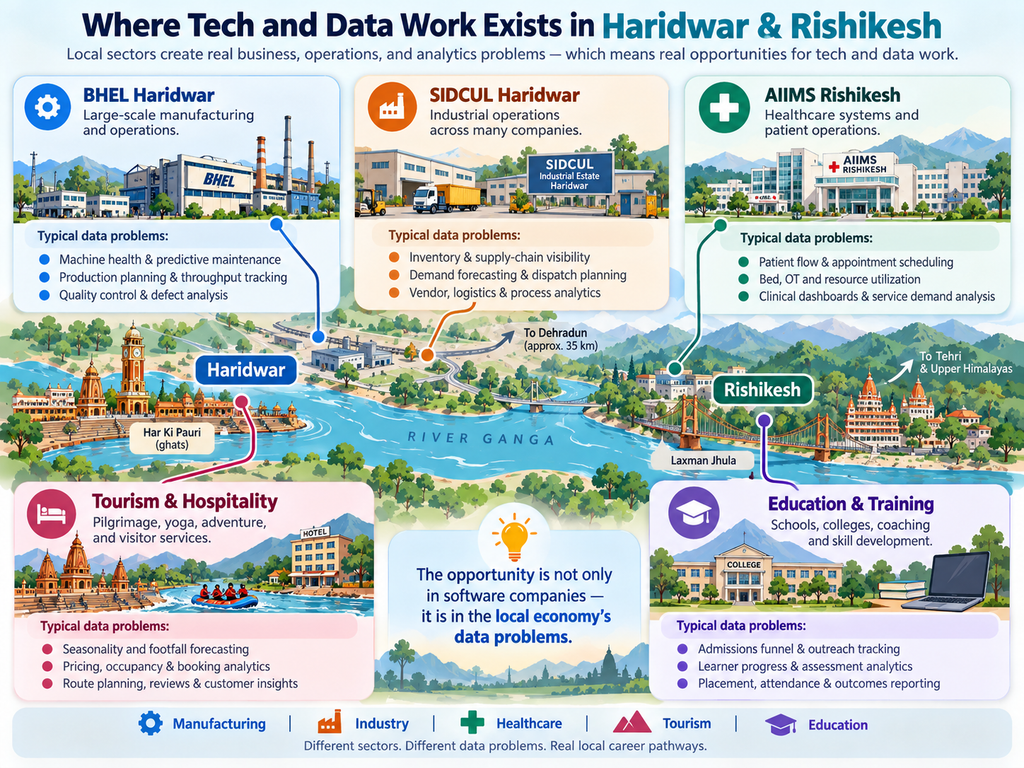
The mistake is to search for “tech jobs in Haridwar”, find almost nothing, and conclude there is nothing here. The local economy is substantial; it just does not advertise under technology titles.
Haridwar
BHEL’s Haridwar operation is one of the larger industrial employers in the state, running its Heavy Electrical Equipment Plant and Central Foundry and Forge Plant across a campus that also hosts the SIDCUL industrial estate and roughly two hundred companies. Manufacturing at that scale generates production reporting, quality data, inventory and supply-chain problems continuously, and much of it is still handled in spreadsheets.
The city also has Gurukula Kangri Vishwavidyalaya, the University of Patanjali and Uttarakhand Sanskrit University, and Roorkee is close enough to matter: IIT Roorkee, Quantum University, Motherhood University and several engineering colleges are within reach, which means a steady supply of technically-minded students and the meetups and communities that come with them.
Rishikesh
AIIMS Rishikesh is the anchor institution, and a teaching hospital of that size runs on patient flow data, scheduling, supply management and research administration. Around it sits a tourism, wellness and hospitality economy with hundreds of hotels, camps, yoga schools and adventure operators, nearly all of which have booking data, seasonality, occupancy and marketing spend that nobody is analysing properly.
Tourism is an unusually good domain to learn analytics in, because the seasonality is strong, the business questions are obvious, and the owners are generally willing to talk to a student who offers to help.
Local entry points, and what to search for
Search by what the work is called locally rather than by what you want to become. The first role is usually adjacent.
| Where to look | What the work looks like | Titles to search |
|---|---|---|
| Manufacturing and industrial | Production reporting, quality data, inventory, supply-chain tracking, dashboards | MIS Executive, Production Analyst, Operations Analyst, Data Associate, Planning Executive |
| Healthcare and hospitals | Patient flow, scheduling, records, supply and billing data, research support | Data Entry to Data Analyst progression, MIS, Research Assistant, Hospital Operations |
| Tourism and hospitality | Bookings, occupancy, seasonality, pricing, reviews, campaign performance | Revenue Analyst, Marketing Analyst, Reservations Analyst, Operations Executive |
| Education and training | Admissions funnels, attendance, learning data, content and reporting workflows | Data Coordinator, EdTech Operations, Analytics Intern, Academic Operations |
| IT services and small business | Internal tools, websites, CRM, automation, implementation support | IT Intern, Python Intern, Software Intern, Automation Associate, Technical Support |
Two of those paths deserve a note. An MIS or reporting role is often dismissed as not being a real analytics job; it is the most common way into analytics in India, and it pays you while you build the skills. And a data entry role at a large hospital or plant puts you next to the data, which is a better position than it sounds if you volunteer for the reporting nobody wants.
Projects you can only build here
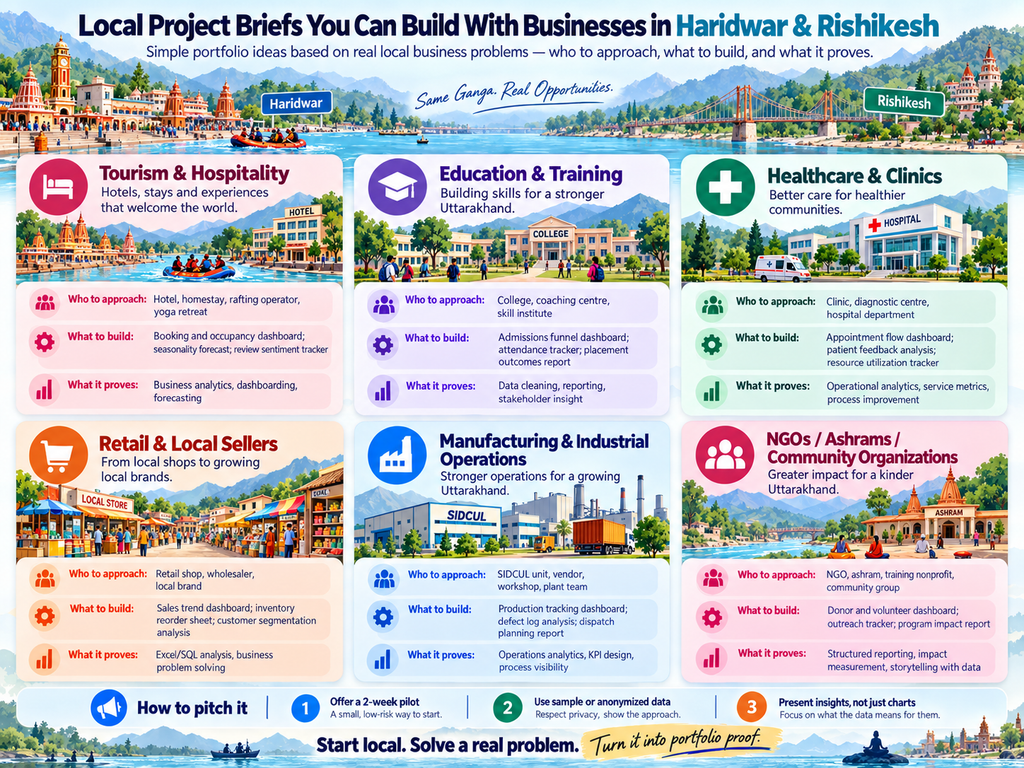
This is the real advantage of being here, and almost nobody uses it. A student in Bengaluru building a portfolio has access to the same public datasets as everyone else. You have access to businesses you can physically visit, whose owners will usually say yes to a polite student offering free help.
| Who to approach | The project | What it demonstrates |
|---|---|---|
| A Rishikesh hotel or camp operator | An occupancy and revenue dashboard covering seasonality, booking channels and pricing | Excel or Power BI, KPI design, handling real messy data, a recommendation the owner can act on |
| A Haridwar manufacturer or supplier | A production or inventory tracker with exception alerts | Operations understanding, data modelling, alerting logic, process improvement |
| A local clinic or diagnostic centre | An appointment and no-show analysis with a scheduling recommendation | Working with sensitive data properly, anonymisation, statistics, a clear business case |
| A coaching institute or college department | An admissions funnel analysis across enquiry, visit, application and enrolment | Funnel thinking, conversion metrics, segmentation, presenting to non-technical people |
| A local retailer or distributor | Demand forecasting against a simple baseline, with stock recommendations | Time-series thinking, honest evaluation, inventory logic |
| Any of the above | An automated weekly report that pulls data, drafts an AI summary and emails it for review | Workflow automation, prompting, validation, human-in-the-loop design |
Three rules make these work. Get permission in writing, even informally, and ask what you may publish. Anonymise anything commercially sensitive or personal before it goes near your portfolio. And state the method behind any result: “cut report preparation from three hours to twenty minutes” means nothing without saying you timed it both ways.
For project briefs with public datasets and evaluation methods, see AI Portfolio Projects for 2026. For the analytics versions, the beginner’s guide has six with the skills each one shows.
The remote half
Local gets you practice and a first role. Remote gets you the market. Both halves matter, and the remote half needs its own preparation.
- Search categories, not listings. Remote analytics, AI evaluation, Python and automation internships exist and turn over constantly. Set weekly alerts on LinkedIn, Internshala, Naukri and Indeed rather than working from any fixed list, including this one.
- Make yourself assessable from a distance. A remote employer cannot meet you, so they judge what they can open: a repository with a readable README, a live dashboard, a two-minute walkthrough video. Work nobody can see does not count.
- Written communication is a tested skill. On a distributed team, how clearly you write an update is how competent you appear. It is also the easiest thing to practise now.
- Get the practical conditions right. Reliable internet, a quiet corner that works on video, and the discipline to keep your own hours. Interviewers for remote roles ask about this, and vague answers read as inexperience.
- Apply beyond your state. Remote roles follow the employer’s pay bands, not local ones, which is the single biggest financial argument for building a portfolio that travels.
Avoiding the scams that target smaller cities
Students outside the metros are targeted disproportionately by fake internship and placement schemes, and the pitch is usually tailored to exactly the anxiety this article is about: you are far from the opportunities, so pay us for access. Some simple rules.
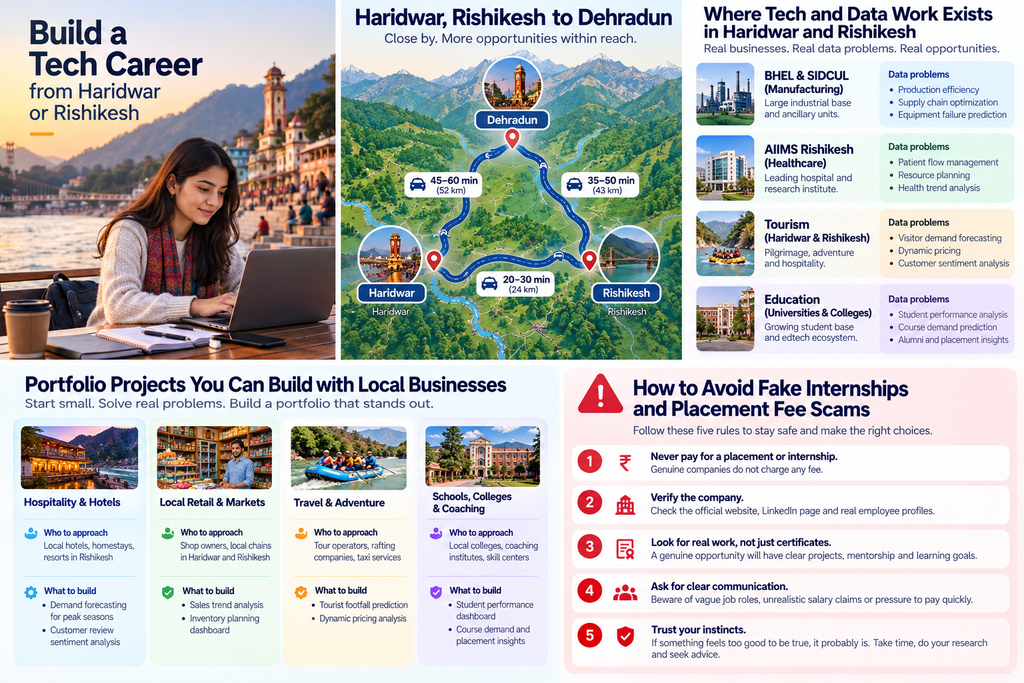
- Never pay for a job, an internship or a placement. Legitimate employers do not charge candidates. Registration fees, security deposits, training bonds payable upfront and “seat booking” charges are all the same thing wearing different names.
- Verify through the employer’s own careers page. If a role is real it will appear there or on the company’s verified LinkedIn page. An offer that exists only in a WhatsApp message or a PDF is not an offer.
- Treat guaranteed placement as a warning. No provider controls hiring decisions. India’s consumer protection guidelines specifically cover misleading advertising in the coaching sector, and “100% placement” is the claim they were written for.
- Do not share documents early. Aadhaar, PAN, bank details and marksheets are requested at onboarding, not at application. An employer asking for them before an interview is collecting data, not hiring.
- Be suspicious of unpaid work that looks like production work. An unpaid internship building a company’s actual product is a job they have decided not to pay for.
What career support can and cannot do covers the same ground from the course side, including the questions worth asking any provider.
Studying without moving: online or in a classroom
OneLeap runs both online and offline cohorts, so the choice is genuinely available rather than theoretical. Which suits you depends less on quality and more on honesty about your own discipline.
| Offline in Dehradun | Online | |
|---|---|---|
| Suits you if | You need a fixed commitment and benefit from a room full of people doing the same thing | Your schedule, shift work or commute makes a fixed Saturday unreliable |
| The cost | Two to three hours of travel on class days | Easier to let a session slide when work gets busy |
| Best for | Students and anyone within about an hour’s travel | Working professionals with unpredictable weeks |
| Where | OneLeap Pvt Ltd, 3rd Floor, AM Tower, GMS Rd, opp. Hotel Gand Legacy Prime, Dehradun | Live interactive sessions, not recordings |
Both formats run on weekends across all three programmes. If you are choosing between paths rather than formats, the career transition guide works through the four routes and which programme serves each; Strategic Data Analyst with AI is the usual starting point from a non-technical background, AI For Product Managers covers no-code automation and product work, and AI Engineering Mastery is the deeper engineering route.
Before comparing any courses, including these, what a course’s advertised duration actually means is worth ten minutes. The headline months tell you much less than the live hours and the weekly commitment.
Frequently asked questions
Can I get a tech job without moving to Bengaluru or Delhi?
Yes, though it usually takes a different route. Most people start with a local or remote internship and an adjacent title rather than a titled tech role, then move into analytics, AI or software work once they have evidence. Relocation stays an option later; it does not have to be the first step.
Is Dehradun close enough to study in while living in Haridwar?
Haridwar to Dehradun is roughly 50 km and under an hour by road in normal traffic; Rishikesh is about 46 km and a little over an hour. For weekend classes that is a realistic commute, and OneLeap’s offline cohort already includes learners who travel in from outside Dehradun.
Which tech career is most realistic to start with from here?
Data analytics and no-code AI automation are the most accessible, because you can start without programming and the local economy generates genuine reporting and operations problems to practise on. AI engineering is achievable but takes longer and starts with Python rather than with AI.
Are there real remote internships, or is that wishful thinking?
They are real but competitive, and the listings move constantly. Treat remote openings as a category to search weekly rather than a list to copy, and verify every employer through their own careers page before sharing documents or paying anything.
Does living outside a metro hurt my chances?
Less than it used to, and least of all if your work is visible. A public portfolio with a dashboard someone can open and a project someone can read removes most of the disadvantage, because a remote employer is assessing the evidence rather than your address.
Should I do an online or an offline course?
Offline suits people who need the fixed commitment and the room full of others doing the same thing. Online suits people whose schedule or commute makes that unreliable. Both exist here, so choose on honesty about your own discipline rather than on which sounds more serious.
What if I am studying at a college in Roorkee or Haridwar?
Then you have the best version of this: time, a cohort, and access to local businesses for project data. Build two domain projects before you graduate and you will be ahead of most applicants, who arrive with coursework and nothing else.
How long before I am job-ready?
At 15 to 20 hours a week, about six months for analytics or automation plus one to three months of applying. Longer for AI engineering. Weekly hours matter far more than which city you are in.
Final thoughts
The disadvantage of being in Haridwar or Rishikesh is smaller than it feels, and it is not the one people assume. It is not distance from opportunity; Dehradun is under an hour away and the rest of the market is online. It is that the opportunities here are not labelled as technology jobs, so they are easy to miss.
Look for the work rather than the title, build something for a business you can visit, make it visible to people who will never meet you, and give it the weekly hours. Relocation stays available later, with better options than you have now.
Browse OneLeap’s programmes: theoneleap.com/programmes

Leave a Reply