
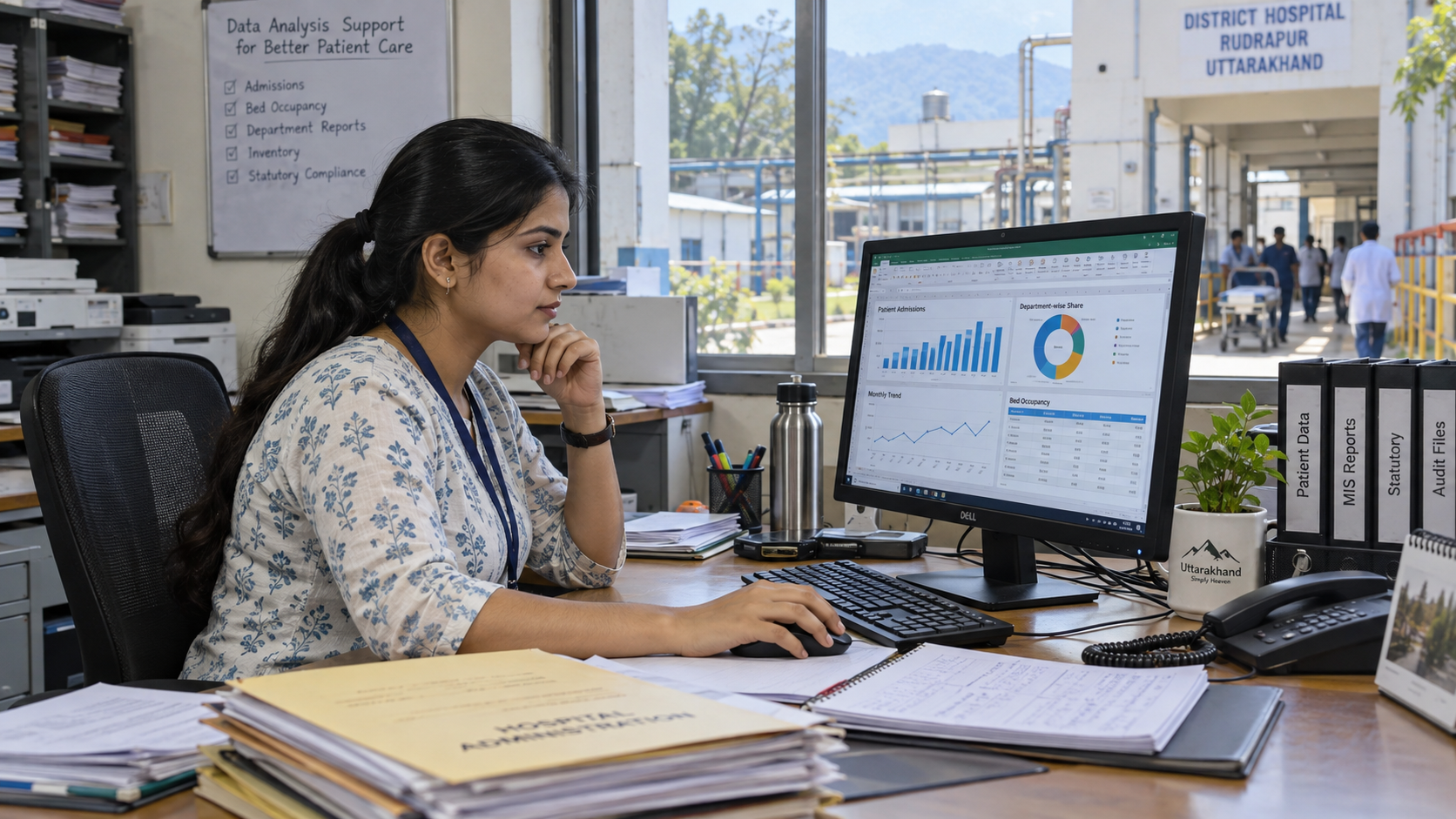
Yes, and here is the part that makes this different from almost every other technology career article aimed at this state: you may not have to leave. Uttarakhand has very few AI engineering jobs, but it has a great deal of work that involves reporting, dashboards, operations data and business analysis. That work is advertised under other names, and it is where most local analytics careers actually start.
This guide is written for graduates without a computer science degree B.Com, BBA, BA, B.Sc, and anyone who has been working in something unrelated. Analytics is genuinely reachable from there in a way AI engineering is not. If you do have a CS or engineering background, there is a different version of this below.
Key takeaways
- Analytics work exists inside Uttarakhand, unlike AI engineering. It is advertised as MIS, reporting and operations rather than as data analysis.
- A commerce, management or arts degree is a workable starting point. SQL and a BI tool matter more than your branch.
- The MIS-to-analyst ladder is the most common local route, and it pays you while you learn.
- That route becomes a trap only if you spend two years formatting reports instead of automating them.
- Roughly six months to job-ready at 15 to 20 hours a week, against ten to thirteen for AI engineering.
- Build your first project for an employer you can physically visit. It beats a public dataset in every interview.
Table of contents
- The good news: this work exists here
- Who this is written for
- The MIS-to-analyst ladder
- Where the work actually is
- Projects aimed at employers you can reach
- Six months, honestly
- If you have a CS or engineering degree
- Frequently asked questions
The good news: this work exists here
Search for data analyst jobs in Uttarakhand and the results will look thin. That is a labelling problem rather than a market one. Every manufacturer in the Haridwar industrial belt produces reports on output, quality and inventory. Every hospital tracks patient flow, scheduling and supplies. Every hotel group in Rishikesh and Mussoorie watches occupancy and seasonality. Every college tracks admissions and attendance. Somebody is doing that work, usually in Excel, usually with a job title that does not contain the word analyst.
That matters because it changes your plan. Someone aiming at AI engineering from here has to assume their first job will be remote or outside the state. You do not. You can get paid locally to work with business data from month one, and build towards an analyst title from inside a job rather than from outside the market.
Be realistic about the money, though. Entry-level reporting roles in Uttarakhand generally pay below national fresher bands, sometimes well below. The reason to take one is the access and the experience, not the salary and the salary changes considerably once you have SQL, a dashboard and two years behind you.
Who this is written for
Most graduates in this state come through the general universities rather than the engineering colleges: Kumaun University in Nainital, Doon University in Dehradun, Sri Dev Suman Uttarakhand University in Tehri, Soban Singh Jeena University in Almora, HNB Garhwal in Srinagar, Uttarakhand Open University in Haldwani, and the many degree colleges affiliated to them. If that is you, this path was built for you more than the engineering one was.
| Your degree | What you already have | What to add first |
|---|---|---|
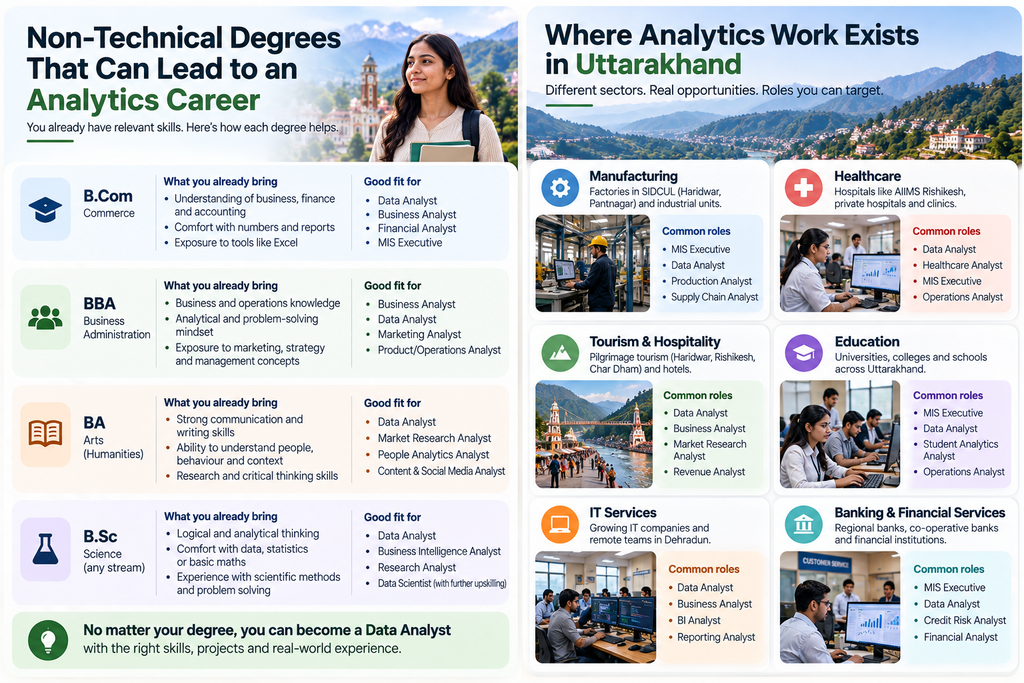
| B.Com or BBA | You understand revenue, cost, margin and what a business actually measures. This is the hardest part to teach. | Excel to a serious level, then SQL. Your commerce background makes the business-question half straightforward. |
| BA (economics, statistics, geography) | Analytical reasoning, and often statistics already | Excel and SQL. Economics and statistics graduates frequently move faster than CS graduates on the judgement side. |
| B.Sc (any science) | Comfort with data, method and evidence | Business context, which is the piece science degrees leave out. Learn what a KPI is before you learn Power BI. |
| BA or BCA with a gap since graduating | Whatever you have been doing since, which is domain knowledge | The same sequence as everyone else, aimed at the industry you have been working in |
| Working in a non-analytical job now | A live business to practise on and an income while you learn | Nothing new to start. Automate one report in your current job this month. |
A note worth saying plainly, because it stops people before they start: analytics hiring in India does not filter heavily on degree branch at the fresher level. It filters on whether you can write a join, build a dashboard somebody would use, and explain what you would do about what you found.
The MIS-to-analyst ladder
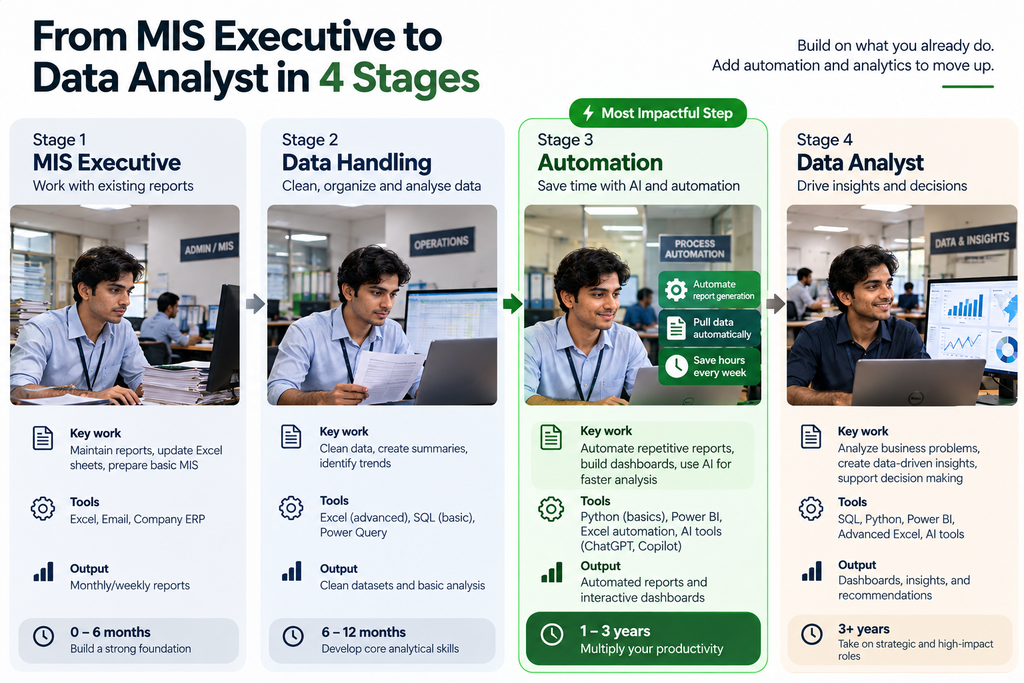
This is the route most local analysts actually take, and almost nobody writes it down. It starts with a job that does not sound like the one you want.
| Stage | What it looks like | What you do deliberately |
|---|---|---|
| Months 0–3: get in | MIS Executive, Reporting Assistant, Data Associate or Operations Executive. Mostly Excel, chasing numbers from departments, formatting recurring reports. | Learn the business before the tools. Which numbers matter, who reads them, what decisions follow. Map where every figure in your reports comes from. |
| Months 3–9: automate your own job | Still the same title. But the three-hour weekly report now takes twenty minutes. | Replace manual compilation with formulas, then Power Query, then a proper refreshable model. This is the single highest-leverage move available to you and it is invisible to everyone else. |
| Months 9–18: get to the database | Ask for read access to the system behind your reports. Learn SQL on your own company’s data. | Build one dashboard nobody asked for that answers a question management actually has. Present it. This becomes your portfolio piece and your case for a new title. |
| Months 18–30: move | Internal promotion to Data Analyst or Business Analyst, or an external move with two years and real dashboards behind you | Decide which. Internal is faster and lower risk; external usually pays more. Having both options is the point of the previous eighteen months. |
The honest warning: this route traps people who skip the second stage. If you spend two years formatting reports by hand without ever automating one, you have two years of experience that employers read as data entry. The job is only a ladder if you treat it as one, and the automation step is what turns it from a job into a career move.
Study alongside it rather than waiting. A weekend programme and an MIS job together is a far stronger position after a year than either alone and what a course’s advertised duration actually means is worth reading before you pick one.
Where the work actually is
Search by what the work is called locally, not by what you want to become.
| Sector | Where | Titles to search |
|---|---|---|
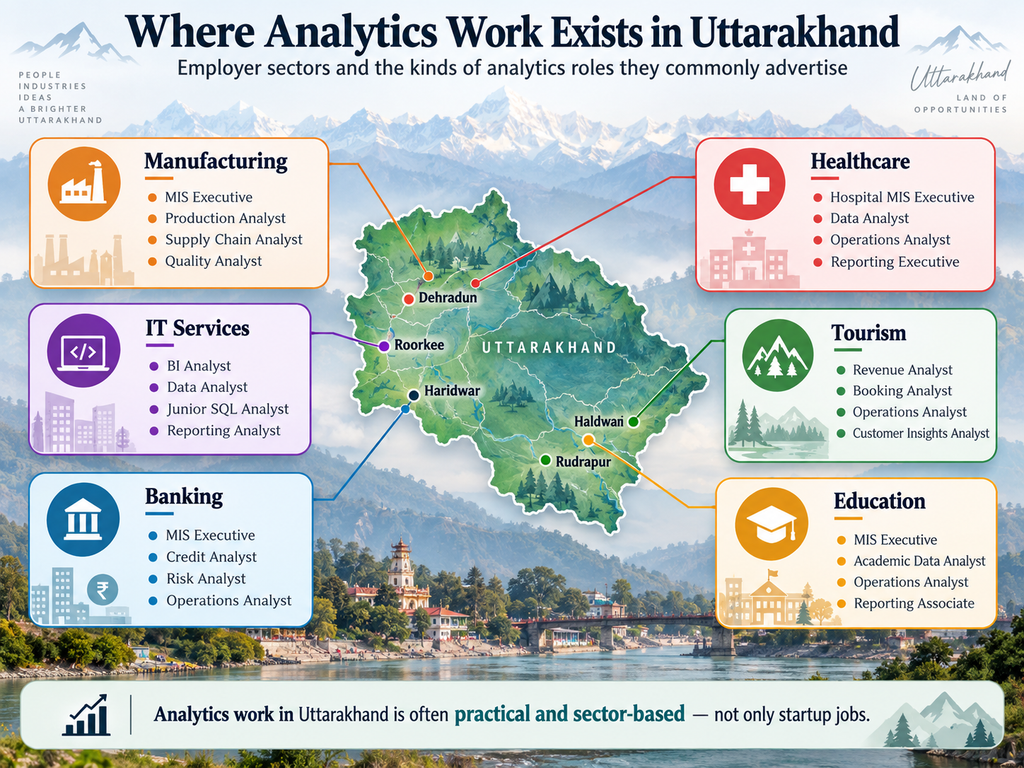
| Manufacturing and industrial | BHEL Haridwar and the SIDCUL estate, Selaqui, Pantnagar, Sitarganj | MIS Executive, Production Analyst, Planning Executive, Operations Analyst, Supply Chain Executive |
| Healthcare | AIIMS Rishikesh, private hospitals and diagnostic chains across Dehradun and Haldwani | MIS Executive, Hospital Operations, Data Coordinator, Billing Analyst |
| Tourism and hospitality | Rishikesh, Mussoorie, Nainital, Jim Corbett; hotel groups and Char Dham operators | Revenue Analyst, Reservations Analyst, Marketing Analyst, Operations Executive |
| Education | The state universities, their affiliated colleges, coaching institutes and EdTech firms | Data Coordinator, Admissions Analyst, Academic Operations, Analytics Intern |
| IT services and startups | Dehradun IT Park on Sahastradhara Road and the STPI cluster | Data Analyst, Reporting Analyst, Business Analyst, BI Analyst |
| Banking, NBFC and retail | Branch and regional offices across Dehradun, Haldwani, Haridwar, Rudrapur | MIS Executive, Credit Analyst, Sales MIS, Reporting Executive |
Set weekly alerts on Naukri, Indeed and LinkedIn for those titles plus your city rather than searching manually, and apply to remote roles in parallel. If you are in Haridwar or Rishikesh, this covers the local market and the Dehradun commute in more detail.
Projects aimed at employers you can reach
Aim your portfolio at the employers in that table. A dashboard built for a Rishikesh hotel is more persuasive to a Dehradun hiring manager than another Kaggle notebook, because it proves you can work with messy real data and talk to a business owner.
| Who to approach | The project | What it proves |
|---|---|---|
| A hotel, camp or travel operator | Occupancy and revenue dashboard across season, booking channel and room type, with a pricing recommendation | Excel or Power BI, KPI design, seasonality, and a recommendation an owner can act on |
| A manufacturer or supplier | Production or inventory tracker with exception alerts and a weekly summary | Operations understanding, data modelling, alerting logic |
| A clinic or diagnostic centre | Appointment and no-show analysis with a scheduling recommendation | Handling sensitive data properly, anonymisation, statistics, a clear business case |
| A college or coaching institute | Admissions funnel from enquiry to enrolment, by source and programme | Funnel metrics, conversion analysis, presenting to non-technical people |
| A retailer or distributor | Demand forecast against a simple baseline, with stock recommendations | Time-series thinking, honest evaluation against a baseline |
| Your own employer, if you have one | Automate a report that currently takes someone hours | Measured impact, which is the strongest thing a fresher portfolio can contain |
Three rules. Get permission in writing and ask what you may publish. Anonymise anything commercially sensitive or personal. And state the method behind any claim: “cut report time from three hours to twenty minutes” only counts if you say you timed it both ways.
For six more project briefs with the skills each demonstrates, see the beginner’s guide.
Six months, honestly
At 15 to 20 hours a week, roughly six months to build the skills and a portfolio, plus one to three months of applying. At 8 to 10 hours a week, closer to ten to twelve months. That is the main variable; your city is not.
The sequence is not local and there is no Uttarakhand version of it. Briefly: business thinking and KPIs first, then statistical judgement, then AI fluency, then Excel, SQL and Python as one workflow, then Power BI, then retrieval and automation. Tools come after the thinking, deliberately. The full roadmap with timelines, interview rounds and salary ranges by experience covers it properly, and the beginner’s guide has the phase-by-phase detail.
On money: the national fresher ranges and what moves them are in the roadmap’s salary section. Two local adjustments apply. Uttarakhand employers generally pay below those figures at entry level, and remote roles follow the employer’s own bands which is the clearest financial argument for building a portfolio that can be assessed from anywhere.
If you have a CS or engineering degree
If you have a CS, IT or engineering degree, you have a decision this article does not cover: whether to aim at analytics at all or at AI engineering, which has a higher ceiling but takes longer and depends far more on remote or metro employment. The roadmap for Uttarakhand engineering graduates covers that path, including the campus placement decision and the college-by-college starting points.
The two paths are compared directly here on skills, timelines and roles, and this covers all four AI-adjacent routes if you are weighing automation and product work as well.
Frequently asked questions
Can I become a data analyst with a B.Com or BA degree?
Yes, and it is the most common route into analytics in India. Employers screen on SQL, a BI tool and whether you can explain a business recommendation. A commerce or management degree is often an advantage, because you already understand the numbers the business cares about.
Is coding required?
Not to start. Excel and SQL carry most entry-level analyst work, and SQL is closer to writing a structured question than to programming. Python becomes valuable later for automation and larger datasets, but it is not a gate.
Are there really data analyst jobs in Uttarakhand?
Under that exact title, not many. Under MIS Executive, Reporting Analyst, Operations Analyst and Data Associate, yes — across the Haridwar industrial belt, hospitals, hotel groups, education institutions and Dehradun’s IT services firms. That is where most local analytics careers actually begin.
Should I take an MIS job or wait for a Data Analyst title?
Take the MIS job, but take it deliberately. It pays you while you learn, it puts you next to real business data, and the move from MIS to analyst is a well-worn path. It becomes a trap only if you spend two years formatting reports without ever automating them.
How long does this take?
At 15 to 20 hours a week, about six months to build the skills and a portfolio, plus one to three months of applying. That is considerably shorter than the AI engineering route, which usually runs ten to thirteen months from a non-technical start.
Do I need to move to Dehradun?
Not necessarily to work, and not necessarily to study. Haridwar is about 50 km from Dehradun and Rishikesh about 46 km, which makes weekend classes a commute rather than a relocation. For employment, local reporting roles exist across the state and remote roles are open to anyone with a visible portfolio.
What if I graduated two or three years ago and have been doing something unrelated?
That is a normal starting point rather than a problem. Whatever you have been doing is domain knowledge, and domain knowledge plus analytics is a rarer combination than another fresher with the same coursework. Build your first project in the industry you have been working in.
Is analytics a safer bet than AI engineering from here?
Locally, yes, and by a clear margin. The state has employers who need reporting and analysis today; it has very few who need AI engineers. Analytics is also faster to a first role and reachable without programming. AI engineering has the higher ceiling, but it is a longer and more remote-dependent path.
Where OneLeap fits
Strategic Data Analyst with AI is built for exactly this reader: aspiring analysts, Excel users moving into SQL, Python and Power BI, and career switchers. No coding experience is required and basic Excel familiarity helps but is not mandatory. It runs six months of weekend classes with 70+ hours of live teaching, seven modules and seven real-world projects, with weekly one-to-one sessions throughout.
Both online and offline cohorts run, which is what makes it workable alongside an MIS job or from outside Dehradun. If you would rather build automations than analyse, AI For Product Managers covers the no-code route and also requires no programming.
Final thoughts
The advantage you have over a graduate in a metro is not obvious but it is real: the work here is unglamorous, under-contested and close by. Nobody is queueing for an MIS role at a Haridwar manufacturer, and that role puts you next to exactly the data you need to learn on, while paying you.
Take the unglamorous job. Automate your own work within six months. Get to the database by the end of the first year. Build one dashboard nobody asked for. That sequence turns a reporting job into an analyst career, and it does not require you to leave the state to start.
Browse OneLeap’s programmes: theoneleap.com/programmes

Leave a Reply