

Yes, with one condition that did not apply a few years ago. Data analytics remains a strong career for people who enjoy solving business problems with data, and it is still one of the more accessible entry points into technology work. But the narrowest version of the job, where the work is refreshing reports and reformatting spreadsheets, is being automated. Entering the field on Excel and basic reporting alone no longer works.
The analysts who do well are the ones who can frame a question, judge whether an answer is trustworthy, and tell someone what to do about it. That part of the job has become more valuable, not less. This article looks at what has actually changed, what the evidence supports, and whether the work suits you.
Key takeaways
- Analytics is still a good career, but the entry bar has risen. SQL, a BI tool, and real projects are now the minimum.
- AI has automated parts of the job rather than the job itself. Query drafting and first-pass summaries are faster; deciding what to measure and whether to believe a result is not.
- The squeeze is real at entry level, and it is worth planning around rather than dismissing.
- The World Economic Forum finds analytical thinking to be the most sought-after core skill among employers, while AI and big data top its list of fastest-growing skills.
- Treat India-specific job-count statistics with caution. Most of the widely quoted figures come from training providers and disagree with each other by large margins.
- The job suits people who like business questions, detail, and explaining things. It suits people who dislike revising their conclusions considerably less.
Table of contents
- Why analytics still creates value
- What AI has actually changed
- What the evidence says, and what to distrust
- Who the job suits, and who it does not
- What the role is becoming
- The verdict
- Frequently asked questions
Why analytics still creates value
Organisations collect more data than they can use. The constraint has never been storage or dashboards; it is that someone has to define the right question, check the data can answer it, interpret the result, and carry it to a decision. A dashboard cannot tell you whether a falling conversion rate is caused by pricing, a broken checkout, poorer traffic, seasonality, or a tracking bug. That requires judgement and business context.
The demand is not abstract. It attaches to specific, recurring business needs that do not go away in a downturn.
| Business need | What an analyst actually does |
|---|---|
| Revenue growth | Finds profitable segments, conversion gaps, pricing patterns, and customer opportunities |
| Cost and efficiency | Locates bottlenecks, waste, delays, and processes worth automating |
| Customer experience | Analyses churn, retention, support tickets, journeys, and satisfaction drivers |
| Risk and compliance | Monitors unusual patterns, quality issues, fraud signals, and operational risk |
| Planning | Forecasts revenue, demand, headcount, inventory, and resources |
What AI has actually changed
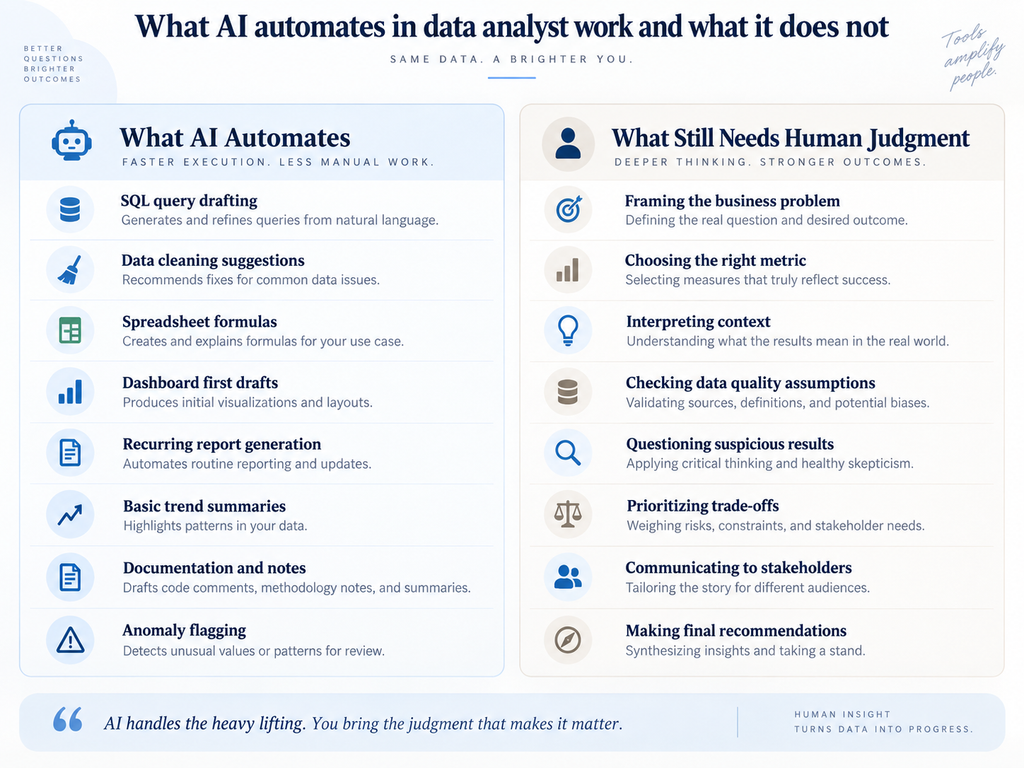
AI has genuinely changed this job. Drafting a query, writing a formula, suggesting a chart, summarising a table, and producing a first-pass report are all much faster than they were. It is worth being specific about where the work moved rather than waving the change away.
| Increasingly automated | Increasingly where the value sits |
|---|---|
| Writing repetitive formulas and first-draft queries | Deciding which question is worth asking |
| Producing first-draft summaries and commentary | Checking whether the answer is accurate and actually useful |
| Routine report refreshes and distribution | Designing KPIs and agreeing what a metric means |
| Basic anomaly flagging | Explaining cause, uncertainty, and what to do next |
| Simple chart generation | Storytelling, stakeholder alignment, and decision support |
The entry-level squeeze is real
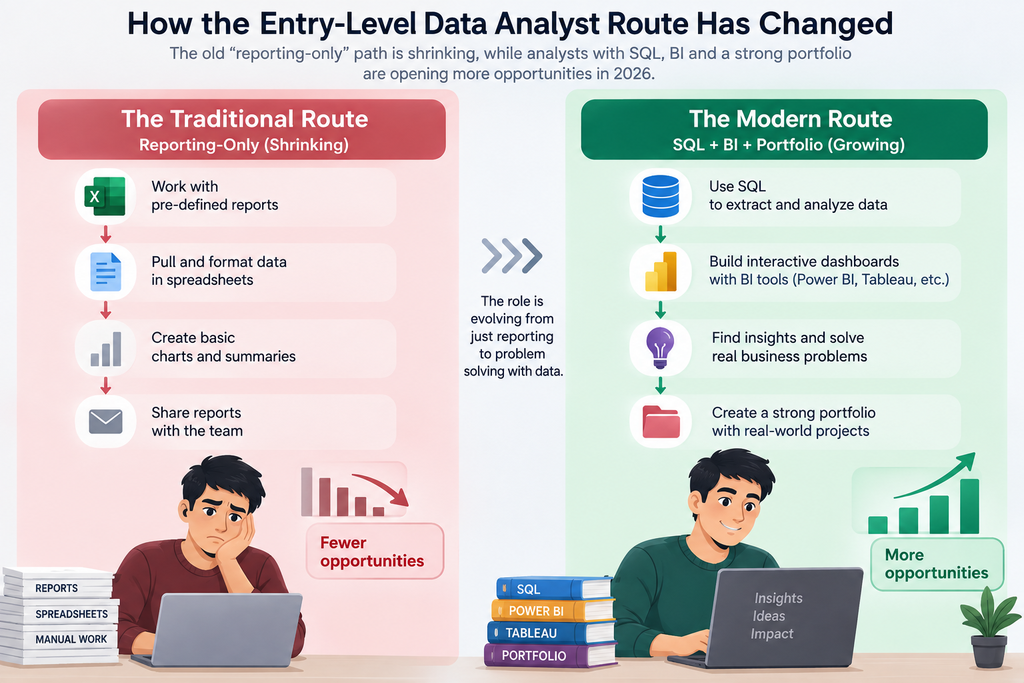
Most career articles stop at the reassuring half of that table. The honest addition is that the automated column used to be a job. Junior roles built around refreshing reports and reformatting spreadsheets were a common way into analytics, and there are fewer of them.
The World Economic Forum’s June 2026 report on AI and entry-level work, produced with PwC, found that more than one in three young workers globally are in occupations with medium to high exposure to AI-driven change in their tasks. The report frames the risk as a structural one across job access, job design, talent pipelines, and how education aligns with them. Read it at weforum.org.
What this means practically is narrow and useful: do not plan to enter on reporting skills alone. Enter with SQL you can be questioned on, one BI tool you know properly, and two or three projects you can defend. That combination is not what is being automated.
What the evidence says, and what to distrust
On the demand side, the most credible evidence is broad rather than precise. The World Economic Forum’s Future of Jobs Report 2025 found analytical thinking to be the most sought-after core skill among employers, described as essential by around seven in ten of those surveyed, with AI and big data at the top of its fastest-growing skills list. The combination matters more than either finding alone: it points towards people who can use the technology without handing over their reasoning to it.
On the India-specific side, be sceptical. Search for analytics job numbers and you will find claims of 11 million data jobs, 2.8 lakh open positions, 97,000 vacancies, and 34% year-on-year demand growth, mostly published by companies selling analytics courses, mostly uncited, and mutually inconsistent by an order of magnitude. Some may be broadly right. None should be the reason you choose a career.
A better test is one you can run yourself in twenty minutes. Search your target job titles on LinkedIn and Naukri, filter to entry level, and read thirty postings. Note which tools appear, what experience they ask for, and how many are remote. That tells you more about your actual market than any aggregate figure.
Who the job suits, and who it does not
Career advice usually skips this part. Analytics is a good career in general and a bad career for some people in particular, and the difference is predictable.
It tends to suit you if
- You are curious about why numbers move, not just what they are.
- You are willing to spend real time on data cleaning, which is genuinely most of the work.
- You like explaining things, and you are comfortable being questioned on your reasoning.
- You already understand a business domain, whether that is retail, finance, operations, healthcare, or marketing. Domain knowledge is scarce and hard to teach.
- You are happy being useful to a decision rather than owning it.
It tends not to suit you if
- You dislike detail-checking. Quietly wrong numbers are the main occupational hazard, and catching them is unglamorous.
- You find it hard to revise a conclusion when the evidence changes. Analysts are wrong in public fairly often.
- You want to build things rather than inform things. That instinct points towards engineering.
- You want to avoid stakeholder conversations. The technical work is maybe half the job.
- You are drawn mainly by salary figures. The realistic fresher range makes it a solid start, not a windfall.
You do not need to love mathematics. You do need patience and a tolerance for ambiguity.
What the role is becoming
One reason the “is analytics dying” question keeps circulating is that the job title is fragmenting. The work is increasingly advertised as analytics engineer, product analyst, decision scientist, business intelligence specialist, or AI-powered analyst. Each leans towards a different part of the same underlying job.
This matters for two practical reasons. If you search only for “Data Analyst” you will miss much of the market. And if you judge the field by the health of that one title, you will misread a role that is splitting as a role that is shrinking.
The direction of travel is consistent: away from producing reports, towards forecasting, monitoring, automation, and decision support. Analysts who make that move stay valuable. Analysts who do not are the ones competing with the automated column above.
The verdict
Data analytics is a good career in 2026 if you treat it as a decision-making profession rather than a tool-collection exercise. It is an average one if you collect certificates and hope the title carries you. The gap between those two outcomes is wider than it was five years ago, and that is the real change AI has brought.
If that sounds like work you would enjoy, the practical next questions are covered elsewhere: how to become a data analyst in India sets out the roadmap, timelines, interview rounds, and salary ranges by experience level; the beginner’s guide covers starting from a non-technical background; and AI course vs data analytics compares this path against AI engineering if you are still weighing the two.
If you would rather follow a structured route with live teaching and project feedback, OneLeap’s Strategic Data Analyst with AI is built around the business-first sequence described above: six months, weekend classes, seven modules, and seven real projects, with no prior coding experience required.
Frequently asked questions
Is data analytics still worth learning if AI can write SQL?
Yes, because writing the query was never the hard part. Deciding which question to ask, knowing whether the data can answer it, and spotting when the result is wrong are the skills that carry the job. An assistant that drafts SQL makes a good analyst faster and a weak one confidently wrong.
Is the Indian data analytics market saturated?
Entry level is crowded; experienced level is not. There are many candidates holding a certificate and a tutorial dashboard, and comparatively few who can write solid SQL, explain a business recommendation, and show work they actually own. The bar has risen rather than the openings disappearing.
Will entry-level analyst jobs disappear?
The narrowest version of the job is shrinking. Roles that consisted mainly of refreshing reports and reformatting spreadsheets are being automated, and that used to be a common way in. The realistic response is to enter with more than reporting: SQL depth, a BI tool, and a project you can defend.
Is data analytics a good career for freshers in 2026?
Yes, with a caveat. It remains one of the more accessible entry points into technology work, and it does not require a specific degree. But entering on Excel and basic reporting alone is no longer enough, so plan for SQL, a BI tool, and two or three documented projects before you start applying.
Is it too late to start in 2026?
No. Every tool in the analyst stack still has to be learned by someone, and AI has not removed the need for judgement about business data. What has changed is the starting bar, not the door.
Which has better prospects: data analytics, data science, or AI engineering?
They suit different people rather than ranking against each other. Analytics is the fastest route to a first role and is business-facing; data science adds statistical modelling; AI engineering is a software discipline with a higher technical ceiling and a longer runway. The choice should follow what you enjoy doing all day.

Leave a Reply