
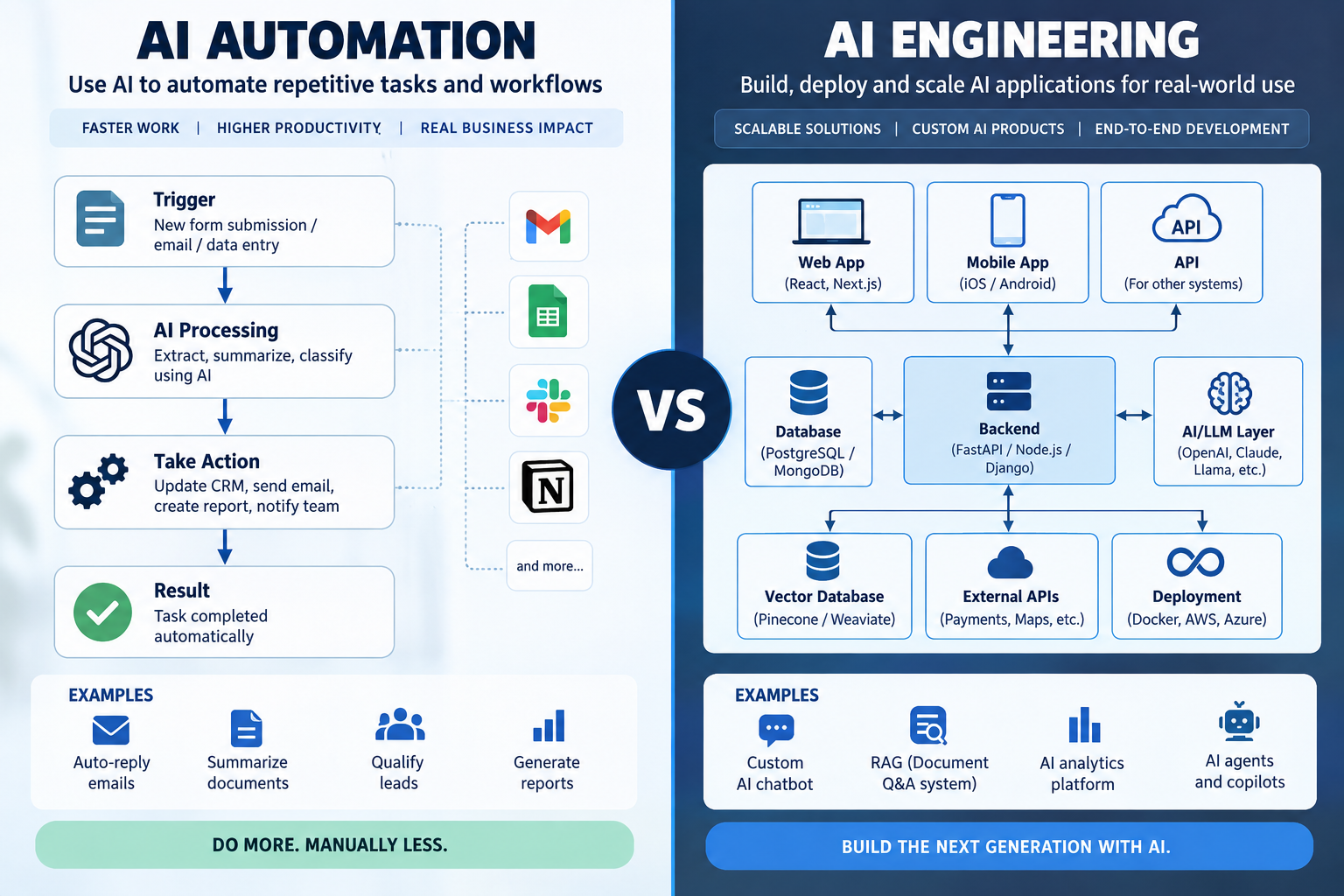
AI automation vs AI engineering: the direct answer
AI automation is about making an existing business process faster and more consistent by putting AI, APIs and workflow tools inside it. AI engineering is about building the AI product or system itself and keeping it reliable in production. Both use the same models. The difference is whether you are improving how work flows through a company, or building the thing the company sells.
The short version: choose automation if you like taking a broken process apart and putting it back together faster. Choose engineering if you like building software and care about why a system fails at three in the morning. Neither is the junior version of the other.
Key takeaways
- Automation in one line: you automate business workflows using AI, APIs, integrations and process design, and you are measured in hours saved and errors avoided.
- Engineering in one line: you build AI applications and systems RAG products, agents, APIs, evaluation pipelines, deployed services and you are measured on whether they hold up under real traffic.
- Entry difficulty differs: automation is a faster route in for process-minded professionals, while engineering asks for real programming and software fundamentals first.
- The overlap is large: AI literacy, data handling, business understanding, responsible use and a portfolio of working projects matter equally on both sides.
- On pay: automation often starts higher and plateaus earlier; engineering starts lower and has the higher ceiling, mainly because it leads into architecture and platform roles.
- The choice is not permanent: automation experience leads naturally into engineering, solutions architecture, product, analytics or AI operations.
Table of contents
- What is AI automation?
- What is AI engineering?
- Why this choice matters in 2026
- Key differences at a glance
- Day-to-day work
- Skills and tools
- Real-world examples
- Portfolio projects for each path
- Three projects and what they actually delivered
- Entry paths and backgrounds
- Salary and career growth in India
- Which career should you choose?
- How to start each path
- Choosing an AI course
- OneLeap learning paths
- Best practices
- Common mistakes
- Frequently asked questions
- Final thoughts
What is AI automation?
AI automation is the use of AI inside a workflow to remove manual, repetitive work. You connect models to the systems a business already runs a CRM, an inbox, a spreadsheet, a support desk, a document store so that a process that used to need a person at every step needs one only at the decisions that matter.
The craft is in the parts nobody demos. Trigger conditions, validation, fallback paths when the model is unsure, monitoring, and an approval gate on anything that touches money or a customer. “Adding ChatGPT to a workflow” is the easy 20% the rest is making it survive the inputs nobody anticipated.
What is AI engineering?
AI engineering is building AI-powered software that works in production and keeps working. That might be an enterprise RAG assistant, an agent with tools, a multimodal application, an evaluation system, or an AI API sitting behind a product interface.
It asks for deeper software engineering because the system has to hold up on quality, latency, cost, security, scale and failure recovery simultaneously. A large part of the job is judgement about approach: when to prompt, when to retrieve, when to fine-tune, when to write ordinary deterministic code, and when the right answer is to put a human in the loop.
Why this choice matters in 2026
A few years ago this was not a real fork in the road, because almost every AI job was an engineering job. That changed once the models became good enough to use off the shelf. The bottleneck moved from building models to wiring them into work that already exists, and a whole category of roles appeared that need API fluency and process judgement rather than a computer science background.
On volume, AI engineering roles are still advertised in larger numbers under that exact title. Automation work is often listed as something else Automation Specialist, RPA Developer, Solutions Engineer, Operations Analyst, or a process role with AI responsibilities bolted on so searching for “AI automation engineer” alone will badly understate what is available. Judge demand by the work described in the listing, not the title on it.
Key differences at a glance
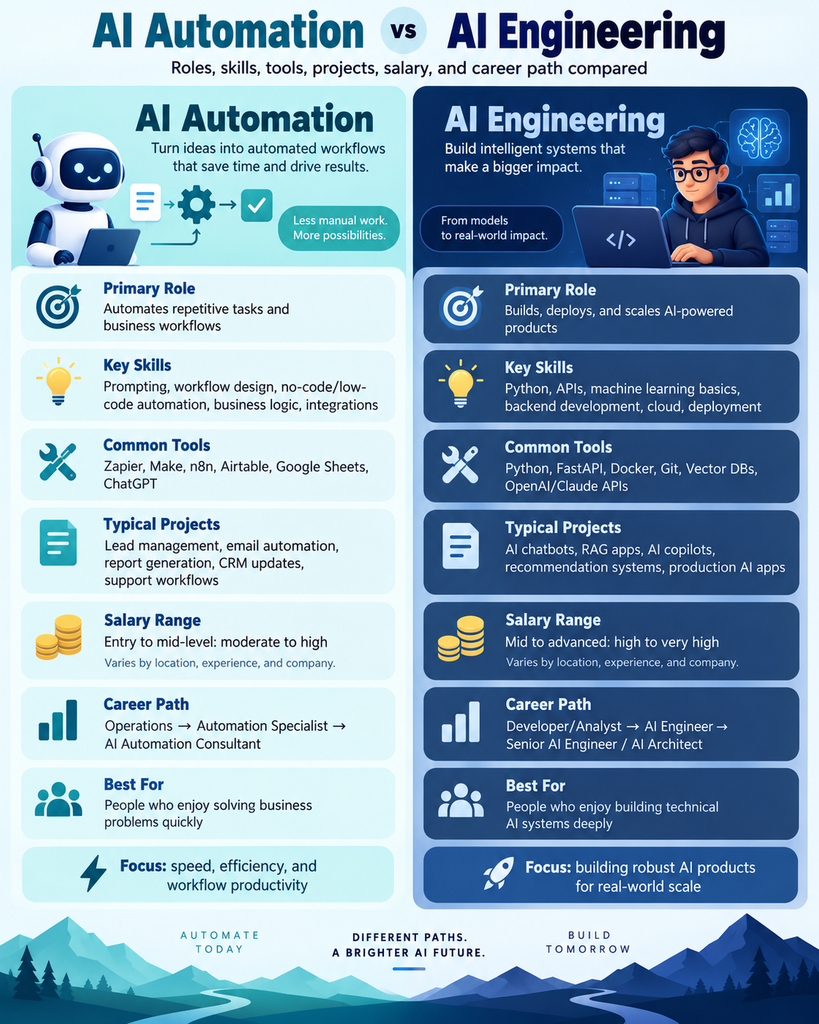
The clearest way to separate the two is by what you hand over when the work is finished. An automation professional hands over a process that now runs with less human effort. An AI engineer hands over a system that other software or customers depend on.
| Area | AI automation | AI engineering |
| Primary goal | Automate and improve business processes | Build and operate AI-powered products and systems |
| Typical output | Automated workflow, integrations, alerts, reports, process improvements | AI application, API, RAG system, agent, evaluation pipeline, deployed service |
| Core mindset | Process and operational efficiency | Software architecture, system quality, and product reliability |
| Programming depth | Low-code/no-code plus scripting can be sufficient for many roles | Strong Python and software engineering are usually essential |
| Common tools | n8n, Zapier/Make, APIs, webhooks, CRMs, spreadsheets, LLM APIs | Python, FastAPI, LLM APIs, vector databases, LangGraph, Docker, cloud tools |
| Key risks | Broken workflow, incorrect routing, permissions, poor handoffs | Hallucinations, retrieval failure, latency, cost, security, scalability, unsafe outputs |
| Best fit | Process thinkers, operations professionals, analysts, builders who enjoy integration | Developers and technical builders who enjoy code, systems, and product development |
Read the “programming depth” row carefully, because it is the one that determines whether a path is realistic for you this year rather than in three years.
Day-to-day work
Job descriptions blur together. A week does not. Here is what each role is actually doing when nobody is writing a LinkedIn post about it.
| AI automation engineer | AI engineer |
| Map a manual business process and identify automation opportunities. | Define an AI product problem, architecture, constraints, and success metrics. |
| Connect triggers, forms, CRMs, email, databases, and AI models through APIs or workflow tools. | Build backend services, model integrations, retrieval pipelines, interfaces, and data flows. |
| Write prompts and transformation logic for classification, extraction, summarisation, or routing. | Design prompts, structured outputs, retrieval, agents, tool use, and evaluation methods. |
| Test edge cases, approvals, permissions, retries, and workflow failures. | Test answer quality, grounding, latency, cost, security, and system reliability. |
| Track time saved, reduced errors, faster response time, and adoption. | Monitor performance, user outcomes, costs, errors, and production incidents. |
The rhythm differs as much as the content. Automation work tends to arrive as discrete requests with a visible finish line, which suits people who like closing things. Engineering work is longer-running and rarely finished a system you shipped in March is still yours in November.
Skills and tools
The skill lists overlap more than the job titles suggest. The difference is depth, not territory: both paths need Python, both need to understand how a model behaves, and both need someone to explain the result to a non-technical stakeholder.
| Skill area | AI automation path | AI engineering path |
| Programming | Basic to intermediate Python or JavaScript is valuable; scripting helps. | Strong Python, data structures, OOP, testing, Git, APIs, and backend fundamentals. |
| AI usage | Prompt design, structured outputs, function calling, model selection basics. | Prompting, LLM APIs, embeddings, RAG, agents, evaluation, fine-tuning basics. |
| Data | Spreadsheets, JSON, databases, data cleaning, CRM fields and records. | SQL, databases, vector stores, data pipelines, document ingestion, embeddings. |
| Workflow and integration | n8n, Zapier/Make, webhooks, API integrations, scheduling, error handling. | Workflow orchestration, agent graphs, APIs, backend services, queues, event-driven systems. |
| Deployment | Credentials, permissions, workflow monitoring, logs, secure automation operations. | Docker, cloud, CI/CD, observability, caching, rate limits, performance optimisation. |
| Business skills | Process mapping, ROI, stakeholder requirements, change management. | Product thinking, system design, requirements, technical documentation, trade-off analysis. |
If you are starting from zero, the honest read is that the automation column is roughly six months of focused work and the engineering column is closer to twelve to eighteen. That is the real trade-off behind “which is easier to enter”.
Real-world examples
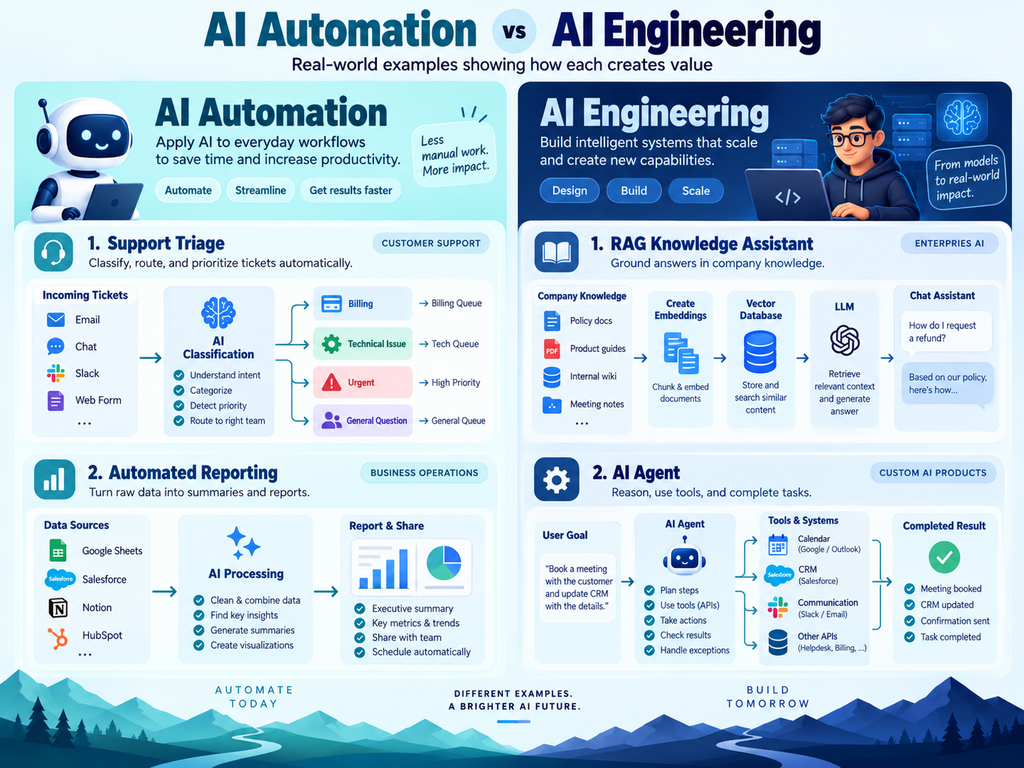
AI automation examples
The patterns that come up again and again in automation work:
| Use case | How the automation works | Business outcome |
| Customer-support triage | A new ticket triggers an AI classifier that detects intent and urgency, suggests a response, routes it to the right team, and asks a human to approve high-risk replies. | Faster first response, more consistent routing, less manual sorting. |
| Sales lead enrichment | A form submission triggers enrichment from approved data sources, an AI summary of the company and use case, CRM record creation, and a personalised follow-up draft. | Sales teams receive better-qualified context without repetitive research. |
| Invoice and document processing | A workflow extracts fields from incoming documents, validates totals and required fields, sends exceptions for review, and updates an accounting or tracking system. | Lower data-entry effort and clearer exception handling. |
| Weekly performance reporting | Data is pulled on a schedule, KPIs are calculated, an AI summary drafts highlights and anomalies, and the report is delivered to stakeholders. | Reporting becomes faster and more consistent while humans retain review control. |
AI engineering examples
And the equivalent patterns on the engineering side:
| Use case | How the system works | Engineering challenge |
| Enterprise RAG knowledge assistant | Documents are cleaned, chunked, embedded, retrieved, reranked, and cited so employees can ask grounded questions about approved internal knowledge. | Retrieval quality, source citations, access control, evaluation, latency, and data freshness. |
| AI-powered SaaS feature | A product uses LLM APIs and structured outputs to generate drafts, classify content, or guide users through a task within an authenticated application. | API design, user experience, validation, cost control, rate limits, and observability. |
| Research agent with tools | An agent plans research steps, calls approved search or database tools, synthesises findings, and produces a structured report with human review gates. | Tool reliability, state management, hallucination control, citations, safety, and workflow recovery. |
| Multimodal quality-assurance system | A system uses vision-language models to inspect images or documents, extract relevant details, and send uncertain cases to human reviewers. | Accuracy thresholds, dataset quality, model choice, privacy, and escalation logic. |
Portfolio projects for each path
A portfolio is the fastest way to make the choice concrete. Read both columns and notice which one you would rather spend a weekend on that reaction is better career advice than any comparison table.
| AI automation portfolio | AI engineering portfolio |
| Lead-routing workflow with validation, CRM integration, AI qualification, human approval, and a dashboard showing time saved. | Production-style RAG assistant with citations, evaluation dataset, access control, retrieval metrics, and deployed demo. |
| AI-powered reporting workflow that pulls data, calculates KPIs, drafts a summary, flags anomalies, and sends approval-ready reports. | Full-stack AI application with authentication, API backend, database, structured outputs, testing, and monitoring. |
| Customer-support automation with classification, sentiment/priority routing, escalation rules, and audit logs. | Tool-using agent with stateful workflow, approvals, error handling, and evaluation of task completion. |
| Document-processing workflow with extraction, validation, exception queues, and secure storage. | Model evaluation dashboard that tracks accuracy, hallucination/grounding, cost, latency, and regression tests. |
Three projects and what they actually delivered
The tables above are patterns. These three are shaped like real engagements the problem, what was built, and what changed with one from each side and one that started as automation and outgrew it. They are composites of common engagements rather than named clients, and the figures are representative rather than audited.
Automation: a distributor losing deals to slow quotes
- The problem: a B2B industrial distributor received requests for quotation as emails and PDF attachments in no consistent format. Two people spent their mornings matching described items to catalogue SKUs, pricing them from a rate card, and typing up a quote. Average turnaround was two days, and the sales team knew they were losing orders to whoever replied first.
- What was built: a workflow that read each incoming RFQ, extracted the line items with an LLM, matched them against the product catalogue, priced them from the current rate card, and produced a draft quote. Anything it could not match confidently, and anything above a value threshold, went to a human with the uncertain lines highlighted.
- The result: turnaround dropped from about two days to roughly three hours, and the two coordinators moved to handling exceptions and following up on sent quotes. The win rate on contested RFQs improved noticeably, for the unglamorous reason that they were now usually first to respond.
- Why this is automation, not engineering: nothing novel was built. The value came from mapping the process properly, deciding where the confidence threshold sat, and putting the approval gate on anything expensive.
Engineering: a parts catalogue nobody could search
- The problem: an industrial parts supplier had 90,000 SKUs behind a keyword search that only worked if you already knew the part number. Customers described what they needed in plain language, got nothing, and phoned instead. Search abandonment was high and the call centre was absorbing the cost.
- What was built: a hybrid retrieval system combining keyword matching with embeddings over cleaned product descriptions and specifications, a reranking layer, and a fallback that asked a clarifying question rather than returning an empty page. An evaluation set of several hundred real customer phrasings, labelled with the correct part, was built before any of it shipped and became the regression test for every subsequent change.
- The result: search success on plain-language queries rose from roughly a third to about four in five, self-serve orders increased, and inbound “help me find this part” calls fell by around a quarter. Median search latency stayed under 400 milliseconds, which was a hard requirement.
- Why this is engineering: the evaluation set, the latency budget, the reranking and the fallback behaviour are all system-design decisions. No workflow tool would have got there.
Where automation ends: a staffing firm that outgrew its workflow
- The problem: a recruitment firm automated its first-pass CV screening with a workflow tool parse the CV, score it against the job description with an LLM, route the top candidates to a recruiter. It worked well enough to cut screening time substantially in the first month.
- Where it broke: recruiters began noticing the scoring was inconsistent between similar candidates, and nobody could explain why a particular CV had been rejected. There was no evaluation set, no way to test a prompt change without breaking something else, and no audit trail which is a serious problem when screening decisions are involved.
- What it took to fix: a labelled set of past decisions to measure the scorer against, structured outputs with explicit reasons rather than a bare number, versioned scoring logic so changes could be tested before release, and logging of every decision. That work is engineering, and the workflow tool could not carry it.
- The lesson: automation gets you to value fast, and then hits a ceiling the moment the decisions matter enough to need testing and explaining. This is the most common reason automation professionals start learning engineering and the most persuasive argument for doing both.
Read across the three and the boundary becomes visible. Automation is the right tool while the process is the problem. Engineering becomes necessary the moment the system itself has to be measured, tested and defended.
One project done properly, with the failures documented, beats four half-finished ones on either side. Employers read depth, not count.
Entry paths and backgrounds
Automation is unusually open to people without a computer science degree: analysts, operations and sales-operations staff, marketers, no-code builders, and developers who want to work closer to the business. Start with a workflow tool, APIs, data basics, prompting and a scripting language, then build small automations with a number attached to each one.
Engineering suits people who genuinely enjoy code and debugging: software developers, CS and IT graduates, ML engineers, data scientists, and technical career switchers willing to put in the foundation work. Python, Git, APIs, SQL and software design come first attempting RAG and agents before those are solid is the most common way people stall.
Salary and career growth in India
Pay varies by company type more than by anything else, and remote hiring has loosened the link between location and salary. The bands below are India-wide planning estimates for annual CTC, aligned with the figures used across our other 2026 guides.
| Career stage | AI automation engineer | AI engineer |
| Fresher / 0–2 years | ₹8–12 LPA in dedicated roles; internships and adjacent process roles start lower | ₹6–10 LPA |
| Mid-level / 3–6 years | ₹18–28 LPA for professionals who own integrations and can show measurable outcomes | ₹12–25 LPA |
| Senior / 7+ years | ₹30–50 LPA+ in automation leadership, solutions or platform roles | ₹30–60 LPA+, with GenAI and platform specialists above this |
Figure: India-wide salary benchmarks for 2026, compiled from Masai School, Taggd and EICTA (IIT Kanpur) salary guides (see Sources and references). Automation figures are directional, as fewer published guides track that title separately.
Read those two columns together and the shape becomes clear. Automation often pays better in the first few years, because the skills are quicker to acquire and the business impact is easy to point at. Engineering starts lower and overtakes it, because it opens into architecture, AI platform and engineering leadership, where the senior bands run higher and further. Automation has its own senior track automation leadership, solutions architecture, AI operations, AI product but the very top of the range is narrower.
If you are choosing on money alone, that is the actual trade-off: a faster start against a higher ceiling. Most people find their interests decide it long before the numbers do.
Which career should you choose?
Choose AI automation if you…
- Enjoy improving workflows and eliminating repetitive work.
- Prefer practical business processes, integrations, and fast iteration.
- Like connecting tools, APIs, data, and teams.
- Want to start with lower-code or no-code tools while gradually building scripting ability.
- Can explain value through time saved, reduced errors, faster turnaround, or better employee/customer experience.
Choose AI engineering if you…
- Enjoy coding, debugging, architecture, and technical depth.
- Want to build AI applications, RAG systems, agents, APIs, or AI-enabled products.
- Are willing to build strong foundations in Python, data structures, databases, APIs, and deployment.
- Care about model quality, evaluation, cost, latency, safety, monitoring, and scale.
- Want to grow toward senior engineering, MLOps, AI platform, applied AI, or architecture roles.
You can combine both paths if you…
The hybrid route is underrated, and it is the one most senior practitioners end up on. A good progression is to start with automation, ship things, then add depth as you hit its limits exactly the arc of the staffing-firm example above. Consider it if you:
- Want to deliver end-to-end solutions rather than hand off at a boundary.
- Already work in operations, analytics or support and can see the processes worth fixing.
- Enjoy shipping quickly but keep running into the limits of what a workflow tool can do.
- Want the fastest possible route to a first AI role, with the option of depth later.
- Are aiming at solutions architecture or AI operations, where both skill sets are expected.
If neither path sounds right and you lean towards the business side, the third option is product: see AI product manager skills in 2026
How to start each path
AI automation roadmap
- Learn process mapping, KPIs, and basic data concepts.
- Choose a workflow tool and build simple trigger-action automations.
- Learn APIs, webhooks, JSON, authentication, and basic error handling.
- Add LLM prompts, structured outputs, classification, extraction, and human approval steps.
- Build three portfolio workflows tied to real business outcomes.
- Add Python or JavaScript to extend workflows and handle complex logic.
- Learn monitoring, documentation, permissions, data privacy, and AI governance.
AI engineering roadmap
- Master Python, data structures, OOP, Git, APIs, SQL, and backend basics.
- Learn ML and deep-learning foundations, including transformers and embeddings.
- Build LLM applications with structured outputs, retrieval, and evaluation.
- Build RAG systems with document processing, vector retrieval, reranking, citations, and quality tests.
- Learn agent workflows, tool use, state management, and approval patterns.
- Deploy applications with APIs, Docker, cloud infrastructure, monitoring, caching, and guardrails.
- Publish three to five substantial projects with architecture diagrams, READMEs, demos, and lessons learned.
For a full breakdown of what AI engineering employers actually test for, read our guide to becoming an AI engineer, including the six-phase roadmap
Choosing an AI course
The best AI course is the one that matches your target path and produces evidence of capability. For automation, look for business-process design, workflow tools, APIs, AI integration, real use cases, governance, and portfolio support. For engineering, look for Python, ML foundations, LLM applications, RAG, agents, evaluation, safety, deployment, and production projects.
- Check that the curriculum includes real projects, not just tool demonstrations.
- Look for live feedback, mentorship, portfolio reviews, and interview preparation.
- Assess instructor credibility and whether the programme covers practical trade-offs and real workplace constraints.
- Choose a course whose prerequisites match your current level.
- Prioritise programmes that teach responsible AI, validation, documentation, and measurable outcomes.
OneLeap learning paths
For the AI engineering path, OneLeap’s AI Engineering Mastery programme is designed to progress from ML and deep-learning foundations to advanced prompt engineering, AI product development, production RAG, fine-tuning, agents, multi-agent systems, safety, observability, deployment, optimisation, and multimodal AI. It includes live learning, production-grade projects, mentorship, and career support.
Explore the engineering programme: OneLeap AI Engineering Mastery
For the AI automation path, OneLeap’s Strategic Data Analyst with AI programme builds business acumen, statistical judgment, AI fluency, Excel, SQL, Python, Power BI, AI knowledge systems, forecasting, and intelligent automation. It is designed around business-first, AI-powered workflows and portfolio-ready projects.
Explore the analytics and automation-aligned programme: OneLeap Strategic Data Analyst with AI
Best practices
- Start with a real business problem instead of a technology demo.
- Add human approval and clear escalation paths to high-impact automations.
- Measure quality, time saved, errors, latency, cost, and user satisfaction.
- Treat AI outputs as drafts that need validation, especially in customer-facing or high-risk workflows.
- Document your architecture, trade-offs, failures, and improvements in every portfolio project.
- Learn enough business context to explain why a workflow or AI product matters.
Common mistakes
| Mistake | Why it costs you |
| Thinking automation is not technical | Reliable workflows need API knowledge, data handling, permissions, error handling and security discipline. The no-code label describes the interface, not the difficulty. |
| Thinking engineering is just calling an API | Anyone can get an answer out of a model. Production systems need retrieval, evaluation, safety, deployment and monitoring, and that is where the entire job lives. |
| Choosing on salary headlines | The bands overlap heavily and depend more on company type than on which path you picked. Choosing against your interests to chase a number rarely survives the first hard year. |
| Building another generic chatbot | Every reviewer has seen fifty. A narrow project solving a specific business problem, with a number attached, outperforms it on both paths. |
| Shipping AI output without validation | Unchecked model output in a customer-facing or high-risk workflow is the failure mode that ends projects. Approval gates and evaluation are not optional extras. |
| Not documenting the work | Undocumented projects are invisible to employers. A short write-up covering architecture, trade-offs and what went wrong is often more persuasive than the code. |
| Treating the choice as permanent | People move between these paths constantly. Picking one to start is a decision about the next twelve months, not the next decade. |
Frequently asked questions
Is AI automation the same as AI engineering?
No. AI automation focuses on improving business processes with AI, workflows, integrations, and operational logic. AI engineering focuses on building and operating AI-powered software products and systems. The paths overlap but require different depths of programming and system design.
Which is easier to start: AI automation or AI engineering?
AI automation is often easier to enter because you can start with process thinking, workflow tools, APIs, prompts, and basic scripting. AI engineering usually requires stronger programming and software foundations, but it can offer deeper technical specialisation.
Can an AI automation engineer become an AI engineer?
Yes. Automation experience builds useful skills in APIs, data flows, prompts, tool use, workflows, and business requirements. To transition, add Python depth, SQL, software engineering, RAG, evaluation, deployment, monitoring, and system design.
What does an AI automation engineer earn in India?
India-wide planning estimates put dedicated AI automation roles at roughly ₹8–12 LPA early career, ₹18–28 LPA at mid level, and ₹30–50 LPA or more at senior level. Much automation work is advertised under other titles at lower bands, so compare the responsibilities in a listing rather than the title.
What does an AI engineer earn in India?
India-wide planning estimates put AI engineering at roughly ₹6–10 LPA for freshers, ₹12–25 LPA at mid level, and ₹30–60 LPA or more at senior level. Generative AI, cloud, MLOps and production deployment experience move you up these bands faster than years served.
Which OneLeap programme should I choose?
Choose AI Engineering Mastery if you want to build and deploy AI systems such as RAG applications, agents, and production AI services. Choose Strategic Data Analyst with AI if you want a business-first path focused on AI-powered analytics, dashboards, forecasting, and intelligent automation.
Final thoughts
Both paths are real careers, and neither is the lesser version of the other. Automation changes how work moves through a company; engineering builds the systems that make new things possible. Pick based on which kind of problem you want to spend your days on, then build two or three projects with numbers attached to them. The projects will settle the question faster than any comparison table, including the ones above.
If you want to build production AI systems, explore OneLeap’s AI Engineering Mastery. If you want to master AI-powered analytics and intelligent business workflows, explore Strategic Data Analyst with AI.
Explore AI Engineering Mastery: AI Engineering Mastery
Explore Strategic Data Analyst with AI: Strategic Data Analyst with AI

Leave a Reply