
Introduction
A data analyst can move into high-growth careers. Here are ten options:
* Data Scientist
* Analytics Engineer
* Data Engineer
* Business Analyst
* Product Manager
* AI/ML Engineer
* Data Architect
* Marketing Analyst
* Financial Analyst
* Healthcare Data Analyst
These roles give you pay a bigger say in company decisions and a chance to work with new technologies like Artificial Intelligence and machine learning as a Data Scientist or work on data projects as a Data Engineer.
You can have an impact as a Product Manager or Business Analyst.
The field of data analysis also includes roles, like Marketing Analyst and Financial Analyst.
Additionally you can work in the healthcare field as a Healthcare Data Analyst.
Key Takeaways
• Data analysts can move into different jobs, not just the usual reporting roles.
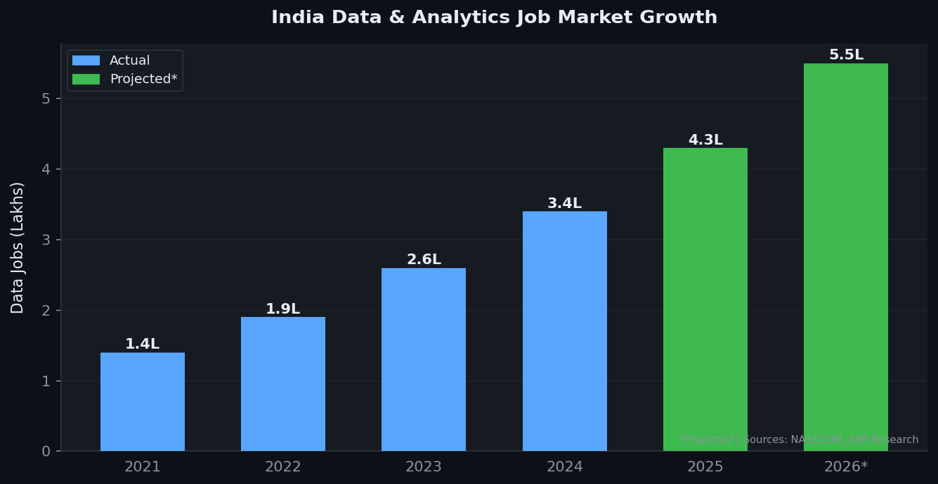
• Data Science, Analytics Engineering and Data Engineering are really in demand for 2025 and 2026.
• Jobs like Product Manager and Strategy Analyst can lead to leadership roles.
• Knowing an area like Healthcare, Finance or Marketing can make you more, in demand and increase your salary.
• Learning Python, SQL, Machine Learning and cloud platforms is important to move in your career.
• OneLeap Dehradun has courses that match what the industry needs to help data analysts get into these growing roles.
What Is a Data Analyst Career Path?
A career as a data analyst is a path that people follow to move from data analysis jobs to more advanced jobs like Data Scientist, Analytics Engineer, Data Engineer or leadership roles in business. This path includes moving to higher positions like going from a Senior Analyst to a Lead to a Manager and it also includes switching to different areas of work that are related to data analysis, such, as specialized domains. Data analyst careers can be very rewarding. Can lead to many different types of jobs including Data Scientist and Data Engineer roles..
Why Career Progression Matters for Data Analysts
For Data Analysts
| Benefit | Impact |
| Higher salaries | Senior and specialized roles pay 30–100% more than entry-level analyst roles |
| Strategic impact | Move from reporting to decision-making and product strategy |
| Future-proofing | AI/ML and data engineering roles are growing faster than traditional analytics |
For Businesses
| Benefit | Impact |
| Data leadership | Skilled analysts who progress become data leaders, driving better ROI from data investments |
| Reduced turnover | Reduced turnover when analysts see clear growth paths |
| Better accuracy | Domain experts (Healthcare, Finance) deliver more accurate insights |
How Data Analysts Transition to Next Roles
Step 1: Skills Audit
Assess current skills in Excel, SQL, Power BI/Tableau, and Python:
| Skill | Check If You Can Do This |
| Building dashboards | Building dashboards in Power BI or Tableau |
| Writing SQL queries | Writing basic SQL queries |
| Presenting insights | Presenting insights to your team |
| Learning Python | Curious about learning Python |
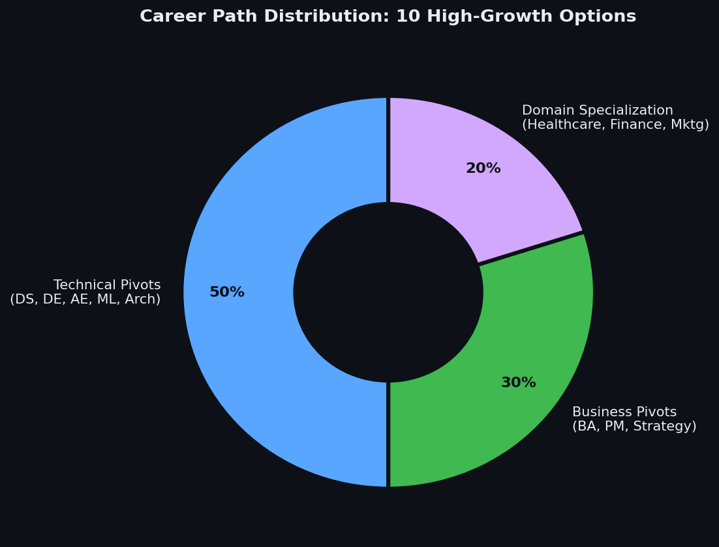
Step 2: Choose Your Path
| Path Type | Options |
| Technical Pivot | Data Science, Data Engineering, Analytics Engineering |
| Business Pivot | Product Manager, Business Analyst, Strategy |
| Domain Specialization | Healthcare, Finance, Marketing |
Step 3: Upskill Strategically
| Skill | For What Path |
| Python | Automation and advanced analysis |
| SQL | Database queries |
| ML/AI | Data Science path |
| Cloud (AWS/Azure) | Data Engineering |
Step 4: Build a Portfolio
Showcase real-world projects with different data types, questions, and visualizations.
Step 5: Apply & Network
- Attend industry conferences
- Join Slack groups, Reddit forums, local meetups
- Reach out to professionals on LinkedIn
The 10 High-Growth Career Options
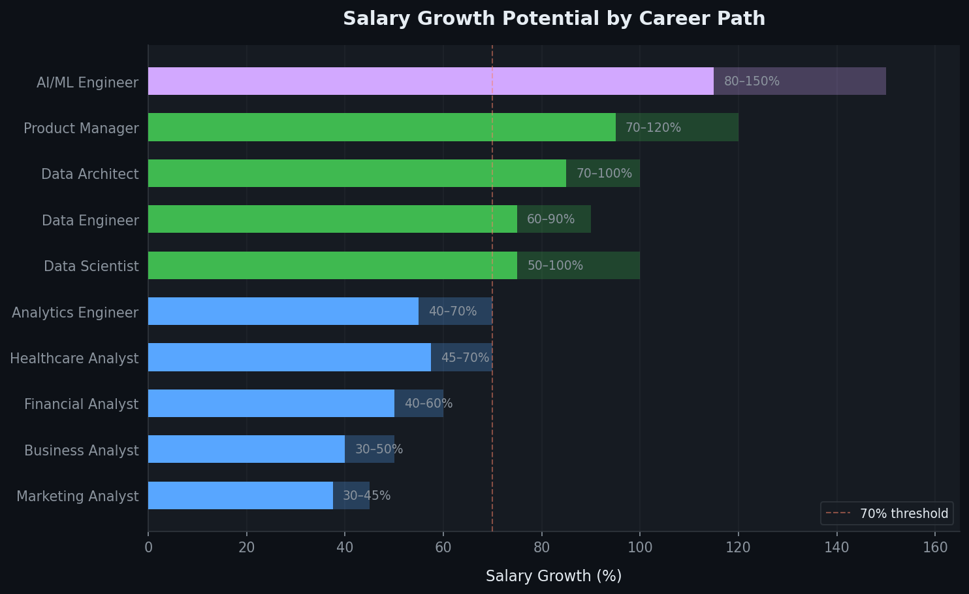
| Career Path | What You Do | Key Skills | Salary Growth | |
| 1 | Data Scientist | Build predictive models, use ML for forecasting | Python, ML, Statistics, SQL | 50–100% higher |
| 2 | Analytics Engineer | Create clean data models, metrics, definitions | SQL, Data Modeling, BI Tools | 40–70% higher |
| 3 | Data Engineer | Build data pipelines, infrastructure, scale | Python, SQL, Cloud (AWS/Azure) | 60–90% higher |
| 4 | Business Analyst | Fix broken processes, shape business strategy | Excel, Power BI, SQL, Python | 30–50% higher |
| 5 | Product Manager | Lead product decisions using data insights | Strategy, Data, User Research | 70–120% higher |
| 6 | AI/ML Engineer | Build AI systems, neural networks, automation | Python, Deep Learning, ML | 80–150% higher |
| 7 | Data Architect | Design data systems everyone builds on | SQL, Cloud, System Design | 70–100% higher |
| 8 | Marketing Analyst | Track ad performance, customer behavior | Power BI, Google Analytics, Excel | 30–45% higher |
| 9 | Financial Analyst | Manage budgets, investments, risk | Advanced Excel, SQL, Finance | 40–60% higher |
| 10 | Healthcare Data Analyst | Analyze patient outcomes, hospital data | Python, Tableau/Power BI, Stats | 45–70% higher |
Tools & Technologies for Each Path
| Career Path | Primary Tools |
| Data Scientist | Python, TensorFlow, Scikit-learn, SQL |
| Analytics Engineer | SQL, dbt, Data Modeling, Power BI |
| Data Engineer | Python, SQL, Apache Spark, AWS/Azure/GCP |
| Business Analyst | Excel, Power BI, SQL, Python, Visio |
| Product Manager | Data tools, A/B testing, User Research tools |
| AI/ML Engineer | Python, PyTorch, TensorFlow, Kubernetes |
| Data Architect | SQL, Cloud platforms, System design tools |
| Marketing Analyst | Google Analytics, Power BI, Excel |
| Financial Analyst | Advanced Excel, SQL, Finance software |
| Healthcare Analyst | Python, Tableau/Power BI, SPSS |
Real Examples: Data Analyst Success Stories
Example 1: Data Analyst → Data Scientist (E-commerce)
Problem:
Raksha works as a data analyst at an e-commerce company in Delhi. She was only able to make sales dashboards. Raksha could not make models that predict when customers will stop buying from the company or when the company will run out of things to sell. This was holding back Rakshas career and the amount of money she could earn which was ₹4.5 LPA.
Solution:
Raksha learned Python and some other tools like Scikit-learn and TensorFlow to make models that can predict things. Raksha made a model that can predict when customers will stop buying from the company using information from than 50,000 customers. Raksha also worked on six projects that used data, from the real world and the data was not very clean or easy to use.
Result & Impact:
| Metric | Outcome |
| Salary | ₹4.5 LPA → ₹9.2 LPA (50% increase) |
| Churn Model Accuracy | 87% |
| Inventory Forecast Precision | 92% |
| Business Impact | Company saved ₹28M annually from reduced stockouts |
| Time to Transition | 8 months |
Example 2: Data Analyst → Analytics Engineer (Healthcare)
Problem:
Amit, a data analyst at a healthcare startup in Dehradun spent six hours every day cleaning messy patient data.
His team at the healthcare startup in Dehradun had no trusted metrics.
The leadership at the healthcare startup in Dehradun could not make data-driven decisions about patient data.
Solution:
Amit mastered SQL data modeling and dbt which’s a data build tool.
He created patient outcome metrics for the healthcare startup in Dehradun.
Amit built automated data pipelines for the healthcare startup, in Dehradun.
Result & Impact:
| Metric | Outcome |
| Salary | ₹6 LPA → ₹8.5 LPA (40% increase) |
| Data Cleaning Time | 6 hours → 45 minutes/day |
| Dashboard Churn | Decreased by 40% |
| Reporting Errors | Reduced by 65% |
| Time to Transition | 6 months |
Example 3: Data Analyst → Product Manager (Tech Company)
Problem:
Priya works as a data analyst at a tech company in Uttarakhand. She was only able to report on user metrics. She had no say in product decisions. This made her feel like she was stuck just looking at numbers on a screen all day with no influence on the company. She was earning ₹5 LPA. She felt like she was not making a difference.
Solution:
Priya took it upon herself to learn about A/B testing and user research methods. She used the things she learned to build a product recommendation engine using the insights she got from the data. Then she presented a product strategy that was based on data, to the CEO and the board of the company
.Result & Impact:
| Metric | Outcome |
| Salary | ₹5 LPA → ₹14 LPA (180% increase) |
| App Retention | Increased by 28% |
| App Downloads | Increased by 42% |
| Company Revenue | Grew ₹45M from new features |
| Time to Transition | 10 months |
Comparison: Technical vs Business Career Paths
| Factor | Technical Paths (DS, DE, AE) | Business Paths (BA, PM, Strategy) |
| Focus | Models, pipelines, systems | Strategy, decisions, stakeholders |
| Skills | Python, ML, Cloud, SQL | Excel, Communication, Strategy |
| Salary Growth | 50–150% | 30–120% |
| Impact | Infrastructure & prediction | Business decisions & teams |
| Best For | Coders who love tech | Leaders who love strategy |
Best Practices: Actionable Recommendations
| Best Practice | Why It Matters | |
| 1 | Do a skills audit before choosing your path | Prevents wrong direction |
| 2 | Pick based on curiosity, not clout | Follow what excites you |
| 3 | Build a portfolio with real-world messy data | Shows job-ready skills |
| 4 | Practice smartly — avoid copy-paste projects | Real learning |
| 5 | Master 1–2 tools deeply | Better than shallow learning |
| 6 | Attend conferences and join communities | Network building |
| 7 | Network on LinkedIn and reach out to professionals | Missed opportunities |
| 8 | Update resume & LinkedIn regularly | Job-ready presence |
| 9 | Teach others or blog about your work | Become thought leader |
| 10 | Take industry-aligned courses like OneLeap Dehradun | Job-ready skills |
Common Mistakes to Avoid
| Mistake | Why It’s Bad | Fix |
| ❌ Copy-paste projects | No real learning | Use messy real-world data |
| ❌ Perfect pre-cleaned datasets | Not job-ready | Work with messy data |
| ❌ Learning too many tools shallowly | No mastery | Master 1–2 tools deeply |
| ❌ Ignoring Python | Limited automation | Add Python at the right stage |
| ❌ No portfolio | Can’t prove skills | Build 5+ real projects |
| ❌ Not networking | Missed opportunities | Join LinkedIn, meetups |
| ❌ Jumping paths without audit | Wrong direction | Do skills audit first |
| ❌ Choosing based on salary only | Burnout | Follow curiosity |
FAQs
Q1. What is the next step after being a data analyst?
Well if you are a data analyst your next steps could be: Data Scientist, Analytics Engineer, Data Engineer. These roles are more technical.
If you are more interested, in business you could consider: Business Analyst &Product Manager. These roles help you grow in the business side of things.
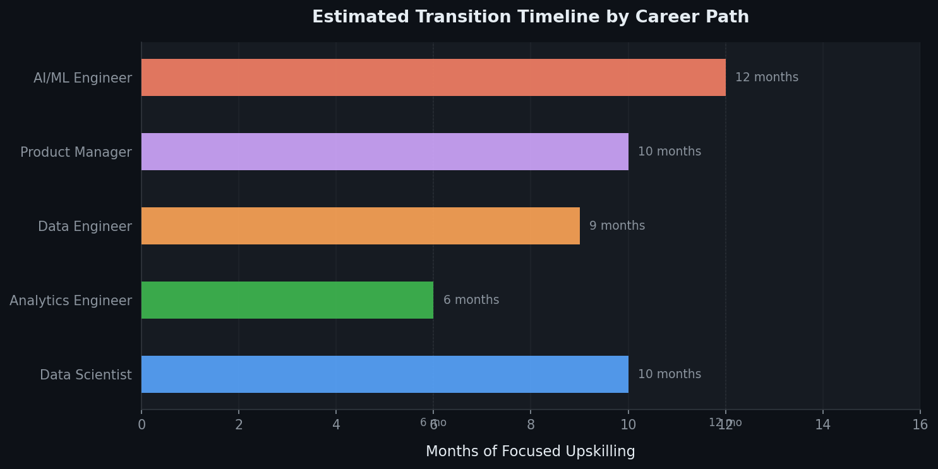
Q2. How long does it take to transition from data analyst to data scientist?
You usually need to spend around 6 to 12 months learning and getting better at Python and machine learning and statistics. This is what people typically do when they want to get good at Python and machine learning and statistics. You have to focus on Python and machine learning and statistics for 6 to 12 months to get the skills you need.
Q3. Which career path pays the most for data analysts?
The salary of an AI/ML Engineer and a Product Manager can really go up a lot. We are talking about an increase of 80 to 150 percent. This is a jump, for an AI/ML Engineer and a Product Manager. An AI/ML Engineer and a Product Manager can see their salary grow by an amount.
Q4. Do I need a master’s degree to become a data scientist?
No a lot of companies think that the skills you have and the work you have done are more important than where you went to school. Having a masters degree can still be helpful though. Companies like to see that you have skills and a portfolio that shows what you can do. That is often more important, than a formal education. Many companies value skills and portfolio over education.
Q5. What skills do data analysts need to progress?
Python, SQL, ML, data modeling, cloud platforms (AWS/Azure) and visualization tools.These skills are needed by a data analyst to progress in career.
Q6. Can data analysts become product managers?
Data analysts really have a base for handling products because they make decisions based on the information they get from data. This is what we call data driven decision making. Data analysts are very good at this kind of thing. They use data to help them make the choices, for product management. Data driven decision making is a part of what data analysts do.
Q7. Is analytics engineering better than data engineering?
Analytics engineering is really popular among analysts who work with business intelligence. On the hand data engineering is a better fit, for people who focus on building and maintaining infrastructure.
Q8.What courses should I take to transition?
You should enroll in courses that are related to the industry like the ones offered by OneLeap Dehradun. They have courses like Strategic Data Analyst with AI , AI Engineering Mastery & AI for Product Managers . These courses will help you get the skills that you need to be ready, for a job.
Q9. Does domain specialization help data analysts?
Specializing in things like Healthcare or Finance or Marketing can really make a difference. It can increase the demand for people with those skills. Also increase their salary. This increase can be much as 30 to 70 percent. This is because people with skills in Healthcare or Finance or Marketing are very valuable, to companies.
Q10. How do I know which path is right for me?
Ask yourself this question: Do I want to have leverage in strategy, which includes things like Business Analysis or Project Management or maybe you are interested in models, which includes Data Science or Machine Learning or perhaps you want to have leverage in systems, which includes things, like Data Engineering or Artificial Engineering or Architecture. Follow your curiosity. See where it takes you.
Final Summary: Your Next Step
Data analysts have a lot of options for career growth beyond doing reports.
There are ways they can move forward in their careers.
For example they can move into fields like
* Data Scientist
* Analytics Engineer
* Data Engineer
* AI/ML Engineer
* Data Architect
Data analysts can also move into business fields like
* Business Analyst
* Product Manager
* Strategy Analyst
And they can also specialize in certain areas like
* Marketing Analyst
* Financial Analyst
* Healthcare Data Analyst
To be successful Data analysts need to do a few things:
* look at the skills they have before choosing a career path
* learn Python, SQL, ML and cloud tools well
* build a portfolio with real world examples
* meet new people and go to conferences
* take classes that are related to the industry they want to work in
Data analysts should do these things to be successful in their careers.
They should also remember that Data analysts have options for career growth.
Stay updated with the latest AI, Data Science, and Automation insights by following OneLeap on LinkedIn and Instagram.
Before exploring future career opportunities for data analysts, it’s important to understand whether the role itself is evolving or disappearing. In our guide on “Will AI Replace Data Analysts in 2026?“, we examined how AI is transforming analytics jobs and the skills professionals need to stay relevant.

Leave a Reply