Introduction
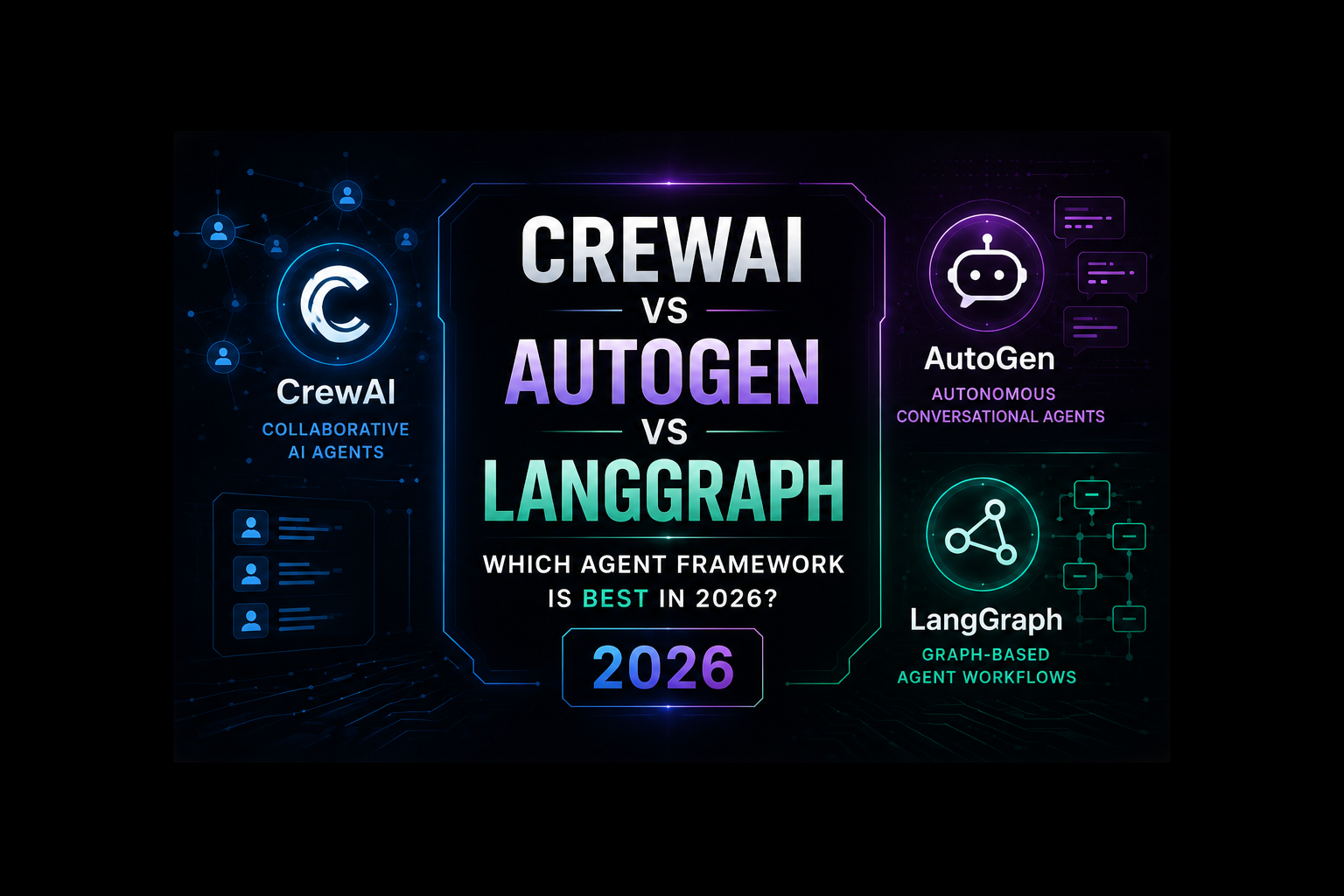
LangGraph is the choice when you need to control production workflows. AutoGen is the way to go for systems that have agents talking to each other. CrewAI is great for teams that are just starting out and need roles. The right framework for you depends on what you want: control over production conversation between agents or collaboration between team members. You have to think about what you need: do you need to control things have agents talk to each other or have people work together as a team. The choice is between LangGraph for control AutoGen for conversation and CrewAI, for collaboration.
Key Takeaways
• LangGraph is built for stateful, graph-based workflows and is strong when reliability and control matter.
• AutoGen shines when agents need to talk to each other, collaborate, and work through multi-step reasoning in conversation.
• CrewAI is easy to understand because it models agents as roles in a team, which makes it beginner-friendly and practical for fast prototyping.
• Production teams often prefer LangGraph for complex systems, while researchers and experimenters may prefer AutoGen or CrewAI depending on the task.
• Learning these frameworks is increasingly valuable for AI engineers, LLM developers, and professionals building modern agentic applications.
• OneLeap’s AI Engineering Mastery program covers agents, LangGraph, production RAG, deployment, and observability, which makes it relevant for this exact skill set.
Table of Contents
- Definition of CrewAI, AutoGen, and LangGraph
- Why This Choice Matters
- How Each Framework Works
- Core Components
- Tools and Technologies
- Real Examples
- Detailed Comparison
- Best Practices
- Common Mistakes
- FAQs
- Final Summary
Definition of the Frameworks
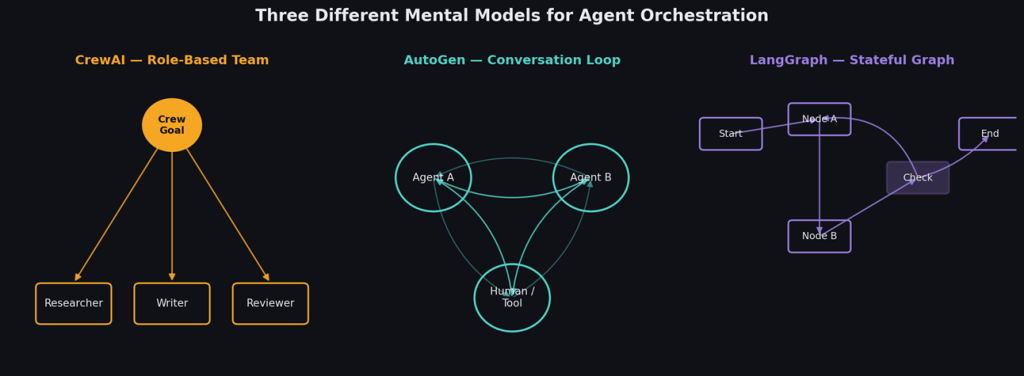
CrewAI, AutoGen, and LangGraph are all agent frameworks, but they solve different orchestration problems. CrewAI is built around agent roles, goals, and teamwork, which makes it feel like a crew of specialists working together. AutoGen is a multi-agent conversation framework where agents can exchange messages, use tools, and involve humans in the loop. LangGraph is a low-level workflow framework that uses nodes, edges, and state to create controlled agent systems.
The easiest way to remember them is this: CrewAI is about teams, AutoGen is about conversation, and LangGraph is about control. That difference becomes very important once you move from demos to production.
Why This Choice Matters?
Choosing the right framework can save time, reduce debugging pain, and improve how reliable your AI product feels. A framework that is too abstract can make production debugging difficult. A framework that is too rigid can slow down experimentation. A framework that is too free-form can become unpredictable when your workflow gets complex.
This matters for business because agent systems are now used for internal knowledge work, research automation, support operations, workflow automation, and decision assistance. It also matters for learners and working professionals because agentic AI is no longer a niche topic; it is part of real production AI engineering, including the kind of practical work covered in OneLeap’s program through RAG, agents, multi-agent orchestration, and deployment-focused projects.
How Each Framework Works?
CrewAI
CrewAI works by giving each person in the team a job something they need to do and sometimes a history or a special skill. You tell them what needs to be done. The system helps them work together to get it done. This is really helpful when you have a team that’s like a regular group of people: someone who finds information someone who makes a plan someone who writes things down someone who checks the work and someone who makes sure everything gets done.
Because CrewAI uses ideas it is easier to get started with than other systems that are more complicated. It gives people a quick way to build something that feels like a real team of people working together. It makes it easy to build a team that can work on tasks. This is what makes it so useful for people who are just starting out with multi-agent systems, like CrewAI.
AutoGen
AutoGen is about talking to each other. The agents in AutoGen can have conversations use things they need. They can even get humans to join in when it is necessary. This is really good for people who help with research for brainstorming and for working with many agents to find a solution by talking about it.
AutoGen is a choice when things do not happen one after the other in a straight line. If the agents in AutoGen need to talk about something make it better say what is wrong, with it or compare things then the way AutoGen is designed around conversations is very useful.
LangGraph
LangGraph is like a manager that helps agents do their jobs. You create a map of what the agent should do. When and the system follows that map one step at a time. This makes LangGraph a good choice for systems where you need to keep track of what is happening make decisions based on what happened before remember things and control what the agent does.
The reason people like LangGraph is that it gives them control over what the agent is doing. That is why LangGraph is often used when people want to make their agent better they want to move from trying out the agent to really using it. LangGraph is especially good, for tasks where you need to know exactly what the agent did at each step so you can understand what happened with the LangGraph and the agent.
Core Components
CrewAI components
• Agents with roles and goals.
• Tasks that can be assigned across the team.
• Collaboration patterns between agents.
• Tool integrations and optional memory.
• Support for structured team-style workflows.
AutoGen components
• Conversable agents.
• Tool-using agents.
• Human-in-the-loop participation.
• Multi-agent chat patterns.
• Flexible conversation-driven workflows.
LangGraph components
• Nodes and edges.
• State management.
• Conditional branching.
• Memory and checkpointing.
• Durable, controllable execution patterns.
The key difference is architecture. CrewAI focuses on role-driven teamwork. AutoGen focuses on conversational collaboration. LangGraph focuses on explicit workflow control.
Tools and Technologies
A real-world agent stack usually includes more than one framework. You may also need retrieval, memory, APIs, model serving, and observability.
| Area | Common Tools |
| Agent frameworks | CrewAI, AutoGen, LangGraph |
| LLMs | OpenAI, Claude, local models |
| Retrieval | Vector databases, embeddings, RAG |
| Tool calling | MCP, APIs, function calling |
| Deployment | FastAPI, Docker, Kubernetes |
| Monitoring | Logging, tracing, dashboards |
| Evaluation | Test sets, human review, automated checks |
Framework Popularity and Adoption (2026)
Community adoption is a useful, if imperfect, signal of how battle-tested a framework is. GitHub stars don’t measure production quality directly, but they do reflect how many developers are actively exploring, building with, and contributing to each project.
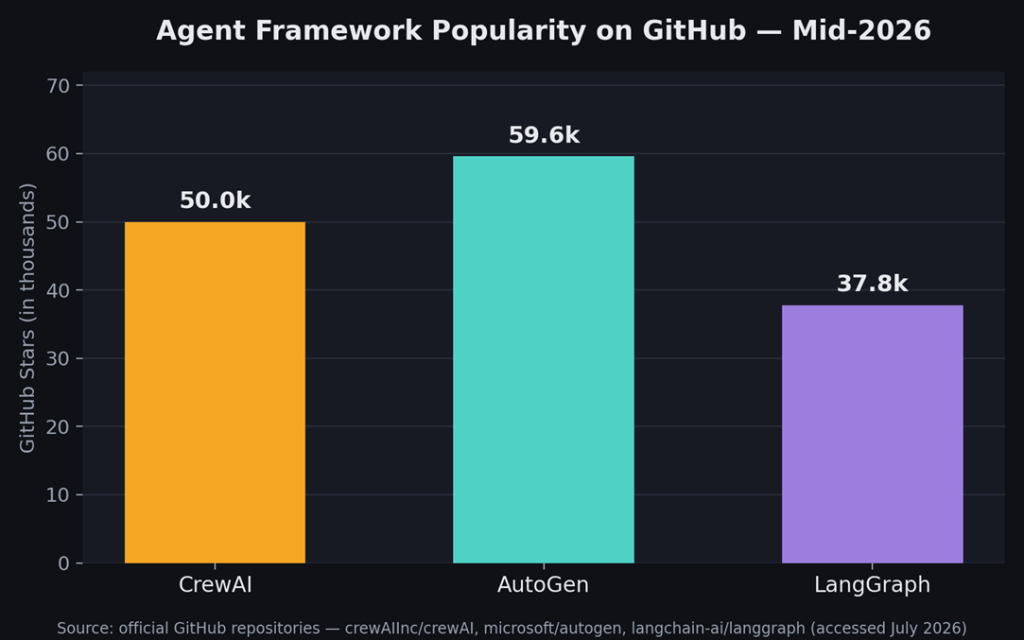
AutoGen has the stars and that is because it got started early and Microsoft is supporting it even though it is not being updated as much now. If you look at LangGraph by itself it does not have many stars but it is part of the bigger LangChain system and it is what makes LangChain work. CrewAI has become popular fast since it came out in 2023 and it has a lot of people downloading it and big companies using it.
Real Examples
Example 1: Research assistant
A team wants an assistant that searches the web, compares sources, and drafts summaries. AutoGen is a strong fit because the workflow depends on agent conversation and refinement.
Example 2: Internal approval workflow
A business needs an AI system that checks a document, routes it for review, triggers a validation step, and then finalizes the output. LangGraph fits well here because the process is stateful and needs explicit transitions.
Example 3: Content production team
A startup wants one agent to research, another to write, and another to review quality. CrewAI is a natural choice because the roles map clearly to a team structure.
Example 4: Customer support automation
A support system may need RAG for internal knowledge, a workflow layer for routing, and guardrails for safety. This is the kind of production pattern that appears in project-based AI engineering training like OneLeap’s enterprise RAG and multi-agent projects.
Detailed Comparison
| Factor | CrewAI | AutoGen | LangGraph |
| Main strength | Role-based teamwork | Conversation-driven collaboration | Stateful workflow control |
| Ease of learning | Easier | Moderate | Harder, but powerful |
| Best for | Beginners, prototypes, team-like systems | Research, discussion, multi-agent chat | Production, branching workflows, reliability |
| Control level | Medium | Medium | High |
| Debugging | Moderate | Moderate | Strong |
| Flexibility | Good | Good | Very high |
| Production readiness | Good for structured tasks | Good for chat-heavy tasks | Strong for serious systems |
A practical rule helps here. Use CrewAI when the mental model is “AI workers on a team.” Use AutoGen when the mental model is “agents talking to solve a task.” Use LangGraph when the mental model is “a workflow with states, checkpoints, and logic.”
Best Practices
• When you are trying to solve something do not start with the tools you will use.
• You should use CrewAI when the people working on your project have jobs to do.
• Use AutoGen when you need to talk about things and work together with people.
• Use LangGraph when you need to control what is happening and keep track of things.
• It is an idea to add a way to see what is happening and follow the steps early on so it is easier to fix problems later.
• You can use these tools with RAG when you need to add information to the system.
• It is important to have people involved in the process when you are dealing with important tasks.
• You should make tests to see if the system is working correctly before you make it bigger.
A lot of the time systems that use agents fail because they are too complicated. It is often better to have a way of doing things or a simple workflow rather than a complicated system, with many agents.
Common Mistakes
• Picking a framework just because a lot of people use it of choosing one that really fits what you are trying to do.
• Creating systems that’re too independent too quickly.
• Not thinking about how the system will store and remember information.
• Not checking if the system really works and just hoping it does.
• Using computer programs called agents when a simpler and more dependable approach would be better.
• Not having a plan, for what to do when things go wrong.
• Thinking that a test version of a system is ready to be used by everyone.
The best systems that use computer agents are not the ones that’re really complicated. They are the ones that’re easy to understand easy to test and easy to keep running smoothly. Computer agents should be simple and reliable that is what makes the computer agent systems.
FAQs
Q1. Which framework is best for beginners?
CrewAI is often the easiest for beginners because the role-based structure is intuitive. You can think in terms of a team of agents rather than low-level orchestration. That makes it easier to understand how tasks move from one agent to another.
Q2. Which framework is best for production systems?
LangGraph is often the best choice for production because it gives you more control over state, branching, and workflow logic. When systems become complex, visibility and control matter a lot. LangGraph is built with that in mind.
Q3. Which framework is best for multi-agent conversation?
AutoGen is especially strong when the agents need to talk to each other, refine outputs, and work through a problem collaboratively. Its conversation-first model makes it good for research assistants and interactive workflows. Note that Microsoft now recommends evaluating its successor, Microsoft Agent Framework, for new production work.
Q4. Can these frameworks be used together?
Yes,. In practice you usually want one main framework to manage everything. Many systems use agent frameworks along with retrieval, APIs and guardrails. Having too many frameworks can make things complicated. The better way to do this is to pick one framework to manage everything and then add the capabilities to it.
Q5. Do I still need RAG if I use an agent framework?
Yes, in cases. Agent frameworks help manage how things work together and behave. Rag gives you new information from documents and databases. If your system needs to give answers from information that changes RAG is still important.
Q6. Which one should a working professional learn first?
If you want to get started with agent systems start with CrewAI. If you want to build something for real-world use learn LangGraph early. If your work involves researching, experimenting or working with agents AutoGen and Microsoft Agent Framework are also worth learning.
Q7. Is LangGraph harder than CrewAI?
Usually yes, because LangGraph requires you to think about things like state machines branching and designing workflows.. That is also what makes it so powerful. You have to learn more to use it. You get better control and reliability in return.
Q8. What kind of jobs use these frameworks?
Jobs like AI engineer, LLM engineer, GenAI engineer, AI agents developer, ML platform engineer and applied AI roles are using these tools more and more.
Final Summary
CrewAI, AutoGen and LangGraph are different in how they work. CrewAI is a way to work with a team. AutoGen helps people talk to each other and work together. LangGraph gives you control over what’s happening and helps with getting work done. If you are looking for something to use in 2026 you need to think about what you want to do with it.
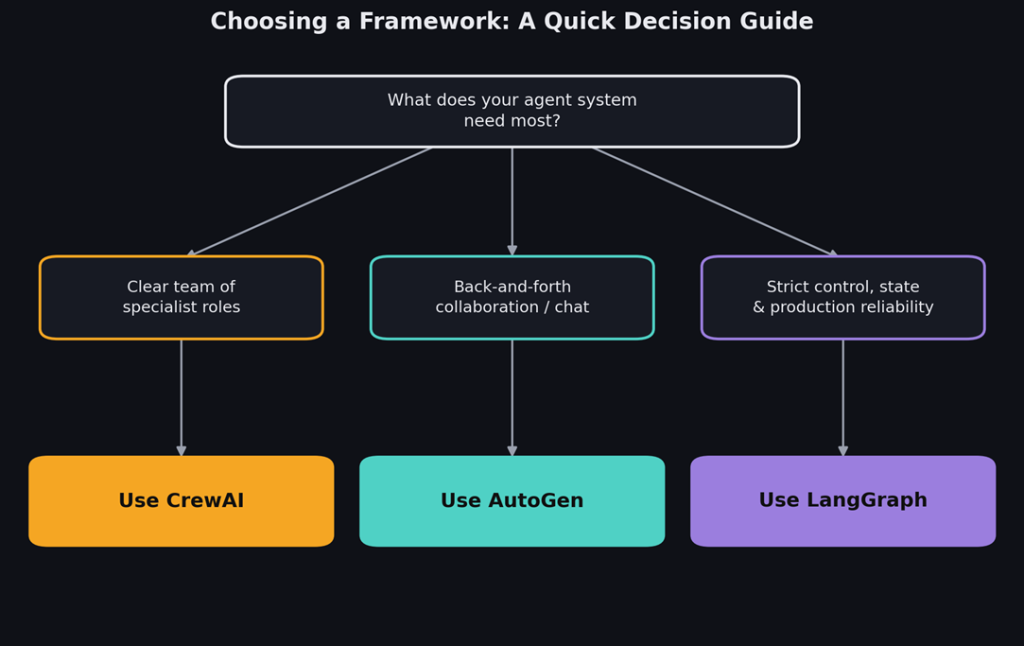
When you are first starting out CrewAI is a way to begin building agent systems. It is easy to use. For people who want to study how multiple agents work together AutoGen is a choice. You can also use Microsoft Agent Framework, which’s an improved version of AutoGen. If you need to build serious production AI LangGraph is usually the option because it gives you a lot of control and works well with complicated workflows.
If you want to build these systems for a living the AI Engineering Mastery program from OneLeap is a choice. This program teaches you about RAG, AI agents and agent frameworks. You also learn about production safety and how to deploy your systems. The program includes hands-on projects that’re similar to real-world jobs. This makes it a good fit, for people who want to start building agent systems. Then actually use them in the real world.
The program helps you move from trying out agents to actually using them. CrewAI and LangGraph and other agent systems are important to learn about. OneLeap’s program can help you learn about these things. Start building agent systems that you can actually use.If you want something that you can count on and that can help all the parts of your project work together LangGraph is usually the best choice. LangGraph is really good, at helping you get things done and making sure everything runs smoothly.
Learn more about When Should You Use RAG Instead of Fine-Tuning in 2026?
Stay updated with the latest AI, Data Science, and Automation insights by following OneLeap on LinkedIn and Instagram.

Leave a Reply