
Introduction
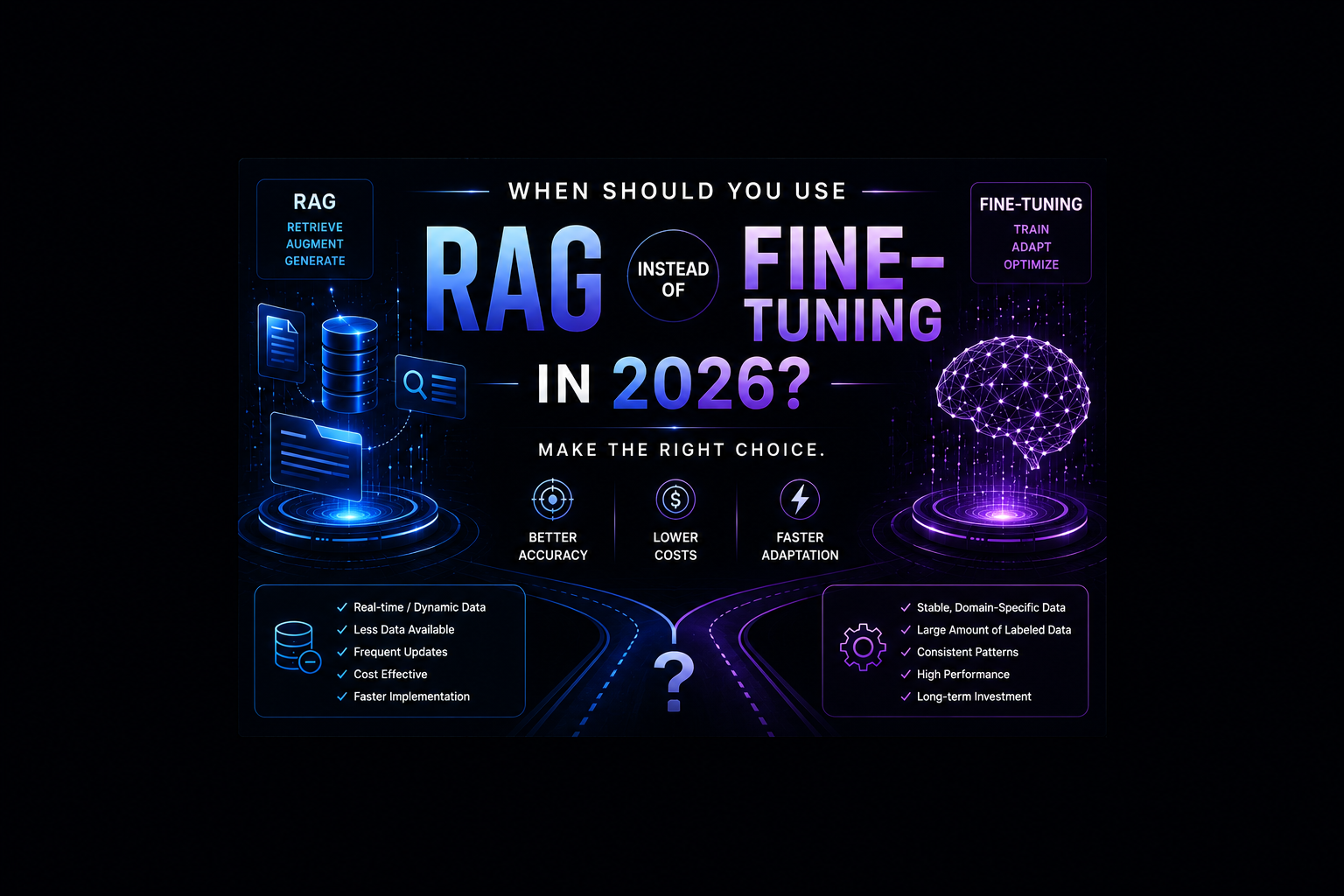
If you want your AI system to have the current information it is a good idea to use RAG. This way you can see where the information is coming from. You also get updates quickly. On the hand if you want the model to learn something specific like a certain tone or a particular way of responding you should use fine-tuning. This helps the model learn the task you want it to do. RAG is great, for information but fine-tuning is better when you want the model to do something over and over in a specific way.
Key Takeaways
- RAG is the way to go when the things you know are changing all the time and the system needs to get answers from the documents.
- Fine-tuning is the option when you want the model to learn something very specific like a certain style or behavior.
- RAG is usually quicker to get started with and easier to make changes to because you can update the things it knows without having to train it all again.
- Fine-tuning needs good datasets a lot of work to train and a clear plan to see how well it is doing.
- A lot of systems that people use every day combine both: they use RAG to get the facts right and fine-tuning to get the behavior right.
- For people who work with data, students, analysts and developers knowing how to use both RAG and fine-tuning is a plus when it comes to getting a job, in the field of artificial intelligence.
Table of Contents
- Definition of RAG and Fine-Tuning
- Why the Choice Matters
- How RAG Works
- How Fine-Tuning Works
- Core Components
- Tools and Technologies
- Real Examples
- RAG vs Fine-Tuning Comparison
- Best Practices
- Common Mistakes
- FAQs
- Final Summary
Definition of RAG and Fine-Tuning
Retrieval-Augmented Generation or RAG is a way of doing things where the model gets the information from somewhere else like documents or databases before it gives an answer. This is helpful because the model can get the facts it needs.
Fine-tuning is when you take a model that already knows a lot of things and you teach it some more so it can do a job better. You show it examples of what you want it to do and it learns from those examples so it can do things in a way or talk about a certain topic or even understand a particular area of knowledge.
The difference is really simple. It matters a lot. RAG is useful because it helps a model find information when it is needed. On the hand fine-tuning helps a model get better at responding to things, for a particular task. RAG is usually better when the truth is changing all the time. Fine-tuning is usually better when the model needs to keep the format, tone or behavior all the time.
Why the Choice Matters?
This decision affects the cost the speed, the accuracy, the flexibility and the maintenance. If you make a choice it can lead to wasting a lot of time and effort on training and then you get weak results when you try to retrieve information. You might even have a model that sounds like it knows what it is talking about. It actually gives you the wrong answer.
That is why many teams now think of this as a decision about how they want to design their system than just a decision about the model they want to use.
For businesses this has an impact. The customer support teams need to have answers that’re up to date. The legal and compliance teams need to be able to trace where the information is coming from. The sales teams need to be able to get to the product information quickly. The product teams need systems that can change and improve without having to be retrained all the time. For all of these teams choosing the method saves a lot of time and makes things more reliable.
For people who are learning about AI and, for people who are actually working with AI knowing when to use RAG of fine-tuning is a really important skill to have. It helps you figure out how to take something that you have demonstrated and turn it into a system that actually works when you are using it for real.
How RAG Works?
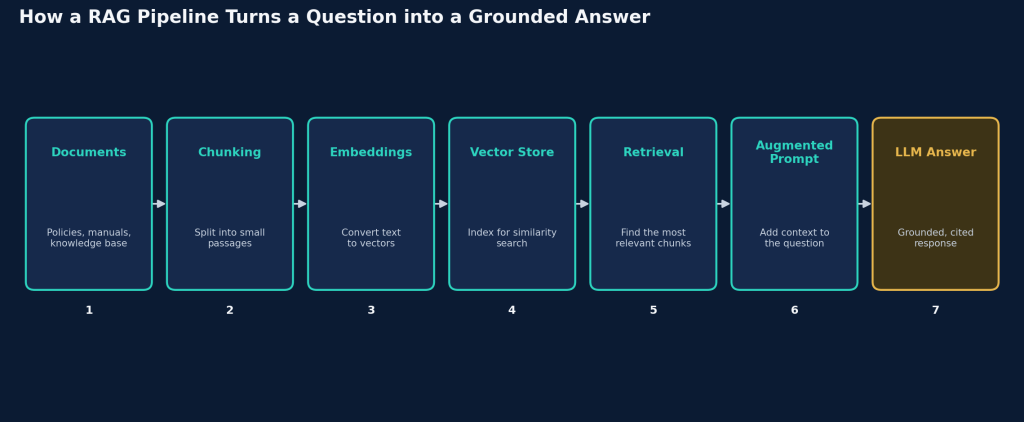
RAG is like a helper that comes between what the user’s asking and what the model is saying.
- First we get all the documents and information we need and make sure they are okay to use.
- We break down the text into pieces so we can look through it quickly.
- Each piece of text is turned into something called embeddings.
- These embeddings are stored in a kind of database that helps us search for things.
- When the user asks a question the system looks for the pieces of text that’re most relevant, to the question.
- The text it finds is added to the question to give information.
- Then the model uses this information to give an answer based on the RAG system and the text it found. The RAG system is really important here because it helps the model understand the question better by using the RAG system to find the information.
The RAG system is really helpful when the information you need is not part of the model. This means the model does not have to remember everything when it is being trained. This is very useful for things like company information that’s only available inside the company documents that have the latest policies, manuals for products, libraries of research and content that supports customers.
A good RAG system is not about searching and using a large language model. It also needs a way of breaking down information into smaller pieces getting the right information putting the information in the right order having good metadata and creating prompts that make sense.
How Fine-Tuning Works?
Fine tuning of a model begins with a model that has already been trained and then trains it some more on examples. These examples can be pairs of questions and answers instructions for tasks examples of style labels for classification or conversations that’re specific to a certain domain. The idea is to change the way the model works so it is more useful for an application.
Fine tuning is really useful when you want the model to give answers to many requests. For example a company might want all the answers to follow the template have the same tone or be structured in the same way. A system that automates support might need answers that’re shorter, safer and more standardized. An assistant that is specific to a domain might need to use language in a special way.
Fine tuning of a model is not perfect. It needs data that has been carefully selected a way to evaluate it and a clear plan for how it will be used. Fine tuning of a model is not a way to fix prompts or poor design of a product. If the problem with the model is that it does not have access, to the facts fine tuning the model will not fix this problem.
Core Components
RAG components
- Document ingestion.
- Breaking things down into bits and getting the text ready.
- Making embeddings
- Using a kind of database or search engine that works with vectors.
- Getting a retriever and sometimes a re ranker too.
- Putting together a prompt, with the context that was found.
- Keeping track of where things came from.
- Seeing how well the retrieval and answer quality are.
Fine-tuning components
- Curated training dataset.
- Validation dataset.
- Base model selection.
- Training method such as full fine-tuning or parameter-efficient tuning.
- Evaluation metrics and test cases.
- Serving infrastructure.
- Drift monitoring and retraining strategy.
RAG depends more on knowledge organization. Fine-tuning depends more on data quality and training discipline. In both cases, the wrong data leads to poor results.
Tools and Technologies
A practical LLM stack often includes:
| Area | Common Tools |
| Vector search | FAISS, Chroma, Pinecone, Weaviate |
| RAG frameworks | LangChain, LlamaIndex, LangGraph |
| Embeddings | OpenAI embeddings, Hugging Face models |
| Fine-tuning | Transformers, PEFT, LoRA, QLoRA |
| Serving | FastAPI, Docker, Kubernetes, vLLM |
| Tracking | MLflow, Weights & Biases |
| UI | Streamlit, Gradio |
| Evaluation | Golden datasets, human review, automated tests |
If you are building production systems, you also need observability, caching, access control, API design, and cost monitoring. These often matter just as much as the model itself.
Real Examples
Example 1: Customer support knowledge base
A support assistant needs to answer from updated internal policies, refund rules, and product documentation. RAG is usually the best choice because the documents change often, and the answers should be grounded in the latest approved content.
Example 2: Brand-specific writing assistant
A marketing team wants AI-generated copy to follow a particular tone, format, and messaging style. Fine-tuning can help more than RAG here because the main goal is behavior and style consistency, not just access to facts.
Example 3: Compliance and legal review
A compliance assistant needs to cite relevant policy clauses, regulations, or contract sections. RAG is better because traceability matters and the sources may change over time.
Example 4: Specialized classification task
A model that tags support tickets, classifies emails, or identifies intent in a highly specific workflow may benefit from fine-tuning because the task is narrow and repeatable.
Example 5: Hybrid production assistant
A company may use fine-tuning to enforce a specific response structure and RAG to supply current company documents. This is one of the most common production patterns because it solves both knowledge and behavior.
RAG vs Fine-Tuning Comparison
| Factor | RAG | Fine-Tuning |
| Best use case | Dynamic knowledge, document QA, citations | Consistent behavior, narrow tasks, style control |
| Data freshness | Excellent | Weak unless retrained |
| Upfront effort | Lower | Higher |
| Ongoing maintenance | Update indexes and retrieval | Retrain and re-evaluate |
| Explainability | Strong because sources can be shown | Weaker unless paired with retrieval |
| Latency | Can be higher due to retrieval | Often lower after deployment |
| Cost to start | Usually lower | Usually higher |
| Best outcome | Grounded answers from external sources | Learned behavior and output consistency |
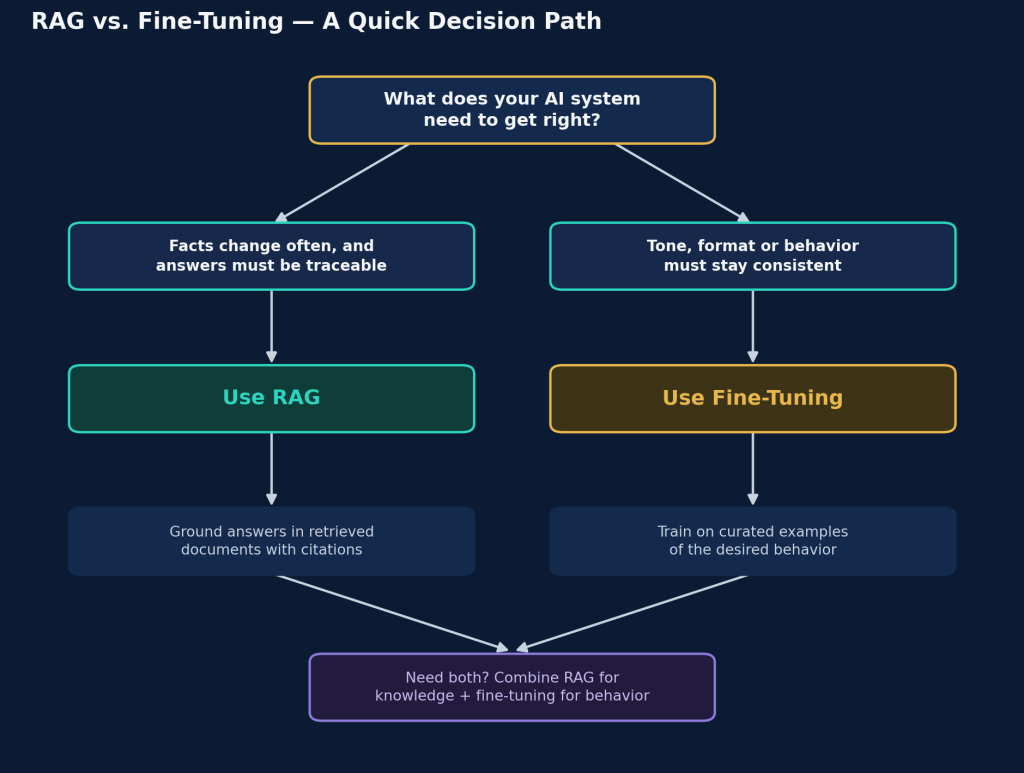
The right choice depends on what problem you are solving. If the issue is “the model does not know my latest information,” RAG is usually the answer. If the issue is “the model knows the facts but behaves inconsistently,” fine-tuning is often the answer.
Best Practices
- Start with RAG when the main requirement is access to fresh knowledge.
- Use fine-tuning when the main requirement is style, behavior, or task specialization.
- Build evaluation datasets early instead of waiting until launch.
- Measure retrieval quality, not just response quality, in RAG systems.
- Use parameter-efficient methods like LoRA when fine-tuning makes sense.
- Keep data clean, structured, and domain-relevant.
- Add guardrails for safety, especially in customer-facing or regulated use cases.
- Consider a hybrid approach when both knowledge freshness and output consistency are important.
A simple rule helps: if the model should know something new, think RAG. If the model should act differently, think fine-tuning.
Common Mistakes
- Stopping to tune too early can be a mistake when finding the information would have been faster.
- Some people think RAG is good when the parts are not good or the documents are not clear.
- They only care about the answer and do not check how the information was found.
- Some people use tuning to make old data seem new.
- They do not make a test set before they start training the AI system.
- They forget about keeping things private and following the rules.
- They launch the system without checking how much it costs or how long it takes to get an answer and without asking users what they think.
Most AI systems that do not work well do not fail because the main AI model is bad. They fail because the way the AI system is built does not match what the business needs.
FAQs
Q1. Is RAG always better than fine-tuning?
No. RAG is better for fresh information and traceability, but fine-tuning is better for consistent behavior and narrow specialized tasks.
Q2. Can fine-tuning replace RAG?
Usually not. Fine-tuning does not update the model with fresh documents in a practical way. RAG is much better for that.
Q3. Which is cheaper?
RAG is usually cheaper to start. Fine-tuning may become worthwhile later if you have high usage volume or a narrow task that benefits from strong specialization.
Q4.What should beginners learn first?
Start with RAG because it is easier to understand and deploy. Then learn fine-tuning to understand when it provides better value.
Q5. Can both be used together?
Yes. In many real systems, fine-tuning handles behavior while RAG handles knowledge. That hybrid design is often the most practical approach.
Final Summary
When you want to get the current information and you need it to be backed up by sources you should use RAG. This is also a choice when you need to get updates quickly. On the hand you should use fine-tuning when you want the model to learn something very specific like a certain way of talking or a particular job it needs to do.
In the world the best way to do things is often to use a little bit of both so you get a system that is mixed. This means you use RAG and fine-tuning together to get the results.
If you are working on intelligence systems for a living you really need to know how to make good decisions about this stuff. The AI Engineering Mastery program from OneLeap is for people who have jobs, students, people who analyze data and developers who want to learn how to build intelligence applications that actually work.
Learn more about RAG vs Fine-Tuning: Choosing the Best Approach for Powerful LLM Applications in 2026
Stay updated with the latest AI, Data Science, and Automation insights by following OneLeap on LinkedIn and Instagram.
Sources and References
- IBM — Retrieval-Augmented Generation: overview and use cases
- Atlan — Fine-Tuning vs. RAG: a practical decision guide
- DeepLearning.AI — Retrieval Augmented Generation learning material
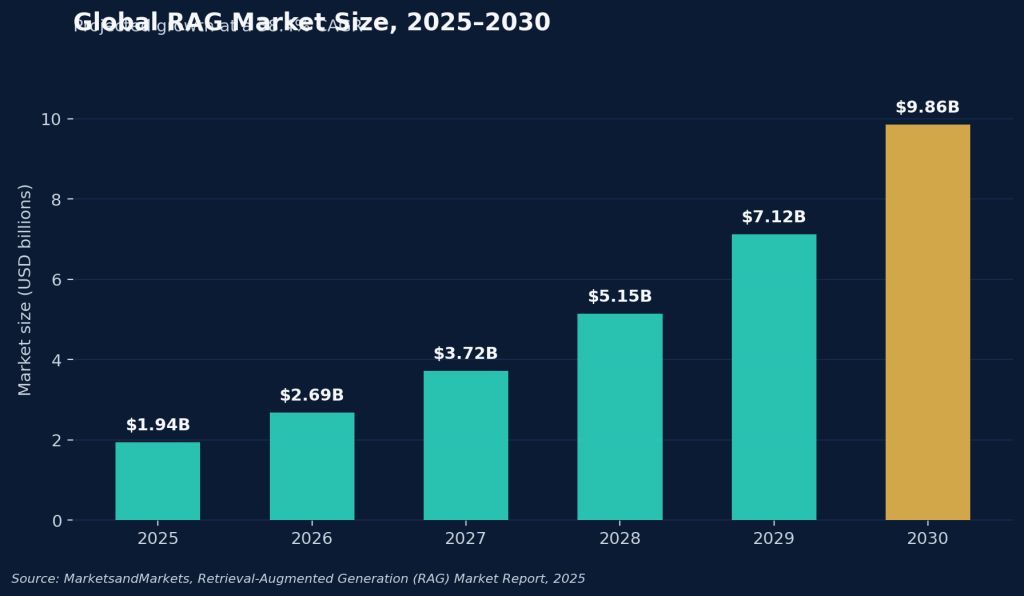
- MarketsandMarkets — Retrieval-Augmented Generation (RAG) Market Report, 2025–2030
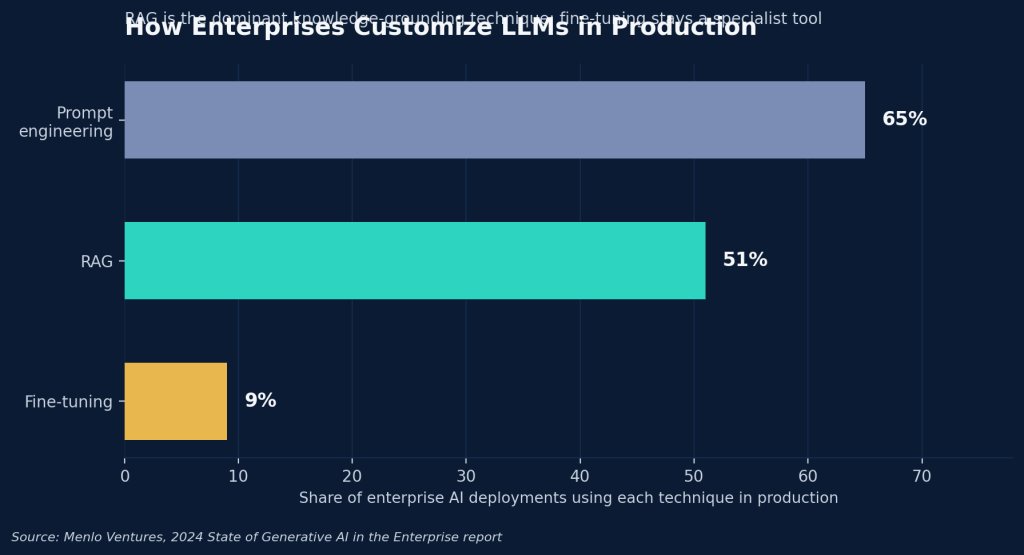
- Menlo Ventures — 2024 State of Generative AI in the Enterprise

Leave a Reply