
Context engineering is really important for a product manager because it helps them make decisions. They can use it to design and shape the information for the artificial intelligence systems and the teams they work with. This way the decisions they make and the work they do is accurate. Works well with everything else. When we use intelligence to do things it is very helpful to be able to think clearly and explain the context of what we are doing. Sometimes this is more important, than just doing the work that needs to be done. Context engineering helps product managers do this. It is becoming a very valuable skill for them to have.
Key Takeaways
• When we talk about context engineering we are talking about context engineering as a way to make sure that information is presented in a way so that teams and artificial intelligence systems can make good decisions.
• Context engineering is useful because it helps people in charge of products avoid mistakes make decisions faster and get results from artificial intelligence systems.
• If you do context design well it makes things clearer for everyone whether you are looking at plans, specifications, user stories or updates for people with a stake in the project.
• Context engineering is important for building intelligence products and features that people actually want to use.
• People who are in charge of products and are good at context engineering can make decision making more efficient. Reduce the amount of work that needs to be done again across different teams.
• For people, in Dehradun who want to be product managers or are already product managers, Oneleaps artificial intelligence and product management courses can help them learn context engineering and other skills in a way that is structured and led by people who work in the industry.
Table of Contents
1. What Is Context Engineering?
2. Why It Matters for Product Managers
3. How It Works
4. Core Components
5. Tools and Technologies
6. Real Examples
7. Context Engineering vs Related Approaches
8. Best Practices
9. Common Mistakes
10. FAQs
11. Final Summary
What Is Context Engineering?
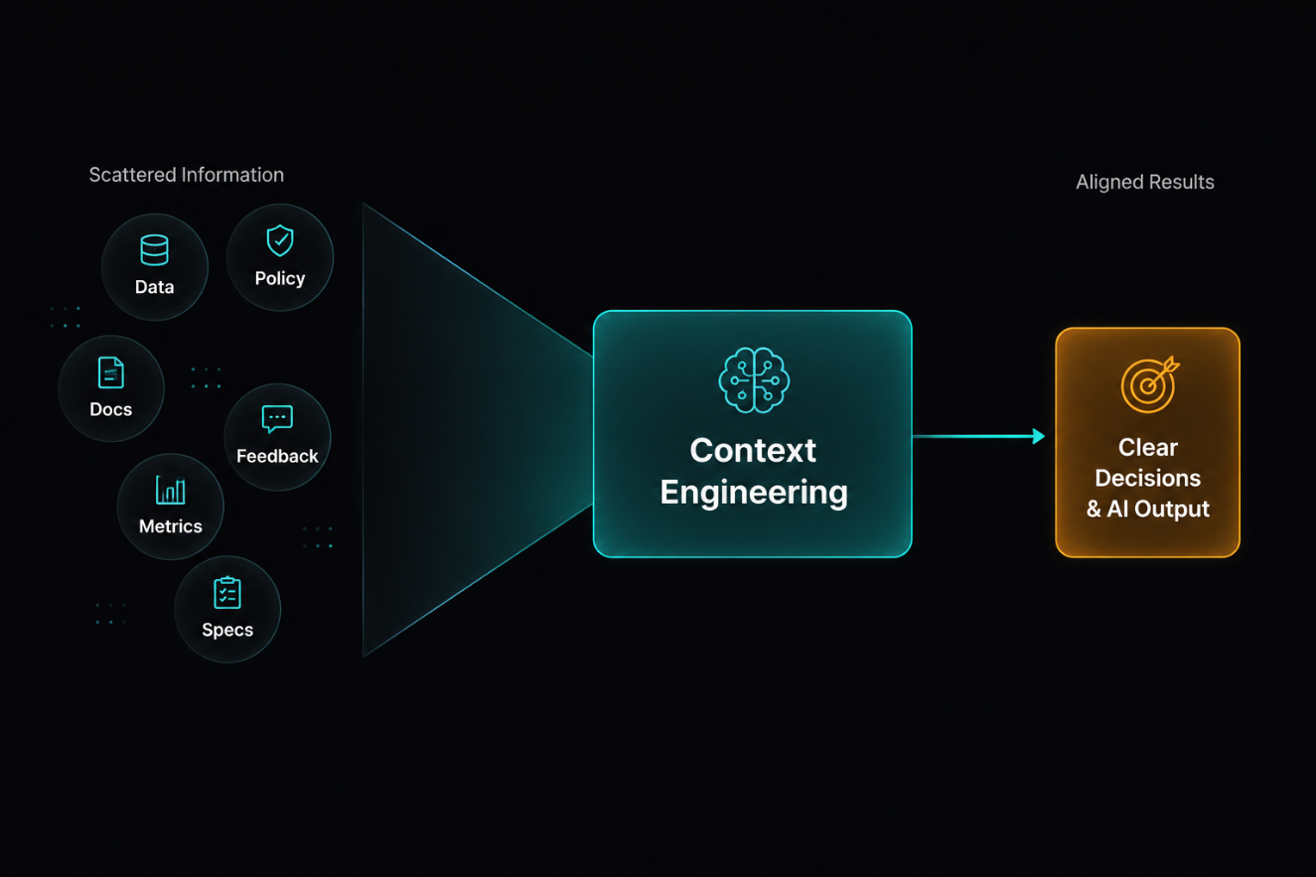
Context engineering is about making sure people or systems have the information to make good choices. It is a process of planning and presenting information in a way that helps. This includes deciding what information to share and how to share it.
* It is about creating the environment for work to be done.
* This environment could be a team of people a plan for a product or a computer model.
For people who manage products it means being careful about how problems are described, how data is shown and what limits are set. Product managers have to think about the problems and also about how they share information, about those problems. They have to make sure the information they share helps people make choices. Context engineering helps product managers do this. It is a part of their job.
Why It Matters
Context engineering is important because artificial intelligence is becoming a part of product development. Even the best models do not work well when the input information is unclear or incorrect. When product managers create information they help AI systems understand what the product goals are, what users need and what limitations exist. This leads to accurate and useful results. This is crucial for building AI features that’re reliable, safe and match business goals.
It also matters because unclear information causes problems. This leads to teams changing plans redoing work and delays. When plans, specifications and user stories have information. Who it is for why it matters and what limitations exist. Teams can make better choices. They do not need to ask for clarification all the time. This reduces meetings clarifies what is important and speeds up work.
Finally context engineering is important because it is a skill that can be used by people. Product managers who can create information can help entire teams work more independently. They can make choices and work faster. In a job market where product roles use AI more and more this skill is becoming what sets performers apart. Product managers with this skill can help their teams. AI systems need information to work well. Product managers are key to providing this information.
Became re-written to Context engineering matters. AI is part of product development. Even good models fail with input. Product managers create context. They help AI systems understand product goals. They understand user needs and constraints. This gives outputs. This is key for AI features. They must be safe. They must match business goals.
Context engineering matters. Unclear context causes misalignment. It causes rework and delays. Clear context in roadmaps helps. Clear context in specs helps. Clear context in user stories helps. Teams make decisions. They do not need clarification. This reduces meetings. This clarifies priorities. This speeds up execution.
Context engineering matters. It is a skill. Product managers, with context skills help teams. Teams operate independently. They make decisions. They move faster. This skill is a differentiator. Top performers have this skill. AI-enabled product roles need this skill.
How It Works
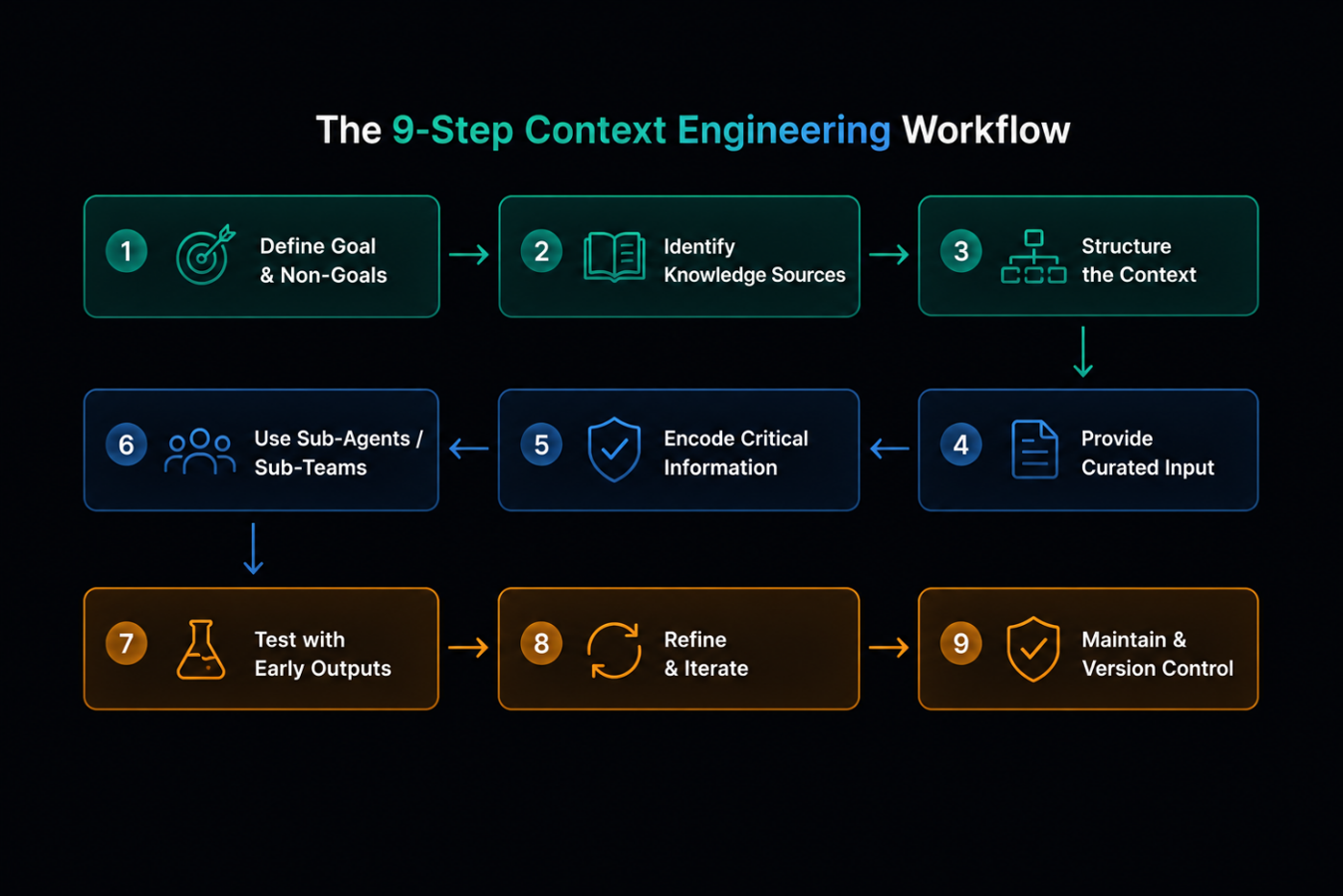
Step 1: Define Your Goals
* Write down one sentence that says what you want to happen.
* Then add another sentence that lists all the things you do not want to achieve.
* This helps people and computer systems like teams and artificial intelligence stay focused on the goal of your goals. The teams and artificial intelligence systems will not get sidetracked into doing things that’re not important, to the teams and artificial intelligence systems when you define your goals.
Step 2: Figure out where the information comes from
• Make a list of all the data, numbers, studies, limitations and rules that the Artificial Intelligence system needs to know about.
• Then decide which of these sources are absolutely necessary and which ones are not as important.
• For the Artificial Intelligence system specify the tables, dashboards or documents that the Artificial Intelligence system is allowed to use.
Step 3: Structure the context
* Use a template, like: Problem, Who it affects Limitations, How we measure success.
* Write sections instead of long blocks of text.
* Keep the format the same so we can use it again for tasks.
Step 4: Provide information
* Just pick the information that is needed for what you are doing right now.
* Get rid of stuff that you do not need, like old information or things that are not important.
* When you are working with intelligence do not copy big documents that are not organized instead use small parts that are relevant, to what you are doing with the artificial intelligence.
Step 5: Encode critical information
•We need to repeat the goals, constraints and definitions in each turn. This helps to avoid confusion.
•Lets use labels like “Goal:” “Constraint:” and “Metric:”. This way the system will not miss details.
•By doing this we and the team stay on the page even when the context gets bigger.
Step 6: Use sub-agents or sub-teams for tasks
•When a task is too big we should break it down into smaller tasks. Each one should have its context.
•For each task we need to set a clear goal know who it’s for and how we will measure success.
•At the end we combine the results, from each task to get the final answer.
Step 7: Test with outputs
• Try out the context with a small sample or the first draft of the context.
• See if the output of the context is what we are looking for and if it meets the goal and constraints of the context.
• Find out if there are any gaps or misunderstandings, in the context that need to be fixed.
Step 8: Refine and iterate the context
• Change the phrasing or structure of the context. Add more information to the context, based on what did not work out.
• Update the templates and examples of the context to reduce mistakes in the context in the future.
• Think of each time we refine the context as a chance to learn and make the context better over time which will improve the context.
Step 9 is about keeping track of the context and making sure it is up to date.
* We need to save all the context templates and examples and the final versions in a document system. This way we can find them easily when we need them.
* We should use version numbers or dates so we can see what changes were made and when.
This helps the team and the artificial intelligence system to use the latest context that we know is correct.
By doing all these things a product manager can take the context. Turn it into a system that works every time which helps us make better decisions and the artificial intelligence system gives us better outputs and the team is, on the same page.
Core Components
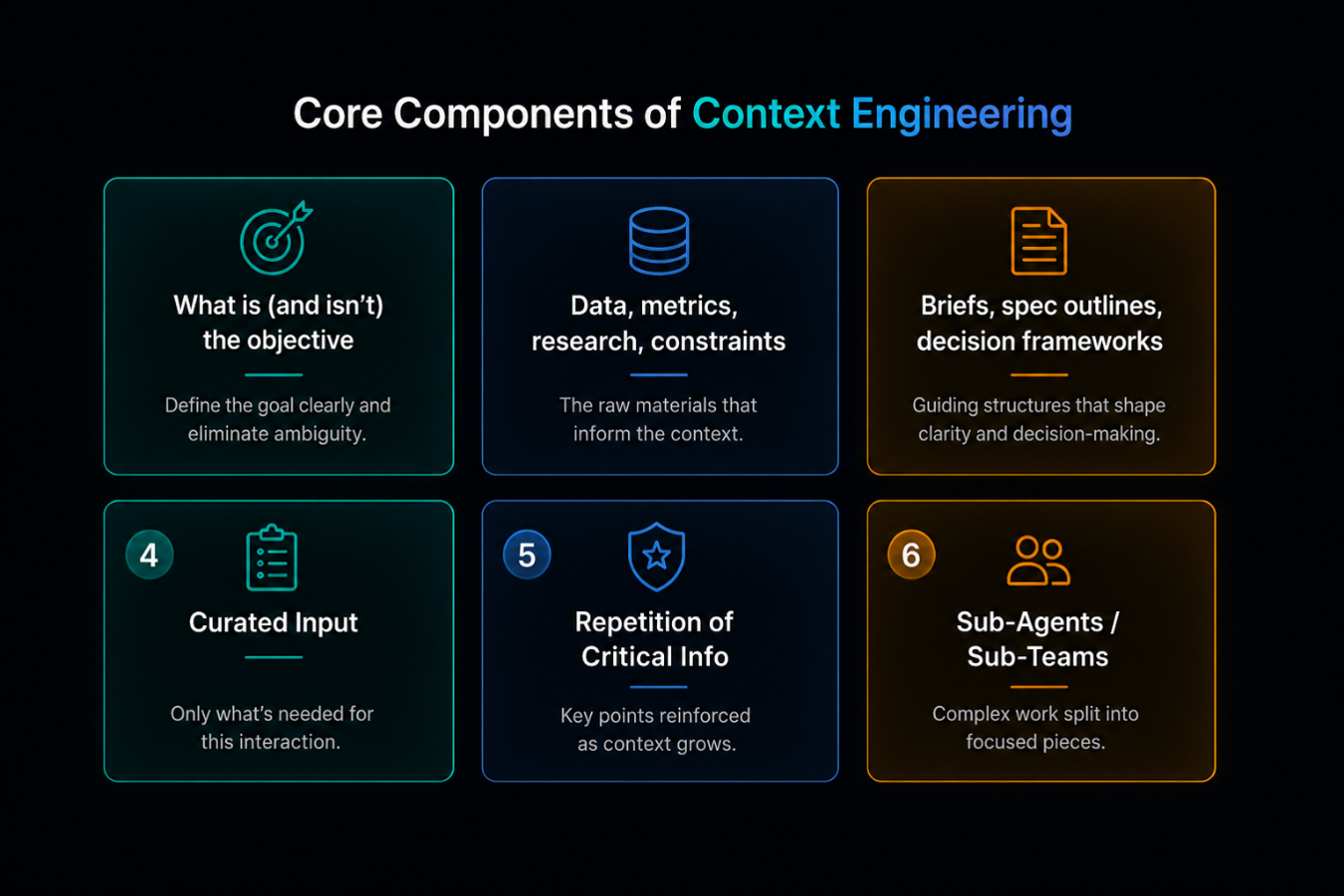
• Goal definition: We need to state what we want to achieve and what we are not trying to achieve.
• Knowledge sources: We should look at data, metrics, research and technical limits to make decisions.
• Structure: Lets use templates like briefs or outlines to organize our thoughts. Curated input: We should be selective, about what we include in each message to avoid overwhelming people.
• Repetition of info: When the context gets bigger we should repeat the key points so they don’t get lost.
• Sub-agents or sub-teams: For tasks we can break them down into smaller tasks and give each one its own focus.
These things help create a context system that works for both people and AI tools.
Tools and Technologies
| Category | Tools / Technologies | Why They Matter |
| AI models | LLMs such as OpenAI, Anthropic, Google, IBM models | These need structured context to produce useful product outputs. |
| Prompt & context tools | Prompt engineering platforms, context managers, memory layers | Help PMs design, test, and refine input flows for AI products. |
| Documentation | Confluence, Notion, Google Docs | Used to store and share structured context with teams. |
| Project tools | Jira, Productboard, Roadmunk | Help present context in roadmaps, epics, and workflows. |
| Analytics | Data platforms, dashboards, observation tools | Provide the factual context needed for decision-making. |
Real Examples
1.The company wanted to use an intelligence feature to help users.
* The problem was that a team that makes products wanted to use an intelligence assistant to answer user questions.. The answers the artificial intelligence assistant gave were too general and sometimes wrong.
* The solution was that the person in charge of the project changed the way the artificial intelligence assistant understood the situation. This included what kind of user was asking the question, what the user was doing with the product and what the company rules were.
* The result was that the artificial intelligence assistant started giving relevant and correct answers that followed the company rules.
* The impact of this change was that users were more happy and the company did not have to deal with many support questions, which showed that thinking carefully about how the artificial intelligence assistant understood the situation was very important for the artificial intelligence feature, for user support.
2. Team alignment on a new feature
• Problem: We had a delay with a new feature because the engineers and the designers did not agree on what we were trying to do.
• Solution: The project manager made an one page document that explained the problem, who it affects what limitations we have and how we will measure if it is successful.
• Result: The team was able to agree on what’s important and what we need to do very quickly.
• Impact: The new feature was launched faster and we did not have to go back and fix things, as many times, which saved us time and made it less likely that something would go wrong with the feature launch.
3. AI prototype for product insights
• Problem: A Project Manager wanted to use Artificial Intelligence to summarize what users were saying but the first versions were not clear enough.
• Solution: The Project Manager organized the information with types of input, examples and the format they wanted the output to be in.
• Result: The Artificial Intelligence was able to make summaries that the Project Manager found useful and that were what they were looking for.
• Impact: The Project Manager could look at the feedback quickly and feel more sure, about which changes to make first.
Context Engineering vs Related Approaches
| Approach | Focus | Role for PMs |
| Prompt engineering | Crafting specific instructions for a single AI call | Helps with one-off tasks like generating copy or SQL |
| Context engineering | Designing the overall information environment for AI and teams | Helps with product systems, decisions, and long-term quality |
| Traditional documentation | Writing specs and requirements | Provides static context that teams refer to |
| Context engineering (ongoing) | Continuously shaping and updating context for AI and humans | Makes documentation dynamic, reusable, and AI-friendly |
Prompt engineering is a tool for a single interaction, while context engineering is a system for ongoing product work.
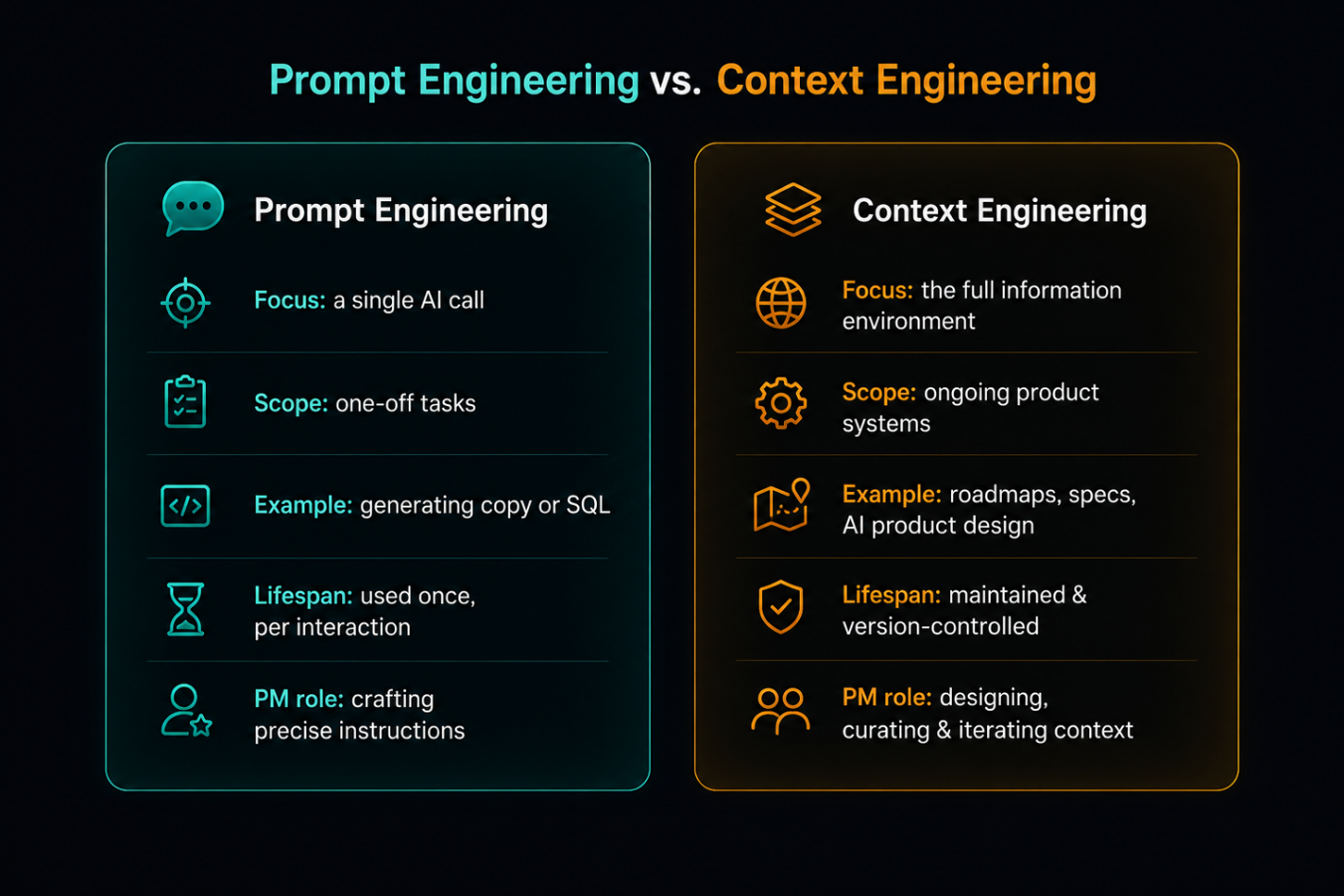
Prompt engineering optimizes one call; context engineering designs the whole system.
Best Practices
• Start every project with a clear goal and know what is not a goal.
• Use templates to structure briefs like problem, audience, constraints and success.
• Keep context simple by including what is needed for each message.
• Repeat important information when context changes so it doesn’t get lost.
• Break down tasks into smaller teams to avoid too much context.
• Keep track of changes so context can be updated without confusion.
• Test context with results and refine it based on whats missing or wrong.
• Think of context as a product. Design it improve it and measure its impact.
For learners Oneleaps AI and Product Management programs, in Dehradun can help Product Managers build these skills with training and real project work.
Common Mistakes
| Mistake | Why It Happens | What to Do Instead |
| Providing too much unstructured context | The information is overwhelming and hard to use | Use compact, structured formats and filters. |
| Not defining non-goals | The system or team assumes too much | State clearly what is not part of the goal. |
| Ignoring critical constraints | The output is unrealistic or unsafe | Include constraints like policies, limits, and risks. |
| Treating context as static | The context becomes outdated and wrong | Treat context as a living system that needs updates. |
| Not testing with early outputs | You miss errors early and fix them late | Iterate quickly with real test runs. |
| Mixing too many tasks in one context | The model or team gets confused | Split complex tasks into smaller, focused pieces. |
FAQs
Q1. What is context engineering in terms?
Context engineering is, about giving people or AI the information in a clear way. This helps them make decisions and do better work.
It is designing the environment where work happens. For product managers this means thinking about how you present problems, goals and constraints
Context engineering helps product managers do their job better by giving them the information. They can then make decisions and do their work well.
Q2. Why is context engineering so important for product managers?
Because it helps product managers reduce misalignment and speed up decisions and also improve the quality of the intelligence outputs.
When product managers design context teams can make high quality decisions without needing constant clarification and artificial intelligence systems can produce more relevant and accurate results.
In an intelligence driven world this skill is becoming a key differentiator for top performers.
Q3. How is context engineering different from engineering?
Prompt engineering is about crafting instructions for a single artificial intelligence call while context engineering is about designing the overall information environment for artificial intelligence and teams.
Prompt engineering helps with one off tasks while context engineering supports product systems and long term quality.
Q4. Can context engineering help with non artificial intelligence product work?
Yes, because it improves how product managers communicate with functional teams, design roadmaps and write specs. Clear context helps engineers, designers and stakeholders make decisions independently. It is a force multiplier for any product work, not artificial intelligence features.
Q5. What skills do I need to learn context engineering?
You need to be clear about your goals, to structure information and willing to test and refine context based on feedback. Understanding how artificial intelligence works and how to constrain it is also important. Practicing with projects, roadmaps and artificial intelligence experiments helps build these skills fast.
Q6. How can I start practicing context engineering?
Start by creating briefs for your work using a template like problem audience constraints success. Then test your context with outputs and refine it. You can also experiment with intelligence tools to see how different context changes their behavior.
Q7. Is context engineering for artificial intelligence product managers?
No it is useful, for any product manager who wants to reduce misalignment and improve decision quality. Without artificial intelligence clear context helps teams work faster and with fewer errors. Artificial intelligence just makes the skill more visible and valuable.
Final Summary
Product managers are getting really good at something called context engineering. This is because it makes communication, documentation and working with intelligence a simple and repeatable process. It helps product managers make decisions and create better products.
Context engineering is very useful, for product managers as it helps them work efficiently reduce mistakes and build artificial intelligence products that are accurate and easy to use. For people who want to be product managers or are already product managers learning context engineering is a way to advance their careers in a world where artificial intelligence is becoming more important.
In Dehradun, Oneleaps AI and product management programs can teach people and professionals the skills they need with training that’s practical and led by people who work in the industry.
Sources
This article draws on the following industry publications and practitioner resources:
- ProductManagement.ai — The Ultimate Guide to Context Engineering for PMs
- The Product Compass — A Guide to Context Engineering for PMs
- Product Talk — Context Engineering: 5 Familiar Strategies from Real Product Teams
- Productboard — Building Successful AI Products for Product Managers
- IdeaPlan — Context Engineering for Product Managers

Leave a Reply