
Introduction
Prompt engineering is a skill for analysts now. It helps data pros get results from AI tools quickly and accurately.
* For data analysts prompt engineering is not meant to replace their analysis work.
It is about helping them ask AI tools for things like SQL, summaries and debugging help in a way.
This way analysts can get reliable insights from AI tools. They can use AI for tasks, like generating insights and get results. Data analysts will still do their job. With the help of AI they can do it more efficiently. Prompt engineering helps them get the most out of AI tools.
💡 A well-crafted prompt turns AI from a generic chatbot into a precise analytical assistant — giving you usable first drafts in seconds instead of minutes.
Key Takeaways
• When you use engineering it helps people who work with artificial intelligence tools get better results from these tools.
• A good prompt is one that includes what you want to achieve with the intelligence tool some background information, details about the data you are using and how you want the results to look.
• People who work with data can use prompts to help them make sql queries look at their data clean up their data make reports and check that everything is correct.
• If you write a prompt it helps avoid confusion and makes sure the results are consistent.
• You still have to check the results because artificial intelligence can make mistakes or come up with things that’re not true.
• Prompt engineering works well when people who work with data treat artificial intelligence like a tool that can help them not like a magic box that always knows the answer.
• The Strategic Data Analyst with AI course, from Oneleap can help students learn how to write prompts use sql and work with artificial intelligence in a way that is practical and will help them get a job.
What Prompt Engineering Means
Prompt engineering is about creating instructions that help AI models give the answers for a task. For data analysts it means writing questions that ask for things like SQL, analysis, explanations, summaries or checking data in a way. A good instruction tells the model what you need what information to use and how to format the answer. You want the model to understand what you are looking for so you have to be specific. The goal is to get a response, from the AI model. This takes some practice. It is worth it. The model will give answers if you ask the right questions.
Why It Matters
Prompt engineering is important because data analysts work in a world where AI can help with tasks but only if the instructions are clear. If the instructions are not clear AI can produce insights, incorrect code or output that is hard to use. On the hand a clear instruction can produce a good first draft in seconds.
Analysts need to switch between tasks like SQL, dashboards, reporting and executive summaries quickly. Prompt engineering helps with that. It also helps reduce work, such as writing the same queries, summaries or documentation over and over. Analysts do the tasks again and again and prompt engineering makes it easier.
Good prompt engineering also helps analysts communicate better with AI. When analysts give instructions that include the goal, dataset, constraints and expected output AIs response is more predictable and easier to check. The goal is important. The dataset is important and the constraints are important. The expected output is also important. Analysts and AI work better, with good prompt engineering.
How It Works
This workflow makes it easy to ask for things over and over. The workflow works well when you give it good instructions. The better the instructions you give it the better the workflow will work for you.
1. You need to say what you want to do with the workflow like looking at why customers leave or tracking how money you make or figuring out what is going on with your sales process.
2. Then you need to tell the workflow about the data it will be working with like what the tables are named what’s in the columns and what some of the words mean.
3. Next you need to say what you want the workflow to do with the data like make a database query summarize what it finds compare groups or fix problems with the code.
4. After that you need to say how you want the workflow to show you the answers, like in a list a table, the database query or a nice report.
5. You also need to tell the workflow about any rules it needs to follow, like what it can and cannot do.
6. When the workflow gives you an answer you need to check it to make sure it makes sense the data is good and it is correct before you use it.
7. If the answer is not what you wanted you need to try asking the workflow and make sure you ask it in a way that is clear and specific and that it is asking for something that the workflow can really do for you like refining the workflow questions so the workflow gives you a better answer.
Core Components of a Strong Prompt
Every effective analytics prompt should contain the following elements:
| Component | Description |
| Goal | What decision or task should the AI support? |
| Context | What business problem, domain, or dataset is involved? |
| Inputs | What tables, columns, files, or notes should the model use? |
| Instructions | What action should the model perform: summarize, compare, generate SQL? |
| Constraints | What should the model avoid, such as inventing numbers or unsupported assumptions? |
| Output Format | Should the answer be a table, bullets, JSON, or step-by-step explanation? |
| Validation Step | Should the model list caveats, unknowns, or checks to confirm the result? |
Tools and Technologies
The following tools are commonly used in an AI-assisted analytics workflow:
| Category | Tools / Technologies | Why They Matter |
| AI assistants | ChatGPT, Claude, Gemini | Generate prompts, SQL drafts, summaries, and explanations. |
| Prompt testing tools | Promptfoo, Agenta, PromptHub, Galileo | Help test, compare, and improve prompt quality. |
| Analytics workflows | SQL, spreadsheets, BI tools | Common analyst environments where prompts speed up work. |
| Coding support | Python, notebooks, scripts | AI-assisted cleaning, analysis, and automation. |
| Evaluation methods | Human review, validation checks, error review | Ensures AI output is accurate and defensible. |
Real World Examples
1. SQL Query Generation
•Problem- I have an analyst who needs to figure out how to keep track of people who come back to something, within 30 days. This analyst does not have a lot of time.
•Solution-The analyst used a kind of prompt that included the names of tables what these things mean and what the output should look like.
•Result-The artificial intelligence made a draft of the SQL query very quickly much faster than if the analyst had to write the whole thing from the start.
•Impact-The analyst got to save a lot of time and focus on making sure the logic of the query was correct of having to start with nothing and write the whole query from scratch for the 30-day retention query.
2. Exploratory Analysis
• Problem – A marketing analyst needed to get some ideas about how their campaign was doing but they did not know where to start.
• Solution – The marketing analyst told the intelligence system about the data and what they wanted to know like the important numbers and how they wanted the information organized.
• Result -The artificial intelligence system came up with some ideas and observations that gave the marketing analyst a direction to go in.
• Impact -The marketing analyst was able to get from having a lot of data to having a basic plan for what to do with it much faster which was really helpful, for the campaign performance and the marketing analyst.
3. Debugging and Validation
•Problem- A data analyst had a query that was not working. They needed help to find out what was wrong with it.
•Solution- The data analyst gave us the code they were using the error message they were getting and what they thought the output should be.
•Result-The model was able to help find the mistake in the query. Suggested a way to fix it.
•Impact- The data analyst was able to fix the query and they also learned a better way to debug their queries, in the future.
Prompting vs Traditional Analysis
| Aspect | Traditional Analysis | Prompt Engineering with AI |
| Speed | Slower when starting from scratch | Faster for first drafts and exploration |
| Control | Full manual control | Needs clear instructions and review |
| Accuracy | Depends on analyst skill | Depends on prompt quality and validation |
| Best Use | Deep, final analysis | Drafting, brainstorming, summarizing, and support work |
| Risk | Human error | Hallucinations or vague output if prompts are weak |
Best Practices
• First say what you want to do in one sentence before giving details.
• If you are working with data include what the data looks like.
• Ask for proof or explanations when you need an answer.
• Say how you want the answer to look so it is easy to use.
• Big tasks should be broken down into parts.
• Ask the model to point out if something’s not clear or missing.
• Try asking the model a question ask again with more details after you see the answer.
• Always check the work of the model with numbers and summaries.
• Keep your question short and to the point. Many words can be confusing.
• Use a way of asking questions for things you do often like looking at data or making reports.
For learners a structured course can help turn these habits into a workflow. Oneleaps Strategic Data Analyst, with AI course helps students learn how to ask questions alongside learning about data, reporting and practical analytics.
Common Mistakes
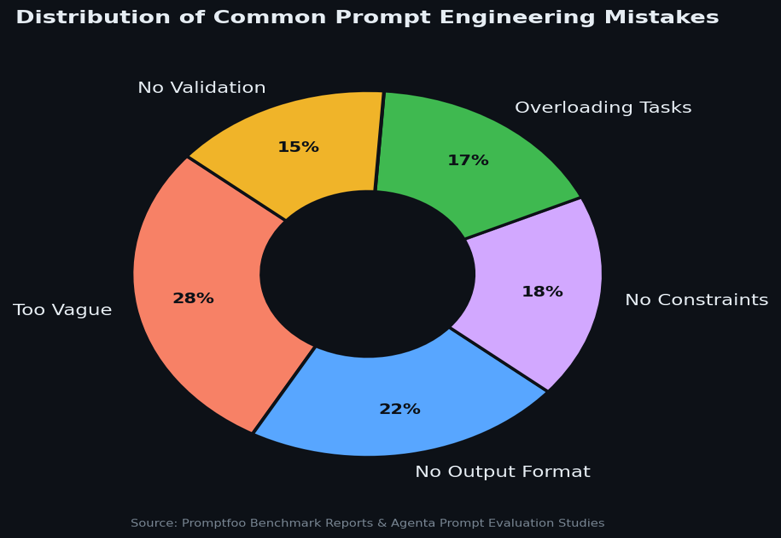
| Mistake | Why It Happens | What To Do Instead |
| Being too vague | Prompt says “analyze this” without context | State the goal, dataset, and output clearly. |
| Not defining the audience | AI may write in the wrong tone or depth | Say whether the answer is for a manager, analyst, or beginner. |
| Forgetting constraints | The model may invent numbers or make assumptions | Add rules like “do not guess” or “use only provided data.” |
| Asking for too many tasks at once | The response becomes unfocused | Split complex requests into steps. |
| Not validating output | Users trust AI too quickly | Review code, logic, and claims before use. |
| Same prompt for every task | Different tasks need different structure | Build task-specific prompt templates. |
Frequently Asked Questions
Q1. What is prompt engineering in simple words?
When you want to get an answer from an artificial intelligence tool you need to know how to ask for it. This is called engineering. For people who work with data like data analysts prompt engineering is about asking the intelligence tool for things, like SQL or summaries in a way that makes sense. You also want the artificial intelligence tool to give you explanations or analysis that’re easy to understand. The main goal of engineering is to make the answers you get from the artificial intelligence tool more useful and reliable.
Good prompt engineering is important because it saves you time. You do not have to keep asking the artificial intelligence tool for the same thing over and over.
Q2. Why should data analysts care about prompt engineering?
Because it helps them work faster. With less effort. Analysts use it to write SQL sum up trends think of analysis ideas and fix code. This tool is really helpful when analysts do the type of analysis over and over. It makes their work easier, without replacing their judgment.
Q3. Can prompt engineering replace SQL or Excel?
Number one thing to remember is that prompt engineering is really helpful when you want to use Artificial Intelligence effectively.. Things like SQL and Excel are still very important because they let you have complete control over your data and the way you analyze it. A good analyst will use Artificial Intelligence as a tool to help them not as a replacement for knowing how to work with data. When you combine engineering with the basics of analytics that is when you get the best results, from using Artificial Intelligence and SQL and Excel together.
Q4. What makes a strong analytics prompt?
When you want to get results from analytics you need to be clear, about what you are trying to do. A good analytics question should say what you want to achieve what information you have to work with what rules you have to follow and how you want the answer to look. Sometimes it is also helpful to ask the model to think about what it’s assuming what facts it is using and how it can make sure its answer is correct. The clearly you can describe what a good answer would be, the better the answer you will get from analytics.
Q5. What kinds of tasks can AI help with in data analysis?
Artificial Intelligence can help with SQL generation and brainstorming and cleaning ideas and things like that. It can also give you report summaries. Suggest what charts you should use.. It can even help with debugging.
Artificial Intelligence can also support you when you are trying to figure out what to look at by suggesting angles to investigate with your data.. People who do this work still need to check if the output from Artificial Intelligence is correct from a statistics point of view and, from a programming point of view.
Q6. What is the biggest risk in using AI for analytics?
The biggest risk is trusting an answer, from the Artificial Intelligence system that sounds confident but is not correct. The Artificial Intelligence system can make things up which is called details or it can misread the instructions or it can miss some very important data constraints. That is why the analysts should always check the code the calculations and the business claims.
Good prompt design can reduce the risk. It is still very essential to do a review of the Artificial Intelligence system results.
Q7. Should beginners learn prompt engineering before advanced analytics?
People who are new to prompt engineering can start learning it on. However prompt engineering works well when you use it with SQL, Excel and the basics of data.
Prompt engineering is more useful when you already know how data is organized and what makes a good analysis.
You should think of engineering as a way to help you learn faster not as a way to avoid learning the basics of data and analysis and prompt engineering is what makes this work.
Q8. How can I improve my prompt writing quickly?
Start by adding details, clear steps and a specific way to present the output. Then try out the prompt check the answer and make it better based on what did not work. You can make templates for tasks you do often like:
* Summarizing performance indicators
* Writing SQL requests
* Making dashboard notes
Getting better at this usually happens with practice and careful review, over time. The more you. Review, the better you will get. Practice and review help you improve.
Final Summary
Data analysts really need to know about engineering these days. It is a help, to them because it makes their work easier and faster. They can think clearly and use artificial intelligence in a better way. The best prompts are the ones that’re simple and easy to understand and that are connected to the actual work that needs to be done.
With good prompts data analysts still have to check the results to make sure they are correct. They have to think about what the results mean and use their judgment to make decisions. Data analysts and prompt engineering go hand in hand. Data analysts really need to use prompt engineering to do their job well..
📘 For learners, Oneleap’s Strategic Data Analyst with AI course is a practical next step for building both analytics fundamentals and AI-ready workflow skills — available at oneleap.co.in
Sources & References
All data, statistics, and claims in this blog are sourced from the following trusted publications and research reports:
• IBM: The 2026 Guide to Prompt Engineering
• Learn Prompting: The Ultimate Guide to Generative AI
• Codecademy: Prompt Engineering for Analytics
• Braintrust: Best Prompt Engineering Tools in 2026
• Prompt Engineering Guide for Data Analysts (Medium)

Leave a Reply