
Introduction
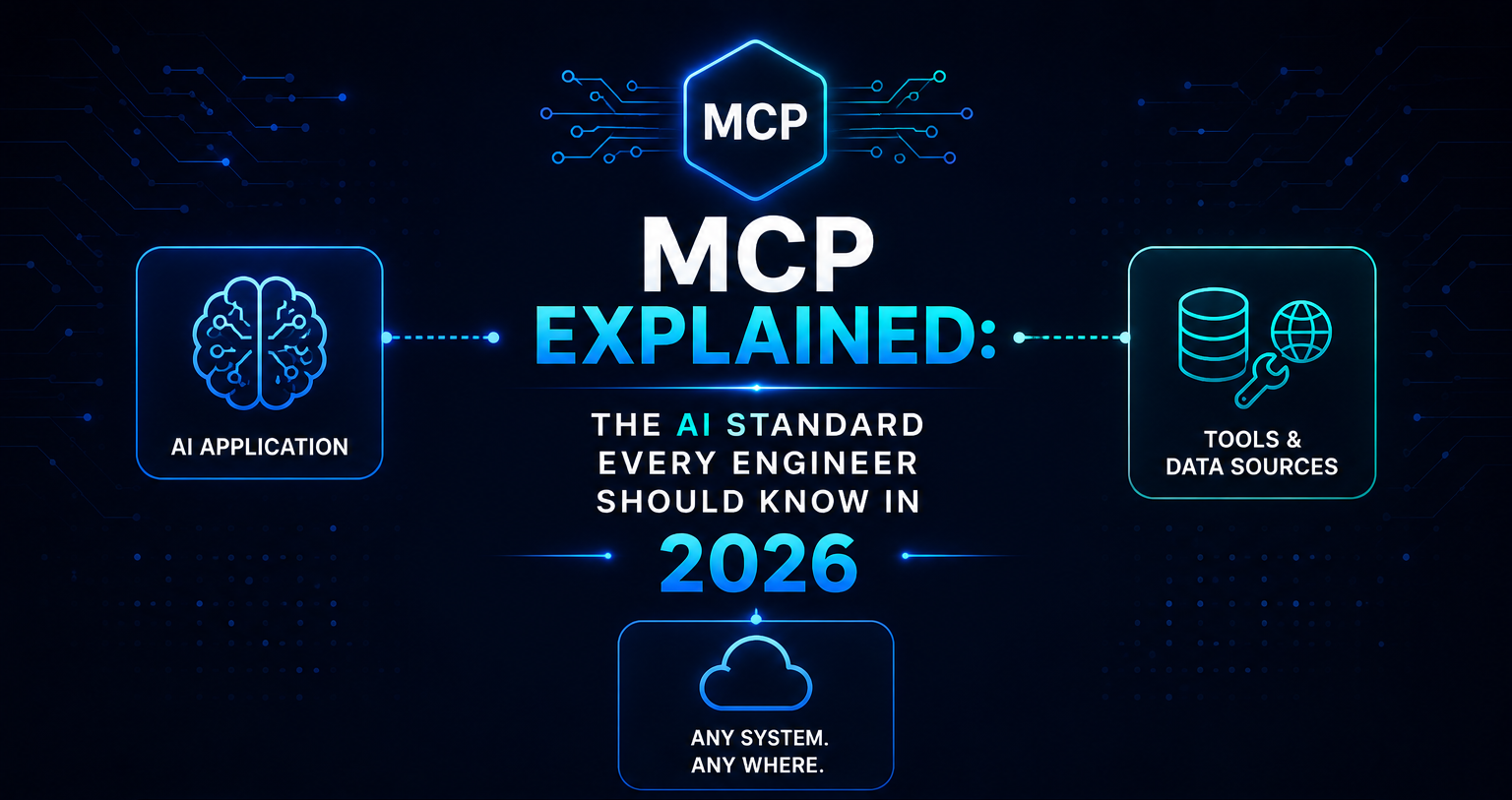
The Model Context Protocol or MCP is a standard that’s open to everyone. It helps artificial intelligence applications connect to tools and other systems in a way. This is important for engineers because it makes artificial intelligence products easier to create easier to make bigger and more useful in the work that people do every day. The Model Context Protocol makes a difference, in how artificial intelligence is used.
Key Takeaways
- MCP is a standard for connecting AI systems with tools and context.
- It helps AI move from simple chat to real task execution.
- Engineers use MCP to reduce integration complexity.
- It is especially relevant for agents, RAG systems, and production AI apps.
- MCP is becoming an important concept for modern AI engineering roles.
- Learning MCP helps you build practical systems, not just prototypes.
Table of Contents
- What Is MCP?
- Why MCP Matters
- How MCP Works
- Core Components
- Tools and Technologies
- Real Examples
- MCP Adoption in 2026: The Numbers
- MCP vs Traditional Integrations
- Best Practices
- Common Mistakes
- FAQs
- Final Summary
What Is MCP?
Model Context Protocol or MCP for short is a standard that helps artificial intelligence applications connect to tools and data in a structured way. This means that developers do not have to create custom connections for every application. They can use Model Context Protocol to make a reusable and predictable interface.
Model Context Protocol is really helpful because it gives an intelligence system the context it needs to provide better answers perform actions and work with other software outside of the model itself. This includes things like files, APIs, databases, internal tools and other systems that are used in production environments.
Model Context Protocol was first introduced by Anthropic in November 2024 as a standard. Since then it has been adopted by lots of companies, like OpenAI, Google DeepMind and Microsoft. Thousands of developers are also using Model Context Protocol to build production intelligence agents. In December 2025 Anthropic decided to donate Model Context Protocol to the Agentic AI Foundation, which’s a part of the Linux Foundation. This was done to keep Model Context Protocol vendor-neutral because it is becoming an important part of artificial intelligence infrastructure.
Why MCP Matters?
MCP is important because the best artificial intelligence applications require more than text that is generated. They need to be able to get to live information, business rules and tools that can actually do things. Without these things artificial intelligence is only good, for talking. Cannot be a real helper or do real work.
For companies MCP can make things faster more consistent and easier to maintain. For the people who build these systems MCP makes it easier to create intelligence systems that can really be used for something. MCP helps engineers build artificial intelligence systems that can support real life situations. This is one reason MCP is showing up in agent frameworks, enterprise AI, and product engineering conversations.
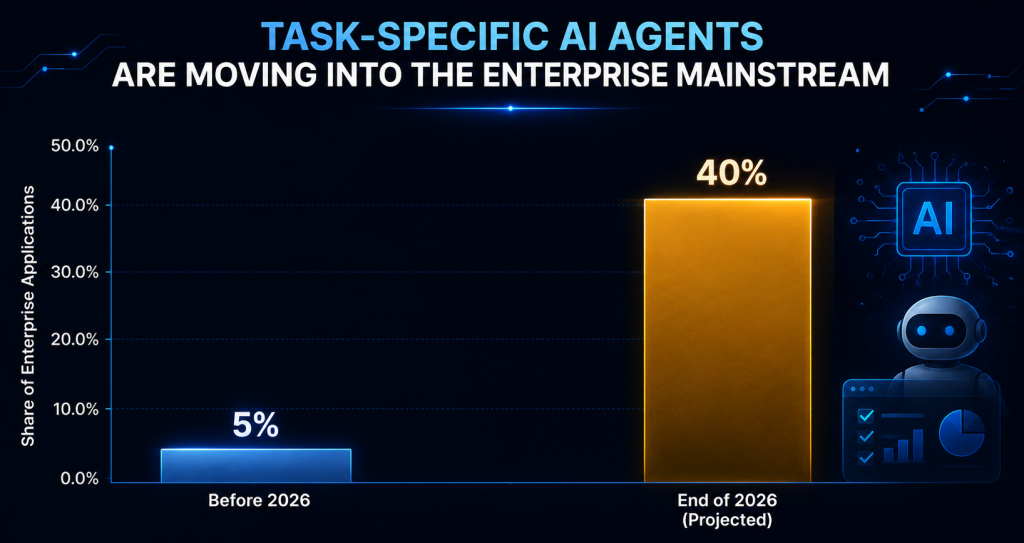
The scale of this shift is significant. Gartner projects that task-specific AI agents will appear in 40% of enterprise applications by the end of 2026, up from less than 5% before this year — and integration layers like MCP are what make that deployment speed possible.
How MCP Works?
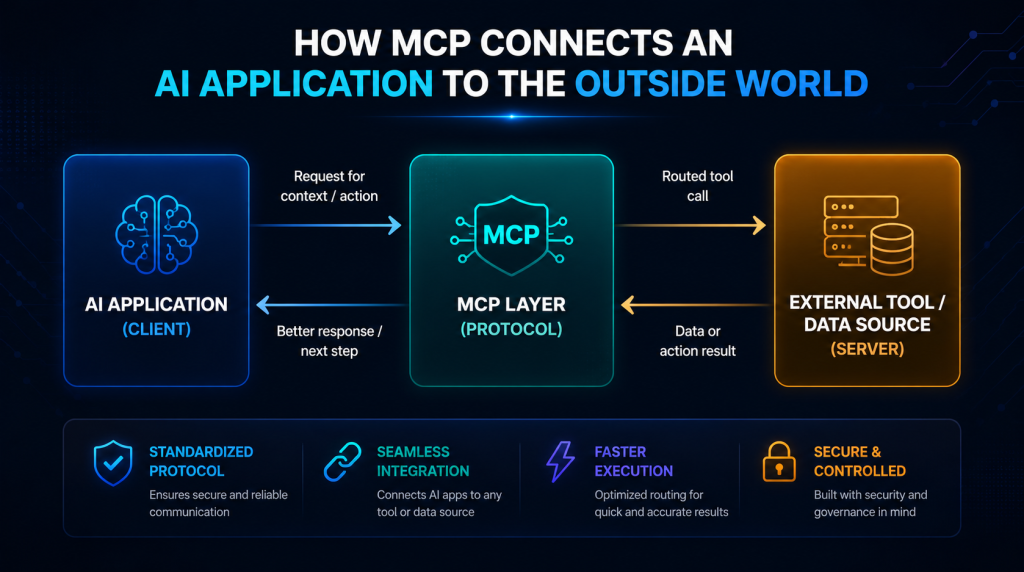
MCP works by creating a standard path between the AI app and the tools it needs. The AI client requests context or action, and the MCP layer connects it to the right server or resource. That server then provides the data, action, or tool output the model needs.
A typical flow looks like this:
- A user asks a question or gives an instruction.
- The AI application determines whether external context is needed.
- MCP routes the request to the right tool or resource.
- The external system responds with data or performs the action.
- The AI application uses that result to generate a better response or next step.
This is especially useful when building agents that need to fetch documents, update systems, or coordinate multiple steps in a workflow. It turns the AI app into something more operational and less purely conversational.
Core Components
MCP is usually made up of a few important parts.
| Component | Role | Why It Matters |
| Client | Sends requests from the AI app | Starts the interaction |
| Server | Exposes tools and data sources | Connects the AI app to outside systems |
| Tools | Actions the model can call | Enables execution, not just generation |
| Resources | Context or data exposed to the app | Improves the model’s understanding |
| Prompts | Structured instructions for the system | Helps standardize behavior |
These parts work together to make integrations cleaner. Instead of every application building its own custom connection format, MCP gives teams a shared pattern they can follow.
Tools and Technologies
MCP is often used alongside modern AI engineering tools. In practice, it fits into systems that use backend frameworks, retrieval tools, agent frameworks, and deployment infrastructure. It is not a replacement for these tools, but a way to make them easier to connect.
| Category | Examples | Typical Use |
| Backend | Python, Fast API | Building the service layer |
| AI Orchestration | LangGraph, Lang Chain, Llama Index | Agent workflows and tool use |
| Retrieval | Chroma, Pinecone, FAISS | Search and context retrieval |
| Deployment | Docker, Kubernetes | Packaging and scaling |
| Monitoring | ML flow, Weights & Biases | Evaluation and observability |
If you are learning AI engineering, MCP is worth understanding because it sits at the intersection of software engineering, tool integration, and agent design.
Real Examples
MCP is most useful when AI needs to do something practical. A customer support assistant can use MCP to pull order history before replying. A research assistant can use MCP to access files, search internal knowledge, and organize findings into a report.
Here are a few real-world examples:
- A coding assistant reading project files and suggesting fixes.
- A sales assistant pulling CRM data before writing follow-up emails.
- A workplace bot accessing documentation to answer internal questions.
- An automation agent updating tickets or triggering actions in business tools.
These are the kinds of systems companies actually want to build. That is why MCP is relevant to engineers who want to move from demos to deployed products.
MCP Adoption in 2026: The Numbers
MCP’s growth over the past 18 months is one of the clearest signals of where AI engineering is heading. Since Anthropic’s November 2024 launch, developer and enterprise usage has scaled sharply:
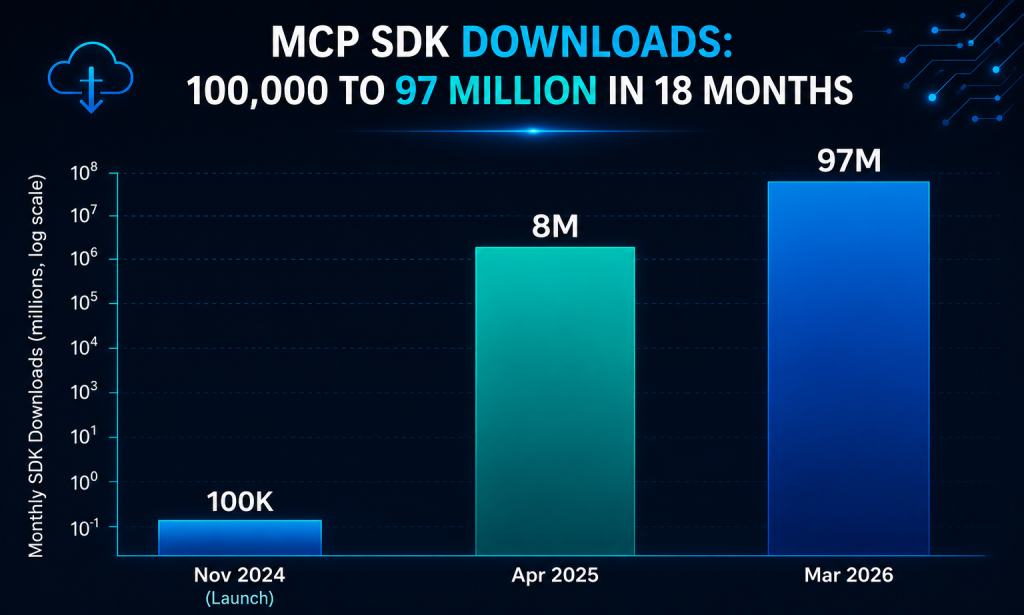
Adoption is not just about developer downloads — it is showing up in production. Independent industry surveys from Stacklok found that a substantial share of software and retail organizations already have MCP servers running in limited or broad production, not just pilots:
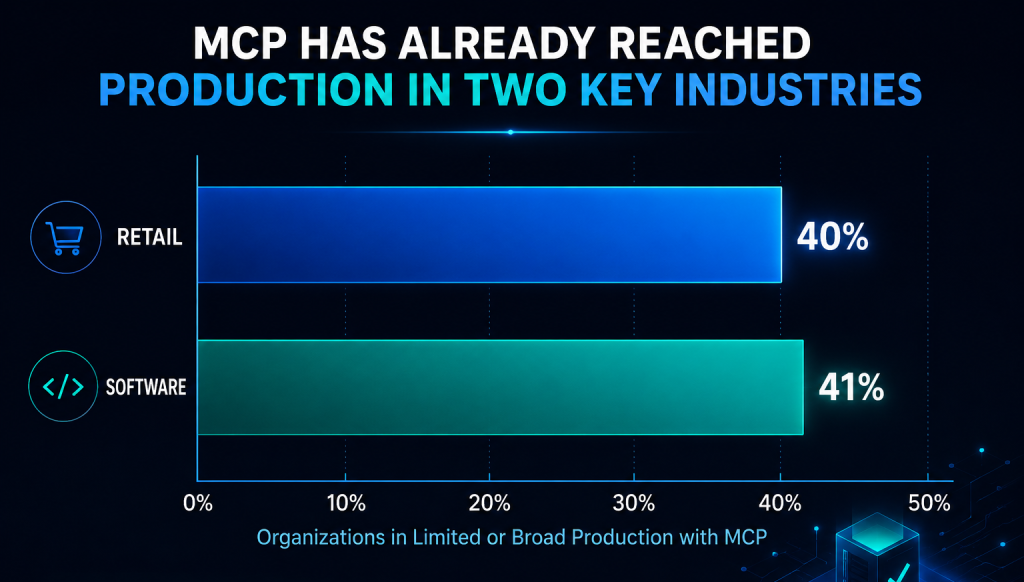
Anthropic also reports more than 10,000 active public MCP servers in use across products such as ChatGPT, Cursor, Gemini, Microsoft Copilot, and Visual Studio Code as of its December 2025 ecosystem update. For engineers, the takeaway is simple: MCP has moved past the experimental stage and is now part of how production AI systems are actually built.
MCP vs Traditional Integrations
Traditional integrations are usually built one, by one for an app. This works for a time but gets hard to manage as more tools are added. MCP helps make this layer standard so the same method can be used again easily.
| Approach | Strength | Limitation |
| Custom integration | Quick for a single project | Hard to scale and reuse |
| MCP-based integration | Standardized and modular | Requires learning the protocol |
| Direct API calls | Simple at first | Can become messy across many tools |
For production AI systems, MCP is attractive because it reduces duplication and improves long-term structure. That makes it useful for teams building agents, assistant products, and enterprise workflows.
Best Practices
To use MCP well, start with a real problem. Do not add it just because it is new. The strongest use cases are the ones where external context or tool access clearly improves the outcome.
Good practices include:
- Keep tools focused on one job.
- Validate outputs before taking action.
- Log tool use for troubleshooting and evaluation.
- Protect access to sensitive systems.
- Use MCP where standardization helps maintainability.
These habits matter even more in production environments. The main thing we want to do is not get systems to talk to each other but to make sure these systems are really reliable and safe. We are talking about systems and the goal is to make these systems work well and be safe for everyone to use. So when we think about systems we need to think about how to make these systems reliable and safe.
Common Mistakes
People often make a mistake when they think that MCP automatically makes an artificial intelligence application smart. This is not true. MCP is a standard that helps different systems work together it is not the part that actually makes decisions.
Other mistakes that people make with MCP include:
• Adding MCP to a project when a simple application programming interface call would be enough.
• Giving users access to many tools without any limits or control.
• Not paying attention to security and permission checks.
• Not testing how tools respond to user input and how they handle errors.
• Building something without an idea of what it is supposed to do.
Good engineering is about using the tool for the job. MCP is a tool but it is only really useful when it helps to achieve a clear goal, for a product or a workflow. MCP is a choice when it supports something that you are trying to accomplish with your artificial intelligence application
FAQs
Q1. What is MCP in Artificial Intelligence?
MCP stands for Model Context Protocol. This is a standard that helps Artificial Intelligence applications connect with tools and data and external systems in a way.
Q2. Why should engineers learn about MCP?
Engineers should learn about MCP because it helps them build Artificial Intelligence systems that can actually work with data and real tools not just generate text.
Q3. Is MCP for computer agents?
No. MCP is useful for computer agents and assistants and retrieval systems and other Artificial Intelligence apps that need context or actions.
Q4. Does MCP replace Application Programming Interfaces?
No. MCP does not replace Application Programming Interfaces. It provides a way for Artificial Intelligence systems to use Application Programming Interfaces more effectively.
Q5. Is MCP useful for production Artificial Intelligence systems?
Yes. It is especially useful in production because it makes integrations more modular and reusable and easier to manage.
Q6. How is MCP different from a chatbot?
A chatbot mainly generates responses. An MCP-based Artificial Intelligence app can also access tools. Retrieve data and take actions, which makes it far more practical.
Q7. Should beginners learn MCP?
Yes, if they are learning Artificial Intelligence engineering. MCP is one of the concepts that helps bridge the gap between model use and real-world application design. Beginners should learn MCP because it is useful, for Artificial Intelligence and it helps them build Artificial Intelligence systems.
Final Summary
MCP is getting to be a deal, in AI engineering. It helps AI apps connect to tools and info in a simpler way. This makes it easier to build systems that can do more than just give answers.
If you want to work on AI projects, like agents and workflows you should learn about MCP. It’s an idea to learn it early on. MCP fits well with the kind of training OneLeap’s AI Engineering Mastery program offers. In this program you build systems not just get a certificate.
Learn more about Generative AI Engineering: Why It Is Becoming the Next Big Career Opportunity in India
Stay updated with the latest AI, Data Science, and Automation insights by following OneLeap on LinkedIn and Instagram.
Sources:
- Anthropic — Model Context Protocol Documentation
- Model Context Protocol — Official Docs
- Anthropic — AAIF and MCP Donation Announcement (Dec 2025)
- Model Context Protocol — Wikipedia
- Gartner projection, cited in Pento — “A Year of MCP: From Internal Experiment to Industry Standard”
- Google Search Central
- Google Helpful Content Guidance

Leave a Reply