
Introduction
We are living through a change in the way people work. AI Skills is not something that scientists and big companies use anymore, it is now a part of everyday work in India and it is changing what employers expect from new employees.
At OneLeap we work with students, people who want to change careers and working professionals who are trying to understand this change. The question we hear often is simple: “What artificial intelligence skills do I actually need to get a job in 2026?” This blog is our answer.
India is at a point right now. The country has the people learning about artificial intelligence in the world. About 1.3 million. But it is ranked 89th out of 109 countries when it comes to how good people are at using artificial intelligence. That gap between how excited people are to learn and how good they actually are is a big challenge and a big opportunity. Companies are hiring people with intelligence skills very quickly they are paying them more money and there are not enough people with these skills to fill all the jobs.
This guide is for three groups of people: students who are just entering the job market and want to know what skills to focus on; working professionals who want to stay up to date or switch to a job that involves intelligence; and managers who want to know what it means to be ready for artificial intelligence in 2026. We talk about the skills that employers want how these skills are used in real jobs, which industries are hiring the most people, with artificial intelligence skills and how to build a strong artificial intelligence skill set that will impress employers. This is to understand what Top AI Skills Employers Want in 2026.
Key Takeaways
- The people who hire workers really want to find workers who can actually use Artificial Intelligence in their work not just people who know what Artificial Intelligence is.
- The skills that are very important to have are being able to understand Artificial Intelligence making prompts for Artificial Intelligence analyzing data automating workflows and using Artificial Intelligence in a responsible way.
- It is not just people who’re good at engineering who can work with Artificial Intelligence now. Almost half of the jobs that involve Artificial Intelligence are for people who do not need to be experts in technology like people who work with data make products do marketing and manage operations.
- In India it is very important that people learn skills because there are not enough people who know about Artificial Intelligence. There will be, around 380,000 jobs that need people who know about Artificial Intelligence by the end of 2026 and right now there are not enough people to fill those jobs.
- When you are looking for a job it is better to show the people who are hiring that you can actually do things with Artificial Intelligence by showing them projects you have worked on and studies you have done than just having a piece of paper that says you know about Artificial Intelligence.
Table of Contents
- What AI Skills Employers Want in 2026
- Why AI Skills Matter for Jobs in India
- How AI Skills Work in Real Workplaces
- Core AI Skills Employers Are Looking For
- Tools and Technologies to Learn for AI Jobs
- AI Skills by Career Path
- AI Hiring Trends by Industry in India
- The Global Picture: AI Roles Are Growing Fast
- Real Examples of AI Skills in Action
- Best Practices to Build AI Skills
- Common Mistakes to Avoid When Learning AI
- Frequently Asked Questions
- Final Thoughts
- Sources & References
What AI Skills Employers Want in 2026?
In 2026 employers do not just want people who know the names of Artificial Intelligence tools. They want people who can actually use Artificial Intelligence to solve problems that businesses face make work easier and help people make good decisions. The difference between these two things is big. One is just knowing about Artificial Intelligence and the other is being able to use it.
The best people for the job understand how to work with Artificial Intelligence tools make sure the work they do is good and show how using Artificial Intelligence helps the business. If you are a student, working or trying to change jobs learning how to use Artificial Intelligence is the best way to stay ahead of others.
This change is not a temporary thing it is a big change in the way things work. Artificial Intelligence and data analytics jobs, in India are growing fast about 30 percent every year because more people are using Large Language Model and automating work. And this trend is not going to stop.
Why AI Skills Matter for Jobs in India?
Artificial Intelligence is changing the way companies hire people in every industry in India. This is happening in Information Technology and banking. Also in healthcare and logistics. Companies want to find employees who can do their work quickly with manual labor and who are good at working with Artificial Intelligence systems. This is not just for the people who work on engineering teams it is also for people who work in operations, marketing, product development and business.
The change that is happening is really big. India has around 1.3 million people who are learning about Artificial Intelligence, which’s the most in the world. When it comes to how good people are at using Artificial Intelligence India is ranked 89th out of 109 countries. This big difference between how many people are interested in Artificial Intelligence and how good they actually are, at it is why it is so important to have training programs that are well organized and focused on getting specific results right now. Artificial Intelligence training is really important because it helps people learn the skills they need to work with Artificial Intelligence systems.
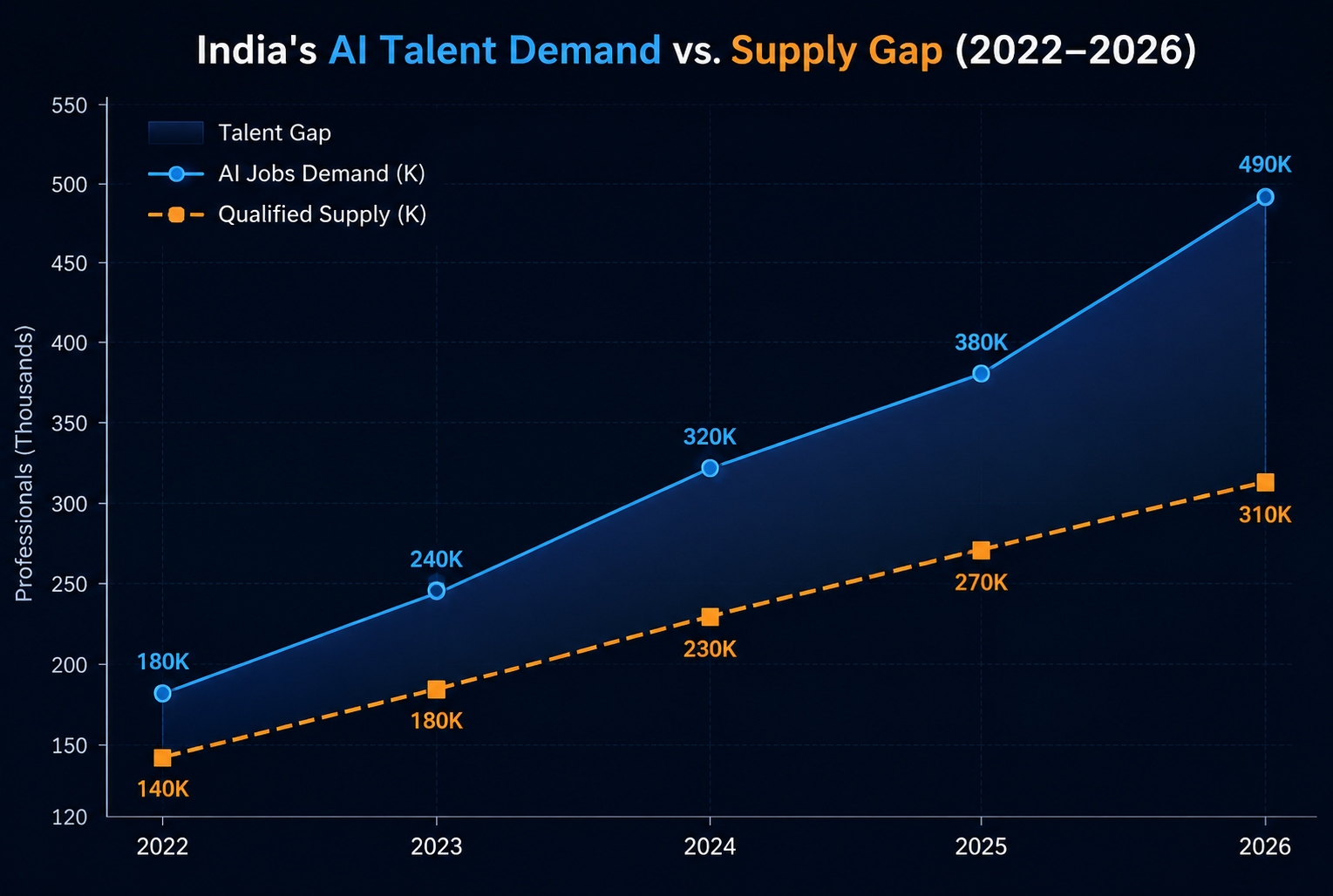
LinkedIn India Jobs on the Rise 2026 report found that the jobs, for Prompt Engineer and AI Engineer and Software Engineer are growing fast this year. Than 90 percent of Indian professionals want to use Artificial Intelligence in their job search in 2026. For people looking for jobs having Artificial Intelligence skills makes them more likely to get hired. Helps them stand out. For companies having people who know about Artificial Intelligence helps them use tools and make better decisions.
How AI Skills Work in Real Workplaces?
AI skills are useful when they help with tasks.The process is easy:
- find a task that’s slow, repetitive or has many errors
- pick the right AI tool
- write a clear instruction or workflow
- check the result carefully
- and use it in the actual job
A data analyst can use AI to quickly summarise a long 50-page report. A product manager can use it to organise customer feedback in a way. An engineer can automate some part of building a product. In each case the skill is not just using the AI tool. It is using the AI tool with judgment, understanding and being responsible. Employers want people, with this approach.
They look for people who can see where AI really helps and who know when not to trust its result. Using AI in an critical way is now a key job requirement. AI skills create value when AI is applied to improve tasks. Employers value people who can apply AI with judgment and AI skills are useful when used with accountability. AI helps in jobs and using AI tool with context is important.
Core AI Skills Employers Are Looking For
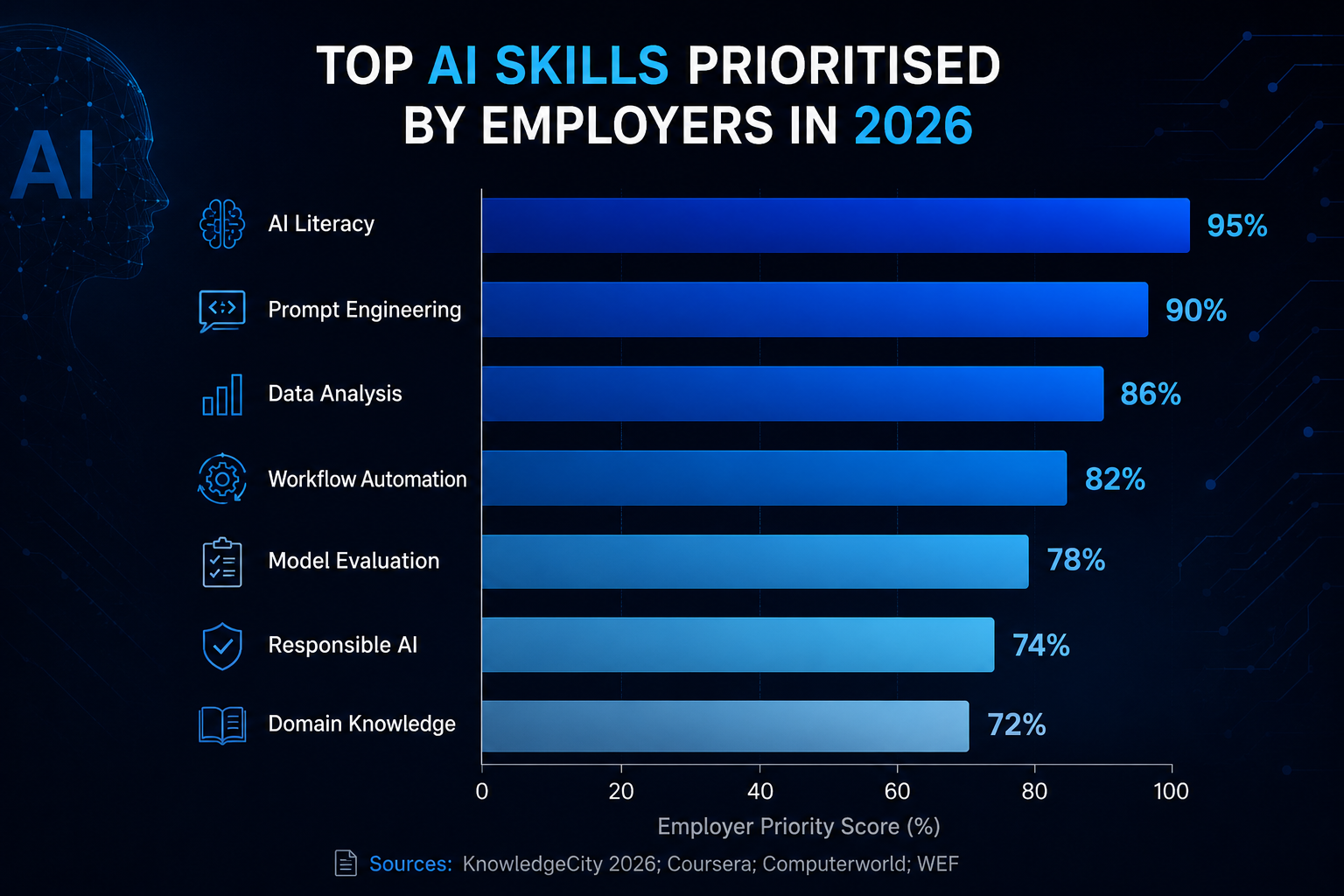
The most important AI skills in 2026 can be grouped into seven major categories. The chart below shows how employers rank these in terms of hiring priority, followed by a detailed breakdown of each skill.
| Skill | What It Means | Why Employers Value It |
| AI Literacy | Understanding what AI can and cannot do | Prevents misuse and sets realistic expectations |
| Prompt Engineering | Writing clear, effective instructions for AI tools | Improves output quality and consistency |
| Data Analysis | Interpreting data; using AI to support decisions | Helps teams make faster, more accurate choices |
| Workflow Automation | Using AI to reduce repetitive processes | Saves time and increases team efficiency |
| Model Evaluation | Checking AI outputs for quality and accuracy | Reduces errors and poor-quality results |
| Responsible AI | Using AI ethically, safely, and transparently | Builds trust; reduces legal and reputational risk |
| Domain Knowledge | Applying AI in a specific job function or industry | Makes AI output more relevant and actionable |
AI literacy is the foundation. This is what everything starts with. Without AI literacy professionals may think that AI can do more than it actually can. They may also trust the results from AI without checking if they are correct. Prompt engineering is very important because it helps get results from any AI tool. When you use AI the way you can get very good results. Data analysis and automation are also very useful because they help create value for businesses. You can actually measure the difference they make.
Responsible AI is something that really matters. This is because organisations are being held responsible for making sure that the results from AI are accurate, fair and safe. Organisations have to make sure that AI-generated results are accurate and fair and safe. AI literacy and responsible AI go hand, in hand with AI tools and data analysis and automation.
Tools and Technologies to Learn for AI Jobs
Employers do not expect everyone to master every tool — but they do expect familiarity with the categories of platforms that power AI-enabled work. Knowing when to reach for which type of tool is what sets strong candidates apart.
| Tool Category | Examples | Use Case |
| Generative AI Assistants | ChatGPT, Gemini-style tools | Writing, ideation, summarisation, drafting |
| Data & Analytics Tools | Excel, Python, BI dashboards | Analysis, reporting, visualisation |
| Automation Platforms | No-code / low-code workflow tools | Repetitive task reduction at scale |
| Knowledge-Grounded AI | Retrieval-augmented workflows (RAG) | Source-backed, factually grounded answers |
| LLM & Engineering Tools | LangChain, MLOps platforms | Building, deploying, maintaining AI systems |
| Product & Testing Tools | Integration and deployment tools | AI-powered product development |
The key principle is not tool collection — it is tool application. Employers value professionals who can select the right tool for the right task and use it with judgment and critical thinking.
AI Skills by Career Path
Different roles require different combinations of AI skills. A structured understanding of your target career path helps you prioritise the right skills rather than trying to learn everything at once.
| Career Path | Core AI Skills Required | Best Suited For |
| AI Engineering | AI literacy, prompt engineering, automation, model evaluation, MLOps, deployment | Technical learners and developers |
| Strategic Data Analytics | Data analysis, reporting, insight generation, AI-assisted workflows, Python | Students, analysts, business professionals |
| AI for Product Managers | Use-case design, customer insight, prioritisation, AI strategy, prompt design | Product managers and business professionals |
| AI in Business / Operations | AI literacy, workflow automation, responsible AI, basic prompt engineering | Operations, HR, marketing, finance professionals |
This way of looking at a career path shows that training for Artificial Intelligence that is the same for everyone usually does not work. A person who wants to become a Machine Learning engineer needs to know things than someone who uses Artificial Intelligence to make business decisions better or to plan products.
Programmes that teach skills and then have the learner work on projects to get a specific job are much better, at making strong candidates. The Artificial Intelligence training needs to be tailored to the career path of the learner like Machine Learning engineering or business analytics.
AI Hiring Trends by Industry in India
India posted 2,90,256 AI-linked roles in 2025 and AI hiring is projected to grow a further 32% in 2026, reaching close to 380,000 positions. The demand is no longer concentrated in pure technology firms.
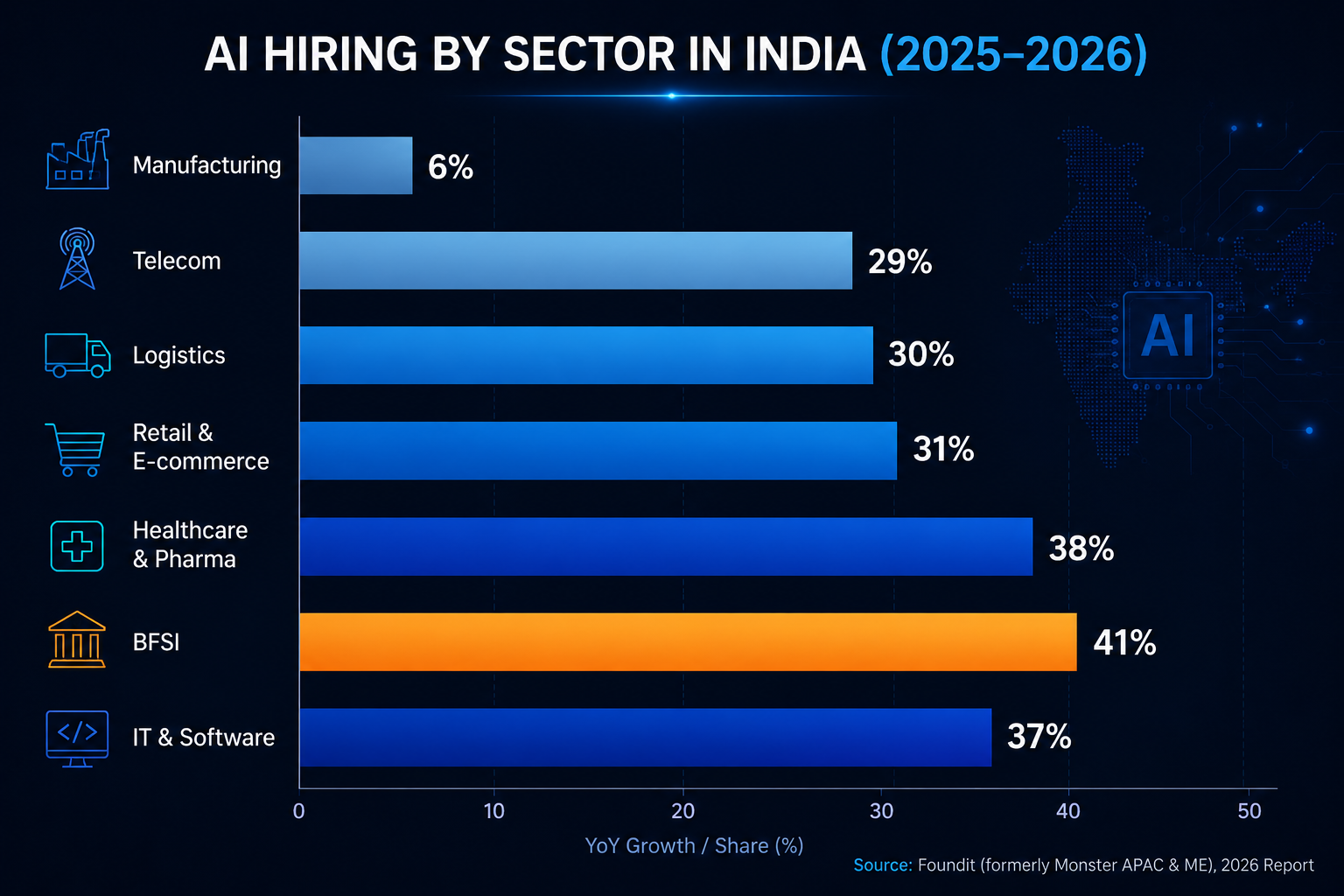
Information technology and software services have the jobs that use artificial intelligence with thirty seven percent of all artificial intelligence jobs. The areas with the most growth are actually in other places. The banking and financial services industry grew forty one percent from year to this year. The healthcare and pharmaceutical industry grew thirty eight percent. The retail, logistics and telecom industries all grew between twenty nine and thirty one percent.
This is important because it shows that artificial intelligence skills are needed in different types of jobs not just in the technology department. Artificial intelligence skills the kind used for generative artificial intelligence and large language models are in very high demand. The number of employers looking for people, with these skills grew sixty percent in the year twenty twenty five which is a really big jump.
The Global Picture: AI Roles Are Growing Fast
India’s AI hiring boom is part of a broader global transformation. Understanding the international context helps learners appreciate just how significant and durable this shift is.
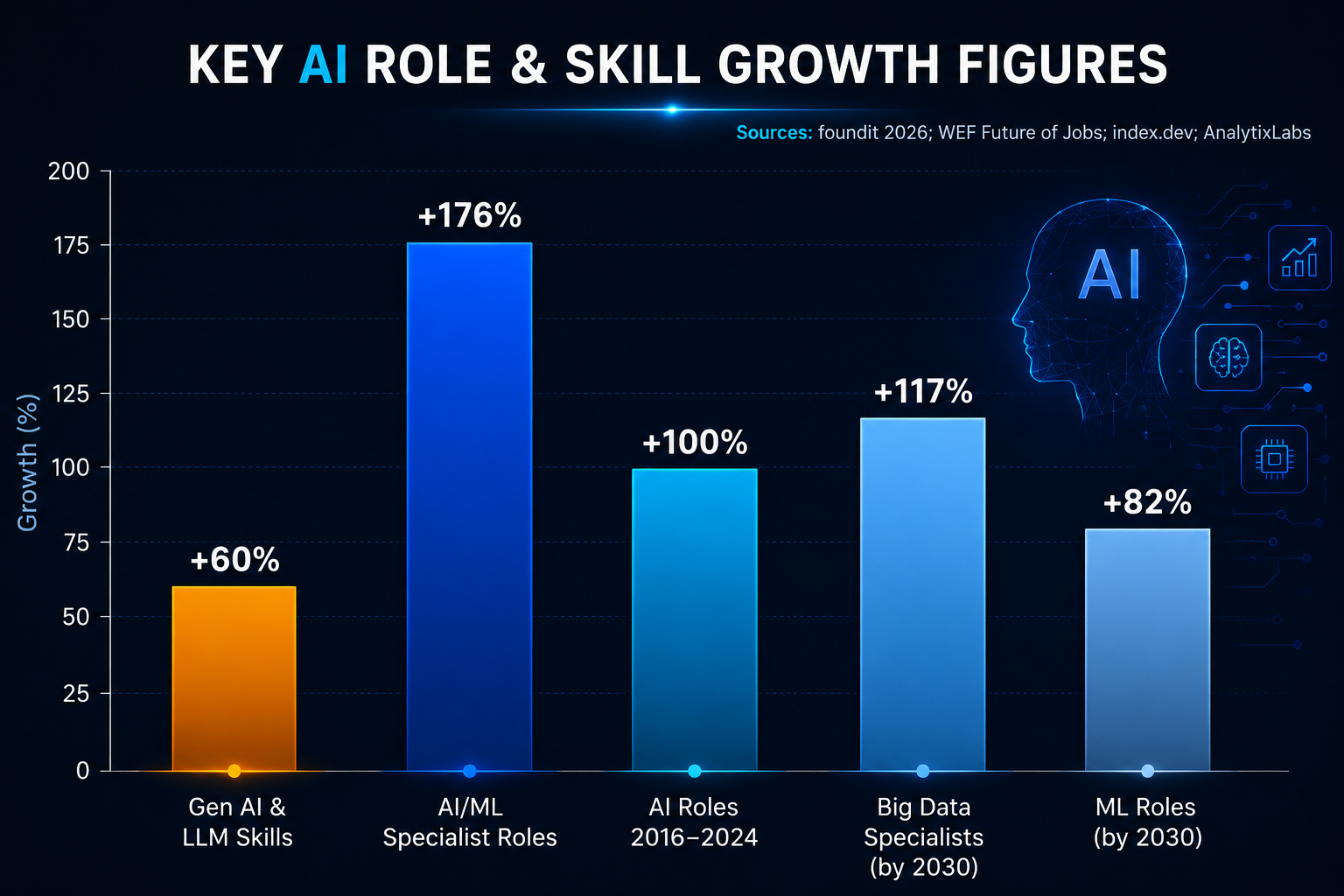
- India and the United Kingdom have seen an increase in Artificial Intelligence and Machine Learning Specialist jobs with a growth of 176 percent and 151 percent respectively.
- The number of Artificial Intelligence related jobs has more than doubled in all industries from 2016 to 2024.
- A lot of employers around the world 86 percent think Artificial Intelligence is the main reason for change through 2030.
- It is expected that the demand for data specialists will go up by 117 percent and Machine Learning roles by 82 percent by the year 2030.
- By 2030 39 percent of the skills we have now will not be needed anymore or will have to be changed and the demand, for new skills is changing much faster about 66 percent faster in jobs that use Artificial Intelligence.
9. Real Examples of AI Skills in Action
Abstract skill descriptions become meaningful when connected to real job scenarios. Here is how AI skills translate into workplace value across different roles.
| Role | AI Skill Applied | Real Outcome |
| Student / Fresh Graduate | Prompt engineering + AI research tools | Built portfolio project; summarised 40 papers in 2 hours instead of 2 weeks |
| Data Analyst | AI-assisted reporting + Python automation | Reduced weekly report cycle from 3 days to 4 hours |
| Marketing Professional | Generative AI + content workflows | Produced 3x content output with consistent brand voice |
| Product Manager | AI use-case design + customer insight tools | Processed 500+ user feedback entries into themes in one session |
| Operations Manager | Workflow automation + AI-aided decision support | Eliminated 12 hours of weekly manual data consolidation |
| HR Professional | AI screening + structured evaluation tools | Improved shortlisting consistency; reduced time-to-hire by 35% |
In India, practical outcomes matter more than credentials alone. Employers increasingly want evidence — a project, a workflow, a business case — that demonstrates AI skill in action. Theoretical knowledge without application has limited signal value in today’s hiring market.
Best Practices to Build AI Skills
The best way to get good at intelligence skills is to start working on real projects from the beginning. Learning the theory is important. Doing real projects helps you learn faster and people will think you are more capable.
- First you need to understand what artificial intelligence tools are and how they work. You should also know when they do not work well. This basic knowledge will help you make decisions later on.
- Then you should practice writing instructions for intelligence tools and see what they produce. You should try again and again until you get what you want. This skill is useful for all intelligence tools and platforms.
- Next you should make something useful like a report template or a library of instructions. You could also automate a task. Write a case study. When you can show what you have made it is better than talking about what you know.
- You should also learn about intelligence in the context of your job. If you are an analyst you should focus on using intelligence to help with reports. If you are a product manager you should think about how to use intelligence in your products. If you are an engineer you should learn about how to put intelligence models into action.
- When you are looking for a certification program choose one that includes projects. These programs will help you learn. Also give you something to show for it.
- Finally you need to stay up to date with what’s happening in the artificial intelligence world. This world is changing fast so you should take some time each week to learn about tools and techniques and what employers are looking for in a candidate.
Common Mistakes to Avoid When Learning AI
- People often think using ChatGPT for stuff means they are good at AI. That’s not the same as using AI at work.
- Some people trust what AI says without checking. Ai can give wrong answers that sound right. You need to check and evaluate the results.
- Having certificates is good. Employers want to see what you have done like a project.
- Trying to learn all AI skills at once is not smart. Focus, on the skills you need for your job.
- Companies get in trouble if they misuse AI. This can include bias, breaking privacy rules or spreading false information. Using AI in a way is important.
Frequently Asked Questions
Q1. What kind of skills related to Artificial Intelligence do employers want the most in 2026?
Employers always want people who know about Artificial Intelligence basics and can make prompts, analyze data, automate work, check if models are good, use Artificial Intelligence in a responsible way and apply Artificial Intelligence tools to specific areas.
Q2. Are skills related to Artificial Intelligence for jobs that are not technical?
Yes. A report from the industry recently found that fifty percent of Artificial Intelligence opportunities are now available in jobs that are not traditional engineering jobs. Skills related to Artificial Intelligence are becoming more valuable in jobs, like analytics, managing products, marketing, operations, human resources and finance.
Q3. Is certification helpful for getting AI jobs?
Yes it definitely is, especially if you have hands-on projects and real results to show. Having a certificate and a portfolio project makes your profile much stronger.
Q4. Which AI skill should beginners start with?
Beginners should start with understanding AI basics. What AI tools are, how they work and their limitations. Then they should learn about engineering, which is useful, across all platforms. After that data analysis and workflow skills come naturally.
Q5. How can professionals move into roles related to AI?
- Build AI skills that apply to your job.
- Complete a certification program that includes projects.
- Create a portfolio that shows what you have achieved with AI.
- Linking AI to what you know is often a better strategy than starting from nothing.
Q6. Why are AI skills important in India now?
India has a gap between the number of AI jobs and the number of people qualified for them. 50 To 55 percent. There will be 380,000 AI jobs in 2026. If you build AI skills in the next year or so you will have good career opportunities in a growing market. Professionals with AI skills will do well in India. AI skills are in demand, in India right now.
Final Thoughts
The best skills in intelligence that employers want in 2026 are skills that can be used in real life are about business and can be used in many different jobs. The people who are the best at getting jobs are those who can use intelligence to get more work done help people make good decisions and create real value in the workplace.
If you are a student who is just starting to work a person who is changing jobs or a manager who is building a team for the future you should do something now. There are not people in India who know about artificial intelligence so this is a good chance for people who want to learn and get skills that employers can see are real.
For people who want to learn in a way that is structured and includes working on projects OneLeap has programmes that’re about getting a job like AI Engineering Mastery, Strategic Data Analysis and AI and AI for Product Managers. Each one is designed to help people get skills that will help them get a job.
Learn more about What Are AI Agents? Types, Applications, Benefits, and Future Trends(2026)
Stay updated with the latest AI, Data Science, and Automation insights by following OneLeap on LinkedIn and Instagram.

Leave a Reply