
Introduction
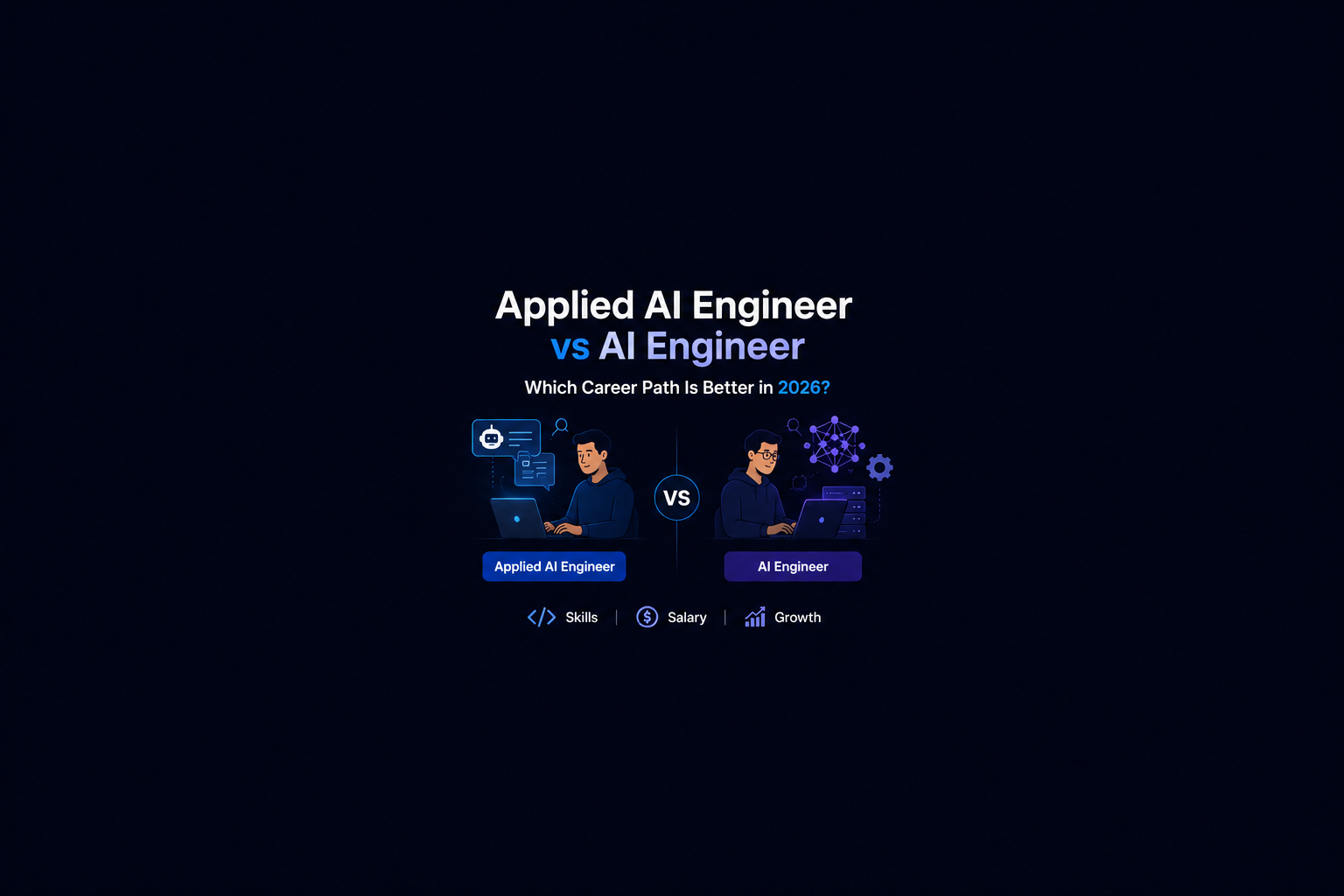
In 2026 if you want to build AI-powered products becoming an Applied AI Engineer is a good way to go. On the hand if you want a career path with more possibilities AI Engineer is a better choice.
Most people should aim to become AI Engineers because this path also teaches you skills and there are more jobs available, for AI Engineers. Applied AI is narrower and product-focused. AI Engineering is broader and more future-proof.
Key Takeaways
• Applied AI Engineer jobs are about adding AI features to products.
• AI Engineer jobs cover ground. Like designing, deploying and improving.
• Both jobs require skills in Python working with APIs getting data, evaluating and thinking about production.
• Retrieval, agents and observability are key for both roles in 2026.
• Many job opportunities are available in startups, big companies, software as a service firms and AI product companies.
• OneLeap‘s AI Engineering Mastery course is a fit for those who want to learn skills, for real-world AI engineering.
Table of Contents
- What Each Role Means
- Job Market Growth (2022–2026)
- Salary Comparison
- Skills Breakdown
- Where Each Role Is Hired
- Head-to-Head Comparison
- Tools & Technologies
- How to Build in Either Role
- Real-World Examples
- Best Practices
- Common Mistakes to Avoid
- Frequently Asked Questions (FAQs) Final Summary
What Each Role Means
Applied AI Engineer
An Applied AI Engineer creates artificial intelligence features that help solve business problems within a product or workflow. This can include things, like intelligence chatbots, search tools that use Retrieval Augmentation Generation, automation tools, systems that summarize information or assistants that help with customer support. The Applied AI Engineer role is focused on making products and getting things done..
AI Engineer
An AI Engineer. Maintains complete AI systems. This job involves deployment, optimization and keeping an eye on the system. It also includes model integration. Sometimes setting up the infrastructure or fine-tuning models. The role covers everything from building to maintaining AI systems in production.
Here are the key differences:
- Applied AI is focused on a product.
- AI Engineering is about managing the process.
It starts with getting the data deploying the model and then monitoring it. AI Engineering covers the lifecycle of AI systems. The focus is on building, deploying and maintaining AI systems. AI Engineers work on AI systems from start, to finish..
Job Market Growth (2022–2026)
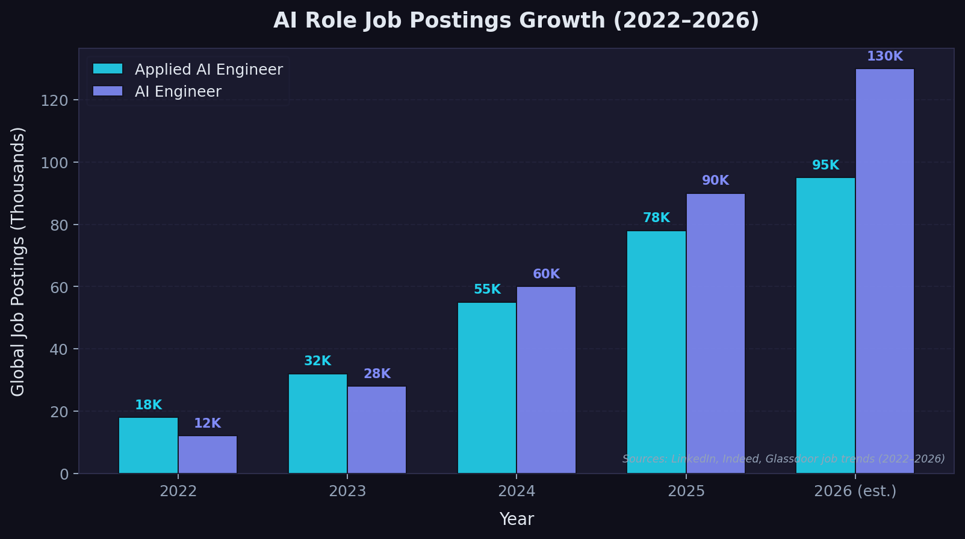
There are a lot of job postings for Data Scientist and AI Engineer roles. The number of job postings, for AI Engineer roles is going up fast. This is because companies want to use Artificial Intelligence systems that’re big and work well. They need people who can make these Artificial Intelligence systems for them. AI Engineer roles are getting more popular because of this.
Salary Comparison
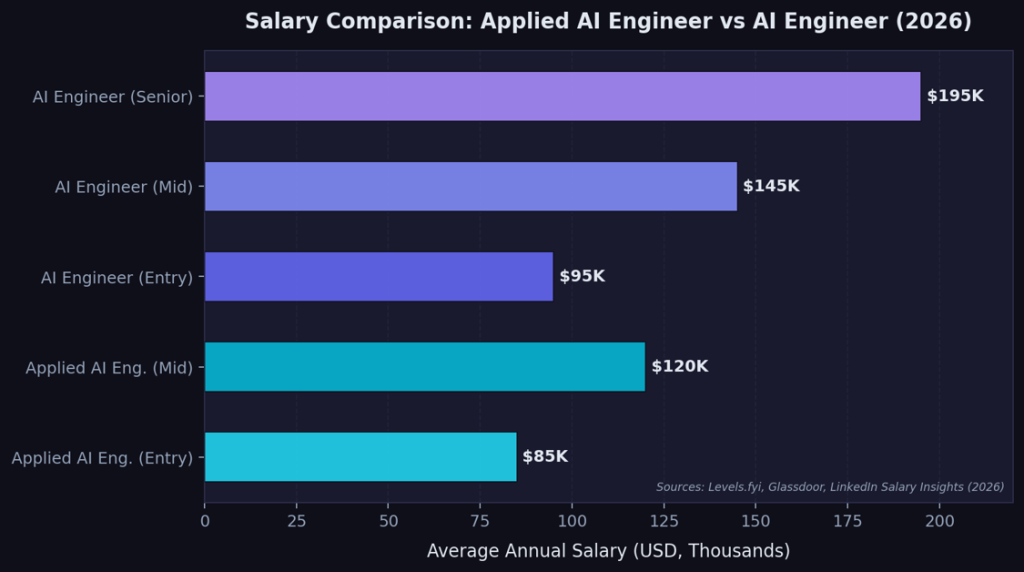
AI Engineers get paid a lot more when they are at a level because they have to know a lot about technology. Applied AI Engineers are a choice, for people who are just starting out and want to build products they pay a pretty good salary.
Skills Breakdown
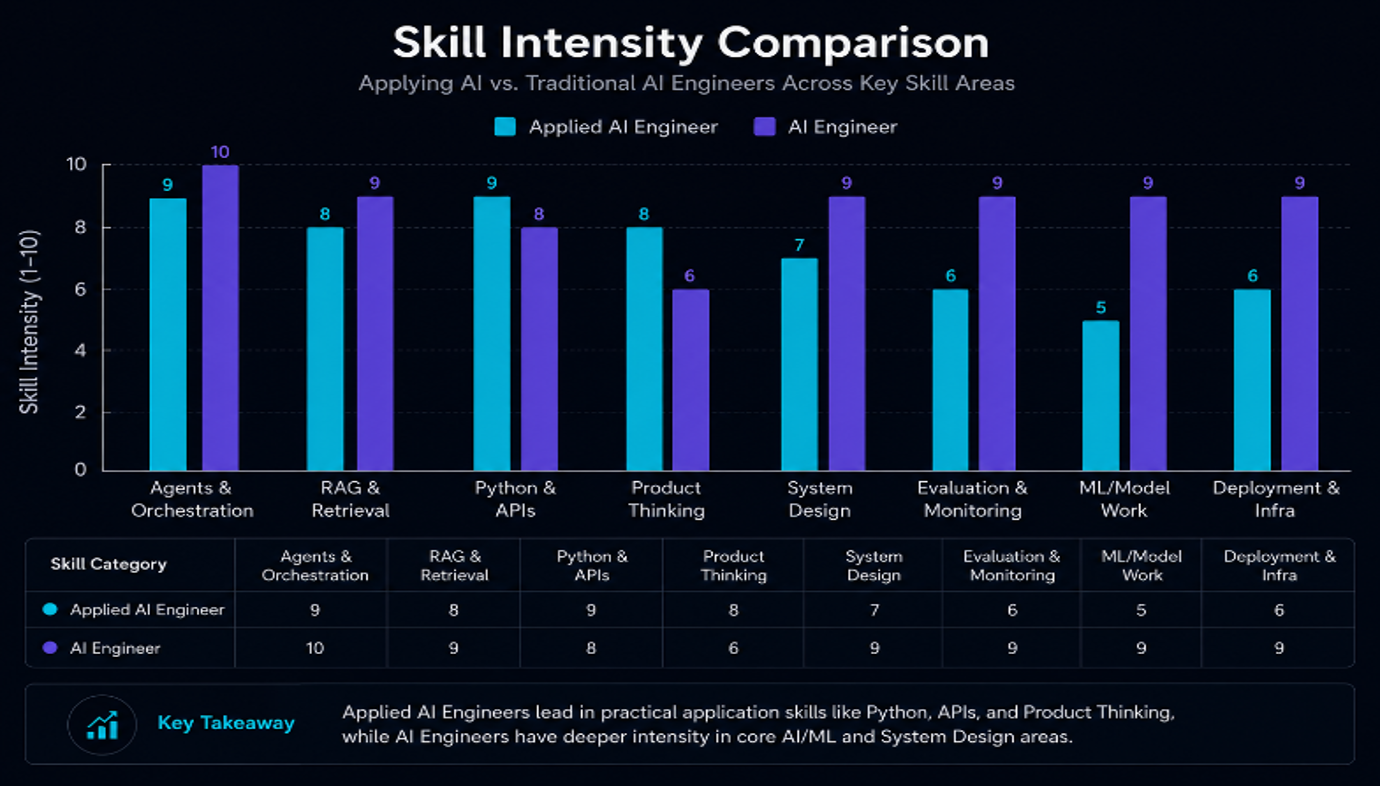
The chart below compares skill intensity across eight core competencies. Applied AI Engineers excel in product thinking and RAG; AI Engineers lead in deployment, system design, and observability.
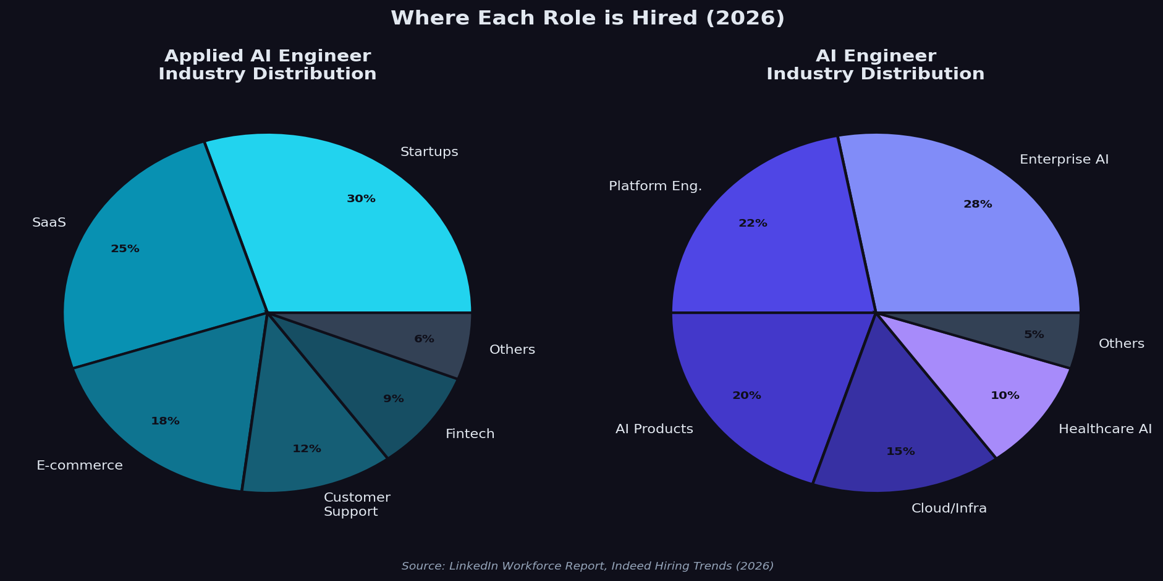
Where Each Role Is Hired
Applied AI Engineers are concentrated in startups and SaaS. AI Engineers are distributed broadly — from enterprise platforms to cloud infrastructure and AI product companies.
Head-to-Head Comparison
| Aspect | Applied AI Engineer | AI Engineer |
| Main Focus | Product AI features | Full AI systems |
| Scope | Narrower, product-specific | Broader, system-level |
| Typical Work | RAG, LLM APIs, AI chatbots | Architecture, deployment, monitoring |
| Best For | Product & feature builders | System & platform builders |
| Career Depth | Strong entry into AI products | Stronger long-term versatility |
| Hiring Demand | High — startups & SaaS teams | High — enterprise & platform teams |
| Avg. Salary (Mid) | ~$120K USD/year | ~$145K USD/year |
Tools & Technologies
Both roles share a Python and API foundation. Divergence happens at the infrastructure layer — AI Engineers go deeper into Kubernetes, MLflow, and production observability.
| Tool | Best For | Role Fit |
| Claude Code | Repo-wide coding & refactoring | Strong for both roles |
| Cursor | AI-assisted IDE development | Fast product implementation |
| Python | Core AI development | Essential for both roles |
| PyTorch | Deep learning & experimentation | Important for model work |
| LlamaIndex | RAG and context augmentation | Best for Applied AI |
| LangChain | LLM orchestration and agents | Useful for both roles |
| LangGraph | Stateful agent workflows | Advanced AI Engineer work |
| Vector DBs | Retrieval and semantic search | Important for both roles |
| MLflow | Experiment tracking | AI Engineer workflows |
| Docker | Packaging and deployment | Production AI systems |
| Kubernetes | Scaling and orchestration | Central to AI Engineer roles |
| Observability | Monitoring, tracing, safety | Essential for production |
How to Build in Either Role
1. Figure out what business problem you want to fix. The business problem is what you need to solve
2. You have to decide if the solution is something you can add to a product or if you need to make a new artificial intelligence system. The solution can be a product feature or a full artificial intelligence system.
3. Now you have to pick the way to do this: you can use something called prompting or RAG or agents or fine-tuning or you can use a little bit of everything. The right approach is very important: it can be. Rag or agents or fine-tuning or a mix.
4. You will have to build this using Python and application programming interfaces and the logic that happens in the background. You will need to build using Python and application programming interfaces and backend logic.
5. Then you have to connect the intelligence system to the places where the data is stored or to the layers that get the data or to the endpoints of the models. You have to connect the system to data sources or retrieval layers or model endpoints.
6. After that you have to add some checks to make sure everything is working correctly and safely and you have to watch it to see how it is doing. You have to add evaluation and safety checks and monitoring, to the intelligence system.
7. Finally you put the intelligence system out there and you make it better based on what the users say and the numbers you get back. You have to deploy the intelligence system and improve it based on user feedback and metrics
Real-World Examples
1. Customer Support Assistant
I think that people who help customers like the Customer Support Assistant who’s also an Applied AI Engineer have a big problem.
The problem is that they spend much time answering the same questions over and over.
To solve this problem we can build an assistant that uses information from frequently asked questions and tickets and internal documents.
This special assistant is called a RAG-based assistant.
The result of building this assistant is that people will get answers faster the people who help customers will have work to do and customers will be happier.
2. Enterprise Document Search
The Enterprise Document Search is worked on by the AI Engineer.
The problem here is that employees have a time finding important information that is inside the company.
To solve this problem we can make a system that helps people find what they need.
This system uses tools like embeddings and search and also checks to make sure everything is working correctly.
The result of this system is that employees will find the answers they need quickly they will be able to get to internal information faster and they will be more productive.
3. AI-Powered SaaS Feature
The AI-Powered SaaS Feature is worked on by the Applied AI Engineer.
The problem is that a company that makes software wants to add intelligence to keep customers and make their product different.
To solve this problem we can add intelligence to the software that helps with things, like summarizing information searching or automating tasks.
The result of adding intelligence to the software is that customers will find the software more useful and will want to keep using it.
Best Practices
• You need to learn Python well before you start working with a specific artificial intelligence framework like Python. Learning Python is very important. You have to do it before you can specialize in something like a specific artificial intelligence framework.
• Building projects is very important because it is like working on real things that people will use and that is more important than just doing tutorials.
When you build projects you have to think about how they will be used by people and that is what matters.
• You have to understand when to use things like prompting, RAG, agents and fine-tuning and you have to know why you are using them.
Understanding intelligence tools like prompting, RAG, agents and fine-tuning is very important and you have to know when to use them.
• You have to track things like how your project is working and how much it costs and how long it takes and if it is safe from the very beginning.
Tracking evaluation, cost, latency and safety from day one is very important. You have to do it when you are working on artificial intelligence projects.
• You should use the projects you have worked on to show people that you can make a difference in business not just that you are good with technology.
Using portfolio projects to demonstrate business impact, not technical skill is very important and you have to do it when you are working on artificial intelligence projects.
• You have to practice explaining what you have done and you have to be able to say what the problem was and what the solution was and what the result was and what the impact was.
Practicing explaining your work from the problem to the solution to the result to the impact is very important. You have to do it when you are working on artificial intelligence projects.
• You should focus on getting really good at one set of tools before you try to learn a lot of frameworks.
Focusing on one tool stack like Python, before expanding to multiple frameworks is very important and you have to do it when you are working on artificial intelligence projects..
Common Mistakes to Avoid
• We should not think that Applied AI Engineer and AI Engineer are the thing.
• When we build demos we need to think about how they will work in the world and design a good system.
• It is very important to check and watch how our systems are working and make sure they are safe.
• Sometimes we use tuning too much when we should be using something else that is better and costs less like RAG.
• We often focus much on the tools we use and forget to think about how the whole system should be designed and put together.
• If we want to show people what we can do we need to have numbers that prove our work is making a difference and helping the business.
• Before we choose a career path we need to understand what each job really means and what it will be, like to do that job every day whether it is an AI Engineer or an AI Engineer.
Frequently Asked Questions
Q1: Is an AI Engineer the same as an AI Engineer?
No they are not the same. An Applied AI Engineer focuses on the intelligence features of a product. On the hand an AI Engineer does a lot of different things related to artificial intelligence systems.
Q2: Which role is better in 2026?
The AI Engineer role is usually better in the run because it covers a lot of areas including the skills that an Applied AI Engineer has.
Q3: Do I need skills in machine learning research?
Not always because a lot of jobs are about using things that are already made like RAG and getting them to work together and designing workflows and checking if they are working well.
Q4: Which role’s easier to get into?
It might be easier to become an Applied AI Engineer if you already know how to make products or develop software.
Q5: Which OneLeap course is the fit?
The AI Engineering Mastery course is a choice because it teaches you the basics and, about RAG and agents and how to get things working and how to keep them safe and it also includes projects that you can put in a portfolio to show what you can do.
Final Summary
Applied AI Engineer and AI Engineer are. Different jobs. Applied AI is about making products while AI Engineer is a field that will be around for a long time.
For people learning in 2026 the best thing to do is to work on Applied AI projects and also learn about AI Engineer skills, at the time. This gives you job options and makes your portfolio stronger.
OneLeap Recommendation: AI Engineering Mastery — because it aligns with production AI, real projects, and career outcomes across both Applied AI and AI Engineering.
Stay updated with the latest AI, Data Science, and Automation insights by following OneLeap on LinkedIn and Instagram.

Leave a Reply