
Introduction
We are at a moment in the development of Artificial Intelligence. What was only seen in research labs and polished demonstrations is now being used in real businesses. Answering customer questions reviewing code, managing operations and doing research on a large scale. It is much harder to move from having an impressive prototype to having an reliable AI agent that is ready for real-world use than most teams think.
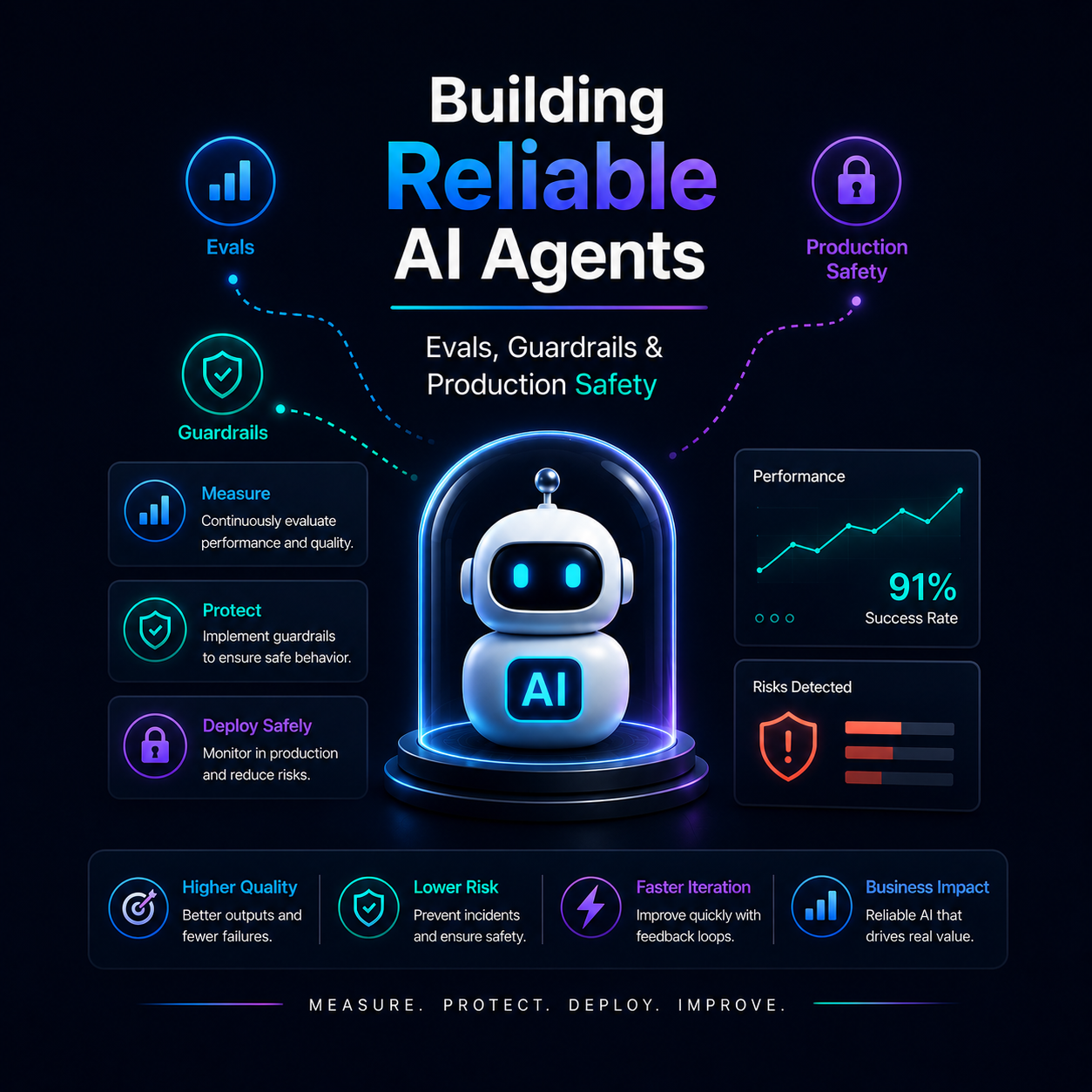
This is why making sure Artificial Intelligence agents are reliable is not something that can be done later. It is the base that everything else is built on. Reliable Artificial Intelligence agents are built by testing them all the time and being careful about what they can do. The controls on the Large Language Model stop the Artificial Intelligence agent from doing something even when things are not predictable. Together they are what make the difference between an Artificial Intelligence workflow that is still being tested and one that can be used with confidence in front of customers, colleagues or for business processes.
In this guide OneLeap explains the concepts, practical methods, real-world examples and necessary tools that engineering and product teams use to build Artificial Intelligence agents that are not just intelligent. But also dependable, safe and ready, for real-world use.
Key Takeaways
- AI agents are really helpful when they work well in real-life situations.
- AI tests check how good safe, accurate and useful the tools are. Both before and after they are launched.
- Special protections for language models help by checking what goes in and comes out and by stopping the agent from doing anything risky.
- For AI agents to be trusted in use they need to be tested and also have protections in place.
- Making AI agents reliable gets better when teams use tests, protections, monitoring and human checking together.
- Companies should think of making AI agents reliable, as a design problem, not just a matter of how you ask questions.
What Are Reliable AI Agents? (And Why It’s Hard to Build Them)
A reliable artificial intelligence agent is a system that uses language models to complete tasks consistently and safely. It should do things on its own when it can ask a human for help when it needs to and stop when it is not sure.
The idea of an artificial intelligence agent sounds easy to understand. Making it work is not easy. It is hard to make artificial intelligence agents reliable because they have some problems.
Here are some of the problems:
- Artificial intelligence models do not always give the answer to the same question.
- These models do things in steps and if they make a mistake early on it can cause bigger problems later.
- Some people can trick the models into doing things they are not supposed to do.
- When people use these models in life they do things that the people who made the models did not think of when they were testing them.
- The models sometimes give answers that’re not true and this is just how they work.
We use tests to see how well the artificial intelligence agents work. We also have rules to control what the agents can do. These rules help us make sure the agents are working correctly and are safe to use. Together the tests and rules help us turn intelligence agents that are still being tested into agents that are ready to be used by everyone.
Why AI Evals and LLM Guardrails Matter for Production Safety?
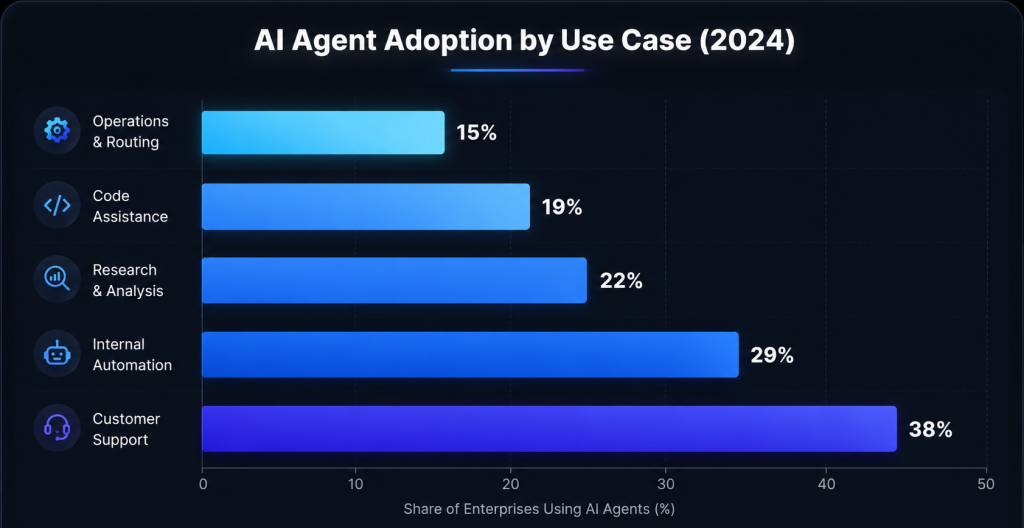
AI agents are really moving fast. Getting into all sorts of things like customer support and research. They are even being used to automate things inside companies. According to Gartner by 2026 than 80 percent of big companies will be using some kind of AI agent that can generate things in the parts of their business that customers interact with. This means that making sure AI agents work well is very important for businesses, not something that is nice to have from a technical standpoint.
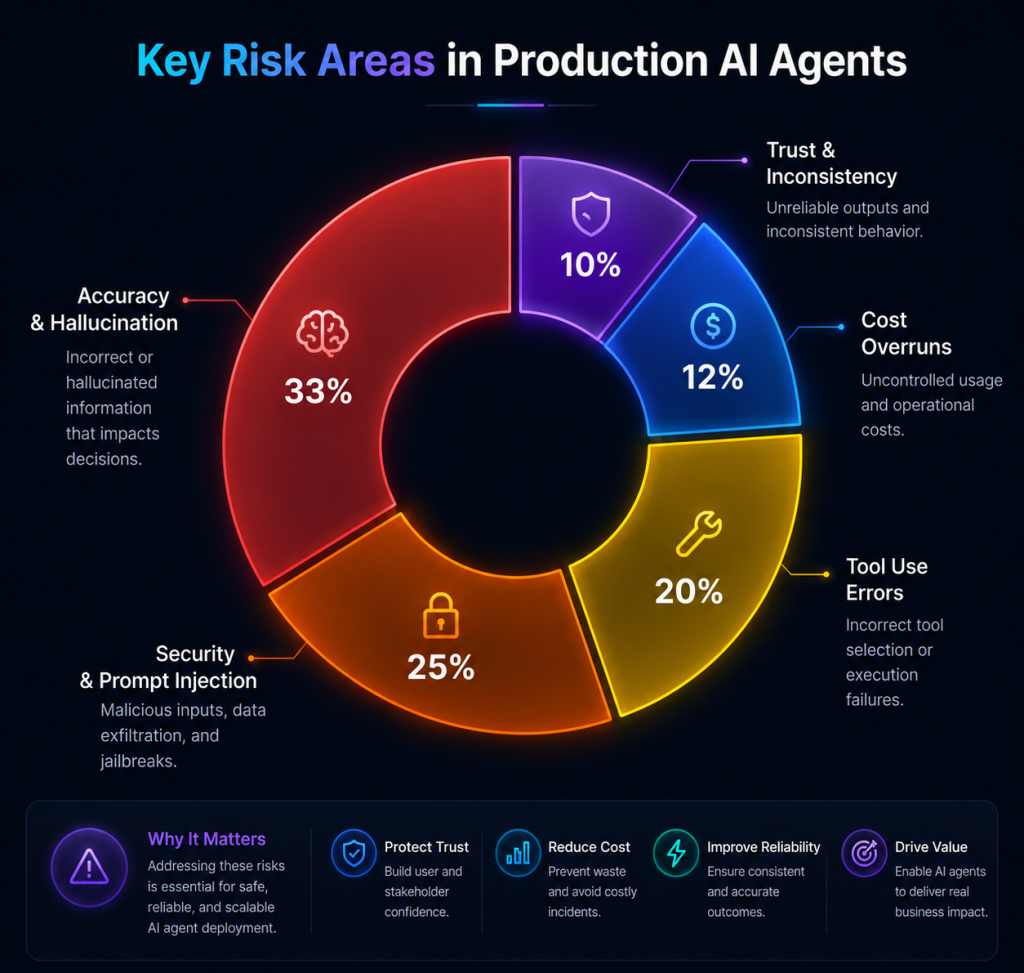
When an AI agent that is being used in a world setting fails it can have serious consequences. If an AI agent gives out information or makes a mistake when it is talking to another computer system or shows sensitive information about a customer it is not just a problem for the user. It can also cause problems, with following rules. Can cost a company money and hurt their reputation. It can take a time to fix the damage that is done to a company’s reputation. AI agents are being used in customer support and other areas so AI agent reliability is crucial.
| Risk Area | What Can Go Wrong | Business Impact |
| Accuracy & Hallucination | Fabricated or factually wrong answers | Poor decisions, eroded user trust |
| Safety & Policy Violations | Unsafe, harmful, or policy-breaking output | Regulatory and reputational risk |
| Tool Use Errors | Wrong API calls or broken workflow steps | Broken processes, increased support load |
| Cost Overruns | Uncontrolled token or tool-call usage | Inflated operating expenses |
| Trust & Consistency | Unpredictable, inconsistent behaviour | Lower adoption, reduced confidence |
How AI Evals and Guardrails Work Together: The Reliability Cycle?
Many teams treat evals and guardrails as separate concerns — running tests before launch and adding filters after problems appear. The most reliable production AI systems treat them as a single, continuous loop. A practical AI agent reliability workflow follows six stages:
| Step | What You Do | Why It Matters for Reliability |
| 1. Define the task | Clarify the agent’s role, scope, and success criteria | Vague goals produce vague — and untestable — behaviour |
| 2. Build eval cases | Write normal, edge-case, and adversarial test inputs | Exposes failure modes before users do |
| 3. Run evals | Measure correctness, safety, latency, and tool-use accuracy | Creates a quantitative baseline for improvement |
| 4. Add guardrails | Apply input validation, output filtering, and fallback logic | Reduces the blast radius of model errors |
| 5. Monitor in production | Track logs, traces, failure rates, and user corrections | Detects drift, regressions, and novel attack patterns |
| 6. Improve continuously | Update prompts, policies, tools, and test suites | Keeps the agent reliable as usage and models evolve |
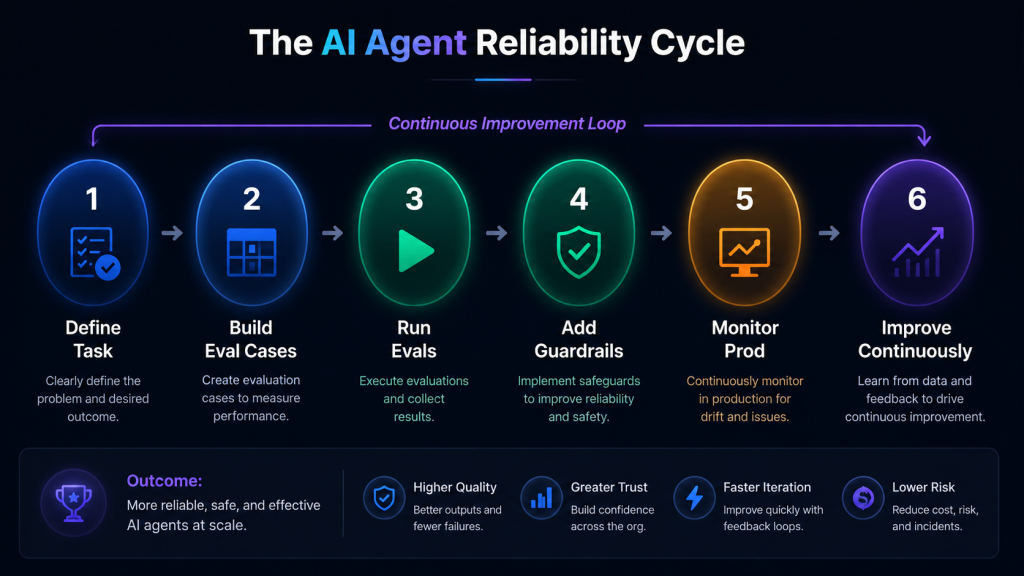
This loop is what separates a prototype from a production-grade AI agent. Without it, teams often ship agents that perform well in controlled testing but deteriorate rapidly under the variety and adversarial pressure of real-world usage. Search engines, regulators, and users all reward consistency — this cycle is how you deliver it.
Core Building Blocks of Reliable AI Agents
Building production-ready AI agents requires four interlocking components. Missing any one of them creates a gap that will eventually surface as a reliability failure.
1. AI Evals — The Measurement Layer
AI evaluations are tests that see how well an AI agent does a job. These tests answer questions like: did the AI agent do what it was told to do? Did it use the tool for the job? Was the answer based on facts. Did it just make something up? Did it say no to requests that were not safe or not what it was supposed to do?
Good AI evaluations use computers to check if the answers are correct and if the AI agent followed the rules. They also use people to review the answers and make sure everything is okay. The best teams do these evaluations before they release a version of the AI agent and they keep checking after it is released. There are a types of evaluations that are important:
• AI evaluations that check for correctness. Does the AI agent give answers that are true and make sense for the job?
• AI evaluations that check for safety. Does the AI agent say no to requests that could hurt someone or are not fair?
• AI evaluations that check how the AI agent uses tools. Does the AI agent use the right tool, for the job and use it the right way?
• AI evaluations that check if the AI agent can resist being tricked. Does the AI agent stay safe even when someone tries to trick it?
2. LLM Guardrails — The Control Layer
LLM guardrails are like rules that are built into a program. These rules and checks control what an AI agent can do or say when it is running. When we test an AI agent we use something called evals to see how good it is. Guardrails make sure the AI agent is good when it is actually being used. Every time someone uses it.
LLM guardrails work in three ways. First they check what the user asks the AI agent to make sure it is okay. This is called input. Then they check what the AI agent says back to the user to make sure it is not bad. This is called output. Lastly they control what the AI agent can do and what it can use. This is called action.
There is a list called the OWASP Top 10 for LLM Applications. It says that the biggest risk for AI agents that are being used is something called injection. LLM guardrails are the way to protect against this risk. They also protect against problems, like the AI agent saying something bad private information getting out and the AI agent being able to do too much.
3. Observability — The Visibility Layer
You cannot make something if you do not know what is going on. Observability helps engineering teams see every step that an artificial intelligence agent takes. What the artificial intelligence agent was asked to do what the artificial intelligence agent did what the artificial intelligence agent came up with how long the artificial intelligence agent took to do it and where the artificial intelligence agent made a mistake.
For intelligence agents that are used in real situations observability usually means: keeping a record of everything the artificial intelligence agent does including what people ask it what it answers and what tools it uses; being able to see how the artificial intelligence agent works when it has to do many things; having a way to look at how well the artificial intelligence agent is doing in real time including how often it fails how long it takes and how much it costs; and getting a warning when something strange happens like when the artificial intelligence agent suddenly starts saying no a lot or costs more money to use.
If you do not have observability it is very hard to figure out what is going wrong when something goes wrong with the intelligence agent and it is easy to miss small problems that get worse over time. This is called model drift. Until people who use the artificial intelligence agent start to complain.
4. Policy Design — The Governance Layer
Policies are like rules that say what an artificial intelligence agent is allowed to do. They also say who can give the agent permission to do things. They say when a human needs to be involved before the agent can do something. This is like a layer of control that’s above the technical parts.
The way we design these policies is really important. This is especially true when the agent is working with information inside the company. It is also important when the agent can make transactions or change records in the systems we use every day.
To do this well we need to make sure our policies, for intelligence agents include a few key things.
- The agent should only be able to access the information it really needs.
- There should be rules that say when the agent needs to stop and ask a human for approval.
- We need to keep records of what the agent does so we can look back. See what happened.
- We should also regularly review what the agent is allowed to do and make changes as needed. This is because the agents abilities and how we use it will change over time.
We need to review these policies so we can make sure the artificial intelligence agent is still working the way we want it to. This helps us stay in control of the intelligence agent and makes sure it is doing what it is supposed to do.
| Component | Layer | Core Purpose | Example in Practice |
| AI Evals | Measurement | Quantify agent performance | Automated correctness scoring on 500 test cases |
| LLM Guardrails | Control | Prevent unsafe runtime behaviour | Blocking prompt injection attempts in real time |
| Observability | Visibility | Surface failures and drift | Tracing tool calls and latency across every session |
| Policy Design | Governance | Define permitted behaviour | Requiring human sign-off before deleting records |
Essential Tools for AI Agent Evaluation and Production Safety
The ecosystem of tools for building reliable AI agents is maturing rapidly. Below are the most widely adopted and trusted frameworks, recommended by practitioners and referenced in leading AI safety guidance:
| Tool / Framework | What It Helps With | Why It Matters |
| OpenAI Evals | Structured LLM and system-level testing | De facto standard for building eval suites against LLM agents |
| NIST AI RMF | Enterprise risk management and AI governance | Maps business risk tolerance to concrete technical controls |
| OWASP LLM Top 10 | Identifying and mitigating LLM security risks | The go-to reference for prompt injection and output-safety defence |
| Anthropic Guidance | Designing safer agentic workflows | Authoritative guidance on multi-agent trust hierarchies and injection defence |
| Promptfoo | Prompt testing, red-teaming, and regression testing | Enables systematic adversarial testing against real attack scenarios |
| LangGraph | Building stateful, multi-step agent workflows | Adds controllability and checkpointing to complex LLM pipelines |
| LangSmith | Tracing, debugging, and monitoring LLM apps | End-to-end observability for LangChain and LangGraph deployments |
Real-World Examples of Reliable AI Agents
Understanding how evals and guardrails apply in practice is easier with concrete use cases. Here are four common AI agent patterns and how production teams approach reliability in each:
1. Customer Support AI Agent
A customer support agent is someone who deals with questions from customers figures out what they are looking for finds the information to help them and gets a human agent involved when necessary. This kind of agent is used a lot by companies like Intercom, Zendesk and Salesforce.
When we evaluate this agent we want to know if it gives answers to questions about bills, policies and products. We also want to know if it can handle questions that’re not clear in a nice way. We want to make sure it gets a human agent involved when it is not sure about something.
There are also some rules we have to follow to make sure everything runs smoothly. We need to make sure the agent does not make claims about products that’re not true. We have to keep customers information private. We need to make sure the agent sounds friendly and professional. If the agent is not sure, about something it should get a human agent involved right away.
2. Research and Knowledge AI Agent
A research agent gets information from things like documents, external sources or databases. The research agent puts together what it finds. Makes a summary that is easy to understand. This is something that people do a lot in places like law, money, medicine and consulting. In these jobs people need to be very careful with the information they use because it is very important.
We need to check a things. First we need to make sure that every fact, in the summary is true and comes from the source material. We also need to check if the citations are correct. We also need to make sure the research agent does not look at documents it is not supposed to see. The research agent should not make claims that’re not true or make up statistics that are not really there.
3. Code Review AI Agent
A code review agent looks at pull requests finds bugs and security problems suggests ways to make things better and tells reviewers what has changed. We already see this kind of thing with tools like GitHub Copilot and Cursor AI.
The main thing we want to evaluate is whether the technical feedback from the code review agent is correct. Does it really find bugs without saying things are wrong when they are not? We also want to make sure the code review agent does not suggest code. This means it should not recommend code that’s not secure. It should also not suggest things that do not exist like APIs that’re not real because this is something that can happen with language models. The code review agent should only suggest things that follow the projects rules, for coding.
4. Operations and Workflow AI Agent
The operations agent does a lot of things. It routes support tickets to the people. It updates records in the company’s system. It sends out notifications when something happens. It makes sure the workflow is moving along as it should.
We also need to make sure the agent is not allowed to do things it should not do. This means it can only look at records that it is supposed to look at. Before it does something that cannot be undone like deleting something or sending a message to someone, outside the company it needs to get permission from a person.
- It has to route support tickets
- It has to update the records
- It has to send the notifications
- It has to manage the workflow
- It has to ask for permission before doing something like deleting something or sending a message outside the company.
| Use Case | Evals Focus | Guardrails Focus | Primary Risk |
| Customer Support | Accuracy, tone, escalation logic | Policy compliance, data privacy | Hallucination, brand risk |
| Research Assistant | Grounded summaries, citation quality | Scope control, no data leakage | Overclaiming, sensitive data exposure |
| Code Review Agent | Technical correctness, false-positive rate | Safe suggestions, no hallucinated APIs | Bad code recommendations |
| Operations Agent | Task success rate, error handling | Permission checks, confirmation gates | Irreversible wrong actions |
How Layering Controls Improves AI Agent Reliability?
One of the most common questions teams ask is: “How much does adding evals and guardrails actually improve reliability?” The data is clear — each additional layer of control meaningfully increases real-world task success rates, and the gains compound.
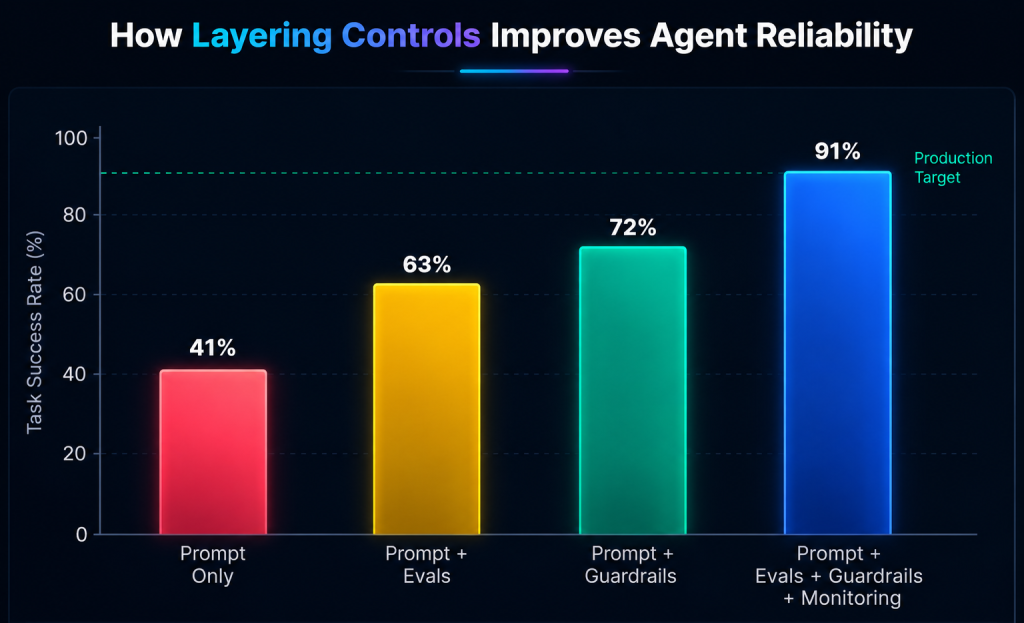
The chart above makes the case plainly: prompting alone is insufficient for production. Each additional reliability layer — evals, guardrails, and continuous monitoring — compounds the improvement. Teams that invest in the full stack are not just reducing risk; they are building a durable competitive advantage through agent trustworthiness.
| Approach | Approx. Reliability | Strengths | Weaknesses | Best Suited For |
| Prompting only | ~40–50% | Fast to prototype | Fragile under real conditions | Early experimentation |
| Evals only | ~60–65% | Quantified quality baseline | Does not prevent unsafe runtime behaviour | Pre-launch testing |
| Guardrails only | ~70–75% | Reduces runtime risk | Does not guarantee output quality | Safety-critical flows |
| Evals + Guardrails + Monitoring | 90%+ | Balanced, measurable, production-ready | Requires meaningful upfront investment | Any production AI agent |
Best Practices for Building Safe, Production-Ready AI Agents
These practices are taken from world deployments NIST AI RMF guidance and OWASP LLM security recommendations. They work for any LLM or framework you use:
- Start with one simple use case. Keeping it simple is helpful when you are first developing an AI agent.
- Decide what success means before you write any code for the AI agent.
- Test the AI agent with world and tough inputs from the start not just the easy ones.
- Add checks at points in the process not just at the end.
- Have a person review what the AI agent does especially when it is important or the AI agent is not sure.
- Look at how good the AI agent’s how long it takes and how much it costs. Do not just try to make it as good as possible.
- Keep updating the tests for the AI agent as people use it the models change and new problems come up.
- Write down every time the AI agent fails figure out what happened and use that to make it better time.
- Only give the AI agent the access it needs.
- Tell people what the AI agent can and cannot do.
Common Mistakes Teams Make When Building AI Agents
Most AI agent reliability failures are not caused by model limitations — they are caused by predictable, avoidable engineering mistakes. These are the most frequently observed:
| Mistake | Why It Causes Problems | Better Approach |
| Shipping a demo as a production system | Controlled demos hide the edge cases that real users find immediately | Test against real, diverse, and adversarial usage patterns before launch |
| Measuring only answer quality | Ignores tool-use failures, cost overruns, and safety policy violations | Evaluate the full agent workflow end-to-end, not just the final output |
| Over-engineering guardrails | Excessive filtering makes agents frustrating and refusal-prone | Balance safety constraints with usability; test guardrails with real users |
| Ignoring prompt injection risk | Leaves a major, well-documented attack surface completely undefended | Include adversarial injection testing in every eval suite, every release |
| Skipping production monitoring | Quality problems and security incidents accumulate invisibly | Instrument all production traffic; set alerting thresholds before launch |
| Treating reliability as a one-time task | Models, usage patterns, and attack vectors all change over time | Build continuous eval and monitoring as a standing operational process |
Perhaps the most costly mistake of all is the belief that a well-crafted prompt can substitute for a reliability engineering practice. In production, prompt quality matters — but it is a single variable in a complex system. Reliability comes from system design, rigorous testing, and continuous monitoring.
Frequently Asked Questions
Q1. What are Artificial Intelligence evaluations. Why are Artificial Intelligence evaluations important?
Artificial Intelligence evaluations are like tests that we use to see how well an Artificial Intelligence model does a job or set of jobs. We need Artificial Intelligence evaluations because they give us a way to measure how good the Artificial Intelligence model is. This helps teams find problems when they update the model. It also shows that the Artificial Intelligence model works the way it is supposed to before and after we use it. Without Artificial Intelligence evaluations teams do not have a way to know if a change they made to the model made it better or worse.
Q2. What are Language Model guardrails and how do Large Language Model guardrails work?
Large Language Model guardrails are, like rules that we put in place to control what an Artificial Intelligence model can do or say when it is running. They work by stopping the model from doing things it should not do. For example they can block requests or filter out bad content before it gets to the user. They can also stop the model from taking actions it is not supposed to take. Large Language Model guardrails help reduce problems that can happen when the model makes mistakes or when someone tries to trick it. They do this without having to change the model itself.
Q3. Do Artificial Intelligence agents need both evaluations and guardrails?
Yes. Neither is enough on its own. Evaluations measure how well Artificial Intelligence agents do in testing. They cannot stop an Artificial Intelligence agent from behaving badly in production when it gets inputs that the test suite does not cover.
Guardrails control how Artificial Intelligence agents behave when they are running. They cannot guarantee that the outputs they allow are good. Artificial Intelligence agents and guardrails work together to create a defence: evaluations make sure Artificial Intelligence agents work well when things are normal; guardrails help manage risks when things are not normal.
Q4. What is injection and how can we stop it in Artificial Intelligence agents?
Prompt injection is when a bad person or a bad document that the Artificial Intelligence agent is supposed to work on puts in instructions that change what the Artificial Intelligence agent is supposed to do. For example telling a customer support Artificial Intelligence agent to ignore its safety rules and share information. To stop this we need to clean up the inputs use guardrails to keep the system instructions separate, from what the user says test the Artificial Intelligence agents with known patterns and check the outputs to catch any weird responses before they get to the user.
Q5. How often should we check to see if AI agents are working correctly?
We should check AI agents every time we make a version before we release it and every time we change something about the AI agent like the model it uses or the tools it has. We should also check AI agents all the time when they are being used to make sure they are still working correctly. For AI agents that’re very important like those that handle sensitive information or money we should check them every day or even more often. The people, at NIST who make rules for AI say that we should always be checking AI agents to make sure they are working correctly not when we first start using them.
Q6. What is the single biggest mistake teams make when building AI agents?
The biggest mistake is thinking a demo that works well is ready for use. Demos are set up to succeed. They use inputs and avoid problems. A person is also there to help if something goes wrong. Real users are different. They do not follow rules. Can try to trick the system. When a real user tries something the problems, with the system become clear. This can be very costly if the team did not test for these issues.
Final Summary : Reliability Is the Competitive Advantage
The world of intelligence is changing really fast. We see models and new things that artificial intelligence can do every few months. But when it comes to using intelligence in a big way the companies that will do well in the end are not the ones that do things the fastest. They are the ones that do things the most reliably.
We build artificial intelligence by measuring things carefully being in control and always trying to get better. We use intelligence tests to see if the system is working like it should. We use something called LLM guardrails to make sure the artificial intelligence does not do anything. We use something called observability so we can see what is going on and make the system better over time. We use policy design to make sure the artificial intelligence is doing what the business needs and what the law says it should do.
For businesses getting this right means things will be safer we will follow the rules better. People will use and trust the artificial intelligence more. For the people who make intelligence it means they need to learn the skills that make artificial intelligence work well. Skills that people need in every industry.
That is why artificial intelligence tests, guardrails, observability and policy design are not things that only the best teams use. They are the things that everyone who makes artificial intelligence needs to know. OneLeap teaches, practises. Tells people about these things. Because making reliable artificial intelligence is not just about being good at technology. It is, about being responsible.
Learn more about What Are AI Agents? Types, Applications, Benefits, and Future Trends(2026)
Stay updated with the latest AI, Data Science, and Automation insights by following OneLeap on LinkedIn and Instagram.

Leave a Reply