

You open your inbox. There are five requests waiting. “Can you pull last month’s sales data?” “Filter this by region.” “Update the dashboard same as last time.”
If this sounds familiar, you are not alone. Thousands of data analysts in India wake up to the same routine every day. And most of them have no idea they are unknowingly capping their own career growth.
Here is the truth: the modern data analyst role has completely changed. Companies do not just need someone who runs queries anymore. They need someone who sits at the table, asks the right questions, and tells the business what to do next.
This is what separates a data analyst who earns 4 LPA from one who earns 15 LPA. And it is not about working harder. It is about evolving how you think, how you communicate, and what value you actually bring.

What Does “Order Taker” Actually Mean?
An order taker in analytics is someone who waits for instructions. A stakeholder says “I need this report,” and the analyst delivers it. The job ends there.
There is nothing wrong with execution. But when that is all you do, you become replaceable. Automation tools, AI dashboards, and self-serve BI platforms are already doing this work faster and cheaper.
The order-taker model has a short shelf life in 2026.
Signs You Might Be Stuck in Order-Taker Mode
- You wait for your manager to define what to analyse before you start
- You deliver data without recommendations or context
- You have never pushed back on a request with a better framing of the problem
- You cannot explain how your last three reports influenced a business decision
- Your stakeholders treat you like a reporting tool, not a thought partner
If even two of these feel uncomfortably familiar, keep reading.
The Modern Data Analyst Role: What Has Actually Changed
The shift did not happen overnight. Over the last four years, the explosion of cloud data tools, AI-powered analytics, and real-time decision-making has fundamentally changed what companies expect from analysts.
Today, a strategic data analyst is expected to:
- Define the right questions before writing a single line of SQL
- Connect data findings to revenue, cost, or customer impact
- Proactively surface insights that stakeholders did not know to ask for
- Communicate findings in plain language that a CEO can act on
- Partner with product, marketing, and finance teams as an equal contributor
This is not a data scientist role. You do not need a PhD. You need a different mindset, a stronger business vocabulary, and a few key skills that most analyst courses simply do not teach.

A Real-World Example That Makes It Click
Imagine a D2C brand in India seeing a drop in repeat purchases. An order-taker analyst would pull a cohort report comparing Month 1 vs Month 2 repurchase rates. Done. Delivered. Forgotten.
A strategic analyst would go further. They would layer in delivery timelines, return rates, first-order category data, and NPS scores. They would come back to the business and say: “Customers who receive orders after Day 5 are 40% less likely to repurchase fixing logistics for just two pin codes could recover 12% of churned revenue.”
That analyst gets promoted. The other one gets automated.
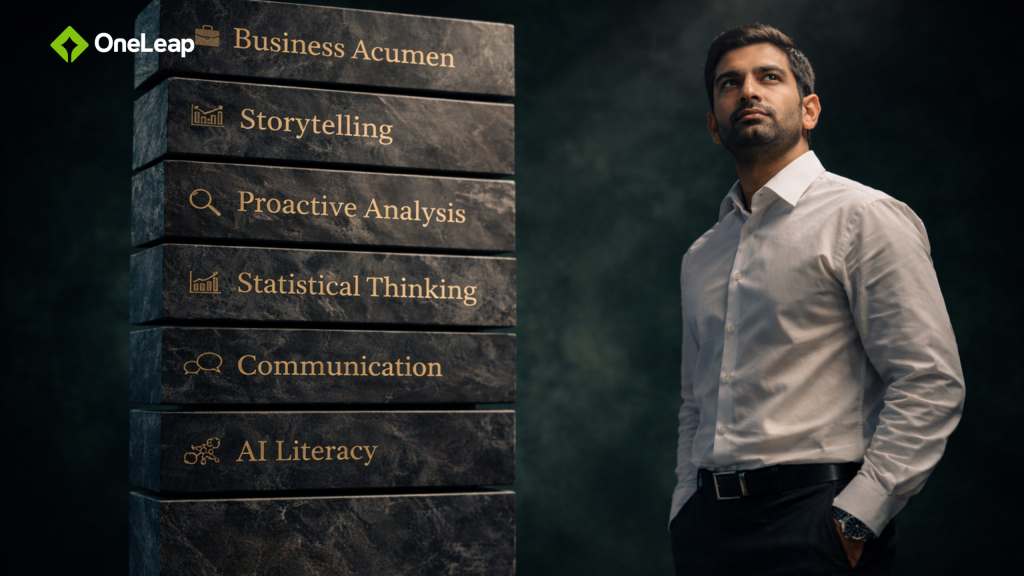
The New Data Analyst Role Requires These Upgraded Skills
Making this transition is absolutely achievable. But it requires intentional upskilling in areas that go beyond tools and technical knowledge.
1. Business Acumen
You need to understand how your company makes money. What drives revenue? What are the key metrics that leadership obsesses over? What does a 1% improvement in customer retention actually mean in rupees? When you think this way, your analysis becomes 10x more relevant.
2. Data Storytelling
Numbers do not speak for themselves. The most brilliant insight buried in a confusing chart will be ignored. Strategic analysts learn to build narratives around data a clear beginning (the problem), a middle (the evidence), and an end (the recommendation).
3. Proactive Analysis
Stop waiting to be asked. The best analysts monitor their dashboards, notice anomalies, and proactively walk into meetings with “I noticed something you should know about.” This behaviour builds trust faster than any technical skill ever will.
4. Stakeholder Communication
You will often work with people who do not understand data. That is not their job it is yours to make it understandable. Practising how to explain a regression output in one sentence or translate a p-value into a business risk is a career-changing skill.
5. Working with AI and Automation
Strategic analysts in 2026 are not threatened by AI they are amplified by it. They use AI tools to cut down on repetitive work, generate first-draft reports, and test hypotheses faster. This frees them up for the thinking work that machines cannot replace.
Your 30-Day Plan to Start Thinking Like a Strategic Partner
You do not need to overhaul everything at once. Start small. Here is a practical checklist to begin the shift this month:
- Pick one report you deliver regularly and add a one-paragraph “So what?” recommendation at the top
- Shadow one business meeting per week where decisions are being made even as a listener
- Ask your manager: “What is the one metric you are most worried about right now?”
- Document one insight per week that you spotted before anyone asked for it
- Practise explaining a recent analysis to a non-technical friend in under two minutes
These feel small. But done consistently, they rewire how you work and how others see you.
Why Most Analysts Never Make This Transition (And How One Leap Helps)
Most analytics training in India focuses almost entirely on tools SQL, Python, Tableau, Power BI. These are necessary. But they are not sufficient.
At One Leap, we built our curriculum around this exact gap. We train analysts not just on the technical foundation, but on how to think strategically, communicate persuasively, and apply their skills to real business problems.
Our learners work on live projects with actual datasets from industries like e-commerce, fintech, and healthcare. They learn how to present findings to stakeholders not just write code. They graduate knowing not just how to do analysis, but why the business cares about it.
This is what turns a 4 LPA analyst into a 15 LPA strategic partner.

Frequently Asked Questions
1. What is the difference between a data analyst and a strategic data analyst?
A data analyst performs analysis when asked. A strategic data analyst proactively identifies business opportunities through data, connects insights to outcomes, and advises stakeholders on decisions. It is a mindset shift as much as a skill shift.
2. Can a fresher become a strategic data analyst right away?
Freshers can absolutely develop a strategic mindset from day one. In fact, starting with this approach asking “why does this matter?” before every analysis gives you a major edge over those who have to unlearn years of order-taker habits.
3. Do I need to learn Python or SQL to become a strategic analyst?
Yes, core technical skills are still important. But the tools are the foundation, not the ceiling. SQL and Python help you get data what you do with it, and how you communicate it, is what makes you strategic.
4. How long does it take to move into a strategic analyst role?
Most analysts see a meaningful shift in how they are perceived within 3 to 6 months of deliberately practising strategic thinking habits. Career title changes and salary bumps typically follow within 6 to 18 months.
5. Which industries in India value strategic analysts the most?
E-commerce, fintech, SaaS, banking, and healthcare analytics are currently the most active hiring sectors for strategic analysts in India. These industries make data-driven decisions at every level of the business.

Leave a Reply