
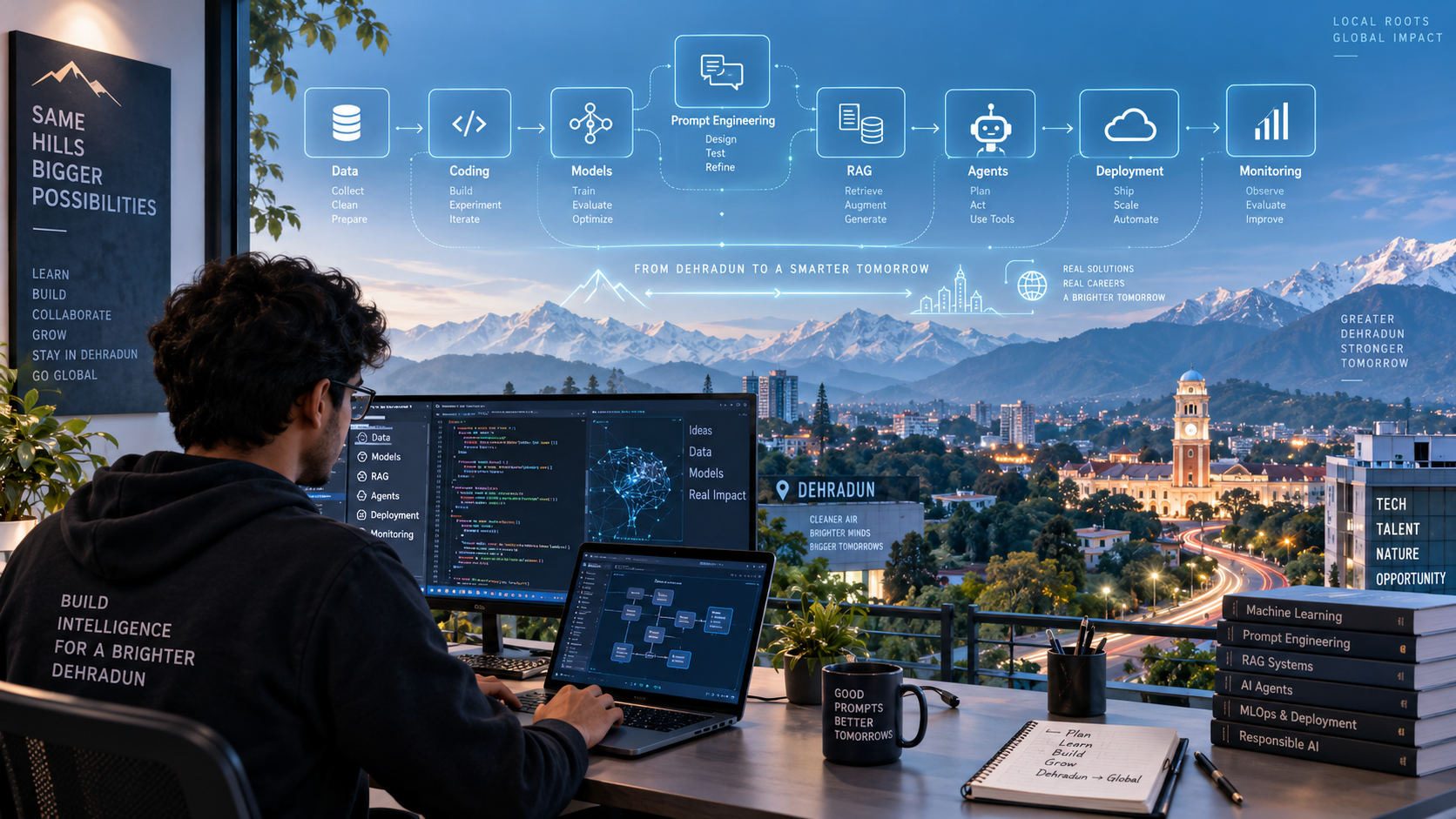
How to become an AI engineer in Dehradun
To become an AI engineer in Dehradun in 2026, build strong Python and software fundamentals, learn machine learning and modern generative AI systems, create deployable portfolio projects, and prepare for technical interviews. A job-ready path goes beyond calling an API: you should be able to design, evaluate, secure, deploy, and improve AI applications such as RAG systems, AI agents, and multimodal workflows. Local roles and internships can help you begin, while a strong public portfolio can also open remote and national opportunities.
Key takeaways
- An AI engineer builds AI-enabled products and production systems; the role blends programming, data, model integration, evaluation, and deployment.
- Start with Python, Git, APIs, databases, SQL, data structures, and basic software engineering before moving into ML and LLM applications.
- In 2026, practical skills such as RAG, agent workflows, tool use, model evaluation, guardrails, observability, cost control, and deployment are highly relevant.
- A portfolio matters more than a collection of tutorial certificates: aim to ship projects with clear problem statements, architecture, evaluation, and live demos.
- For learners in Dehradun, combine local networking and internship applications with remote job preparation to widen the opportunity set.
- A structured programme can shorten the learning path when it offers live guidance, production projects, feedback, interview preparation, and career support.
- Salary in India: freshers typically earn ₹5–9 LPA, mid-level engineers ₹12–24 LPA, and senior engineers ₹25–45 LPA or more, with generative AI and MLOps specialisations commanding a further premium.
Table of contents
- What is an AI engineer?
- Why AI engineering matters in Dehradun
- AI engineer roadmap for 2026
- Skills required to become an AI engineer
- Tools and technologies to learn
- Portfolio projects that help you get hired
- AI engineer vs data scientist vs ML engineer
- AI engineer salary in Dehradun and India (2026)
- How to choose the best course in Dehradun
- How OneLeap’s AI Engineering Mastery supports the roadmap
- Best practices and common mistakes
- Frequently asked questions
What is an AI engineer?
An AI engineer is a software professional who turns artificial intelligence capabilities into useful, reliable products. They connect models, data, APIs, user interfaces, databases, and cloud infrastructure to build systems that solve real problems.
Unlike a role focused only on experimentation, an AI engineer is concerned with whether a system works in production: response quality, latency, cost, security, monitoring, failure recovery, and user experience. In a generative AI context, this can include retrieval-augmented generation (RAG), AI agents, model evaluation pipelines, multimodal applications, and deployed services.
Why AI engineering matters in Dehradun
Dehradun has an established technology ecosystem through IT-focused institutions and businesses, while employers increasingly need developers who can apply AI to customer support, document processing, analytics, automation, content workflows, and internal knowledge systems. For aspiring professionals, this creates an opportunity to build skills locally while pursuing roles in Dehradun, across Uttarakhand, or remotely.
The practical advantage is that AI engineering is portfolio-friendly. A well-documented GitHub repository, deployed demo, concise architecture explanation, and measurable evaluation results can demonstrate capability to employers beyond a candidate’s location.
- Local entry points: AI/ML internships, software development roles, automation projects, analytics teams, and technology service companies.
- Broader opportunities: remote AI engineering roles, contract projects, open-source contributions, hackathons, and startup work.
- Career resilience: focus on building systems rather than relying only on one tool, model provider, or prompt template.
AI engineer roadmap for 2026
The roadmap below is designed for learners who want to progress from programming foundations to production-grade AI systems. The timing will vary with your background; consistency and project depth matter more than rushing through a checklist.
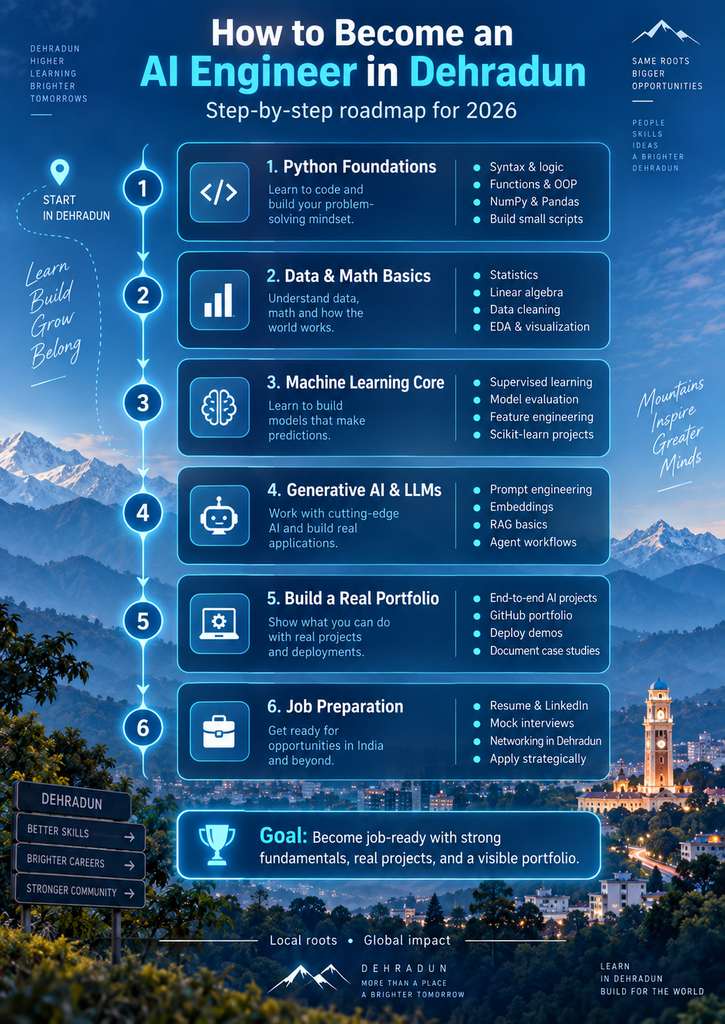
Phase 1: Build the engineering foundation
Begin with Python, data structures, object-oriented programming, Git, command-line workflows, APIs, SQL, and databases. You should be able to write readable code, debug issues, manage dependencies, use version control, and work with structured data before building sophisticated AI applications.
- Learn Python for automation, data handling, APIs, and web services
- Practice SQL, relational databases, JSON, authentication, and REST APIs
- Use Git and GitHub for every project
- Understand basic Linux/command-line workflows and environment management
Phase 2: Learn ML and deep learning concepts
Learn how supervised learning, unsupervised learning, neural networks, and transformers work. You do not need to become a research scientist first, but you do need the engineering intuition to choose sensible approaches, prepare data, interpret results, and recognize model limitations.
- Data preparation, train-validation-test splits, and evaluation metrics
- Core machine learning algorithms and overfitting concepts
- Neural networks, embeddings, attention, and transformer architecture
- Model experimentation and reproducible notebooks
Phase 3: Build LLM applications and RAG systems
Move from model theory to application engineering. Learn prompt design, structured outputs, function calling, embeddings, vector search, document ingestion, chunking, retrieval, reranking, memory, and answer evaluation. The goal is to build grounded systems that can answer questions from trusted data rather than merely generate fluent text.
- Build a document Q&A application using RAG
- Evaluate retrieval quality and answer faithfulness
- Implement prompt versioning and automated tests
- Understand when RAG is appropriate and when fine-tuning may be justified
Phase 4: Learn agents and orchestration
AI agents combine models with tools, state, planning, and workflows. Learn when an agent adds value versus when a simple deterministic pipeline is safer and cheaper. Then practice tool use, approvals, error handling, human-in-the-loop steps, and stateful orchestration.
- Function calling and external tool integration
- Agent planning, workflow graphs, and state management
- Single-agent and multi-agent communication patterns
- Model Context Protocol (MCP) concepts and integrations
Phase 5: Make systems production-ready
Production work separates demos from dependable AI products. Learn deployment, API design, containerization, logging, observability, guardrails, prompt-injection defenses, caching, rate limits, token budgets, latency optimization, and cost monitoring.
- Deploy an AI API and front end
- Add authentication, validation, logging, and monitoring
- Track quality, latency, errors, and usage cost
- Design fallback paths and human review for high-risk cases
Phase 6: Build a portfolio and prepare for hiring
Finish with three to five substantial projects rather than dozens of cloned tutorials. For each project, publish a clear README explaining the problem, users, stack, architecture, trade-offs, evaluation approach, screenshots or demo, and next improvements.
- Create a focused one-page resume and LinkedIn profile
- Practice explaining architecture and trade-offs aloud
- Solve practical coding and system-design problems
- Apply to internships, junior roles, freelance projects, and remote opportunities consistently
Skills required for an AI engineer in Dehradun
| Skill area | What to learn | Why it matters |
| Programming | Python, data structures, OOP, testing, Git | AI products need maintainable software, not only notebooks. |
| Data and backend | SQL, databases, APIs, authentication, data processing | Most AI applications connect models to business data and services. |
| ML foundations | Model training, metrics, embeddings, transformers | Helps you choose, assess, and improve AI approaches. |
| Generative AI | Prompting, structured outputs, LLM APIs, RAG, fine-tuning basics | Enables useful knowledge, assistant, and automation applications. |
| Agent systems | Tool use, orchestration, workflow state, MCP, multi-agent patterns | Supports complex task automation and integrated AI workflows. |
| Production engineering | Deployment, observability, guardrails, caching, cost and latency optimisation | Makes an AI system reliable, safe, scalable, and economical. |
| Communication | Problem framing, documentation, demos, stakeholder conversations | Employers hire people who can translate business needs into systems. |
Tools and technologies to learn
Do not attempt to learn every tool at once. Pick a coherent stack, build projects with it, and understand the trade-offs. The tools below represent useful categories rather than a mandatory checklist.
| Category | Examples | Use case |
| Programming and collaboration | Python, Git, GitHub, VS Code | Code, version control, collaboration, and documentation |
| Data and APIs | PostgreSQL, SQLite, FastAPI, REST APIs | Store data and expose AI capabilities as services |
| ML and deep learning | PyTorch, scikit-learn, Hugging Face | Train, evaluate, and use ML and model components |
| LLM application development | OpenAI/Claude/Gemini APIs, LangChain or LlamaIndex | Build model-powered applications and retrieval flows |
| Vector retrieval | Chroma, FAISS, Pinecone, Weaviate | Similarity search and RAG retrieval |
| Agents and orchestration | LangGraph, OpenAI Agents SDK, Claude Agent SDK, MCP | Stateful workflows, tool use, and agent systems |
| Deployment and monitoring | Docker, cloud services, logging and observability tools | Run and monitor systems in production |
Portfolio projects that help you get hired
Choose projects that demonstrate an engineering decision, not only a model call. The strongest portfolio projects identify a real user, use realistic data, include a deployed demo where possible, and explain how quality and safety are measured.
| Project | What it demonstrates | Ways to strengthen it |
| Enterprise document Q&A assistant | RAG, document processing, hybrid retrieval, citations, evaluation | Add role-based access, source citations, feedback capture, and retrieval metrics. |
| AI-powered SaaS application | Full-stack development, APIs, database design, deployment | Add authentication, billing mock flows, rate limiting, and automated tests. |
| Prompt evaluation framework | Quality testing, A/B comparisons, versioning, repeatable measurement | Track accuracy, format compliance, cost, latency, and regression failures. |
| Autonomous research assistant | Tool use, browsing workflow design, summarisation, structured reporting | Require source traceability, human approval, and failure handling. |
| Multi-agent orchestrator | Coordination, state management, message passing, workflow graphs | Demonstrate when multi-agent design is better than a single workflow. |
| AI safety and monitoring dashboard | Guardrails, prompt injection handling, observability, alerting | Show red-team cases, safety policies, and response playbooks. |
| Multimodal content pipeline | Text, image, audio, or video processing and workflow automation | Track quality checks, provenance, cost, and consent-aware handling. |
AI engineer vs related roles
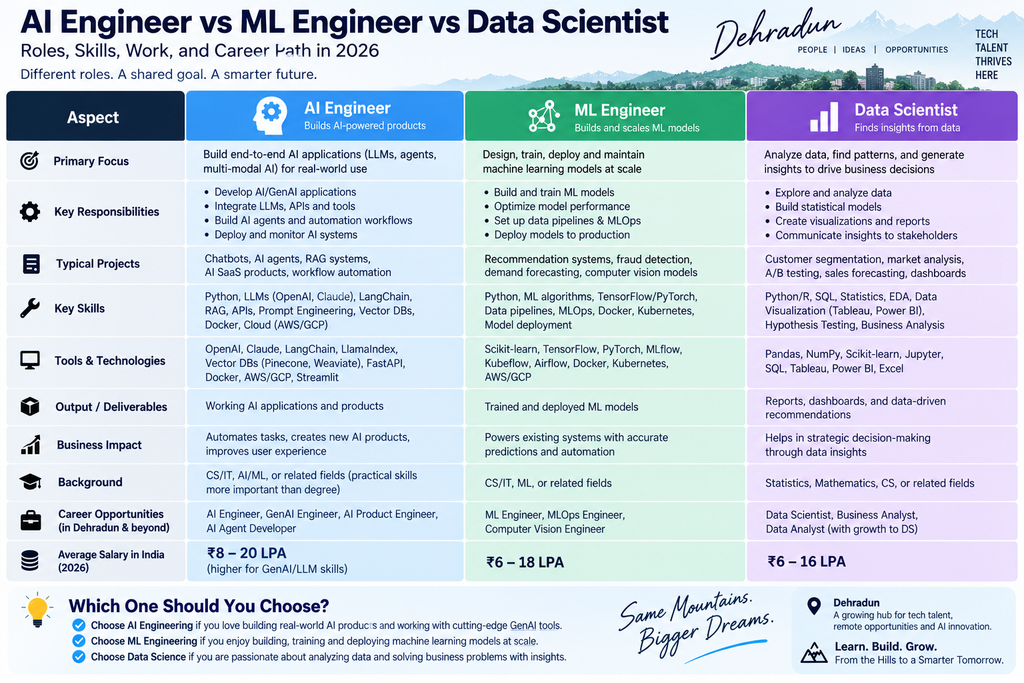
| Role | Primary focus | Typical work | Best fit if you enjoy |
| AI Engineer | Building and deploying AI-powered products | RAG systems, agents, integrations, APIs, evaluation, production optimisation | Software engineering plus applied AI products |
| Machine Learning Engineer | Model pipelines and ML infrastructure | Training workflows, feature pipelines, model serving, monitoring | ML systems, experimentation, and infrastructure |
| Data Scientist | Insights, analysis, and predictive modelling | Data exploration, experiments, forecasting, dashboards, statistical analysis | Data, business questions, and analytical storytelling |
| LLM/GenAI Engineer | Language-model applications | RAG, prompting, fine-tuning, agents, LLM evaluation | Modern language and generative AI systems |
AI engineer salary in Dehradun and India
AI engineer salaries vary by experience, company type, portfolio quality, specialisation, and whether you work locally, in a hybrid role, or remotely. For candidates in Dehradun it is useful to benchmark local opportunities against national ranges while building a portfolio that can compete for remote and product-company roles.
| Experience level | Typical local or hybrid roles in Dehradun | India-wide target range |
| Fresher / 0–2 years | Junior developer, analytics support, service-oriented work, or internship-to-full-time roles | ₹5–9 LPA |
| Early to mid-career / 3–6 years | Hybrid and remote-first roles with genuine production AI ownership | ₹12–24 LPA |
| Senior / 7+ years | Mostly remote or relocation roles; local senior AI-specific openings remain limited | ₹25–45 LPA+ |
Figure: AI engineer salary bands in India, 2026, compiled from the Masai School, Win in Life Academy and EICTA (IIT Kanpur) salary guides. The Dehradun column describes role types rather than verified local pay data.
Recent 2026 salary guides place freshers at roughly ₹5–9 LPA, mid-level engineers between ₹12 and ₹24 LPA, and senior engineers from ₹25 LPA to ₹45 LPA or more, with the top of the senior band reaching considerably higher at product companies and global capability centres. These are directional benchmarks rather than guaranteed packages: compensation differs significantly by city, employer, specialisation, equity, and benefits.
What raises your earning potential
- Specialisation premium: generative AI and MLOps specialists command roughly 20–40% above generalist AI engineer pay, and RAG or AI product engineering specialists sit around ₹25–50 LPA at mid to senior levels.
- Company type: the gap between an IT services firm and a product company at the same experience level can run from 60% to 150%. This is usually the single largest lever early in a career.
- Deployed portfolio: a system you have shipped, monitored, and evaluated separates offers far more reliably than a stack of course certificates.
- Production ownership: cloud deployment, LLM evaluation, observability, guardrails, latency tuning, and token-cost control.
- Remote scope: a strong public portfolio lets candidates in Dehradun compete for national and remote product-company roles rather than only local openings.
- Interview communication: being able to explain your architecture, trade-offs, and failure handling out loud.
For learners in Dehradun, the most reliable way to move up these bands is to build demonstrable production skills: deploy AI applications, evaluate output quality, manage latency and token costs, implement security controls, and explain your architecture choices clearly in interviews.
How to choose the best course in Dehradun
The best course in Dehradun is not necessarily the one with the longest tool list or the strongest placement promise. Choose a programme that helps you produce evidence of capability: working systems, documented projects, feedback, and interview readiness.
- Check the curriculum depth: it should cover foundations, LLM applications, RAG, agents, deployment, safety, evaluation, and optimization not only prompt writing.
- Check project quality: ask whether projects use real constraints such as data quality, testing, security, latency, cost, and deployment.
- Check the learning format: live feedback, code reviews, office hours, and mentorship are valuable for complex engineering work.
- Check instructor credibility: practitioners with real deployment experience can explain trade-offs that tutorials often omit.
- Check career support: portfolio guidance, resume optimisation, mock interviews, and access to a hiring network can support the transition to a job.
- Check prerequisites honestly: strong programmes may expect Python, programming fundamentals, API/database familiarity, Git, and command-line comfort.
OneLeap AI Engineering Mastery: roadmap alignment
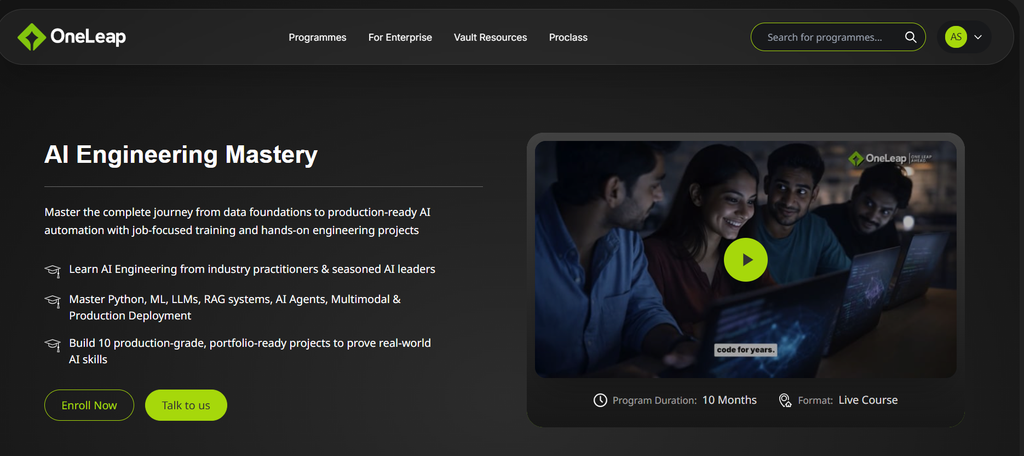
For learners who want a structured, job-focused path, OneLeap’s AI Engineering Mastery programme is designed around the progression from foundations to deployed AI systems. The programme runs for 10 months with weekend classes, 100+ hours of live learning, 14 modules, weekly one-to-one office hours, merit-based certification, and career support.
Its curriculum aligns with the practical roadmap above: ML and deep-learning foundations; advanced prompt engineering and evaluation; AI product development; production RAG; fine-tuning and model optimisation; AI agents; agent frameworks; multi-agent systems; safety and observability; deployment and optimisation; plus image, multimodal, and video AI. The programme culminates in an end-to-end capstone that integrates RAG, agents, and visual AI before production deployment.
The portfolio emphasis is particularly relevant for aspiring AI engineers in Dehradun. OneLeap lists production-grade projects including a transformer built from scratch, prompt evaluation framework, full-stack AI application, enterprise RAG system, domain-specific fine-tuned model, autonomous research agent, multi-agent orchestrator, AI safety and monitoring dashboard, and multimodal content pipeline.
If you want to explore the full roadmap, curriculum, live-project structure, eligibility requirements, and career support, visit the OneLeap AI Engineering Mastery programme page.
Best practices for becoming job-ready
- Learn by shipping: turn each concept into a small working system before moving to the next topic.
- Document decisions: explain why you used RAG, an agent, a particular model, or a deterministic workflow.
- Measure quality: add test cases and metrics for answer quality, retrieval performance, cost, latency, and failures.
- Prioritise fundamentals: fluent Python, SQL, Git, APIs, debugging, and software design compound over time.
- Learn responsible AI practices: protect user data, validate outputs, test for prompt injection, and create human escalation paths.
- Build visibility: share technical write-ups, project demos, GitHub repositories, and lessons learned on LinkedIn or relevant communities.
- Apply early: do not wait for a perfect portfolio before pursuing internships, freelance work, hackathons, and entry-level roles.
Common mistakes to avoid
- Staying in the tutorial trap: watching content without building, deploying, debugging, and documenting your own systems.
- Treating prompting as the entire profession: prompt design matters, but production AI engineering also requires data, evaluation, security, APIs, and deployment.
- Building generic chatbot clones: choose a specific user problem and demonstrate retrieval, tool use, safety, or workflow integration.
- Skipping evaluation: a polished demo is not proof that an AI system is accurate, grounded, or reliable.
- Ignoring cost and latency: model choice, caching, token usage, batching, and retrieval design affect real-world viability.
- Overusing agents: use deterministic workflows when the task is predictable; reserve agents for tasks requiring flexible reasoning and tool selection.
- Hiding project limitations: explain failures and next steps honestly—this demonstrates mature engineering judgment.
Frequently asked questions
Can I become an AI engineer in Dehradun?
Yes. You can develop AI engineering skills from Dehradun through structured learning, portfolio projects, local internships, online communities, and remote job applications. Your portfolio, technical depth, communication, and interview performance are often more important than your location.
What should I learn first to become an AI engineer?
Start with Python, programming fundamentals, Git, APIs, SQL, and databases. Then learn machine learning concepts, deep learning and transformers, LLM application development, RAG, agents, deployment, evaluation, and production operations.
Do I need a computer science degree to become an AI engineer?
A computer science degree can help, but it is not the only path. Employers still need evidence that you can write code, understand data and systems, build reliable AI applications, and explain your technical decisions. A strong portfolio can help demonstrate those capabilities.
How long does it take to become job-ready for AI engineering?
The timeline depends on your current level and weekly commitment. Learners with programming experience can progress faster, while beginners may need more time for foundations. A realistic path prioritises consistent practice and several substantial projects over quick completion of many courses.
What is the salary of an AI engineer in Dehradun?
Published guides report India-wide bands rather than Dehradun-specific figures: roughly ₹5–9 LPA for freshers, ₹12–24 LPA at mid-level, and ₹25–45 LPA or more for senior engineers. Local service-oriented roles usually sit at the lower end of each band, while remote and product-company roles sit at the upper end. That gap is the main reason a deployed, well-documented portfolio matters so much for candidates based in Dehradun.
What projects should an aspiring AI engineer build?
Strong options include a production-style RAG assistant, full-stack AI application, prompt evaluation framework, tool-using research agent, multi-agent workflow, monitoring dashboard, or multimodal pipeline. Each project should include documentation, evaluation, and a clear explanation of trade-offs.
Is AI engineering different from data science?
Yes. Data science generally focuses more on data analysis, experimentation, and predictive insight. AI engineering focuses on turning models and data into integrated, deployable AI products that users can rely on.
What should I look for in the best course in Dehradun for AI engineering?
Look for a curriculum that goes beyond theory and basic prompts, teaches production skills, includes live projects and feedback, is led by experienced practitioners, and supports portfolio development and interviews. Also verify that the course’s prerequisites and weekly commitment match your starting level.
Does OneLeap’s programme require prior experience?
OneLeap identifies intermediate Python proficiency, programming fundamentals such as data structures, algorithms and OOP, familiarity with APIs and databases, plus comfort with Git and the command line as technical prerequisites. It is aimed at software engineers moving into AI/ML, fresh CS/IT graduates with strong programming foundations, data scientists, and ML engineers expanding into LLM and agent systems.
Final thoughts
Becoming an AI engineer in Dehradun is achievable when you follow a disciplined sequence: master software fundamentals, understand ML and LLM systems, build production-minded projects, measure quality, and make your work visible. The goal is not to collect certificates or copy tutorials it is to become someone who can ship dependable AI systems that solve real problems.
Want a structured path from AI foundations to RAG, agents, multimodal workflows, deployment, and a portfolio of production-grade projects? Explore OneLeap’s AI Engineering Mastery programme.
Also check out our blog on Generative AI Engineering here!

Leave a Reply