
Introduction
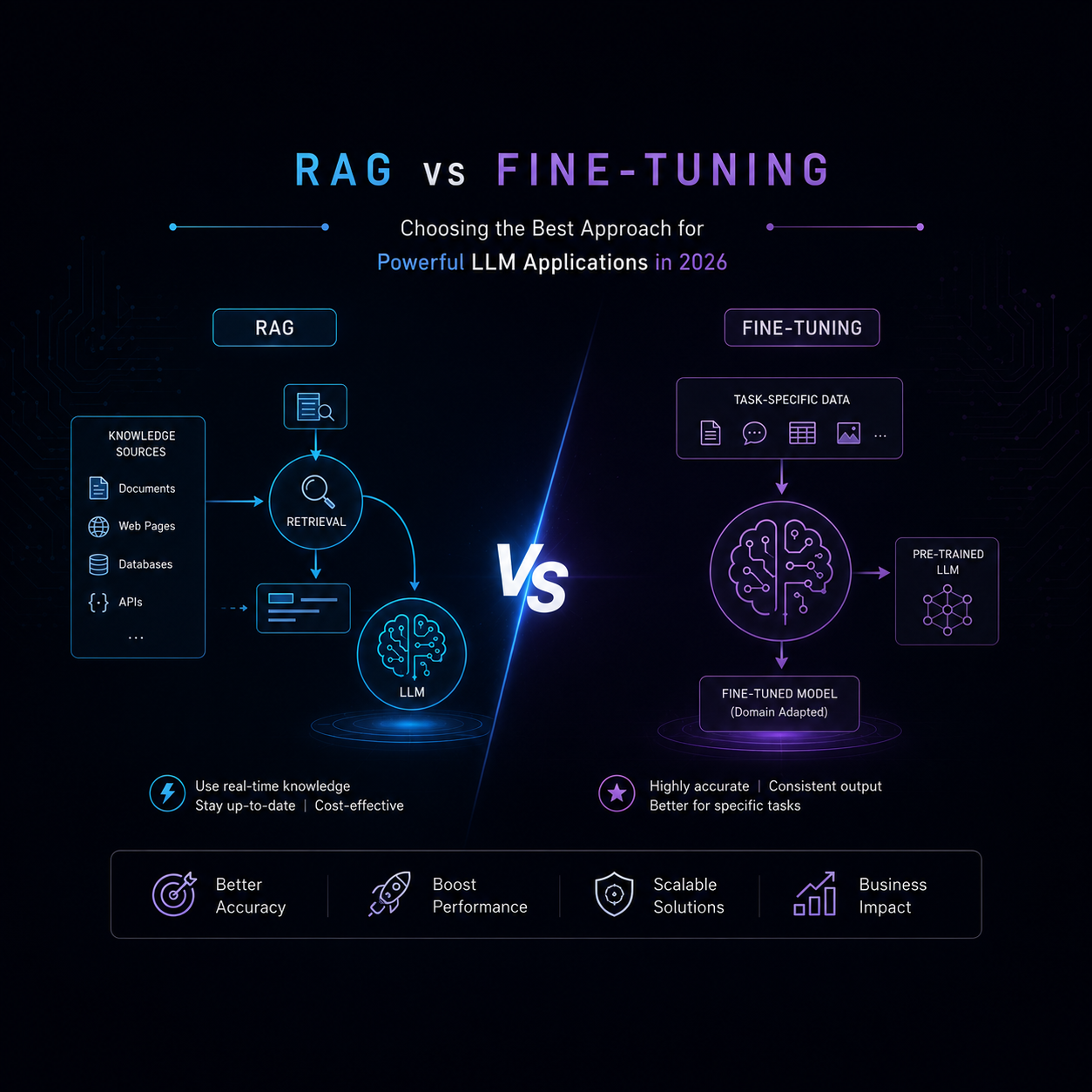
RAG is usually the way to go when you want your AI system to give you information, from things that are changing or that you own. On the hand fine-tuning is better when you want your model to do things in a very specific way follow a certain format all the time or get really good at doing the same task over and over. For people it makes sense to start with RAG make sure it is working well and only use fine-tuning if you really need to.
Key Takeaways
- RAG connects the model to external knowledge so answers can stay current and grounded in your documents.
- Fine-tuning changes the model’s behavior by training it on examples of the outputs you want.
- If your problem is “What does our policy/product/docs say?”, RAG is usually the fit.
- If your problem is “Always answer in this format/style/classification pattern,” fine-tuning often works better.
- The best production teams measure quality with evals, then iterate on prompts, retrieval, and training data.
- OneLeap’s AI Engineering Mastery program covers both production RAG systems and fine-tuning, plus deployment, observability, and portfolio projects.
- The course is made for people who have jobs and want to learn on the weekends and for graduates who want to learn on the weekends too. These people want to be guided by someone who knows what they are doing they want to get ready for interviews. They want to be ready to get a job.
Table of Contents
- What RAG and Fine-Tuning Mean.
- Why the Choice Matters for Business.
- How Each Approach Works.
- Core Components to Build Well.
- Tools and Technologies.
- Real-World Use Cases.
- RAG vs Fine-Tuning Comparison.
- Best Practices.
- Common Mistakes.
- FAQs.
- Final Summary.
What They Mean?
Retrieval-Augmented Generation is a pattern where the model gets information from sources like databases or document stores. It uses this info to create answers. This is helpful when facts change often or are not part of the models knowledge.
Fine-tuning is when you train a model with examples. The model learns a way of doing things or a certain style. OpenAI says fine-tuning helps when you want the model to be really good, at something. You can also use it to make the model produce a format every time. You can use it to make the model handle special examples better.
Why It Matters?
For businesses making the wrong choice is a mistake. It wastes time, money and trust. OneLeap says RAG is an idea because it helps stop wrong information on big tasks by using the sources you have. It also says fine-tuning is good because it makes things more consistent, faster and better formatted when you do the tasks over and over. The choice you make also affects how you make content how much it costs and how fast your system can learn things.
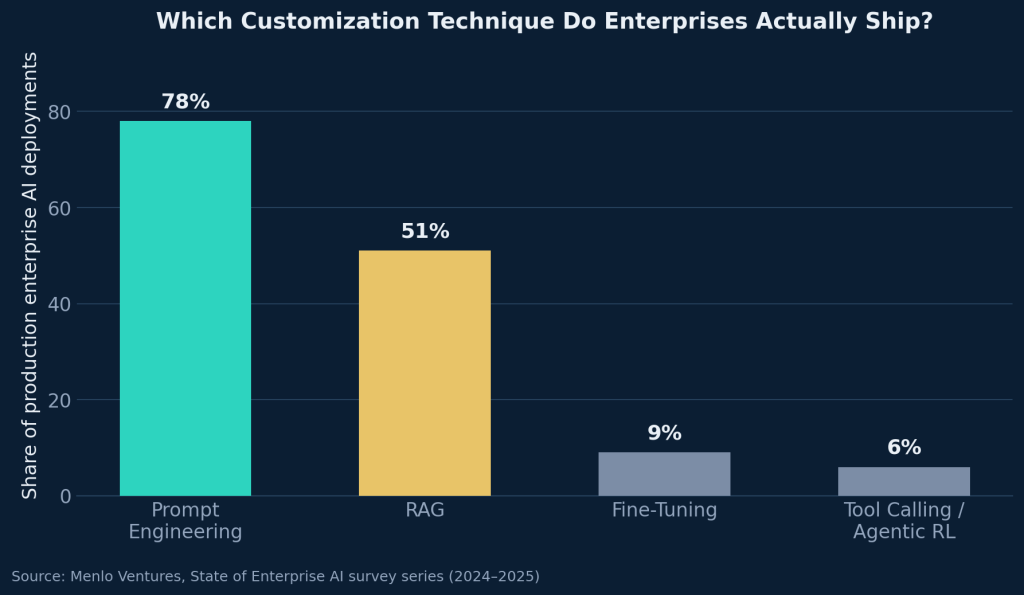
This is why OneLeap focuses on doing things not just talking about them. They have a brochure that shows how they teach people by doing projects. They have ten projects that are like what you would do in a real job classes, on the weekends and mentors who help you every week. They also help you get a job in the field of intelligence. This is important because when you have a job you are not just picking a model you are making a whole system that has to work well be able to handle a lot of work and show that it is worth the money.
How It Works?
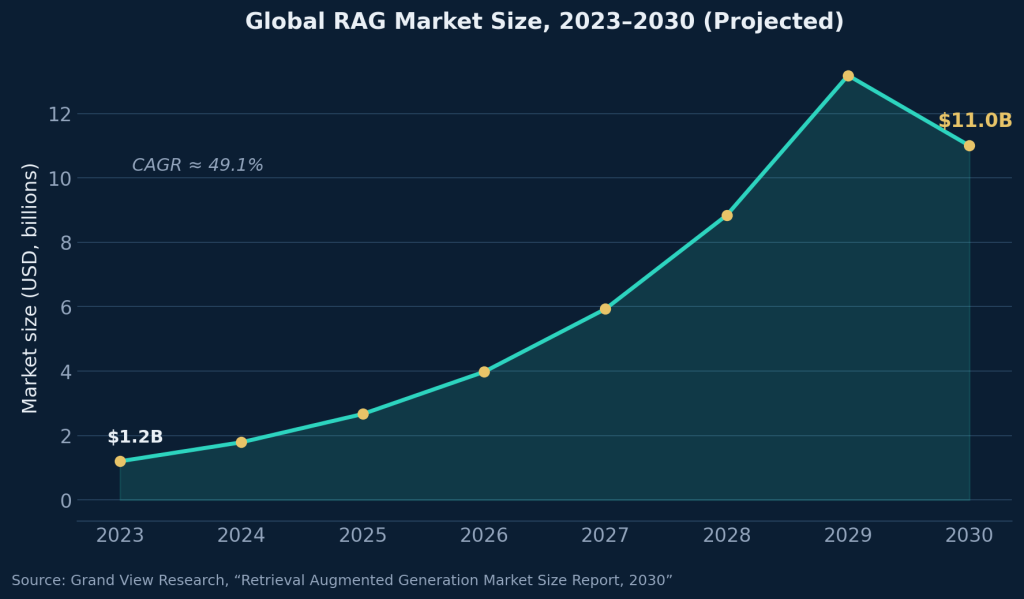
RAG workflow
- A user asks a question.
- The system turns the question into a search query or embedding.
- Relevant chunks are retrieved from documents or a knowledge base.
- The retrieved context is inserted into the prompt.
- The model generates an answer using both the prompt and retrieved text.
Fine-tuning workflow
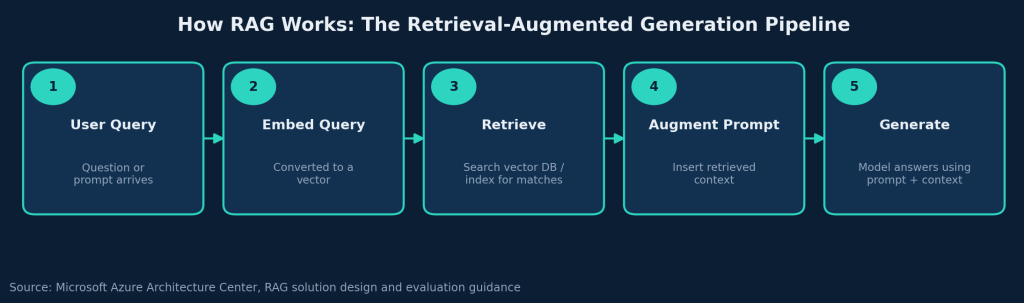
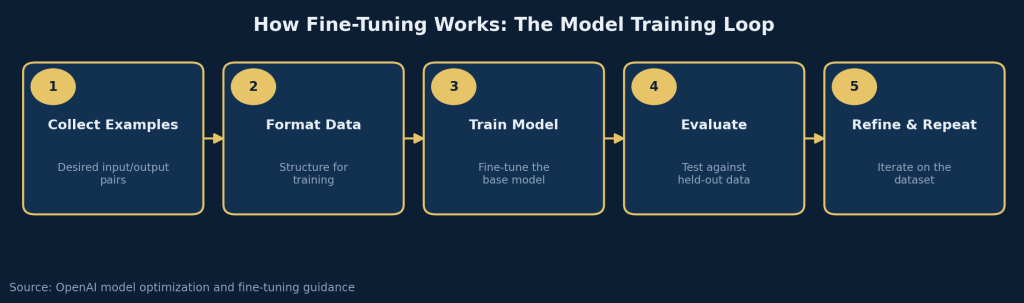
- You collect examples of desired inputs and outputs.
- You format and upload the training data.
- The model is trained on those examples.
- You evaluate the fine-tuned model against test data.
- You make your dataset better. Do the loop again. OpenAIs model optimization guidance says to do a loop of tests improving prompts and adjusting the model so you can see how well it works before and after changes. This way of working is helpful, for teams because it makes sure decisions are based on facts, not guesses.
Core Components
RAG components
| Component | What it does | Why it matters |
| Document ingestion | Collects PDFs, web pages, tickets, FAQs, or internal docs. | Poor ingestion creates poor answers. |
| Chunking | Breaks content into retrievable sections. | Bad chunking lowers retrieval quality. |
| Embeddings | Converts text into vectors. | Helps the system find similar meaning. |
| Vector database or search index | Stores and retrieves relevant chunks. | Makes the knowledge base searchable. |
| Re-ranking | Improves the order of retrieved items. | Raises answer quality and precision. |
| Prompt assembly | Inserts retrieved context into the model prompt. | Grounds the response in source material. |
| Evaluation | Measures retrieval and answer quality. | Prevents silent system degradation. |
Microsoft’s RAG guidance emphasizes design and evaluation at each step of the retrieval pipeline, including search configuration, reranking, and solution-level assessment.
Fine-tuning components
| Component | What it does | Why it matters |
| Training data | Shows the model desired behavior. | Data quality determines outcome quality. |
| Formatting | Structures examples consistently. | Prevents noisy training signals. |
| Base model selection | Chooses the model to adapt. | Impacts cost, latency, and capability. |
| Training method | SFT, DPO, or RFT depending on goal. | Matches method to task complexity |
| Validation set | Checks generalization. | Prevents overfitting. |
| Evaluation | Compares against baseline prompts or RAG. | Confirms the model actually improved. |
OpenAI’s docs note that fine-tuning can help with consistent formatting, lower token costs, and smaller model specialization, especially when prompts alone are not enough.
Tools and Technologies
| Area | Common tools |
| LLMs | OpenAI, Claude, Gemini |
| RAG orchestration | LangChain, LlamaIndex, LangGraph |
| Vector databases | Chroma, Pinecone, FAISS, Weaviate |
| App layer | FastAPI, Streamlit, Gradio |
| ML stack | Python, PyTorch, TensorFlow, MLflow |
| Deployment | Docker, Kubernetes, Azure, Google Cloud Platform |
| Fine-tuning | PEFT, LoRA, model-specific training workflows |
OneLeap’s brochure explicitly includes production RAG systems, fine-tuning and model optimization, agents, safety, deployment, and a tools stack that matches real-world AI engineering work. That’s valuable because your blog can naturally position the course as the place to learn both strategies in a job-ready way.
Real Examples
When RAG is the better fit?
| Use case | Why RAG fits |
| Customer support chatbot | Needs up-to-date documentation and policy answers |
| Financial document analysis | Must read changing filings or reports |
| Legal contract analysis | Needs grounded answers from source clauses |
| Internal knowledge assistant | Must answer from private company docs |
When fine-tuning is the better fit?
| Use case | Why fine-tuning fits |
| Domain-specific classification | Needs consistent labels and behavior |
| Response formatting | Must always produce a structured output |
| Brand tone control | Needs stable style and voice |
| Small specialized task | Needs efficient task performance with fewer prompt tokens |
The brochure’s project examples align well with this split: Enterprise RAG System for retrieval-heavy work, and Domain-Specific Fine-Tuned Model for behavior specialization. That pairing is useful for learners because it mirrors the same decision-making that teams use in production.
RAG vs Fine-Tuning
| Factor | RAG | Fine-Tuning |
| Best for | Dynamic knowledge and grounded answers | Behavior, style, formatting, task specialization |
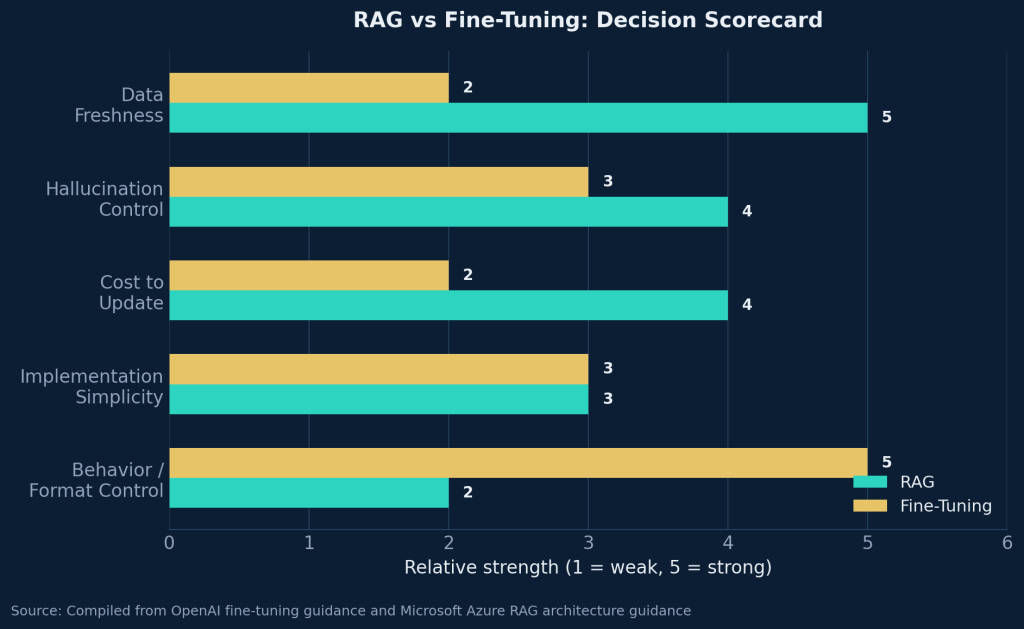
| Data freshness | Strong, because it retrieves external content | Weak for new knowledge unless retrained |
| Hallucination control | Better when retrieval is strong | Better for behavior control, not factual recall |
| Cost to update | Usually easier and cheaper to update documents | Requires new training runs and evals |
| Latency | Can be slower due to retrieval | Can be faster at inference if prompt is shorter |
| Implementation complexity | Retrieval, indexing, chunking, evals | Data prep, training, validation, evals |
| Ideal business goal | “Answer from our knowledge base.” | “Behave exactly like this.” |
Simple rule
- Use RAG when the answer depends on external facts, policies, manuals, or recent content.
- Use fine-tuning when the answer depends on repeated behavior, format, or domain-specific response patterns.
- Use both when you need grounded knowledge and highly consistent output.
Best Practices
- Start with evals before building. OpenAI says it is an idea to check how well something is working from the start. This way you can see if things, like prompts or RAG or fine-tuning actually make the OpenAI results better.
- Use RAG first for knowledge-heavy applications. Microsoft’s guidance focuses on retrieval design and evaluation because retrieval quality strongly affects output quality.
- You should only make adjustments when the task is stable enough to learn from examples. OpenAI notes that making adjustments works best when you want the thing to behave consistently and you can provide examples to learn from. This means you need to have an understanding of what the task is and have some good examples to work with so the thing can learn from them and do what you want it to do, which is to have consistent behavior and that is what fine-tuning is all, about making adjustments to get consistent behavior from the task.
- Keep retrieval chunks clean and focused. Bad chunking can sabotage even a strong model.
- Build safety and monitoring into the system. OneLeap’s program specifically includes guardrails, prompt injection defense, observability, and failure recovery, which are essential in real deployments.
- Before we ship lets compare the base model, the version that only responds to prompts the RAG version and the version that has been fine-tuned.
- We should treat our AI application like a product, not just something, for testing.
Common Mistakes
| Mistake | Why it hurts |
| Using fine-tuning to “teach” a model all your company knowledge | That is usually the wrong tool for changing knowledge that updates often |
| Using RAG without evals | Retrieval may look good but answer quality may still be weak |
| Poor chunking and indexing | Lowers retrieval precision and increases noise |
| Training on low-quality examples | Fine-tuning learns bad patterns fast |
| Skipping validation data | You won’t know whether the model generalizes |
| Ignoring latency and cost | A system can work technically but fail economically |
| Building for a demo only | Production systems need observability, retries, and safety |
OneLeap’s brochure repeatedly stresses production readiness, which is important because many learners can prototype, but fewer can build systems that survive real usage. That message fits this topic perfectly, since both RAG and fine-tuning fail when they are treated as shortcut tools instead of engineering choices.
FAQs
Q1. Is RAG better than fine-tuning?
Not always. RAG is usually better when you need current or private knowledge, while fine-tuning is better when you need consistent behavior, style, or task performance.
Q2. Should I start with RAG or fine-tuning?
Start with RAG in most knowledge-based use cases, then add fine-tuning only if you still need better formatting, consistency, or task specialization.
Q3. Can I use both RAG and fine-tuning together?
Yes. Many production systems use RAG for grounding and fine-tuning for behavior control, which gives you both reliable knowledge access and more consistent outputs.
Q4. Does fine-tuning reduce hallucinations?
It can improve consistency, but it is not the main solution for factual grounding. RAG is generally the stronger choice when you want answers tied to source documents.
Q5. Is fine-tuning expensive?
It can be more expensive than prompt-only work because you need quality training data, training runs, and evaluation cycles. The payoff is often lower inference cost or better control in repetitive tasks.
Q6. What skills do I need to build these systems?
You need Python, API handling, basic ML understanding, database familiarity, and deployment thinking.
Q7. What makes a RAG system production-ready?
Good chunking, strong retrieval, reranking, clean source data, guardrails, monitoring, and fallback logic are key.
Q8. What makes a fine-tuned model production-ready?
High-quality examples, careful validation, task-specific evaluation, and a clear business reason for training are essential.
Final Summary
RAG and fine-tuning solve different problems, and the best AI teams know how to use both. RAG is the right first move for fast-changing knowledge, while fine-tuning is the better choice for stable behavior, structured output, and task specialization. The strongest production teams measure, iterate, and build with evaluation at the center of the workflow.
That is also why OneLeap’s AI Engineering Mastery program is a strong fit for this topic: it teaches production RAG, fine-tuning, deployment, observability, live projects, mentorship, and career support in a portfolio-first format designed for job readiness. For readers who want to move from experimenting to engineering, this is the practical path.
Learn more about Building Reliable AI Agents: Evals, Guardrails & Production Safety
Stay updated with the latest AI, Data Science, and Automation insights by following OneLeap on LinkedIn and Instagram.
Source Links
Microsoft Azure: RAG information retrieval
Microsoft Research: RAG vs Fine-tuning: Pipelines, Tradeoffs, and a Case Studymicrosoft
Microsoft Azure: Standard RAG vs. agentic RAG

Leave a Reply