

How to choose the best AI course in Dehradun
To choose an AI course in Dehradun, work backwards from the job you want rather than forwards from a syllabus. Decide on a role direction first AI engineering, data analytics, automation or product then pick the programme that teaches that role through real projects, gives you feedback from people who have done the work, and leaves you with a portfolio an employer can actually assess. The best AI courses in Dehradun are not the ones with the longest tool list; they are the ones that make you demonstrably employable.
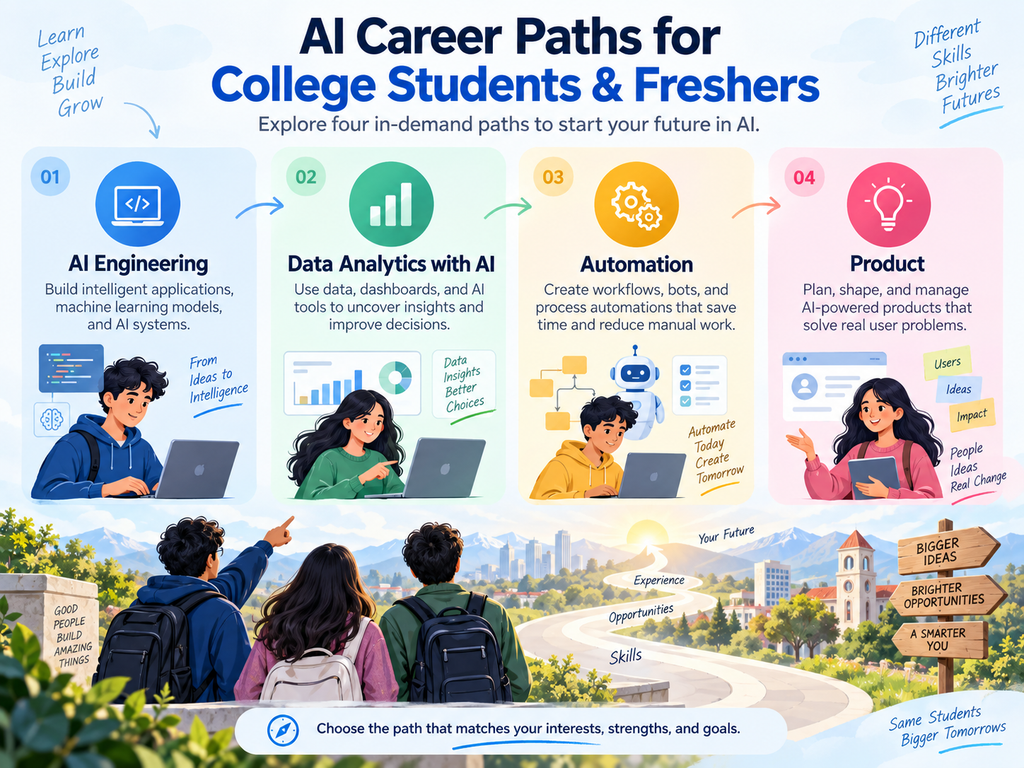
Your starting point narrows this quickly. From a technical background, the deeper path into AI engineering machine learning, RAG, agents, deployment is realistic. From a non-technical or business background, a business-first analytics and AI workflow route into data, dashboards, automation and decision-making is the more accessible door, and it is not a lesser one.
Key takeaways
- Pick the role before the course: AI engineering, data analytics, AI automation and AI product work need genuinely different curricula, and no single programme covers all four well.
- What to prioritise: real datasets, live projects, feedback on your actual work, mentorship, portfolio reviews and interview preparation.
- On pay: what you can demonstrate matters far more than which certificate you hold. Project depth, internships and problem-solving move the number; the course name does not.
- Skills are role-specific: Python, SQL, Excel, Power BI, statistics, APIs, LLMs, RAG, agents and automation all matter, but in very different proportions depending on where you are aiming.
- Domain-aligned projects beat generic ones: OneLeap builds seven real-world projects around the domain a learner wants to work in, so the portfolio reads as relevant experience rather than coursework.
- Compare on outcomes, not location: offline institutes, live-online cohorts and national programmes each suit different people, and fees are the least informative thing about any of them.
Table of contents
- What counts as an AI course in 2026?
- What is actually available in Dehradun
- Types of AI courses for students and freshers
- How to evaluate an AI course
- Why real-world projects matter
- Local, online, and remote learning options
- Career paths after an AI course
- Salary expectations based on skills
- Common mistakes students make when choosing an AI course
- How OneLeap programmes map to career goals
- Best practices before enrolling
- Frequently asked questions
- Final thoughts
What counts as an AI course in 2026?
An AI course in 2026 should teach more than how to prompt a chatbot. Depending on the path, that means programming, data handling, machine learning, generative AI, retrieval-augmented generation, agents, automation, dashboards, forecasting, evaluation, deployment, safety and business judgement. Very few programmes cover all of it, and the ones that claim to usually cover none of it deeply.
The right depth follows the goal. An engineering course should leave you able to build and deploy a system. An analytics course should leave you able to turn data into a decision with AI assistance. A product course should leave you able to spot a valuable AI use case, define what success looks like in numbers, and manage the risks specific to AI features.
What is actually available in Dehradun
Before comparing curricula, it helps to know what you are realistically choosing between. A student in Dehradun is not picking from an unlimited menu the options fall into five categories, and each has a predictable strength and a predictable catch.
| Option | What it is good for | The catch |
| Local computer-training institutes | Classroom routine, low cost, a peer group you see in person, and a fast start for absolute beginners | Curricula often lag the market by a year or two, and tool coverage tends to substitute for project depth. Ask to see a recent student portfolio before paying anything. |
| University programmes at Dehradun institutions | A recognised degree or diploma, campus placement access, and structured foundations in maths and programming | Elective AI content is usually theoretical and not built around deployment or a portfolio. Excellent as a base, rarely sufficient on its own. |
| Live-online national cohorts | Practitioner instructors, national peer groups, current curricula, and scheduled feedback without relocating | Requires self-discipline and a reliable connection. Verify the live hours are genuinely live and that someone reviews your work rather than just marking attendance. |
| Self-paced online courses and MOOCs | Very low cost, flexible timing, and good for filling a specific gap such as SQL or statistics | Completion rates are poor without external accountability, and nobody reviews your projects. Best as a supplement, not a primary path. |
| Company internships and apprenticeships | Real data, real constraints, real stakeholders the fastest learning available anywhere | Scarce locally and competitive. Usually needs a portfolio first, which is what the other four options are for. |
For most students and freshers in Dehradun the realistic decision is between a local classroom programme and a live-online cohort. The local option wins on routine and cost; the online option usually wins on curriculum currency and on who is reviewing your work. If you can combine a university base with one properly project-driven programme and an internship, that is the strongest sequence available in the city.
Types of AI courses for students and freshers
| Course type | Who it suits | What you should learn | Potential entry roles |
| AI engineering | B.Tech/BCA/MCA/CS students, developers, technically inclined freshers | Python, ML, LLMs, RAG, agents, APIs, evaluation, deployment, safety | Junior AI/ML Engineer, GenAI Engineer, AI Developer, AI Intern |
| Data analytics with AI | Students, freshers, business learners, Excel users, career switchers | Business acumen, Excel, SQL, Python, Power BI, statistics, AI workflows, forecasting, automation | Data Analyst, Business Analyst, Reporting Analyst, Operations Analyst, BI Developer |
| AI automation | Operations, marketing, sales, business, no-code builders, developers, Freshers | Process mapping, APIs, workflow tools, prompts, integrations, data, validation, monitoring | AI Automation Specialist, Operations Analyst, Automation Intern, Solutions Associate |
| AI product management | Business, design, engineering, analytics, or product-oriented learners, Freshers | User problems, AI literacy, metrics, roadmaps, experimentation, responsible AI, stakeholder management | Associate Product Manager, Product Analyst, AI Product Intern, Product Operations |
| AI foundations | Students who need career exploration before choosing a specialisation | AI concepts, data basics, Python/logic basics, ethics, business use cases, portfolio orientation | Internships, entry analytics roles, further specialisation |
How to evaluate an AI course
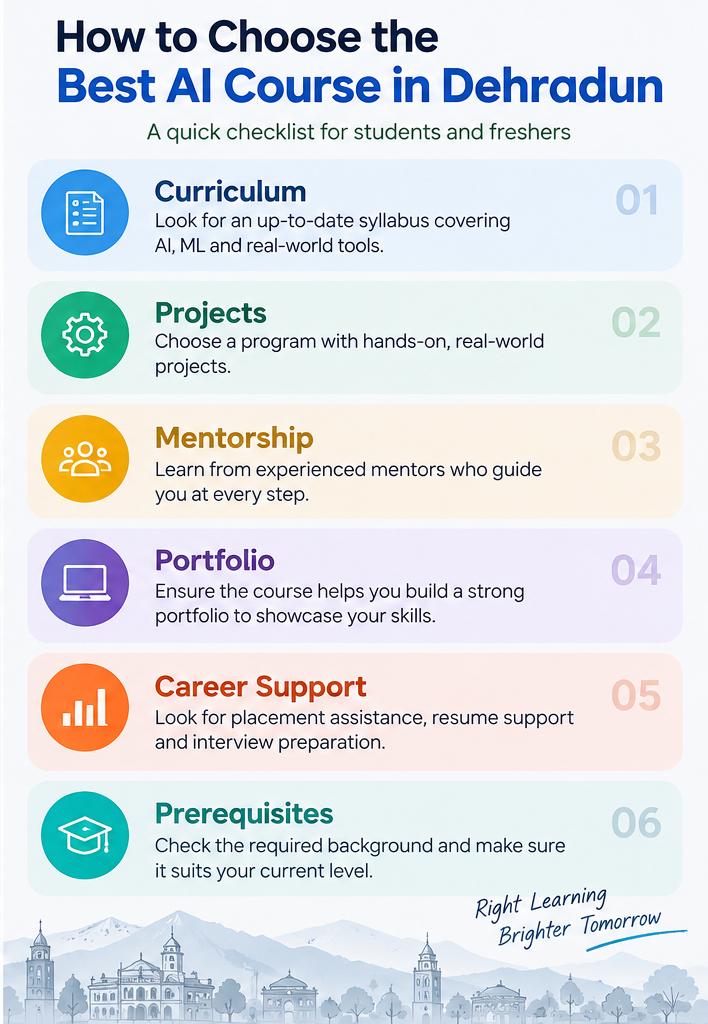
Take this checklist to any provider you are considering and ask the questions out loud. A good programme answers them without hesitating; a weak one changes the subject to placement statistics. What you are testing is whether the course makes your ability easier to demonstrate, or just adds a line to your resume.
- Role alignment: Does the course lead toward the role you actually want engineering, analytics, automation, or product?
- Current curriculum: Does it include current, applied skills rather than only outdated theory or isolated tool lessons?
- Project quality: Will you work on realistic datasets, constraints, trade-offs, and business problems?
- Live learning and feedback: Can you ask questions, receive reviews, debug work, and improve through expert feedback?
- Mentorship: Is there structured access to practitioners who understand real workplace expectations?
- Portfolio support: Does the course help you document projects, GitHub work, dashboards, demos, and case studies?
- Career support: Does it include resume positioning, LinkedIn optimisation, mock interviews, and job-search guidance?
- Prerequisites: Does the course honestly state the required starting level and offer a suitable path for beginners?
- Responsible AI: Does it teach validation, privacy, bias, safety, and the limits of AI outputs?
- Format and commitment: Are class schedules, live hours, workload, and learning support practical for your college or job schedule?
Why real-world projects matter
No employer can judge your ability from a certificate, because certificates measure attendance. What they are trying to establish is whether you can handle messy data, incomplete requirements, edge cases and a deadline and the only evidence that settles that is work you have actually done.
This is why domain alignment matters more than project count. At OneLeap learners build seven projects in the domain they want to work in, so the portfolio reads as relevant experience: someone targeting retail builds KPI dashboards, customer segmentation, revenue forecasting and AI-powered reporting around retail problems, while someone aiming at finance, SaaS, marketing or operations shapes the same skills around that context. A recruiter scanning your work should recognise their own industry in it.
| Portfolio evidence | What it shows an employer |
| Business KPI dashboard | You can define metrics, model data, build filters, and explain what action should follow. |
| Sales or customer analysis | You can use SQL/Python to find trends, segmentation opportunities, and business recommendations. |
| AI-powered report generator | You can automate a repeatable analysis workflow while validating AI-generated insight. |
| Company-data Q&A assistant | You can connect trusted documents or data to an AI knowledge workflow with source-aware answers. |
| Predictive forecasting project | You can apply time-series or AutoML thinking to planning and KPI monitoring. |
| Production AI application | You can build an end-to-end system with APIs, retrieval, agents, safety, evaluation, and deployment. |
Local, online, and remote learning options
Format matters less than most people think, and more than fee comparisons suggest. What actually differs between these four is how much accountability you get and who looks at your work.
| Format | Strengths | What to check |
| Offline / local classes | Peer network, accountability, in-person interaction, local community | Instructor quality, project depth, lab support, class size, career outcomes |
| Live online cohort | Access to practitioner mentors and national peer groups without relocating | Live hours, recordings, office hours, review quality, cohort support |
| Self-paced course | Flexible schedule and often lower cost | Risk of low accountability; supplement with projects, communities, and feedback |
| Hybrid learning | Mix of live guidance and independent practice | Clarity of schedule, support system, and how feedback is delivered |
For students and freshers, deadlines and live feedback are worth paying for. They enforce the discipline that self-paced study rarely produces, and they catch mistakes before they harden into habits. A national or remote cohort also widens the people you meet, which matters more for a career outside the metros than any syllabus detail.
Career paths after an AI course
| If you enjoy… | Possible career direction | Skills to prioritise |
| Coding and building products | AI Engineer, ML Engineer, LLM/GenAI Engineer, AI Agents Developer | Python, data structures, APIs, ML, LLMs, RAG, agents, deployment |
| Data, dashboards, and business decisions | Data Analyst, BI Developer, Business Analyst, Product Analyst | Excel, SQL, Power BI, Python, statistics, storytelling, AI-assisted analytics |
| Workflows and process improvement | AI Automation Specialist, Operations Analyst, Solutions Associate | APIs, workflow tools, prompts, data handling, process mapping, validation |
| Users, business strategy, and product decisions | AI Product Manager, Product Analyst, Product Operations | User research, metrics, AI literacy, roadmaps, communication, experimentation |
For an overview of the skills companies expect from AI product managers, read: AI Product Manager Skills in 2026
Salary expectations based on skills
For freshers, the number on your offer tracks what you can demonstrate, not what you attended. Portfolio depth, internships, communication, company type and interview performance move it; the course name does not. The ranges below are broad India-wide annual CTC planning figures for entry roles, aligned with the bands used across our other 2026 guides.
| Skill stack you can demonstrate | Likely entry-role direction | India-wide fresher range |
| Excel + basic SQL + reporting fundamentals | MIS Executive, Reporting Analyst, junior operations or data support | Around ₹3–4.5 LPA |
| Excel + SQL + Power BI or Tableau + two or three strong dashboards | Data Analyst, BI Analyst, Business Analyst | Around ₹4–6.5 LPA |
| SQL + Power BI + Python + statistics + business case studies | Data Analyst, Product Analyst, Analytics Associate | Around ₹5–8 LPA |
| AI workflows + APIs + automation + measurable business ROI | AI Automation Specialist, Solutions Associate, Operations Automation role | Around ₹6–10 LPA; dedicated automation roles reach ₹8–12 LPA |
| Python + ML foundations + APIs + deployed projects | Junior AI/ML Engineer, AI Developer, ML Intern | Around ₹6–10 LPA |
| Python + LLMs + RAG + agents + evaluation + deployment | GenAI Engineer, AI Engineer, LLM application developer | Around ₹8–12 LPA in stronger entry roles |
| AI product literacy + user research + analytics + product case studies | Associate Product Manager, Product Analyst, AI product intern | Around ₹5–10 LPA where entry roles exist |
Figure: India-wide fresher salary planning ranges for 2026, compiled from Masai School, Taggd, GUVI and Glassdoor (see Sources and references). The national fresher band for data analysts is ₹3–6 LPA and for AI engineers ₹6–10 LPA; the rows above position skill stacks inside those bands.
What moves you up from any of these rows
- Depth over breadth: complex SQL, a polished dashboard, a deployed application. One thing done properly outranks six things touched.
- An internship: even a short one changes how every other line on your resume is read.
- Domain projects: work shaped around retail, finance, SaaS or operations reads as relevant experience rather than coursework.
- Measured outcomes: retrieval metrics, forecast accuracy, hours saved, cost reduced. A project without a number is an anecdote.
- Company type: product companies and GCCs pay substantially above services firms at the same skill level, and this gap is larger than any skill difference at entry.
- Interview performance: explaining your architecture and your failures out loud is a skill you have to practise separately from building.
Treat all of it as directional. A candidate with two strong projects and an internship regularly outperforms someone with a longer but shallower tool list, and some roles AI product management most of all usually expect prior working experience before handing over full responsibilities.
Common mistakes students make when choosing an AI course
| Mistake | Why it costs you |
| Choosing on tool count | A long tool list signals shallow coverage, not comprehensiveness. What you want is a coherent path to one role, taught to a depth you can defend in an interview. |
| Valuing the certificate over the portfolio | Certificates prove attendance. Every hiring decision in this field is made on demonstrated work, and a course that produces no showable output has failed you regardless of its brand. |
| Enrolling above your level | Joining an advanced engineering programme without programming foundations wastes both the fee and the months. Honest prerequisites are a sign of a good provider, not a limitation. |
| Assuming a non-technical background rules you out | It rules out one path, not the field. Analytics, automation and product routes are open, well paid and less crowded than engineering. |
| Skipping business context | Focusing only on models and prompts produces someone who can operate tools but cannot say why any of it matters. That gap is obvious within two minutes of an interview. |
| Trusting AI output without checking | Accepting generated code or analysis without verifying accuracy, sources and privacy is the habit most likely to end a career early. Good courses teach validation explicitly. |
| Waiting until the course ends | Portfolio building and internship applications belong in month one, not month six. Rejections are information, and you want that information while you can still act on it. |
| Comparing fees instead of outcomes | The cheapest programme that produces nothing showable is the most expensive option available. Compare feedback quality, project depth and career support. |
How OneLeap programmes map to career goals
OneLeap offers distinct paths for learners with different starting points and goals. The right choice depends on whether you want to build deployed AI systems or use data and AI to drive business decisions and automation.
| Your goal | Relevant OneLeap path | What the path emphasises |
| Build production AI systems | AI Engineering Mastery | ML and deep-learning foundations, prompt engineering, AI products, RAG, fine-tuning, agents, multi-agent systems, safety, deployment, optimisation, multimodal AI, and production-grade projects. |
| Become an AI-powered data analyst or business-focused automation professional | Strategic Data Analyst with AI | Business acumen, statistics, AI fluency, Excel, SQL, Python, Power BI, RAG basics, predictive analytics, intelligent automation, and portfolio-ready projects. |
Explore AI Engineering Mastery: AI Engineering Mastery
Explore Strategic Data Analyst with AI: Strategic Data Analyst with AI
Best practices before enrolling
- Define your target role and starting level in writing before comparing courses.
- Ask for the syllabus, project list, mentorship model, weekly workload, and career-support details.
- Review whether project work is original, domain-relevant, and easy to show in a portfolio.
- Check whether you will receive feedback on code, dashboards, project logic, and communication not only attendance.
- Set a weekly practice schedule and plan to publish work throughout the course.
- Use every project to build a resume bullet, GitHub repository, dashboard case study, or LinkedIn post.
Frequently asked questions
Which is the best AI course in Dehradun for freshers?
The best AI course in Dehradun for a fresher is one aligned to the role they want and their current level. Look for a current curriculum, real projects, live feedback, mentorship, portfolio support, and career preparation not just a certificate or a list of software tools.
Can non-technical students take an AI course?
Yes. Non-technical students can enter through data analytics, AI automation, business analysis, or AI product paths. Start with business thinking, data literacy, Excel, SQL, visualisation, AI workflows, and communication; add Python as your goals require it.
Are there offline AI institutes in Dehradun?
Yes. Dehradun has a number of computer-training and IT institutes offering courses in Python, data science, machine learning and analytics, and the best one is Oneleap.
The practical approach is to judge any local institute on evidence rather than on proximity. Ask what the curriculum covered a year ago a syllabus that has not changed since 2023 tells you what you need to know. If the local options do not clear that bar, a live-online cohort with practitioner feedback is usually the better use of the same money, and you lose nothing but the classroom.
Do I need Python to learn AI?
Python is essential for deeper AI engineering, machine learning, and custom application development. It is useful but not always required at the beginning for analytics, automation, or product-focused paths.
How many projects should an AI course include?
Look for multiple meaningful projects rather than a single generic final assignment. Projects should show real datasets, clear business questions, technical decisions, and outcomes you can explain in interviews. OneLeap’s Strategic Data Analyst with AI pathway includes seven real-world projects aligned to the learner’s intended domain.
What salary can a fresher expect after an AI course?
It depends on skills and portfolio depth. Broad India-wide planning ranges run from roughly ₹3–4.5 LPA for basic Excel/SQL reporting skills to ₹8–12 LPA for stronger entry GenAI portfolios with Python, LLMs, RAG, agents, evaluation, and deployment. These are benchmarks, not guarantees.
Is an AI certification enough to get a job?
No. A certification can support your profile, but employers also want proof of skills through projects, internships, problem-solving ability, communication, and interview performance.
Should I choose AI engineering or data analytics with AI?
Choose AI engineering if you enjoy programming and want to build/deploy AI applications. Choose data analytics with AI if you want to use data, dashboards, business context, forecasting, and AI workflows to improve decisions and processes.
Final thoughts
Choosing an AI course in Dehradun comes down to one question: at the end of it, will you be able to show someone what you can do? The best AI courses in Dehradun make you demonstrably job-ready rather than certificate-ready. Pick the path that suits how you like to work, build projects in the domain you want to be hired into, and develop the technical, business and communication mix that employers are actually screening for.
If you want to upskill yourself in the AI space, explore OneLeap’s various courses and programmes to find a learning path aligned with your career goals.
Explore OneLeap: theoneleap.com
Browse OneLeap programmes: theoneleap.com/programmes

Leave a Reply