
What AI engineer skills matter in 2026?
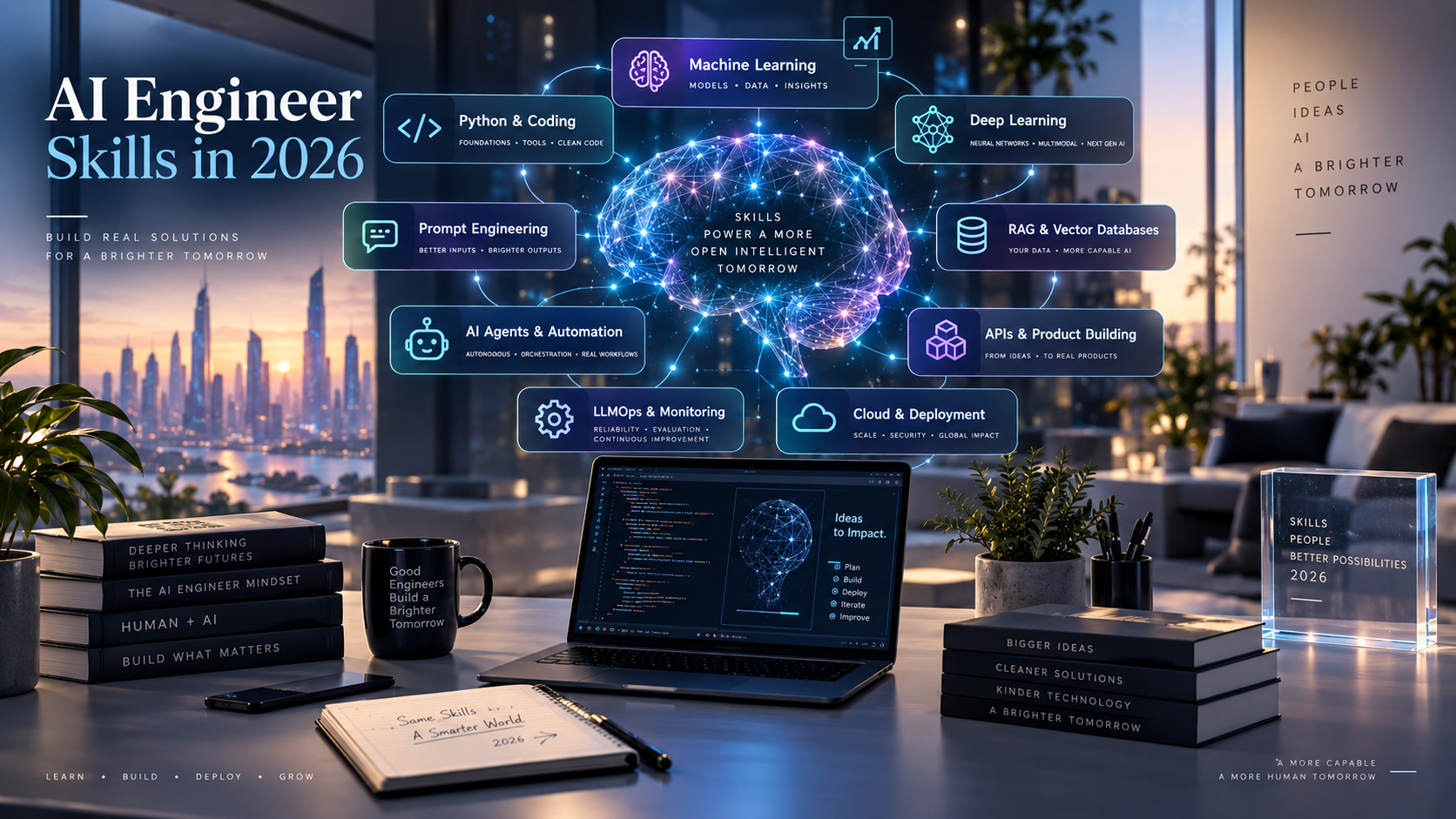
In 2026, the AI engineer skills that actually get people hired are production-oriented: Python and software fundamentals, LLM application development, retrieval-augmented generation (RAG), AI-agent orchestration, evaluation and testing, safety and guardrails, deployment and observability, plus cost and latency optimisation. Employers increasingly expect you to ship working systems, not just write prompts or complete tutorials.
Job-posting analyses show that Python, LLM APIs, RAG, prompt engineering, vector databases, and agent frameworks are among the most frequently mentioned capabilities, while roles emphasising production skills such as evaluation, monitoring, and scalable deployment command stronger compensation and growth prospects.
Key takeaways
- AI engineering in 2026 is less about isolated prompt tricks and more about building, evaluating, and deploying reliable AI systems.
- The most in-demand skills include Python, LLM application development, RAG, agents, evaluation, safety/guardrails, MLOps/LLMOps, and cloud deployment.
- Salary ranges in India for AI engineers vary widely: freshers often see around ₹6–10 LPA, while experienced professionals can reach roughly ₹30–60 LPA+ depending on company, city, and specialisation.
- Future growth is strong, but entry-level candidates must demonstrate practical engineering ability through projects, not just course certificates.
- A structured learning path plus a focused portfolio can significantly shorten the time to job readiness.
Table of contents
- What is an AI engineer in 2026?
- Why these skills matter now
- Core AI engineer skills for 2026
- Tools and technologies to learn
- AI engineer salary in India (2026)
- Future growth and career paths
- How to become job-ready in AI engineering
- Common mistakes to avoid
- Best practices for learning and showcasing skills
- Frequently asked questions
- Final summary and next steps
What is an AI engineer in 2026?
An AI engineer in 2026 is a software professional who turns AI capabilities into dependable products and services. They design and implement systems that combine models, data, APIs, user interfaces, databases, and cloud infrastructure to solve real business problems.
Unlike purely experimental roles, AI engineers are judged on whether their systems work in production: response quality, latency, cost, security, monitoring, failure recovery, and user experience. In a generative AI context, this often means building RAG systems, AI agents, evaluation pipelines, multimodal applications, and deployed services.
Why these skills matter now
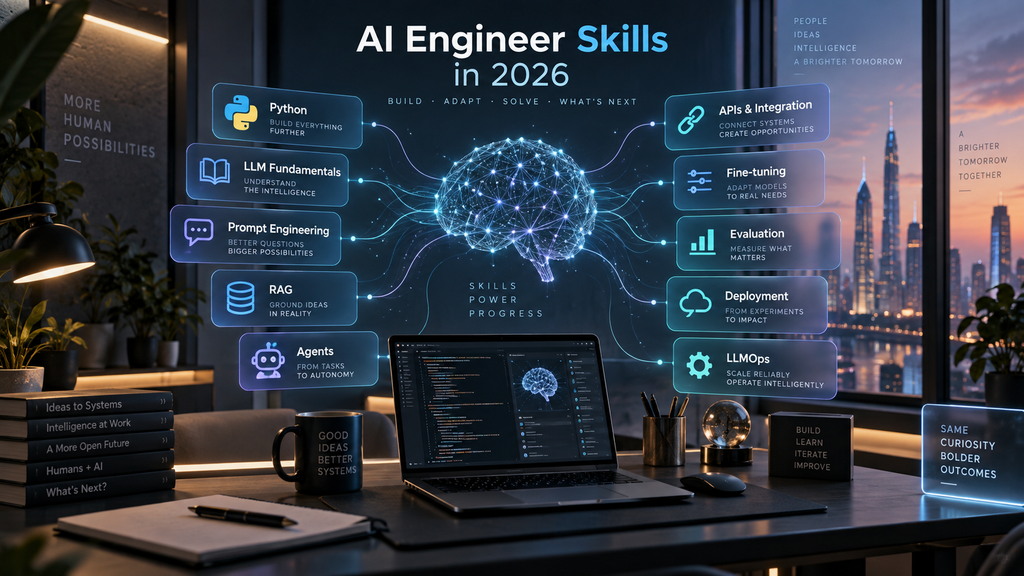
AI hiring has surged, with AI-engineer postings growing dramatically year over year, while employers increasingly expect production skills rather than basic API usage. Analyses of tens of thousands of job postings show that LLM expertise, RAG, agent workflows, and deployment-related skills are among the fastest-growing requirements.
At the same time, salary reports indicate that professionals who can demonstrate end-to-end system design, evaluation, and optimisation tend to access higher compensation bands and more senior roles.
Core AI engineer skills for 2026
| Skill area | What to learn | Why it matters |
| Programming and software engineering | Python, data structures, OOP, testing, Git, APIs | AI products need maintainable software, not only notebooks. |
| Data and backend | SQL, relational and vector databases, data processing, authentication | Most AI applications connect models to business data and services. |
| LLM application development | LLM APIs, prompt design, structured outputs, function calling, evaluation | Enables assistants, copilots, and knowledge applications. |
| RAG and retrieval | Embeddings, chunking, hybrid search, reranking, memory, evaluation | Makes AI answers grounded in your data instead of purely parametric. |
| AI agents and orchestration | Tool use, planning, workflow graphs, state management, multi-agent patterns | Supports complex task automation and integrated AI workflows. |
| Fine-tuning and model optimisation | PEFT/LoRA, dataset curation, evaluation against baselines | Tailors models to specific domains and tasks when justified. |
| Safety, evaluation, and observability | Guardrails, output validation, prompt-injection defences, monitoring, alerting | Makes AI systems reliable, safe, and auditable in production. |
| Deployment and MLOps/LLMOps | APIs, containers, cloud services, caching, batching, cost and latency optimisation | Turns demos into dependable, scalable services. |
| Product and communication | Problem framing, documentation, demos, stakeholder conversations | Employers hire people who can translate business needs into systems. |
Tools and technologies to learn
| Category | Examples | Use case |
| Programming and collaboration | Python, Git, GitHub, VS Code | Code, version control, collaboration, and documentation |
| Data and APIs | PostgreSQL, SQLite, FastAPI, REST APIs | Store data and expose AI capabilities as services |
| ML and deep learning | PyTorch, scikit-learn, Hugging Face | Train, evaluate, and use ML and model components |
| LLM application development | OpenAI/Claude/Gemini APIs, LangChain or LlamaIndex | Build model-powered applications and retrieval flows |
| Vector retrieval | Chroma, FAISS, Pinecone, Weaviate | Similarity search and RAG retrieval |
| Agents and orchestration | LangGraph, OpenAI Agents SDK, Claude Agent SDK, MCP | Stateful workflows, tool use, and agent systems |
| Deployment and monitoring | Docker, cloud services, logging and observability tools | Run and monitor systems in production |
AI engineer salary in India (2026)
AI engineer salary depends on experience, portfolio quality, company type, location, and whether the role is local, hybrid, or remote. The ranges below are practical planning estimates for annual CTC rather than guaranteed offers.
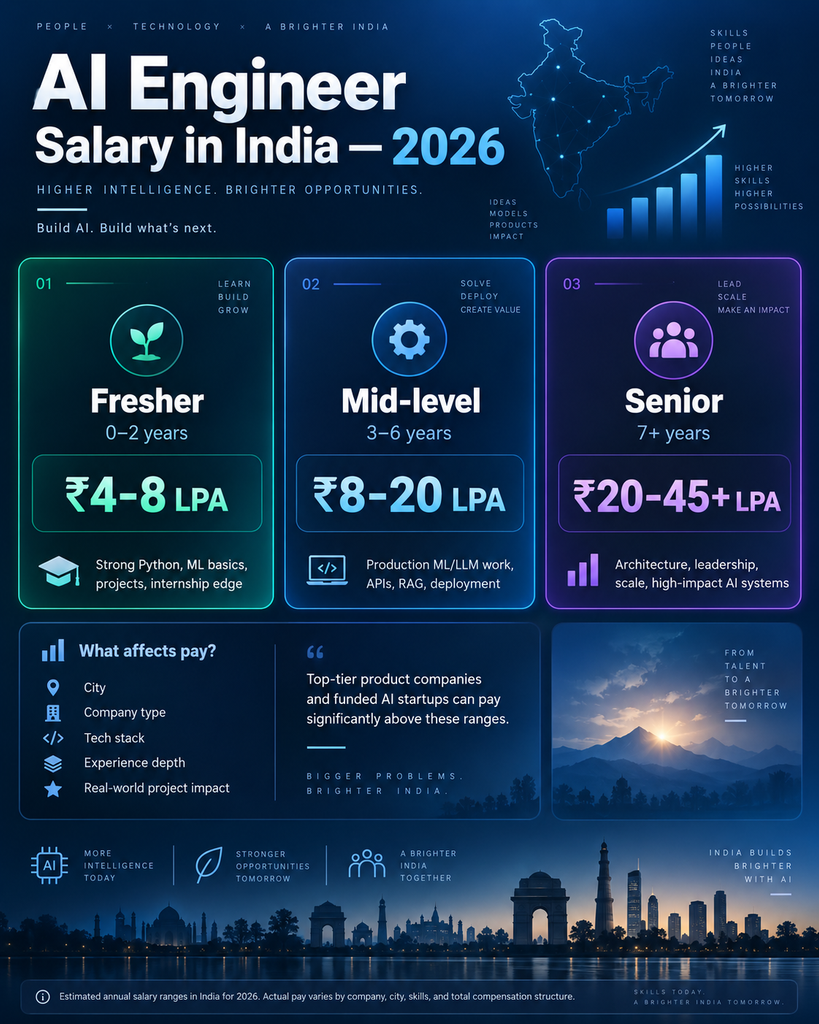
| Experience level | Typical India-wide range | What typically improves earning potential |
| Fresher / 0–2 years | Around ₹6–10 LPA | Solid Python and SQL, shipped portfolio projects, RAG/LLM deployment, internships, strong interview performance |
| Early to mid-career / 3–6 years | Roughly ₹12–25 LPA | Ownership of deployed systems, LLM evaluation, cloud deployment, observability, cost optimisation, domain expertise |
| Senior / 7+ years | Approximately ₹30–60 LPA+ | Architecture leadership, AI platform design, high-scale systems, team leadership, measurable business impact |
Salary guides and market reports for 2026 commonly place entry-level AI engineers around ₹6–10 LPA, mid-level professionals around ₹12–25 LPA, and senior AI engineers around ₹30–60 LPA or more, with variation by city, company, specialisation, and total benefits.
For job seekers, the best salary strategy is to build a portfolio that is competitive nationally: deploy projects, show metrics for quality and latency, explain security and cost decisions, and apply to local, hybrid, and remote opportunities.
Future growth and career paths
AI engineering demand is expanding rapidly, but entry-level candidates will be expected to demonstrate practical engineering ability rather than only course certificates. Hiring analyses highlight strong growth in roles that combine Python, LLMs, RAG, agents, and production skills.
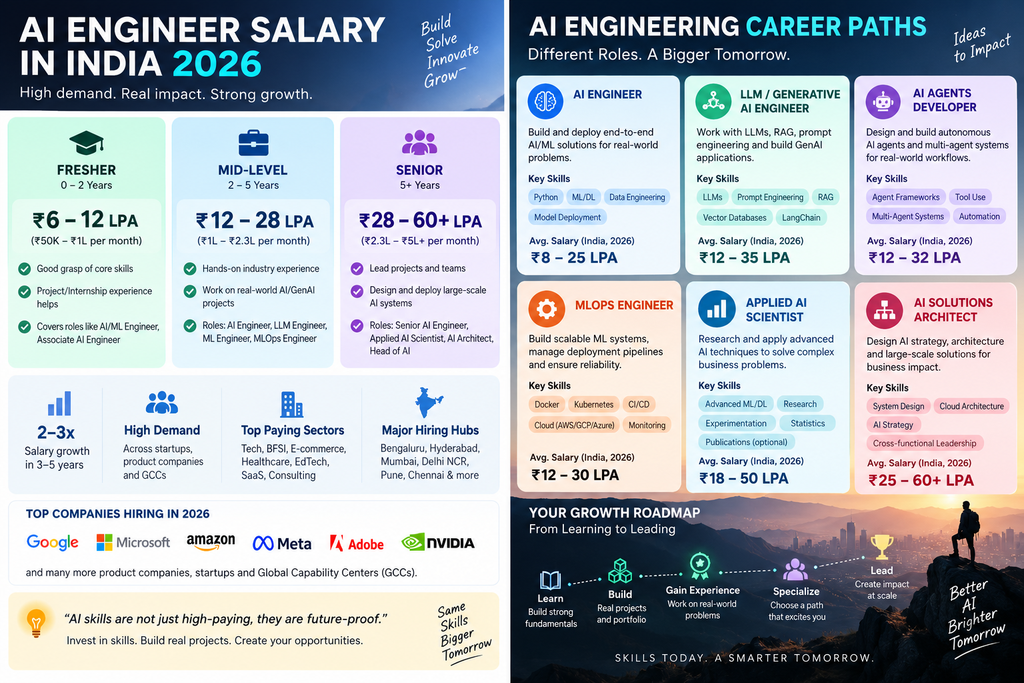
The roles below all draw on the same core skill set, but they differ in what you own day to day. Most people enter as an AI engineer and specialise from there; the salary bands in the table above apply across all six.
| Role | What you own day to day | Skills that set you apart |
| AI Engineer | End-to-end design, build, and deployment of AI features inside products | Breadth: Python, APIs, RAG, evaluation, deployment |
| LLM / GenAI Engineer | Production LLM systems, retrieval pipelines, fine-tuning where justified | Chunking and reranking strategy, structured outputs, PEFT/LoRA |
| AI Agents Developer | Autonomous and multi-agent workflows, tool use, orchestration | State management, planning, failure recovery, tool-call reliability |
| ML Platform / MLOps Engineer | Pipelines, serving infrastructure, and monitoring at scale | Containers, CI/CD, drift detection, cost and latency observability |
| Applied AI Scientist | Translating research techniques into production-grade applications | Experimental design, benchmarking, reading and implementing papers |
| AI Solutions Architect | Enterprise AI system design, integration, and vendor decisions | Security, compliance, build-vs-buy judgement, stakeholder communication |
Specialising in areas such as agentic workflows, evaluation, safety, cost optimisation, and multimodal AI can further improve long-term career prospects.
How to become job-ready in AI engineering
- Master Python, data structures, APIs, SQL, Git, and basic software engineering.
- Learn ML and deep-learning fundamentals, then focus on LLM application development.
- Build RAG systems with real data, including chunking, retrieval, and evaluation.
- Implement AI agents with tool use, planning, and state management.
- Add safety and evaluation: guardrails, output validation, monitoring, and alerting.
- Deploy at least two to three substantial projects with clear documentation and demos.
- Prepare for interviews: explain architecture, trade-offs, and how you measured quality and cost.
- Apply consistently to internships, junior roles, freelance projects, and remote opportunities.
If you are based in or around Dehradun and want a location-aware version of this roadmap, read How to Become an AI Engineer in Dehradun (2026)
For a broader view of generative AI engineering roles and the skills behind them, see Generative AI Engineering
Common mistakes to avoid
| Mistake | Why it is a problem |
| Staying in the tutorial trap | Watching content without building, deploying, debugging, and documenting your own systems leaves you with nothing to show and no experience of the failures that interviews probe. |
| Treating prompting as the whole profession | Prompt design matters, but production AI engineering also demands data modelling, evaluation, security, API design, and deployment. |
| Building generic chatbot clones | A chatbot with no specific user problem demonstrates nothing. Pick a real task and show retrieval, tool use, safety, or workflow integration. |
| Skipping evaluation | A polished demo is not evidence that a system is accurate, grounded, or reliable. Without metrics you cannot defend your design choices. |
| Ignoring cost and latency | Model choice, caching, token usage, batching, and retrieval design decide whether a system is viable in production or merely impressive in a notebook. |
| Overusing agents | Deterministic workflows are cheaper, faster, and easier to debug for predictable tasks. Reserve agents for work that genuinely needs flexible reasoning and tool selection. |
| Hiding project limitations | Explaining what failed and what you would do next signals mature engineering judgement; concealing it signals the opposite once an interviewer digs in. |
Best practices for learning and showcasing skills
- Learn by shipping: turn each concept into a small working system before moving to the next topic.
- Document decisions: explain why you used RAG, an agent, a particular model, or a deterministic workflow.
- Measure quality: add test cases and metrics for answer quality, retrieval performance, cost, latency, and failures.
- Prioritise fundamentals: fluent Python, SQL, Git, APIs, debugging, and software design compound over time.
- Learn responsible AI practices: protect user data, validate outputs, test for prompt injection, and create human escalation paths.
- Build visibility: share technical write-ups, project demos, GitHub repositories, and lessons learned on LinkedIn or relevant communities.
- Apply early: do not wait for a perfect portfolio before pursuing internships, freelance work, hackathons, and entry-level roles.
Frequently asked questions
What are the most important AI engineer skills in 2026?
The most important AI engineer skills in 2026 include Python and software engineering, LLM application development, RAG, AI agents, evaluation and testing, safety and guardrails, deployment and observability, and cost/latency optimisation.
Can I become an AI engineer without a computer science degree?
Yes. A computer science degree can help, but employers ultimately need evidence that you can write code, understand data and systems, build reliable AI applications, and explain your technical decisions. A strong portfolio can help demonstrate those capabilities.
How long does it take to become job-ready for AI engineering?
The timeline depends on your current level and weekly commitment. Learners with programming experience can progress faster, while beginners may need more time for foundations. A realistic path prioritises consistent practice and several substantial projects over quick completion of many courses.
What projects should an aspiring AI engineer build?
Strong options include a production-style RAG assistant, full-stack AI application, prompt evaluation framework, tool-using research agent, multi-agent workflow, monitoring dashboard, or multimodal pipeline. Each project should include documentation, evaluation, and a clear explanation of trade-offs.
Is AI engineering different from data science?
Yes. Data science generally focuses more on data analysis, experimentation, and predictive insight. AI engineering focuses on turning models and data into integrated, deployable AI products that users can rely on.
What salary can an AI engineer expect in India?
Plan on roughly ₹6–10 LPA as a fresher, ₹12–25 LPA once you have three to six years and a deployed system to your name, and ₹30–60 LPA or more at senior level. Where you land inside each band depends far more on company type and specialisation than on years served: product companies and generative AI or MLOps specialisations sit well above the services-firm median.
Is there future growth in AI engineering careers?
Yes, though the shape of the demand is shifting. Hiring is growing fastest for people who can run systems in production rather than prototype them, so entry-level candidates are judged on shipped projects rather than course completions. Specialising in agentic workflows, evaluation, safety, cost optimisation, or multimodal AI compounds that advantage over time.
Final summary and next steps
AI engineer skills in 2026 are centred on production capability: Python and software engineering, LLM application development, RAG, agents, evaluation, safety, deployment, and optimisation. The goal is not to collect certificates or copy tutorials it is to become someone who can ship dependable AI systems that solve real problems.
If you want a structured, job-focused path that covers ML foundations, production RAG, agents, fine-tuning, safety, deployment, and a portfolio of production-grade projects, explore OneLeap’s AI Engineering Mastery programme.
Learn more about the programme here: OneLeap AI Engineering Mastery

Leave a Reply