
Introduction
Product managers can use AI to make their products better. Generative AI makes every part of the product lifecycle go faster and be more informed. It helps product managers do things like summarize what customers are saying come up with feature ideas write first drafts of product requirement documents create user stories help with making prototypes and make launch communication better.
The important thing is to use AI to make things go faster not to do everything for you. When product managers use what AI gives them and add in what they know about customers what the business wants to achieve and their ideas, about the product they can make good decisions without having to do as much work themselves.
The Rise of AI in Product Management
The use of intelligence that can create things also known as generative AI has become really popular among people who make products. This has been happening a lot since 2022.
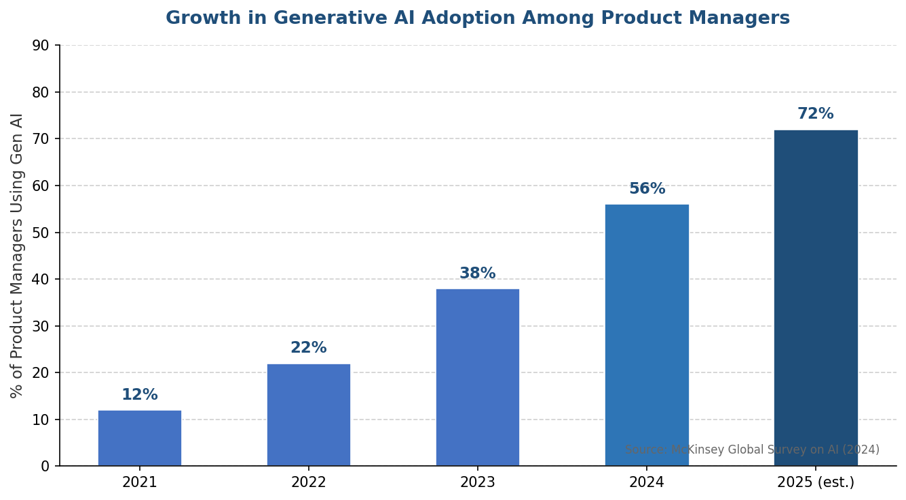
According to a survey that McKinsey does every year called the Global Survey on AI more and more product managers are using intelligence tools as part of their work.
In 2021 12 percent of product managers were doing this.. By 2025 it is thought that 72 percent of product managers will be using generative AI tools as part of their work, with products.
Key Takeaways
- Generative AI is really helpful for product managers because it helps them get things done faster.
- They can go from having an idea to actually doing something about it in no time.
- It is very useful when you want to learn more about your customers come up with ideas write documents and plan what to do next.
- AI can do things like look at what people’re saying and find common themes and it can even write the first version of what you want to build and the details that go with it.
- Product managers still have to use their own judgment and decide what is most important and think about how it fits with the business.
- There are courses like OneLeap that teach you how to work with AI and get ready for the real world by learning how to design good prompts and work in a way that is natural, with AI.
What Is Generative AI for Product Managers?
Generative AI is a kind of intelligence that can make text, summaries, designs, code, ideas and other things based on what you tell it and the information it has. For people who manage products Generative AI is like a helper that makes their job easier by doing research, planning, writing and giving them ideas to make decisions.
In making products Generative AI helps take what customers say which can be confusing and turn it into something. It can take ideas. Make them into organized documents. Generative AI also helps get products to customers faster by making the process from thinking of an idea, to launching it quicker.
Why It Matters
Product managers have to handle a lot of information and not enough time. They get lots of customer feedback support tickets and have to keep up with what competitor’s are doing discuss roadmaps and hear from stakeholders. All this can be really overwhelming. Generative AI helps make sense of all this information Product teams need to work but still do a good job. AI can help product managers find out what customers need sooner. It can also help them come up with solutions.AI reduces the work, in documentation and coordination.
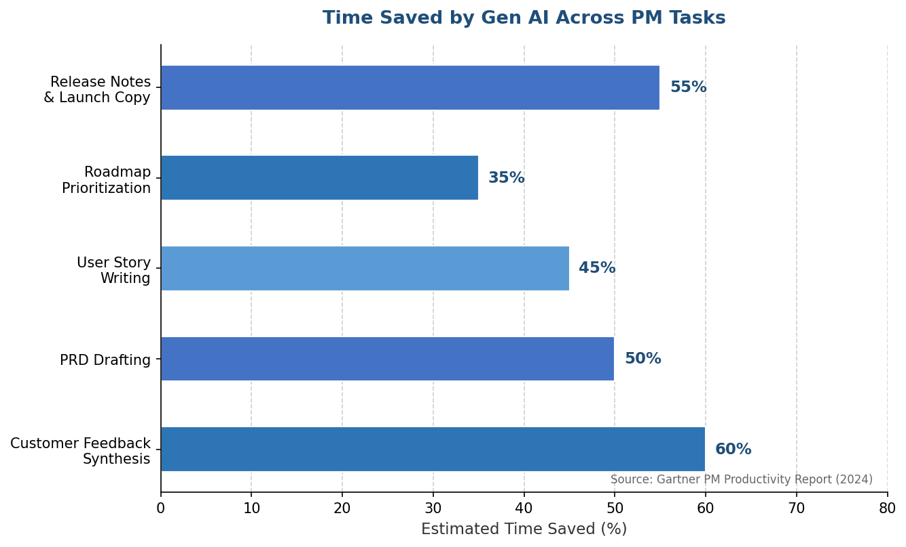
This gives businesses an advantage. Gartner’s 2024 Product Manager Productivity Report says teams using AI workflows get things done faster. They take time for research, documentation and launching products. Product managers using AI can do their job better and faster.AI helps them make the most of their time. They can focus on things instead of repetitive tasks.
How It Works: The AI-Augmented Product Managers Workflow
The best way to use AI in product management is to apply it step by step. First start with customer research. Use AI to summarize customer feedback. Then use AI to cluster that feedback. After that move to idea generation. Use AI there too. Next use it for documentation for prototyping and finally, for prioritization. This way generative AI helps at each stage of product management.
A practical workflow looks like this:
- We gather what users think from surveys, interviews, support tickets and reviews.
- Then we use AI to find themes, issues and requests that come up a lot.
- AI also helps us think of product ideas and possible solutions.
- With AIs help we draft PRDs, user stories and launch notes.
- AI assists, with creating wireframes outlining flows or writing prototype text.
- Before we share with the team we review and refine everything with human judgment.
This process works well because it makes the boring parts of product work faster while keeping the decisions made by people.
Core Components: Where AI Adds the Most Value
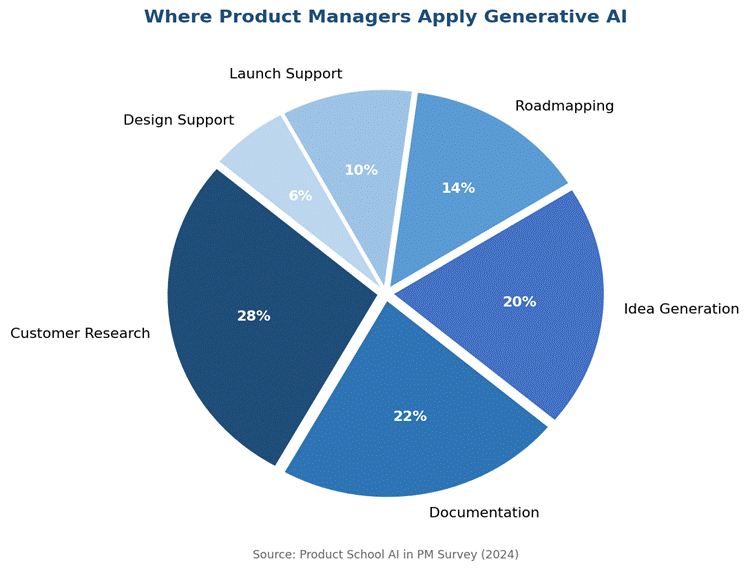
Product Schools 2024 AI in Product Manager Survey asked a lot of product professionals 1,200 to be exact to tell them how they use AI. So what did they find out? Product Schools 2024 AI in Product Managers Survey found out that product professionals use AI for customer research and documentation the most. These two things are pretty popular and idea generation is also something that product professionals use AI for it is just a little less popular, than customer research and documentation.
Key use categories:
We do customer research by summarizing lots of interviews support tickets and what users have to say.
• Idea generation is quickly coming up with feature ideas and possible solutions.
• For documentation we draft PRDs, write user stories create release notes and make FAQs.
• Design support involves helping with wireframes making mockups and mapping out the user journey.
• Road mapping is where we prioritize features and plan things out faster.
• Launch support is about creating assets, for the market crafting the message and making onboarding documents.
These parts work best when we guide AI with specific instructions and give it some product background. If the instructions are not clear the output won’t be clear either.. If we give structured prompts we get more helpful results.
Tools Product Managers Use
Product managers use a bunch of things to do their job. They need project management tools, design tools and communication tools. They also use assistants that are powered by artificial intelligence. The following things are really important for a modern product manager to have:
| Tool | Primary Product Managers Use Case |
| Jira | Backlog management, task tracking, sprint coordination |
| Figma | Design reviews, wireframes, prototype collaboration |
| Slack | Team communication and real-time collaboration |
| Miro | User journey mapping, brainstorming workshops |
| Power BI | Data dashboards, business analytics, reporting |
| Claude AI | PRD drafting, feedback synthesis, user stories |
| Notion AI | Product notes, documentation, summaries |
Real-World Examples
1.Customer Feedback Synthesis
A Product Manager can give a lot of support tickets or interview notes to Artificial Intelligence. Ask it to put the customer feedback into groups like problems with onboarding concerns about pricing or missing features. This helps the team find the patterns in the customer feedback faster and focus on the important problems that the customers are facing with the product.
2. PRD Writing
When a Product Manager starts to write a product requirements document they do not have to start from scratch because they can ask Artificial Intelligence to create a draft of the document. Then the Product Manager can review the draft. Make changes to make sure it meets the business goals handles unusual situations and is technically correct. This saves a lot of time when creating the draft, sometimes up to half the time it would take.
3. Feature Brainstorming
If the users of a product say that a workflow is slow or hard to understand Artificial Intelligence can help come up with ideas to solve the problem quickly. The Product Manager can then look at these ideas. Choose the ones that are possible to do and will bring the most value to the product. According to Harvard Business Review, when Artificial Intelligence is used to help with brainstorming it can produce thirty five to forty percent ideas than when people do it, on their own.
4. Launch Support
The thing about Artificial Intelligence is that it can really help us when we are getting ready to launch something. It can make a version of our frequently asked questions the information we give to new users, a summary of what is new and the words we use to market our product. This makes it easier for our teams to work together because everyone is using the language. The product team, the marketing team and the support team can all be on the page. Artificial Intelligence really helps make this process more consistent, for our product, marketing and support teams.
Comparison of Product Managers Workflow Approaches
Some teams use Artificial Intelligence a lot while others do not use it much. The table and chart below show how three levels of workflow maturity work and how well they do in important Project Management activities like these: they have different levels of Artificial Intelligence.The Artificial Intelligence is used in different ways, for each level of workflow maturity.
| Approach | Strengths | Weaknesses |
| Traditional Product Managers workflow | Strong human judgment, deep context | Slower research and documentation |
| AI-assisted Product Managers workflow | Faster synthesis, drafting, and ideation | Needs careful review and good prompts |
| AI-native Product Managers workflow | Built for speed and iteration | Requires strong prompt and workflow discipline |
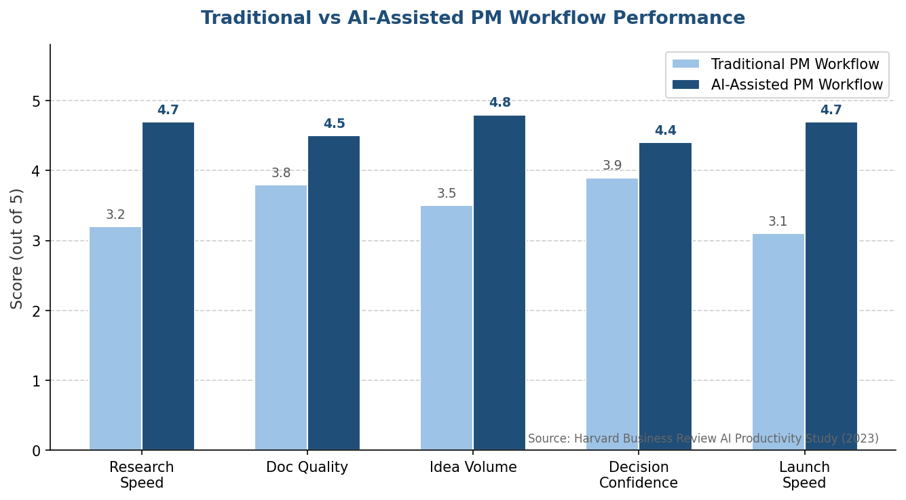
The best way to do things is usually when you use computers to help the Product Manager do their job. The computers do not make the important decisions about the product. This way the Product Manager and the computers work together so things get done faster without making mistakes or losing quality. The Product Manager and the computers, like the Product Manager and the computers work together to make sure the product is good.
Best Practices
- We should use AI to help with tasks but not to make final decisions. Our strategy still needs judgment, knowledge of the market and understanding of our customers.
- When using AI we need to give it clear information. We should tell it who our audience is, what we want to achieve and how we want the output to look. This way the output is more helpful and not too general.
- We need to check and improve everything AI produces. AI can give us first drafts but we should verify that the information is accurate adjust priorities as needed and make sure the output aligns with our business goals.
- AI should be a part of our workflow, from the start not something we add later. We get the benefits when we use AI consistently throughout the discovery, planning and launch phases.
Common Mistakes to Avoid
- When you use intelligence without giving it some background information, the things it comes up with will not be very clear.
- You should not have much faith in artificial intelligence. Always make sure to check what artificial intelligence comes up with against the information you have what your company wants to achieve and if it is possible to do.
- Some people think artificial intelligence is only good for writing. Artificial intelligence can do a lot more than that. It can help put things figure out what is most important come up with new ideas and help you make decisions faster.
- It is not an idea to ignore the ethical issues and accuracy when you use artificial intelligence to make products. You have to be careful, about peoples privacy making sure artificial intelligence is fair and checking that it does not come up with things that’re not true when you use it to make products.
Frequently Asked Questions
Q1:Can product managers use AI every day?
They can use it to help with research and planning and writing documents and coming up with ideas and supporting launches on a basis. Product managers can use AI daily to help with their work.
Q2:Will AI replace the job of product managers?
No it will not. AI can speed up the work that product managers do. Product managers still need to understand the context and use their judgment and lead people from different teams. The World Economic Forums Future of Jobs Report from 2023 says that the number of product manager roles will actually increase as more companies use AI.
Q3:What is the best way for product managers to use AI?
Product managers can use AI to look at customer feedback and write product requirement documents. These are two ways for product managers to start using AI because they can save time and get good results. Customer feedback synthesis and product requirement document drafting are two of the impactful starting points for product managers to use AI.
Q4:Do product managers need to know how to write prompts for AI?
Yes they do. If product managers write prompts they will get better results from the AI especially when they are working on structured product work. Writing prompts is a key skill that product managers need to have and programs, like OneLeap can help them learn this skill.
Q5:Can OneLeap help product managers learn about AI?
Yes it can. OneLeap is designed for professionals who want to learn about AI in a way and think about how to use it in business. OneLeap teaches people about AI through product scenarios and hands-on learning, which helps them learn how to use AI for product work. OneLeap can help product managers learn the AI skills they need for product work.
Final Summary
Generative AI helps product managers create products. It speeds up research makes idea generation easier simplifies documentation and supports launch work.
Product managers use AI as a helper throughout the product lifecycle.. They still use their own judgment for strategy and prioritization.
The numbers show that more teams are using AI. They save a lot of time. Teams that use AI workflows do better, than those that do not.
For product managers who want to stay knowing AI is now a must. It is a skill they need to have.
Sources
2. Gartner

Leave a Reply