
Your complete roadmap from Python basics to production AI systems
Introduction
Becoming an AI engineer is a step by step process. It starts with learning programming basics. You need to understand the fundamentals. Then you move on to machine learning and deep learning.
The next steps are:
* Building AI products
* Creating retrieval systems
* Developing agents
* Deploying systems
* Working on portfolio projects
In 2026 AI engineering is not about writing isolated code. It is, about creating systems that solve problems. These systems help businesses and users. A good way to become an AI engineer is to follow a learning path. This path should be project driven. It helps you grow from a beginner to an AI engineer. You learn by working on projects and These projects help you build a portfolio. You also get to deploy your systems. That is how you become an AI engineer. You keep improving your skills. You keep working on projects and that is the way to grow..
The AI Engineering Opportunity
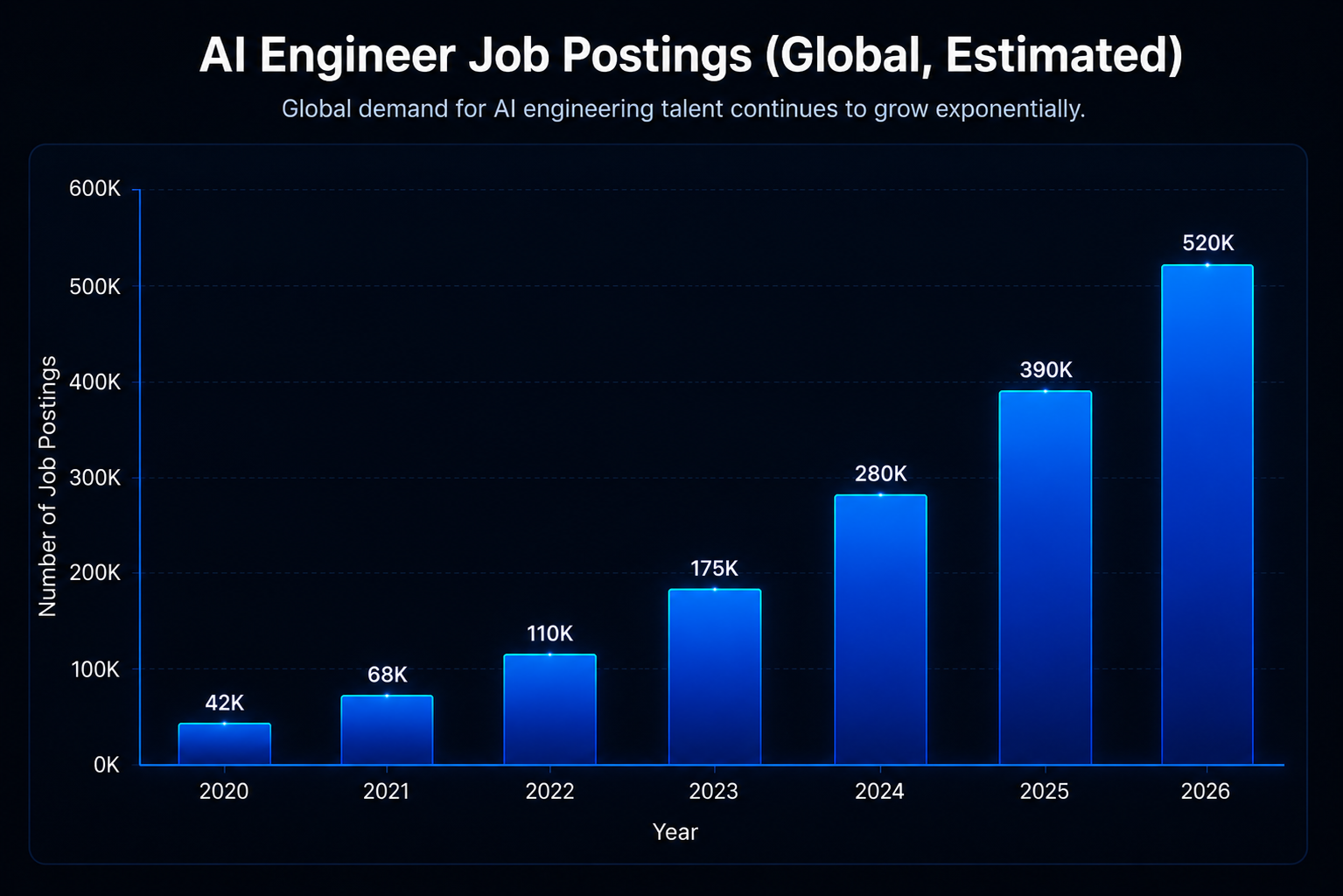
The demand for AI engineers has exploded globally. Below is the projected growth in AI job postings worldwide:

Key Takeaways
• Software Start with Python and Git and APIs and backend basics.
• Machine Learning Foundations: Study supervised learning and unsupervised learning and deep learning to understand how models behave.
• Prompt Engineering and RAG: Build applications with Large Language Model APIs and add Retrieval Augmented Generation for knowledge retrieval.
• Agents: Learn about multi-step agent frameworks like LangGraph after you have learned the basics of Machine Learning Foundations.
• Project-Driven: Build projects at every stage to prove your skills in Machine Learning Foundations and Prompt Engineering and Agents.
• Production Tools: Use tools like FastAPI and Docker and LangChain and LlamaIndex and vector databases to build and ship AI systems.
• The Goal: The goal is to design and build and ship AI systems that can be used by people.
• Follow a Structured Roadmap: A program, like OneLeap‘s AI Engineering Mastery can help you progress from beginner to AI Engineer through hands-on projects and tools that are used in the industry.
Table of Contents
- What AI Engineering Means
- How the learning oath works
- Core Components of AI Engineering
- Tools and Technologies You Need
- Real-World Examples
- Comparison:AI Engineer vs ML Engineer
- Best Practices for Learning
- Common Mistakes to Avoid
- FAQS
- Final Summary and Course Recommendation
What AI Engineering Means
An AI engineer is a person who builds things using intelligence models and other tools. They make applications that people can actually use. This is different from a job that’s all about research. AI engineers take intelligence and turn it into things that work in everyday life.
When you want to learn about intelligence it is a good idea to take it one step at a time. You do not have to learn everything all at. You can start with the basics of software then move on to machine learning basics, artificial intelligence applications and so on. The steps are clear: you learn about software then machine learning, artificial intelligence apps and other things like RAG and agents and finally how to deploy your projects and work on actual projects, with artificial intelligence.
How the Learning Path Works
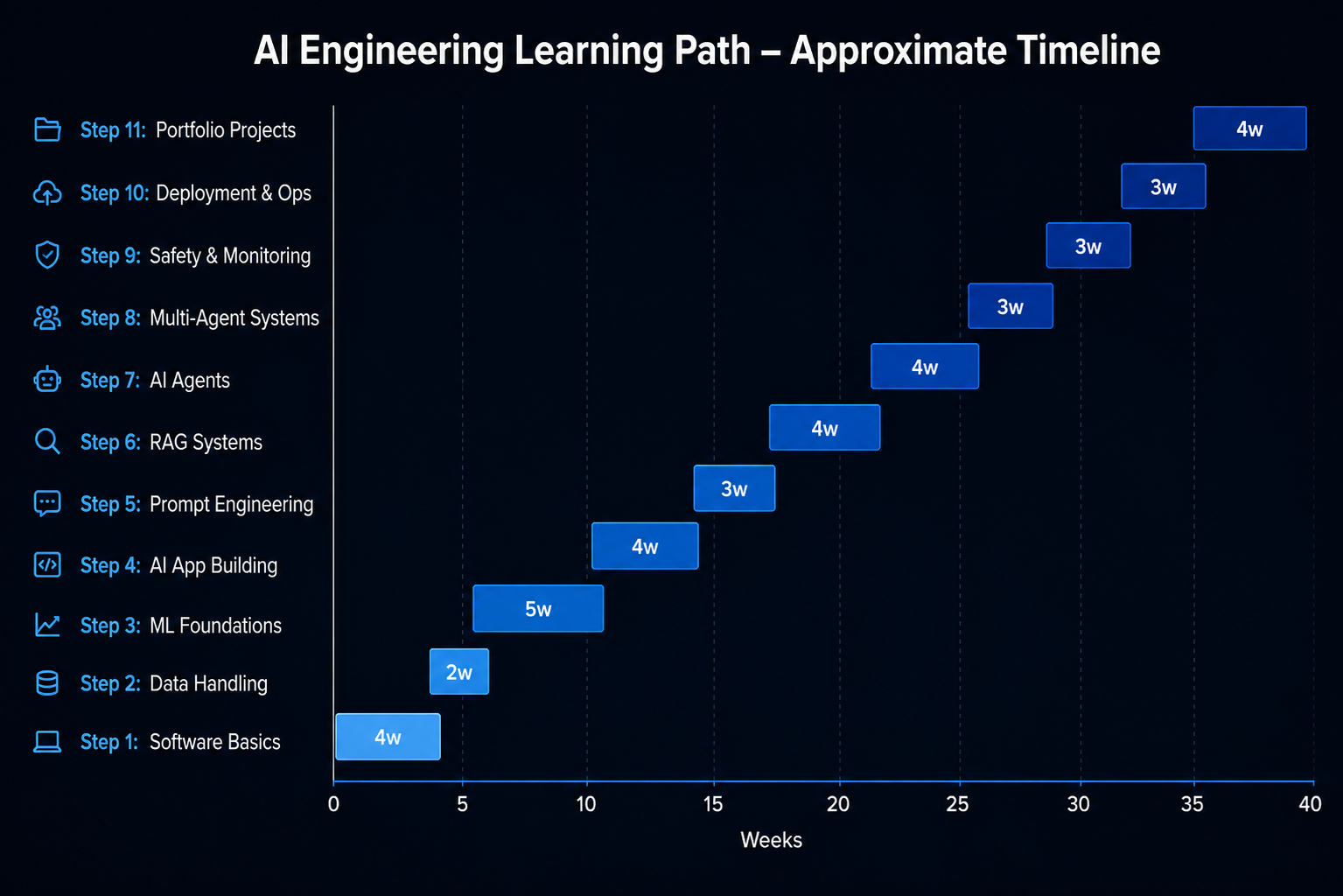
The path has 11 steps. Each step is built on the one. This helps you learn the skills in an order.
The goal is to get you ready to develop AI that works in real-life situations. Each stage teaches you something on top of what you learned before. This way you can be sure you have a foundation. The steps are a journey, not a list of things to learn..
Step-by-Step Breakdown
Step 1: Learn Programming Basics
Let us start with Python. We will also look at Git and how to use the command line. It is also important to understand coding logic. Python is an important language for people who work with artificial intelligence. Every tool and framework that people use for this work is based on Python. This means that Python is the language that most people, in this field use to communicate with each other. Python is used by every tool and framework that people use for artificial intelligence engineering.
Step 2: Understand Data Handling
You need to learn how to work with data and APIs and simple databases. This way you can move the data in and out of the applications. You should master Pandas and NumPy. Learn how to use REST APIs. This will help you to work with the data and the APIs and the simple databases. You will be able to move the data in and, out of the applications using Pandas and NumPy and REST APIs.
Step 3: Study Machine Learning Foundations
Move into learning about learning, unsupervised learning and model evaluation. You will also learn the basics of learning. Use scikit-learn and PyTorch for hands-on practice with learning and unsupervised learning. This will help you understand model evaluation and deep learning better. You will get to practice with scikit-learn and PyTorch. These tools are great, for learning learning, unsupervised learning and deep learning.
Step 4: Build Small AI Applications
Create tools that use artificial intelligence. These tools should use model APIs, what users give us and easy-to-use interfaces.
We can use FastAPI and Streamlit to turn models into applications. FastAPI helps to create APIs.
Streamlit helps to create interfaces. Here are some steps:
* Get a model API
* Get user input
* Create an interface with Streamlit
* Connect the model API to the interface, with FastAPI
This way we can turn models into real apps. These apps can use AI to do things. For example they can classify images. They can answer questions. We should make sure the tools are easy to use. The interfaces should be simple. The APIs should be fast. By doing this we can make AI more useful. More people can use AI-powered tools. These tools can make life easier..
Step 5: Learn Prompt Engineering and Evaluation
To get better at writing prompts you need to practice. You should also check if the answers you get are good and helpful. Checking to see if something is good is a part of being an engineer. So you should do it that way. Practice writing prompts and checking whether outputs are reliable and useful, for your projects like writing better prompts. Evaluation of your work is an engineering skill so you should treat evaluation of your prompts that way.
Step 6: Add Retrieval Systems (RAG)
To make your AI give answers you need to set up RAG workflows. This way your AI can look at documents, knowledge bases and internal files to find the information it needs. You can use tools like LlamaIndex, LangChain and special databases called vector databases, such, as Pinecone or Chroma to make this happen with your RAG workflows.
Step 7: Move to AI Agents
To get started with intelligence you need to learn how to use tools and plan things out. This includes learning about functions and how to call them and also understanding frameworks. These frameworks are really important because they let intelligence complete tasks that have many steps. You should take a look, at LangGraph and the OpenAI Agents SDK to see how they work. Artificial intelligence can do a lot of things with these tools so it is worth learning about them. The OpenAI Agents SDK and LangGraph are places to start when you want to learn about artificial intelligence and how it can complete multi-step tasks.
Step 8: Work with Multi-Agent Systems
Understand how many agents can work together on one workflow. They divide tasks among themselves. Agents also pass messages to each other. This helps them achieve goals that are hard to accomplish alone. Agents cooperate by sharing work. For example one agent does a task then sends a message to another agent. The second agent does another task. They keep doing this until the workflow’s complete. By working agents can do complex things. They break down a goal, into smaller tasks. Each agent does one or more tasks. Agents talk to each other to make sure everything gets done. This way they achieve goals.
Step 9: Learn Safety and Monitoring
To make sure things work well in production we need to use validation and guardrails. We also need to be able to see what is going on so observability is important.. We should have a human review everything.
Tracing and logging are things we must have in systems. We cannot do without them. This is because tracing and logging help us understand what is happening in our production systems.
Step 10: Deploy and Optimize
You can put your system together send it out keep an eye on it and make it faster and more cost effective using Docker, Kubernetes and cloud platforms. You use these things to make your system better. Docker, Kubernetes and cloud platforms help you do all these things.You can make your system go faster and not cost much money.
Step 11: Build a Strong Portfolio
To really show what you can do finish up some projects that prove you are able to build Artificial Intelligence systems. Do not just follow the steps, in some tutorial.
Make sure you put all of your projects on GitHub.
* Make sure each project has a README that explains what the project is about
* Make sure each project has a clear README that explains how to use it.
Core Components of AI Engineering
| Component | What It Covers |
| Software Basics | Python, Git, APIs, command line |
| ML Foundations | Core algorithms, model evaluation, learning concepts |
| AI App Development | Frontend, backend, APIs, database integration |
| RAG Systems | Retrieval, embeddings, knowledge search, memory |
| Agents | Planning, tool use, function calling, workflow automation |
| Multi-Agent Orchestration | Coordination, messaging, task division |
| Safety & Observability | Guardrails, validation, monitoring, human-in-loop |
| Deployment | Docker, Kubernetes, FastAPI, optimization |
| Portfolio Projects | End-to-end systems that show practical skill |
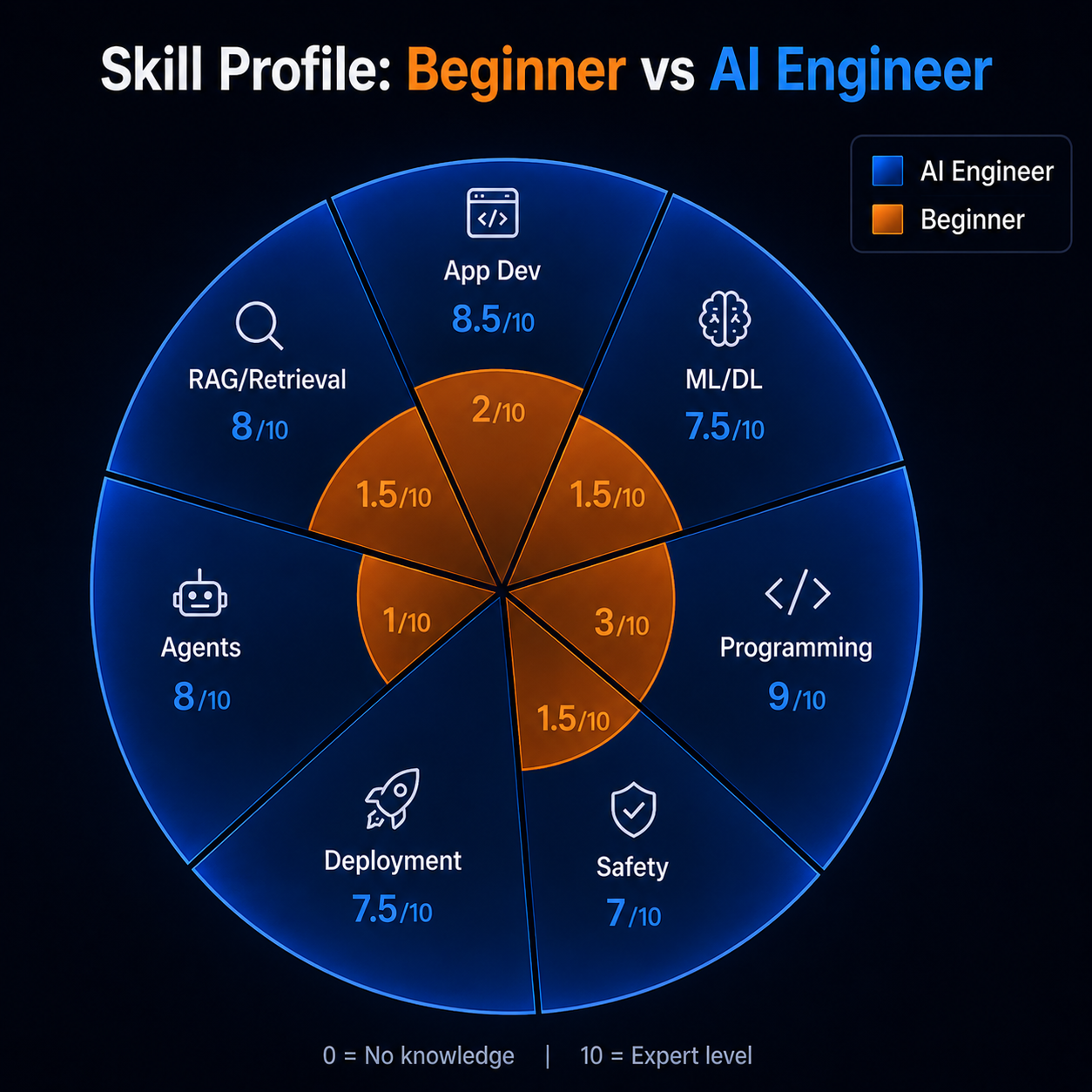
Skill Profile: Beginner vs AI Engineer
Tools and Technologies You Need
| Area | Tools and Technologies |
| Programming | Python |
| Data Handling | Pandas, NumPy |
| ML / DL | Scikit-learn, PyTorch, TensorFlow, Transformers |
| AI APIs | OpenAI, Claude (Anthropic) |
| App Development | FastAPI, Streamlit, Gradio |
| Retrieval | LlamaIndex, LangChain, Chroma, Pinecone, FAISS, Weaviate |
| Agents | LangGraph, OpenAI Agents SDK, Claude Agent SDK, MCP |
| Fine-tuning | PEFT, LoRA |
| MLOps | MLflow, Weights & Biases |
| Deployment | Docker, Kubernetes, vLLM, TensorRT |
| Cloud | Azure, Google Cloud Platform, AWS |
| Visual AI | Stable Diffusion, DALL·E |
Real-World Examples
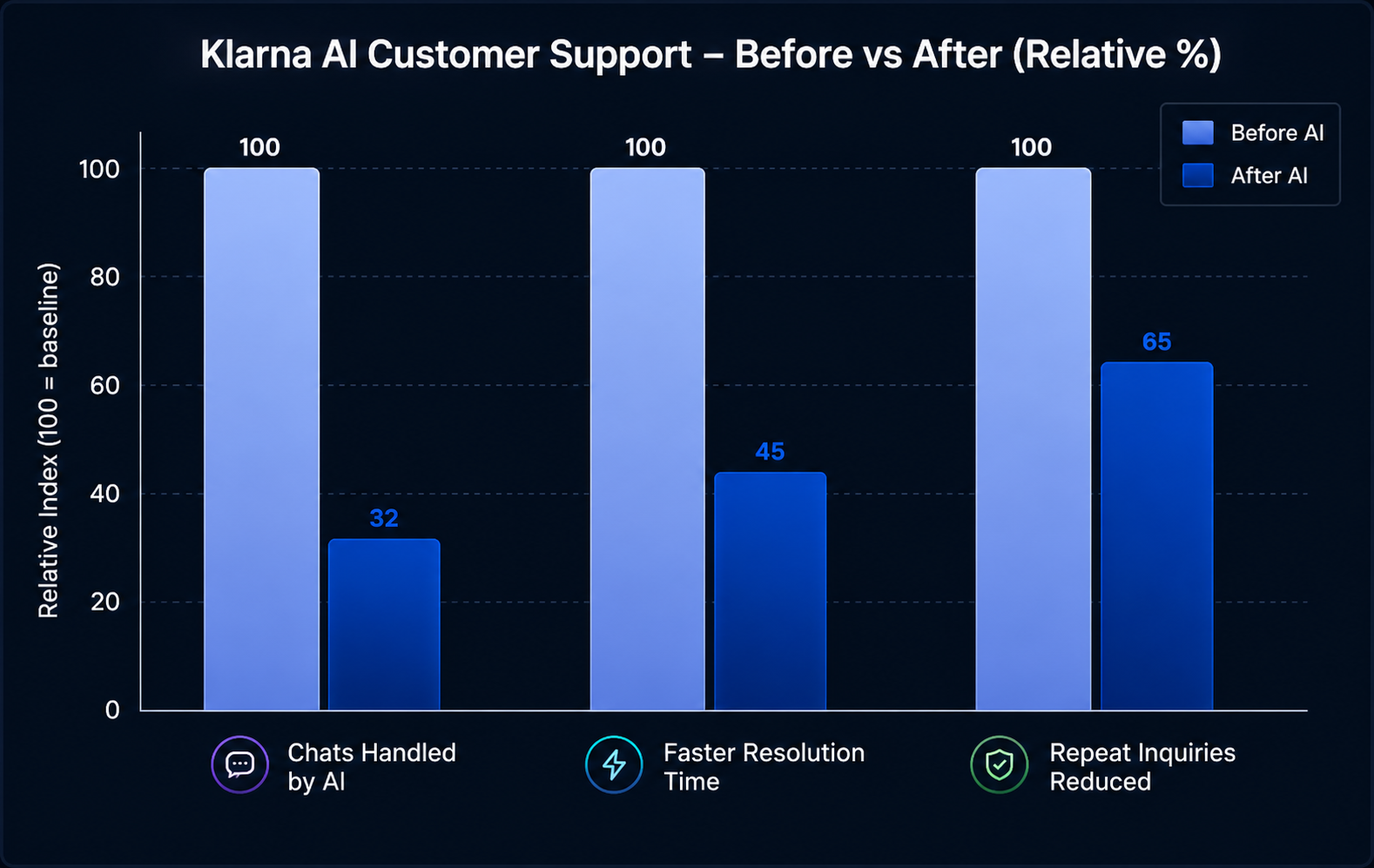
1. Klarna’s AI Customer Support Assistant
Problem: Klarna had to deal with a number of customer service chats in a better way.
Solution: They brought in a chatbot to give answers to questions that customers ask a lot and make it easier, on human customer support teams.
Result: The chatbot took care of two-thirds of the chats got things sorted out quicker and cut down on customers asking the questions over and over.
2. GitHub Copilot in Developer Workflows
Problem: Developers waste a lot of time on coding tasks like writing the same code over and over and doing routine tasks, for pull requests.
Solution: GitHub Copilot helps developers by suggesting code and making everyday programming tasks easier.
Result: Studies that were carefully controlled showed that developers got more done with pull requests and found GitHub Copilot to be really useful.
3. Enterprise Document Q&A Systems
Problem: Companies have a time looking through big piles of contracts, policies, manuals and reports by hand.
Solution: Systems that use intelligence to answer questions, from documents can find the information people need and process it.
Result: This means that teams can find what they are looking for faster they do not have to handle documents by hand much and companies can get work done more efficiently. Teams can work better when they use these document question and answer systems because document question and answer systems help teams to get the information they need from contracts, policies, manuals and reports.
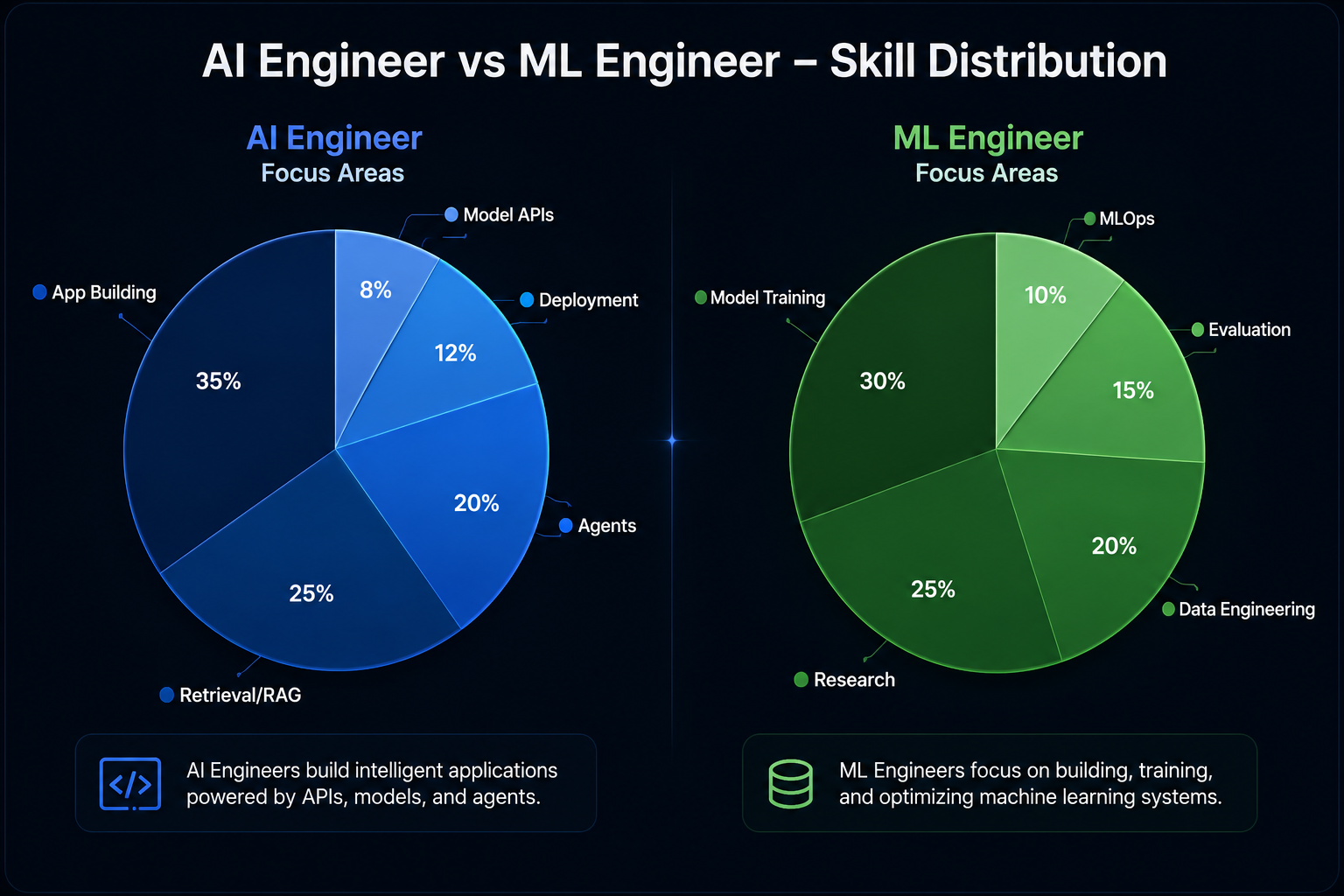
Comparison: AI Engineer vs ML Engineer
| Aspect | Beginner Approach | AI Engineer Path |
| Learning style | Random tutorials | Structured roadmap |
| Focus | Isolated tools | End-to-end systems |
| Skill growth | Theory-heavy | Project-driven |
| Portfolio | Few examples | Real deployable projects |
| Career outcome | AI awareness | Job-ready engineering ability |
Best Practices for Learning
- When you start focus on Python and the basics of software first. This is important before you move on to intelligence frameworks.
- Building things is a way to learn so try to make small projects after each stage of your learning process.
- Evaluating things is a skill do not think of it as something you can do later it is essential to learn and practice evaluation as you go along.
- It is better to understand RAG well before you try to learn about advanced agent systems.
- You should learn about deployment and monitoring on this will help you understand what it takes to get your projects ready, for production.
- Having a portfolio is a good idea use it to share your code, demos and notes with others.
- Safety is very important so make sure to use guardrails and have a review your work especially when it comes to safety-sensitive workflows.
- It is more important to make projects that’re clear and useful rather than trying to make flashy demos that do not really do much.
Common Mistakes to Avoid
• I think it is an idea to start with advanced agents before you even learn Python and APIs. You should learn the basics of Python and APIs first then you can move on to agents.
• Some people watch a lot of tutorials. They do not actually build anything. This is not a way to learn you need to practice what you learn by building projects with Python and APIs.
• I have seen people ignore RAG and retrieval fundamentals, which’s a big mistake. RAG and retrieval fundamentals are very important so you should make sure you understand them before you move on to things like advanced agents.
• Another mistake people make is treating deployment as an afterthought. Deployment is an important step it is not something you should think about later you should think about it from the beginning when you are building your project with Python and APIs.
• Some people think that AI engineering is about prompting, which is not true. AI engineering is a lot of things including RAG and retrieval fundamentals, deployment and building projects, with Python and APIs.
• Not showing your projects publicly in a portfolio is also an idea. You should show your projects publicly so people can see what you have built with Python and APIs. You can get feedback from them.
Frequently Asked Questions
Q1: How do I start becoming an AI engineer?
To start becoming an AI engineer you should start with Python, Git, APIs and basic software development. Then you can move into machine learning AI applications, RAG, agents and deployment. This is the path to follow. AI engineer is what you want to become so you have to follow these steps.
Q2: Do I need math first?
You do not need math at the beginning of your journey to become an AI engineer. What matters early on is practical programming and system-building. However you should still learn the core machine learning concepts. AI engineer requires a lot of work.
Q3: What is the difference between AI engineering and ML engineering?
The difference between AI engineering and ML engineering is that AI engineering is more about building applications on top of models. On the hand ML engineering is more focused on training and improving models themselves. AI engineering and ML engineering are. They are different.
Q4: Which tools should beginners learn first?
Beginners should learn Python, FastAPI, Pandas, LangChain and a vector database first. These are strong starting points for anyone who wants to become an AI engineer. AI engineer uses these tools every day.
Q5: What projects should I build for my portfolio?
You should build a RAG app, a document Q&A tool, an AI assistant and an end-to-end deployed AI system. These projects are great for your portfolio, as an AI engineer. AI engineer needs to have a portfolio to showcase their skills.
Final Summary and Course Recommendation
To become an AI engineer you should follow a path. First you need to learn the basics of software. Then you need to learn about machine learning foundations. After that you can learn about AI applications. You also need to learn about retrieval systems, agents, safety, deployment and projects.
This way of learning is good because it is similar to how real AI systems are built in the industry. For example companies like Klarna, GitHub Copilot and document Q&A systems are using AI engineering to solve problems. AI engineering is really helping to solve these problems. The AI engineer path is clear. It helps you to become a good AI engineer by learning AI applications and retrieval systems and agents and safety and deployment and projects. AI engineer is a job that needs to be learned step, by step starting with software basics machine learning foundations then AI applications.
Course Recommendation
OneLeap‘s AI Engineering Mastery fits this journey well because it covers the full progression from foundations to deployed AI systems. It is a structured, project-driven program that matches the exact sequence described in this guide.
Stay updated with the latest AI, Data Science, and Automation insights by following OneLeap on LinkedIn and Instagram.

Leave a Reply