
Introduction
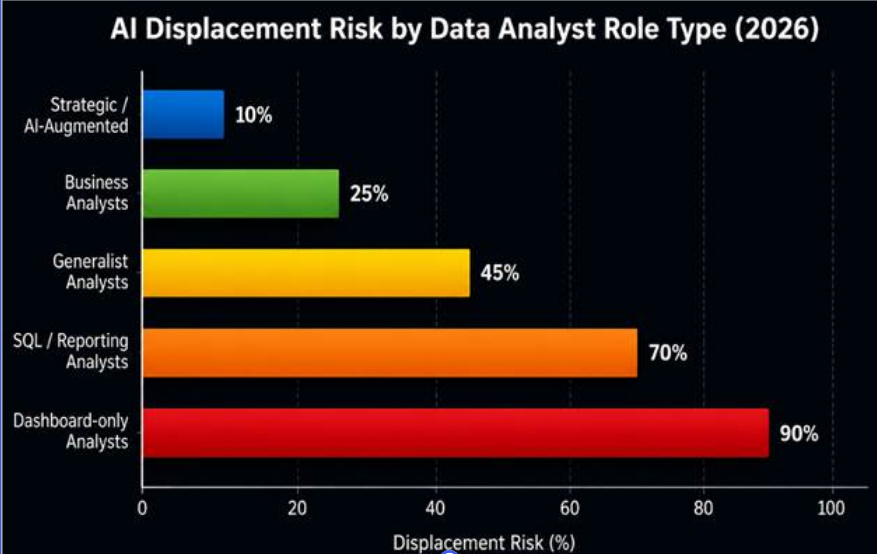
No, AI will not replace data analysts in 2026. AI is replacing data analyst role by automating everyday tasks data such as cleaning, creating dashboards and basic querying. Data analysts who learn AI tools and focus on interpreting data, business problems and complex problem solving will remain highly valuable. Meanwhile, analysts who only create dashboards with no knowledge of deeper insights are at high risk.
Key Insight
The main career risk for data analysts in 2026 is not AI,it is not adapting to AI powered workflows when the rest of the industry moves forward.
Key Takeaways
•Artificial Intelligence will not take the place of data analysts. It will do the boring tasks like writing SQL and looking at data to see what it says
•Jobs that might be in trouble are those where analysts only make reports and answer simple questions without really thinking about what the data means
•Safe jobs are those where analysts ask good questions understand what the business is trying to do and can do complicated analyses with a lot of information
•To keep your job you should learn about Artificial Intelligence tools understand how the business works focus on figuring out what the data really means and work on your own projects to show what you can do
•The important skills you will need by 2026 are being good with technology like SQL and Python being good with people and understanding the business and knowing about Artificial Intelligence
•OneLeap thinks you should take their Strategic Data Analyst with AI course to make sure you have a job, in the future
Table of Contents
1. Why AI Is Changing Data Analytics in 2026
2. How It Works: AI-Augmented Analytics Workflow
3. Core Components of AI-Augmented Analytics
4. Essential Tools & Technologies for Data Analysts in 2026
5. Real-World Examples of AI in Analytics
6. Traditional vs AI-Augmented Analysis: A Comparison Top Skills Data Analysts Need in 2026
7. Best Practices to Stay Relevant in the AI Era
8.Skills required
9. Common Mistakes to Avoid
10.Frequently Asked Questions
11. Final Summary
Why AI Is Changing Data Analytics in 2026
The shift to AI-augmented analytics is not a distant future—it is happening right now. Here is what it means for you:
| Aspect | Impact |
| Efficiency | AI reduces time spent on routine tasks by 40–60%, freeing analysts for strategic work |
| Decision Quality | AI identifies patterns humans might miss, but analysts interpret context and business implications |
| Competitive Advantage | Companies using AI-augmented analytics make faster, data-driven decisions |
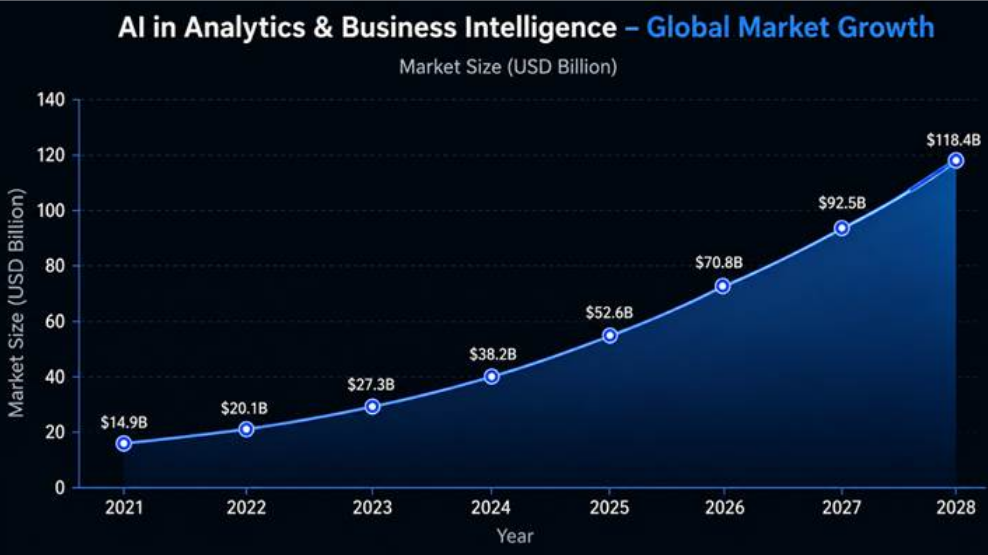
| Career Security | Analysts who adapt to AI workflows become more valuable, not less |
| Skill Evolution | The definition of an effective data analyst is changing significantly in 2026 |
How It Works: AI-Augmented Analytics Workflow
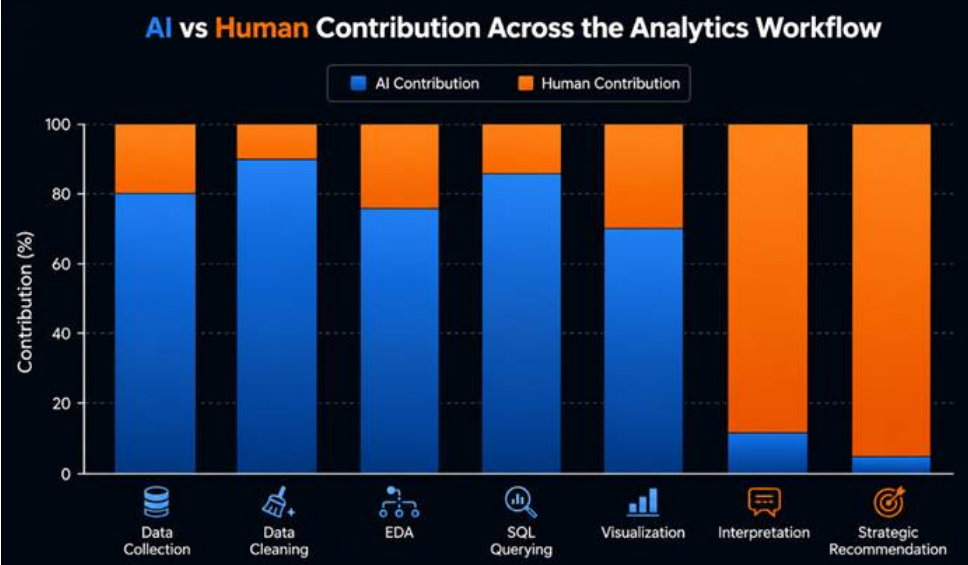
The modern analytics pipeline splits effort between AI and human intelligence:
1. Data Collection. The system automatically connects to different sources and takes out information like metadata.
2. Data Cleaning. The system removes copies of the thing fills in missing information makes sure everything is in the same format and points out things that do not seem right.
3. Exploratory Analysis. The system makes summaries of the data shows how things are related to each other and makes graphs to show how the data is spread out.
4. Natural Language to SQL. The system changes questions that people can understand into special codes that the computer can understand.
5. Visualization. The system suggests the best type of graph to use and automatically makes dashboards that are easy to look at.
6. Predictive Modeling. The system picks the way to make predictions uses old data to learn and then makes guesses about what will happen in the future.
7. Human Interpretation. A person who knows about the business looks at what the system found and adds their understanding of what it means figures out if two things are just related or if one actually causes the other and makes sure the systems findings are correct.
8. Recommendations. The person who knows about the business takes what they learned and turns it into a plan that the business can use.
9. Reporting. The system makes a summary of the main points and the person who knows about the business makes sure the information is presented in a way that is easy for the people, in charge to understand.
Core Components of AI-Augmented Analytics
Understanding the six major components helps you know where to focus your learning:
| Component | What It Does | Human Role |
| Automated Data Prep | Cleans, transforms, and prepares data | Validate quality, handle edge cases |
| Natural Language Querying | Converts questions to SQL/code | Pose insightful business questions |
| Intelligent Visualization | Recommends chart types, creates dashboards | Choose meaningful visuals, add context |
| Predictive Modeling | Builds ML models for forecasting | Interpret results, validate assumptions |
| Pattern Recognition | Identifies trends in high-dimensional data | Explain business implications |
| Insight Generation | Flags anomalies and correlations | Determine significance and actionability |
Master These at OneLeap : The Strategic Data Analyst with AI course covers automated data preparation, natural language querying, and predictive modeling with hands-on projects. Join the next cohort in Dehradun.
Tools & Technologies You Need in 2026
| Category | Tools |
| AI-Powered SQL | ChatSQL, DataGrip AI, AI Query Builders |
| Visualization with AI | Power BI Copilot, Plotly AI, Tableau AI |
| Data Preparation | Trifacta, Alteryx, Pandera AI |
| Machine Learning | Python (scikit-learn, TensorFlow), Google AutoML |
| Natural Language Querying | AskData, Wolfram Alpha, Internal AI query tools |
| Analytics Platforms | Google Analytics 4, Adobe Analytics, Snowflake |
| Programming | Python, SQL (still essential) |
Real Examples
7.1 Klarna : AI Is Taking Over Routine Analysis
In the years 2024 to 2025 Klarna talked about using AI for customer service and internal work. Before analysts spent a lot of time making reports and getting insights from dashboards by hand. Now AI makes summaries. Answers questions about data right away. The main thing to remember is that AI is replacing the work of making reports over and over. But it is not replacing the analysts who understand the insights and give advice to the business.
7.2 Microsoft Copilot And Power BI
Microsoft added AI to Power BI with Copilot. Before analysts made dashboards wrote formulas and made summaries by hand. Now users can ask questions like “Why did sales go down in the quarter?”. Copilot gives them answers automatically. The work that is being automated is making dashboards. Doing basic analysis. The work that is being elevated is making strategic decisions.
7.3 Netflix: Human Decisions Are Still Important
Netflix uses a lot of AI and analytics. AI predicts what users might watch and which content is better.. Humans still decide which shows get money make content plans and decide which markets to go into. The pattern is clear: AI gives recommendations. Humans make business decisions about Netflix.
7.4 Amazon: Forecasting On A Big Scale
Amazon uses AI to predict demand predict inventory and make supply chains better. Analysts who only make forecasts, update spreadsheets or do calculations over and over are in danger of losing their jobs.. Analysts who check assumptions understand anomalies and recommend actions are still very important, to Amazon.
Comparison: Traditional vs. AI-Augmented Analysis
| Aspect | Traditional Analysis | AI-Augmented Analysis |
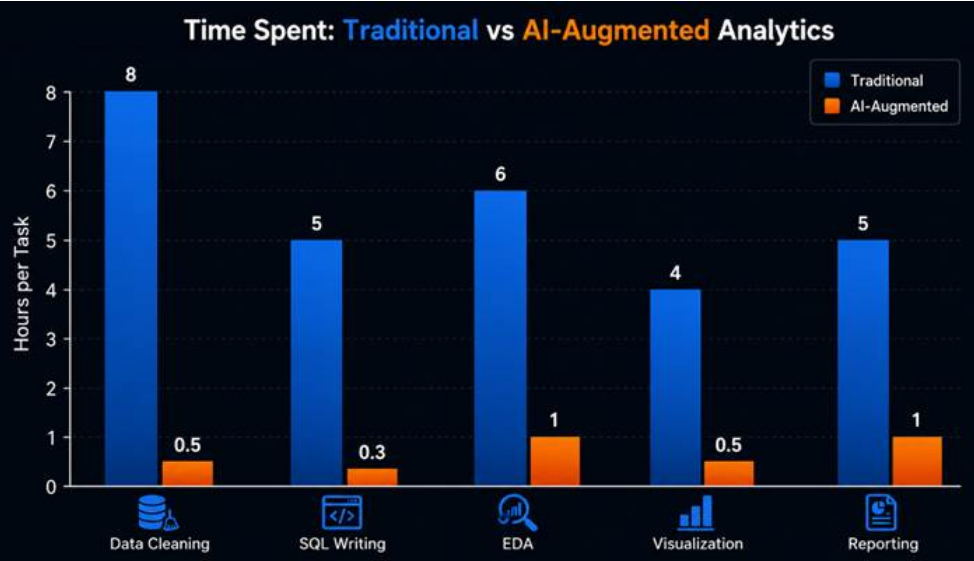
| Data Cleaning | Manual, hours to days | Automated, minutes |
| SQL Writing | Manual coding required | AI generates from natural language |
| Exploratory Analysis | Analyst performs manually | AI completes preliminary EDA |
| Visualization | Manual chart selection | AI suggests optimal visuals |
| Time per Project | 2–4 weeks | 1–2 weeks |
| Analyst Focus | Technical execution | Strategic interpretation |
| Skill Requirement | SQL, visualization tools | SQL + AI tools + business acumen |
| Accuracy | 60–75% (human error possible) | 85–96% (consistent algorithms) |
| Scalability | Limited by team size | Handles 10x+ data volume |
| Cost | Higher (more analysts needed) | Lower (automation reduces labor) |
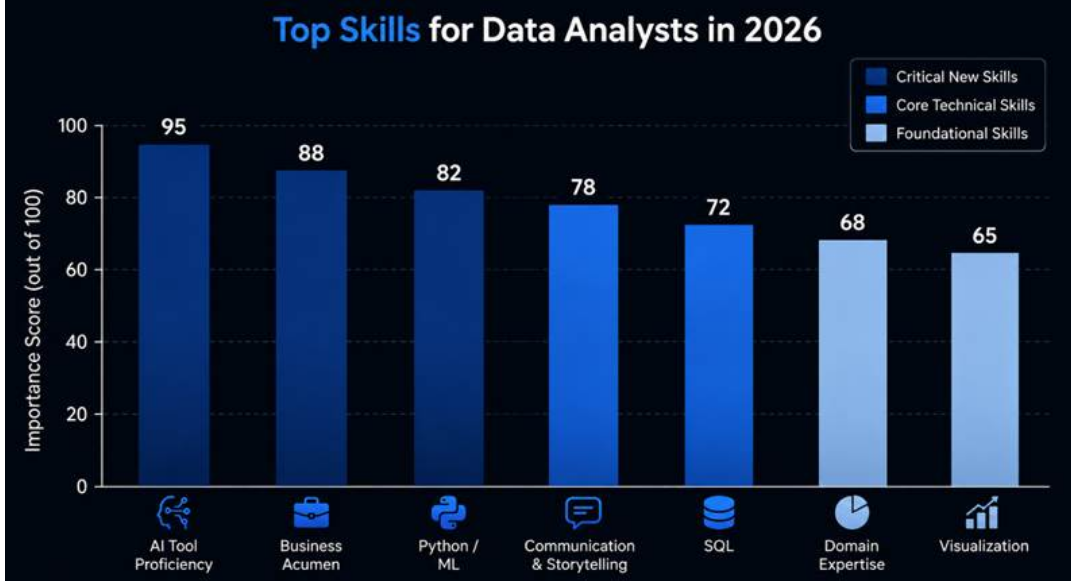
Skills That Will Define Data Analysts in 2026
Best Practices to Stay Relevant
- Learn Artificial Intelligence Tools Away: Do not wait start using Artificial Intelligence tools before the people you are competing with do
- Pay Attention To Getting Insights: Go past just making dashboards and do a deeper analysis of the information
- Learn About Business: Understand the situation and the important numbers and problems in your line of work
- Get Good At Working With People: Build friendships with the people in charge and explain the insights in a clear way
- Make A Collection Of Your Work: Create projects that show you can do analysis with the help of Artificial Intelligence
- Learn Python And Machine Learning: It is very important to understand the basics of machine learning
- Keep Asking Questions: Always ask yourself why something is happening with the data not just what is happening
- Become An Expert: Focus on doing analysis in areas where people can do things that computers cannot
- Get A Certificate: Try to get a certificate that people recognise you can start with the programme at OneLeap Dehradun
Common Mistakes to Avoid
| Mistake | Why It’s Dangerous | Better Alternative |
| Only creating dashboards | AI can do this faster; you’ll be sidelined | Add deeper analysis and strategic recommendations |
| Ignoring AI tools | You’ll be at a huge disadvantage | Learn AI tools immediately |
| Focusing only on SQL | AI generates SQL from natural language | Focus on posing insightful questions |
| Skipping business context | Insights without context are useless | Understand your industry’s business model |
| Not building portfolio | Hard to prove skills without examples | Create 3–5 AI-augmented projects |
| Avoiding ML/AI learning | You’ll miss critical skill evolution | Learn Python and ML fundamentals |
| Working alone | Isolation reduces career mobility | Build stakeholder relationships |
| Staying in generic roles | Standardised analysis is high-risk | Specialise in custom, research-heavy work |
Frequently Asked Questions
Q1: Will artificial intelligence completely replace data analysts by 2026?
No artificial intelligence will not completely replace data analysts. Data analysts will still be needed to do things that artificial intelligence cannot do. Data analysts are still needed to look at findings and ask good questions.
Q2: Which data analyst jobs are at risk of being replaced?
Data analysts who only make reports and answer questions without really thinking about what the data means will be replaced. If a data analyst only makes reports they have a very high chance of losing their job about 85 to 90 percent.
Q3: What skills will data analysts need to have in 2026?
Data analysts will need to know how to do a lot of things including working with databases using SQL, programming with Python making graphs and charts to show data doing statistics understanding how businesses work, managing people who need data using intelligence tools understanding the basics of machine learning knowing about the specific area they are working in and communicating well.
Q4: How time will artificial intelligence save data analysts?
Artificial intelligence will save data analysts a lot of time about 40 to 60 percent by doing routine tasks for them. This means data analysts will have time to think about important things.
Q5: Should I learn about intelligence before I become a data analyst?
Yes you should learn about intelligence. If you do not learn about intelligence you will be behind others who are learning about it. You should learn about intelligence at the same time you are learning about data analysis.
Q6: Is being a data analyst a good job in 2026?
Yes being a data analyst is still a job especially if you are willing to work with artificial intelligence. Data analysts who learn to work with intelligence will be very valuable and will keep their jobs.
Final Summary
- AI will not replace data analysts in 2026. It will change their job.
- The main difference is between analysts who only make dashboards and might lose their job and those who ask questions understand the business and do complicated analysis and are very valuable..
Stay updated with the latest AI, Data Science, and Automation insights by following OneLeap on LinkedIn and Instagram.

Leave a Reply