

AI has moved fast. Over the last few years, we went from predictive models to generative AI that writes code, summarizes documents, and drafts emails. But the next shift is different in kind, not just degree. Agentic AI doesn’t just respond to prompts it takes action. It plans, executes, evaluates results, and retries. And if you’re in software engineering, IT operations, or platform architecture, it’s already heading toward your backlog.
This blog gives you a technically grounded picture of how agentic AI systems are built, what they’re actually being used for in enterprise environments, and what the data says about where adoption stands today without requiring you to wade through vendor marketing.
The Market Reality: Hype Meets Hard Numbers
Before diving into architecture, it helps to understand where the industry actually stands. According to McKinsey’s 2025 State of AI report, 62% of organizations are at least experimenting with AI agents but only 23% have begun scaling an agentic system in even one business function. Most are still in proof-of-concept territory.
Gartner adds useful context from the other direction: they predict over 40% of agentic AI projects will be canceled by the end of 2027, citing escalating costs, unclear ROI, and inadequate risk controls. These aren’t reasons to ignore the technology they’re reasons to approach it with engineering discipline rather than enthusiasm alone.
On the growth side, Gartner projects that 40% of enterprise applications will integrate task-specific AI agents by the end of 2026, up from less than 5% today. McKinsey estimates that 92% of firms plan to increase their AI budgets within the next three years. The window to build informed judgment on this technology before it appears in your organization’s roadmap is narrowing.
What Agentic AI Actually Is (And What It Isn’t)
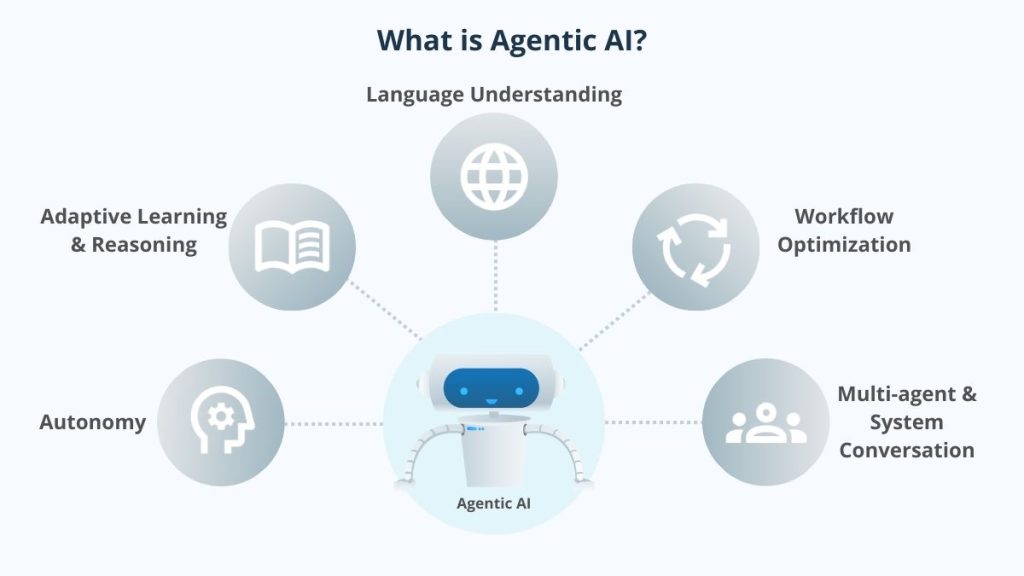
A standard LLM interaction is stateless and reactive: you send a prompt, you get a response, the loop ends. An agentic system is different in three fundamental ways:
- It pursues a goal across multiple steps, not just a single response.
- It uses tools APIs, databases, code executors, web search to take actions in real systems.
- It evaluates its own outputs, detects failures, and retries or adjusts strategy.
One important term to know: “agentwashing.” Gartner has flagged this explicitly it’s the practice of relabeling existing chatbots, RPA workflows, or simple AI assistants as “agents” without the underlying capability to plan, act, and self-correct. When evaluating vendor offerings, ask whether the system can actually decompose a goal into sub-tasks, execute those tasks against live systems, and handle failure gracefully. Most cannot.
How Agentic Systems Are Built: The Architecture Layer by Layer
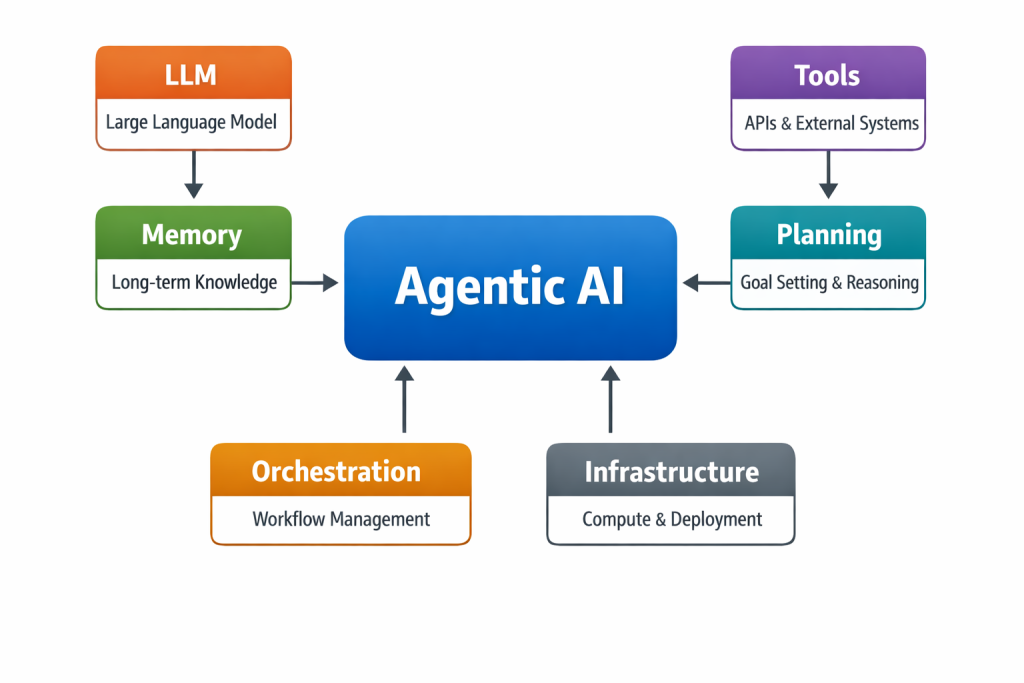
Understanding the technical components helps you assess what’s actually under the hood in any agentic product or internal project.
The Reasoning Engine (LLM)
The large language model serves as the agent’s brain it interprets goals, decomposes them into steps, selects which tools to invoke, and interprets results. The quality of the LLM determines how well the agent handles ambiguity, recovers from errors, and handles edge cases it wasn’t explicitly designed for.
Memory Architecture
Memory in agentic systems works in layers. Short-term (in-context) memory holds the current task state and recent tool outputs. Vector-based retrieval memory lets agents pull from large knowledge bases without stuffing everything into a single prompt. Long-term persistent memory, stored in databases, allows agents to remember decisions across sessions critical for workflows that span hours or days. How these layers interact is one of the most actively evolving design problems in the field.
Tool & API Integration
Agents interact with real systems through tool calls structured function invocations that trigger actions in external APIs, databases, or services. The emerging standard here is Anthropic’s Model Context Protocol (MCP), which has become the de facto interface for connecting agents to tools and data sources. Think of it as a USB-C standard for AI: it allows any agent to connect to any tool without custom integration code, and it’s now supported across most major agent frameworks.
Orchestration Patterns
This is where architecture gets interesting. There are three dominant patterns in production systems today:
- Reactive agent: A single agent with tools. It receives a task, decides which tools to call, executes them in sequence, and returns a result. Good for well-scoped, single-domain tasks.
- Planner-executor: A planning agent decomposes a goal into sub-tasks, and executor agents carry them out. The planner evaluates results and adjusts the plan dynamically. Suited for complex, multi-step workflows.
- Multi-agent supervisor: A supervisor agent coordinates multiple specialized sub-agents (e.g., one for research, one for code generation, one for testing). Each sub-agent has narrow scope; the supervisor routes tasks, merges outputs, and handles escalation. This is the architecture behind most enterprise-grade deployments today.
The dominant framework for implementing these patterns is LangGraph, which uses a directed graph model where nodes are agents or tools, edges define execution flow, and shared state persists across steps. It supports cycles (agents can loop), conditional branching, and human-in-the-loop checkpoints. As of late 2025, it’s in production at roughly 400 enterprises globally. CrewAI is a popular alternative for role-based multi-agent setups, and Microsoft’s Agent Framework (which merged AutoGen with Semantic Kernel) targets enterprise Azure deployments.
Retrieval-Augmented Generation (RAG)
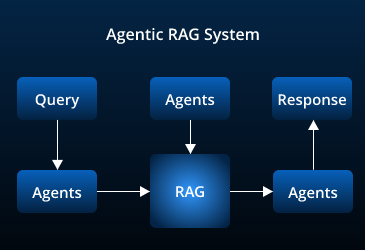
Most production agents don’t rely solely on model training data. RAG lets agents pull relevant, current information from enterprise knowledge bases before responding or acting. For IT teams, this means agents can be grounded in your internal documentation, runbooks, or ticketing history rather than hallucinating answers based on general training.
What Agentic AI Is Actually Doing in Enterprise Environments
The use cases vary significantly in maturity. Here’s where IT professionals are seeing the most traction:
IT Service Desk Automation
Agentic systems are handling L1 and L2 IT tickets end-to-end: a user requests access to a system, the agent verifies identity against directory services, checks approval policies, provisions access in the relevant SaaS platform, logs the action, and notifies the user without a human touching the ticket. This goes well beyond a chatbot that escalates to a human. McKinsey identifies IT and knowledge management as the functions with the highest current rate of agent deployment.
Software Development Pipelines
Coding agents are moving up the value chain. In addition to code generation, multi-agent systems are being deployed across the development lifecycle: one agent monitors CI/CD pipelines for failures, another analyzes the error logs and identifies the likely root cause, a third generates a candidate fix and opens a pull request, and a fourth runs the test suite and reports results. Engineers review and merge they don’t diagnose and patch. The task length an AI agent can handle with at least 50% success rate has been doubling every seven months, according to research cited by McKinsey.
Security Operations
Security teams are using agentic systems to accelerate threat triage. An agent monitors alerts, correlates events across SIEM logs, enriches indicators of compromise with threat intelligence APIs, and generates a prioritized incident summary with recommended remediation steps before a human analyst opens the ticket. The agent doesn’t make the final call; it compresses the investigation time from hours to minutes.
Data & Compliance Workflows
In financial services and healthcare, agents are being used to collect transaction or operational data from multiple systems, run rule-based and ML-based anomaly checks, generate structured compliance reports, and route findings to the appropriate stakeholders. Gartner predicts that by 2029, agentic AI will autonomously resolve 80% of common customer service interactions without human intervention the same design pattern applies to internal operational workflows.
The Risks You Need to Engineer Around
Agentic systems introduce failure modes that don’t exist in passive AI tools. The key ones to plan for:
- Runaway actions: An agent with broad permissions can propagate a bad decision across multiple systems before anyone notices. Implement least-privilege access for every agent, and design explicit human-in-the-loop checkpoints for high-stakes actions.
- Error propagation: A wrong output early in a multi-step workflow can cascade. Production-grade agentic systems require logging at each step, rollback capability, and validation gates between stages.
- Prompt injection: When agents browse the web, read emails, or process external documents, malicious content in those sources can attempt to hijack the agent’s instructions. This is an active attack surface with no complete solution yet.
- Governance gaps: When an agent takes an action that violates policy, who is accountable? Regulatory frameworks have not caught up. Build audit trails and define accountability structures before deploying agents with real-world access.
- Cost overruns: Multi-agent systems that loop, retry, and call external APIs can accumulate compute and API costs faster than teams expect. Instrument your pipelines early and set spending guardrails.
Where This Is Going
The near-term trajectory is toward interconnected agent ecosystems not single agents, but networks of specialized agents that collaborate across systems. The communication layer for this is maturing quickly. Google’s Agent-to-Agent (A2A) protocol, launched in 2025 and now governed under the Linux Foundation, enables agents from different vendors to discover each other and coordinate tasks. Over 150 major enterprise software vendors including Salesforce, SAP, and ServiceNow already support it.
The practical implication: enterprise software is being rebuilt around agents as first-class participants, not just end users. The platforms your organization uses today ITSM, CRM, ERP, code pipelines will increasingly expose agent-accessible interfaces alongside human UIs. Knowing how these systems work at the architecture level will be a meaningful differentiator for engineers who want to shape how their organizations adopt them, rather than inherit decisions made by others.
The Takeaway
Agentic AI is not a future technology. It’s in production today, with well-understood architectural patterns, an emerging standards layer, and clear failure modes. The gap right now is between organizations deploying it thoughtfully with proper access controls, observability, and human oversight and those chasing the trend without that foundation.
For IT professionals, the most valuable thing you can do right now is develop a working mental model of how these systems are structured, where they succeed, and where they fail. That judgment will matter far more than familiarity with any specific tool or framework both of which will change significantly over the next 18 months anyway.

Leave a Reply